
NBME 33 – Block 4 (Duplicate 1)
Time limit: 0
Quiz Summary
0 of 20 Questions completed
Questions:
Information
You have already completed the quiz before. Hence you can not start it again.
Quiz is loading…
You must sign in or sign up to start the quiz.
You must first complete the following:
Results
Quiz complete. Results are being recorded.
Results
0 of 20 Questions answered correctly
Your time:
Time has elapsed
You have reached 0 of 0 point(s), (0)
Earned Point(s): 0 of 0, (0)
0 Essay(s) Pending (Possible Point(s): 0)
Categories
- Not categorized 0%
- 1
- 2
- 3
- 4
- 5
- 6
- 7
- 8
- 9
- 10
- 11
- 12
- 13
- 14
- 15
- 16
- 17
- 18
- 19
- 20
- Current
- Review
- Answered
- Correct
- Incorrect
-
Question 1 of 20
1. Question
A 40-year-old woman comes to the physician after skin blisters appeared following exposure to the sun 2 days ago. Physical examination shows vesicles and bullae on the face, hands, upper and lower extremities, and feet. Urine studies show increased concentrations of porphyrins. This patient most likely has a defect in which of the following biochemical pathways?
CorrectIncorrect -
Question 2 of 20
2. Question
A 7-year-old girl is brought to the physician by her mother because of a 5-day history of nasal congestion, sore throat, nonproductive cough, and malaise. Evaluation shows an upper respiratory tract infection. The physician advises the mother that the patient should begin feeling better during the next few days with continued rest; he also tells the mother to ensure that the patient drinks plenty of fluids so that she stays well hydrated. The mother asks the physician, “Aren’t you going to give her an antibiotic?” The physician declines, telling the mother that an antibiotic is not necessary in this case. The mother angrily responds, “Look, I know my daughter, and I know that she needs an antibiotic.” Which of the following is the most appropriate initial response by the physician?
CorrectIncorrect -
Question 3 of 20
3. Question
A 58-year-old man occasionally takes a vasodilator drug sublingually to relieve chest pain due to angina pectoris. After taking this drug, the activity of which of the following enzymes is most likely increased in the coronary vascular smooth muscle cells of this patient?
CorrectIncorrect -
Question 4 of 20
4. Question
A 60-year-old man with a history of angina pectoris well controlled with nitroglycerin comes to the physician because of a 6-month history of intermittent erectile dysfunction. He tells the physician that he no longer feels like a real man and is too embarrassed to discuss the situation with his wife. He underwent successful coronary artery bypass grafting 5 years ago. Medications include one aspirin each morning. He asks the physician for a prescription for sildenafil. Which of the following is the most appropriate response by the physician?
CorrectIncorrect -
Question 5 of 20
5. Question
A 6-year-old boy has had progressive fatigue and weakness over the past several months. Examination indicates both cardiac and skeletal muscle involvement. Microscopic examination of skeletal muscle tissue obtained on biopsy shows ragged red fibers. The most likely cause of his condition is a defect in which of the following organelles?
CorrectIncorrect -
Question 6 of 20
6. Question
A 5-month-old girl is brought to the emergency department by her parents in January because of a 2-day history of runny nose and cough followed by fever; noisy, rapid breathing; and difficulty feeding. She was delivered at 28 weeks’ gestation. Her temperature is 38.8°C (101.8°F), pulse is 155/min, and respirations are 38/min. Pulse oximetry on room air shows an oxygen saturation of 92%. Physical examination shows nasal flaring and intercostal and supraclavicular retractions. Scattered wheezes are heard over all lung fields. The clinical picture in this patient is best explained by attachment of the causal infectious agent to the epithelium of which of the following structures?
CorrectIncorrect -
Question 7 of 20
7. Question
A 64-year-old woman comes to the office because of a 2-year history of joint pain and stiffness in her knees, which has resulted in decreased mobility. Examination of the right knee shows diminished range of motion; passive and active flexion of the knee elicits pain. Examination of the left knee shows similar but milder findings. Arthroscopic examination of the knee joints would most likely show which of the following?
CorrectIncorrect -
Question 8 of 20
8. Question
A 46-year-old man with AIDS is admitted to the hospital because of fever and severe shortness of breath. He has no known allergies. His temperature is 37.6°C (99.7°F), pulse is 92/min, respirations are 32/min, and blood pressure is 110/70 mm Hg. Breath sounds are decreased. There is dullness to percussion in all lung fields. Immunofluorescent staining of a sediment obtained via bronchoalveolar lavage is positive for Pneumocystis jirovecii. The most appropriate pharmacotherapy for this patient is a drug that inhibits which of the following?
CorrectIncorrect -
Question 9 of 20
9. Question
During a clinical study of an Ashkenazi Jewish population, Tay-Sachs disease is found to have an incidence of 1 in 3900 children. Which of the following is the approximate heterozygote frequency in this population?
CorrectIncorrect -
Question 10 of 20
10. Question
A 45-year-old woman comes to the emergency department 8 hours after developing nausea, vomiting, and severe abdominal pain that radiates to the back. She has a history of several similar episodes during the past year, usually lasting 1 to 2 hours. She has type 2 diabetes mellitus, osteoarthritis, and hypertension. Current medications include ibuprofen, glyburide, and hydrochlorothiazide. She is 173 cm (5 ft 8 in) tall and weighs 93 kg (205 lb); BMI is 31 kg/m2. Her temperature is 37.5°C (99.5°F), pulse is 110/min, and blood pressure is 140/90 mm Hg. Physical examination shows scleral icterus. There is tenderness of the right upper quadrant of the abdomen with no masses. Laboratory studies show:
Hemoglobin
13 g/dL
Hematocrit
39%
Leukocyte count
12,000/mm3
Serum
Urea nitrogen
20 mg/dL
Creatinine
1.2 mg/dL
Total bilirubin
4.6 mg/dL
ALT
100 U/L
Amylase
1000 U/L
Which of the following is the most likely cause of these findings?
CorrectIncorrect -
Question 11 of 20
11. Question
A 4.6-kg (10-lb) female newborn is delivered at 38 weeks’ gestation to a 28-year-old woman. The mother has had type 1 diabetes mellitus since the age of 12 years, and was treated with insulin during the pregnancy. Her hemoglobin A1c was 11%. The newborn appears large. Physical examination shows a plethoric face. This newborn is most immediately at risk for hypoglycemia because of which of the following?
CorrectIncorrect -
Question 12 of 20
12. Question
A 6-month-old infant has a convulsion 2 days after starting antibiotic therapy and intravenous fluids for bacterial meningitis. Laboratory evaluation shows:
Serum
Na+
115 mEq/L
K+
4.2 mEq/L
Glucose
140 mg/dL
Osmolality
227 mOsmol/kg
Urine osmolality
700 mOsmol/kg
Which of the following is the most likely diagnosis?
CorrectIncorrect -
Question 13 of 20
13. Question
A 24-year-old man with dislocated lenses, tall stature, scoliosis, and a dilated aortic root is found to have a mutation in the fibrillin gene on chromosome 15. Which of the following terms best explains the assortment of features seen with this gene abnormality?
CorrectIncorrect -
Question 14 of 20
14. Question
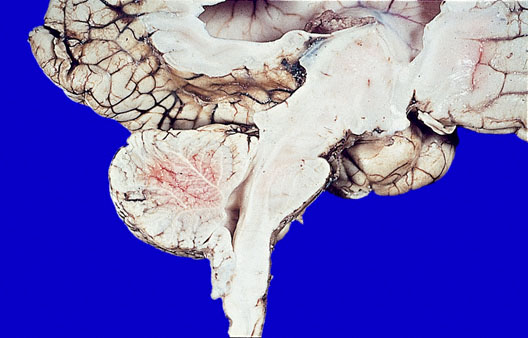
A female infant dies at the age of 2 months. She underwent closure of a lumbar myelomeningocele 24 hours after birth. A photograph of a sagittal section of the brain is shown. Which of the following is most likely present in this infant’s brain?
CorrectIncorrect -
Question 15 of 20
15. Question
A 32-year-old man with type 1 diabetes mellitus comes to the physician for a routine examination. This morning he took his usual dose of insulin (12 units of short-acting insulin and 24 units of long-acting insulin), but he did not eat breakfast. At 11 am, his blood glucose concentration is 45 mg/dL. Which of the following organs is most likely to be adversely affected in this patient?
CorrectIncorrect -
Question 16 of 20
16. Question
A study is being planned to evaluate cigarette smoking prevalence. Which of the following approaches is most likely to give the best estimate among adults between the ages of 18 and 65 years in a large city?
CorrectIncorrect -
Question 17 of 20
17. Question
A 58-year-old woman comes to the physician for a follow-up examination after she was found to have an intraocular pressure of 30 mm Hg in the left eye and 31 mm Hg in the right eye. A drug is administered that increases the outflow of aqueous humor. This drug is most likely which of the following?
CorrectIncorrect -
Question 18 of 20
18. Question
A 45-year-old man is brought to the emergency department 30 minutes after being stabbed in the chest with a knife. Physical examination shows a 10-inch knife protruding from the chest in the fourth intercostal space along the left sternal border. The knife most likely passed through which of the following structures (from first to last)?
CorrectIncorrect -
Question 19 of 20
19. Question
A 3-year-old boy and girl who are fraternal twins are brought to a new physician for a scheduled examination. The mother estimates that she drank 3 to 5 beers daily and had wine or hard liquor 2 to 3 times weekly throughout the pregnancy. The girl has unusual facies, delayed growth, and intellectual developmental disorder consistent with the diagnosis of fetal alcohol syndrome. The boy has only minor behavior problems. Which of the following is the most likely explanation for these discordant findings?
CorrectIncorrect -
Question 20 of 20
20. Question
A 49-year-old man comes to the physician because of a 2-month history of progressive fatigue. He also has had a 6.8-kg (15-lb) weight loss during the past 4 months. He has smoked 1 pack of cigarettes daily for 30 years. His blood pressure is 162/92 mm Hg. Physical examination shows mild, right-sided costovertebral angle tenderness. Laboratory studies show:
Hemoglobin
18.5 g/dL
Hematocrit
56%
Leukocyte count
24,000/mm3
Serum Ca2+
11.3 mg/dL
A chest x-ray shows two small peripheral masses in the right lower lung lobe. Fine-needle aspiration of one mass shows a malignant clear cell tumor containing a spindle cell component. Tumor cells express cytokeratin, carcinoembryonic antigen, and epithelial membrane antigen, but they do not express thyroid transcription factor-1 or S-100. Which of the following is the most likely diagnosis?
CorrectIncorrect