
NBME 33 – Block 3
Time limit: 0
Quiz Summary
0 of 20 Questions completed
Questions:
Information
You have already completed the quiz before. Hence you can not start it again.
Quiz is loading…
You must sign in or sign up to start the quiz.
You must first complete the following:
Results
Quiz complete. Results are being recorded.
Results
0 of 20 Questions answered correctly
Your time:
Time has elapsed
You have reached 0 of 0 point(s), (0)
Earned Point(s): 0 of 0, (0)
0 Essay(s) Pending (Possible Point(s): 0)
Categories
- Not categorized 0%
- 1
- 2
- 3
- 4
- 5
- 6
- 7
- 8
- 9
- 10
- 11
- 12
- 13
- 14
- 15
- 16
- 17
- 18
- 19
- 20
- Current
- Review
- Answered
- Correct
- Incorrect
-
Question 1 of 20
1. Question
A 72-year-old man who has had to use a Foley catheter for 10 years as a result of a spinal cord injury comes to the emergency department 1 hour after attempting to extract urine, resulting in blood at the end of his penis. On an examination, there is blood at the urethral meatus. There is no other trauma to the penis. Retrograde urethrography shows extravasation of contrast consistent with urethral disruption. Which of the following portions of the urethra would most likely be at risk for injury in this patient?
CorrectIncorrect -
Question 2 of 20
2. Question
A 15-year-old girl is brought to the physician by her mother because of a 2-week history of intermittent episodes of bleeding gums while brushing her teeth and nosebleeds. She has not had weight loss. She is 157 cm (5 ft 2 in) tall and weighs 50 kg (110 lb); BMI is 20 kg/m2. Her temperature is 37°C (98.6°F), pulse is 64/min and regular, respirations are 16/min, and blood pressure is 110/72 mm Hg. Physical examination shows several lesions on the distal upper extremities and multiple (more than 100) pinhead-sized red spots on each lower extremity that do not blanch with pressure. Laboratory studies show:
Hemoglobin
14 g/dL
Hematocrit
42%
Mean corpuscular volume
85 μm3
Leukocyte count
9500/mm3
Platelet count
7000/mm3
Prothrombin time
12 sec (INR=1.04)
Which of the following is the most likely cause of her condition?
CorrectIncorrect -
Question 3 of 20
3. Question
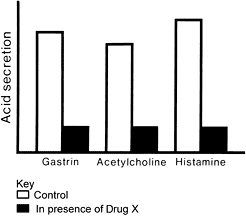
A 37-year-old man comes to the physician because of a 2-month history of abdominal discomfort. Physical examination shows no abnormalities. Upper endoscopy shows erosive gastroesophageal reflux disease. Appropriate pharmacotherapy (Drug X) is initiated. The medication’s effects in the presence of multiple mediators of gastric acid secretion are shown in the graph. Which of the following is the primary mechanism of action of Drug X?
CorrectIncorrect -
Question 4 of 20
4. Question
A 74-year-old man comes to the physician because of a 1-year history of shakiness in the fingers of his left hand and difficulty moving his left arm. Physical examination shows a fine tremor of the left thumb and fingers at rest. The tremor ceases when he picks up an object. His left elbow is resistant to passive flexion, and he has difficulty maintaining his balance when the physician nudges him backwards. Appropriate pharmacotherapy for this patient involves a drug that increases receptor activation by which of the following neurotransmitters?
CorrectIncorrect -
Question 5 of 20
5. Question
A 25-year-old woman has had swelling and tenderness posterior to the lateral malleolus since spraining her left ankle while playing basketball 2 days ago. The most likely cause of these findings is inflammation of the tendons of which of the following muscles?
CorrectIncorrect -
Question 6 of 20
6. Question
A 75-year-old man has exertional chest pain and light-headedness. His blood pressure is 100/80 mm Hg. Cardiac examination shows a decreased carotid upstroke, a left lower parasternal heave, and an apical impulse displaced to the sixth intercostal space 2 cm lateral to the midclavicular line. Auscultation of the heart is most likely to show which of the following additional findings?
CorrectIncorrect -
Question 7 of 20
7. Question
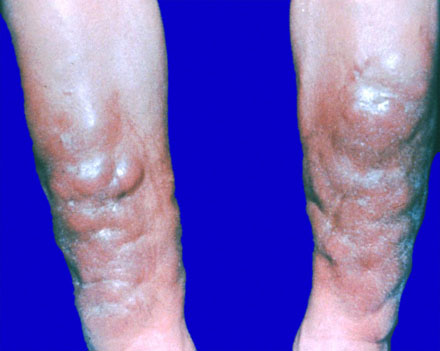
A 42-year-old woman comes to the physician because of a 6-week history of fatigue and difficulty sleeping. She has had an unintentional 3.6-kg (8-lb) weight loss during this period. She is 170 cm (5 ft 7 in) tall and now weighs 63.5 kg (140 lb); BMI is 22 kg/m2. Her pulse is 120/min. A photograph of the shins is shown. An ECG shows atrial fibrillation. Which of the following is the most likely diagnosis?
 CorrectIncorrect
 -
Question 8 of 20
8. Question
An observational cohort study of a possible association between vitamin C supplementation and coronary artery disease (CAD) finds a rate ratio of 0.5 and 95% confidence limits of 0.3 and 0.7. Based on these data, which of the following is the most appropriate conclusion?
CorrectIncorrect -
Question 9 of 20
9. Question
A 35-year-old woman comes to the physician to discuss weight loss. She has seen advertisements for a proprietary weight-loss medication and wants to try it. She is 160 cm (5 ft 3 in) tall and weighs 86 kg (190 lb); BMI is 34 kg/m2. After telling the patient that they will discuss the possibility of using medications in a few minutes, which of the following statements or questions by the physician is most appropriate?
CorrectIncorrect -
Question 10 of 20
10. Question
A 53-year-old man comes to the physician because of cough and shortness of breath for 6 days. Physical examination shows:
Right Lower
Left Lower
Finding
Posterior Thorax
Posterior Thorax
Tactile fremitus
absent
normal
Percussion note
dull
resonant
Breath sounds
absent
vesicular
Crackles
absent
absent
Which of the following is the most likely cause of the right-sided physical examination findings in this patient?
CorrectIncorrect -
Question 11 of 20
11. Question
A 23-year-old woman comes to the office because of an 8-day history of heavy menstrual bleeding. She has a 6-month history of irregular menses. She has no history of major medical illness. Her only medication is ibuprofen as needed for pain. She appears tired. Her temperature is 37.1°C (98.8°F), pulse is 75/min, respirations are 18/min, and blood pressure is 105/70 mm Hg. Pelvic examination shows blood in the vagina. Physical examination shows no other abnormalities. Laboratory studies show a hemoglobin concentration of 10.8 g/dL and hematocrit of 33%. Which of the following processes is most likely involved in this patient’s menstrual disorder?
CorrectIncorrect -
Question 12 of 20
12. Question
An investigator is conducting a study to determine the cause of cognitive decline in two previously healthy men. The men recently took a hunting trip to southeastern Wyoming, after which they began to have subtle cognitive difficulties. Their symptoms have progressed to frank dementia. During the study, it is discovered that an unusually large number of elk have been found dead of unexplained causes in northeastern Colorado and southeastern Wyoming. The brains of several of these elk are studied, and an infectious agent is detected. The agent is resistant to inactivation by drying, heating, immersion in formaldehyde, and exposure to ultraviolet light. Which of the following characteristics of the infectious agent most likely enables this resistance?
CorrectIncorrect -
Question 13 of 20
13. Question
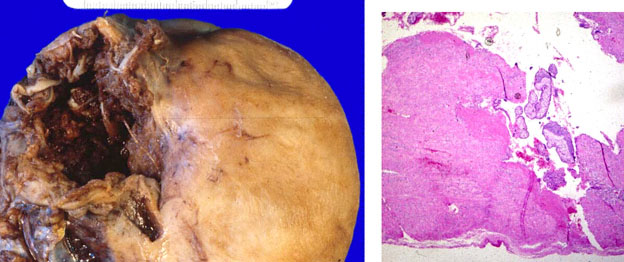
A 25-year-old woman delivers a healthy male newborn at term. At the onset of delivery of the placenta, there is massive vaginal bleeding requiring blood transfusions and an emergency hysterectomy. Gross and microscopic appearances of the resected uterus are shown. Which of the following is the most likely diagnosis?
 CorrectIncorrect
 -
Question 14 of 20
14. Question
A 35-year-old woman comes to the office as a new patient for a health maintenance examination. She feels well. She has a history of difficulty getting along with her coworkers. She says she had similar difficulties with classmates in high school and college. She describes her relationships with others as “flipping between hot and cold.” She recently was reprimanded for being disruptive at work when she made jokes about her current boss, but she does not believe that there is any problem with her behavior. She has been divorced twice and has had four jobs during the past 5 years. She says that past supervisors all seemed “great” when she was hired but later showed how “stupid” they were when they could not “take a joke.” Mental status examination shows no abnormalities. Which of the following best describes the defense mechanism used by this patient?
CorrectIncorrect -
Question 15 of 20
15. Question
A 26-year-old man comes to the physician with his wife because of a 3-month history of episodes of staring. His wife says that he is unresponsive during these episodes. During the interview, the patient stops talking in mid-sentence, turns his head to the right, and extends his right upper extremity. He does not respond to questions. He then exhibits some repetitive lip smacking and picking movements of the hands. This episode lasts approximately 30 seconds. He slowly returns to his normal state during the next 5 minutes. This patient most likely has which of the following types of seizures?
CorrectIncorrect -
Question 16 of 20
16. Question
A 4-year-old boy is brought to the physician for a well-child examination. He was born with an enlarged head, a depression of the root of the nose, and shortened proximal legs and arms. His height is at the 10th percentile for his age. His father, brother, and sister have a similar habitus. Which of the following is the most likely cause of his condition?
CorrectIncorrect -
Question 17 of 20
17. Question
A 57-year-old man comes to the physician for a follow-up examination 18 months after receiving a lung transplant. Current medications include immunosuppressive drugs. He says that he feels well. Flexible bronchoscopy of the transplanted areas shows recovery of the cough reflex after mechanical and chemical stimulation. The recovery of this reflex is most likely the result of regeneration of which of the following nerve fibers?
CorrectIncorrect -
Question 18 of 20
18. Question
A 60-year-old man with hypertension is brought to the emergency department because of a 2-hour history of severe chest pain that occurred after several recent episodes of forceful vomiting. He has smoked one-half pack of cigarettes daily for 40 years. He appears in acute distress. His temperature is 38°C (100.4°F), pulse is 95/min, respirations are 18/min, and blood pressure is 100/70 mm Hg. A chest x-ray shows an effusion in the right thoracic cavity. Fluid from the right thoracic cavity is aspirated. Pleural fluid analysis shows:
Specific gravity
1.018
Appearance
cloudy
Protein, total
5 g/dL
Leukocyte count
20,000/mm3
Segmented neutrophils
90%
Lactate dehydrogenase
600 U/L
Amylase
1500 U/L
A Gram stain of the aspirate shows gram-positive cocci and gram-negative rods. Which of the following is the most likely cause of these findings?
CorrectIncorrect -
Question 19 of 20
19. Question
A 57-year-old woman comes to the physician because of a 2-month history of lower abdominal fullness, increased abdominal girth, and alternating diarrhea and constipation. She has type 2 diabetes mellitus and hypertension. Physical examination shows a fixed, nontender, left adnexal mass and ascites. Serum studies show a markedly increased CA 125 concentration. Ultrasonography shows a 7.5-cm, partially cystic, left ovarian mass. This mass most likely originates from which of the following types of cells?
CorrectIncorrect -
Question 20 of 20
20. Question
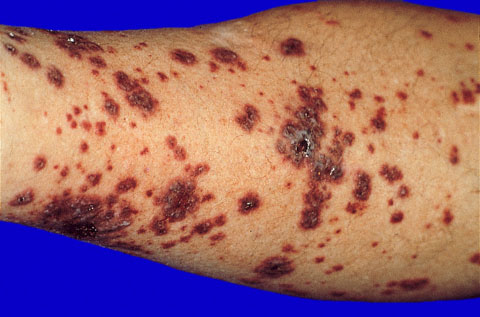
A 38-year-old man with asthma comes to the physician because of a 3-day history of a rash on his left leg. He does not smoke. Current medications include fluticasone and a β-adrenergic agonist. Examination of the left lower extremity shows the findings in the photograph. Laboratory studies show:
Hemoglobin
12.3 g/dL
Hematocrit
42%
Leukocyte count
19,800/mm3
Segmented neutrophils
59%
Eosinophils
6%
Lymphocytes
30%
Monocytes
5%
Serum antineutrophil cytoplasmic antibody
positive
Which of the following is the most likely diagnosis?
CorrectIncorrect