
NBME 33 – Block 3 (Duplicate 1)
Time limit: 0
Quiz Summary
0 of 20 Questions completed
Questions:
Information
You have already completed the quiz before. Hence you can not start it again.
Quiz is loading…
You must sign in or sign up to start the quiz.
You must first complete the following:
Results
Quiz complete. Results are being recorded.
Results
0 of 20 Questions answered correctly
Your time:
Time has elapsed
You have reached 0 of 0 point(s), (0)
Earned Point(s): 0 of 0, (0)
0 Essay(s) Pending (Possible Point(s): 0)
Categories
- Not categorized 0%
- 1
- 2
- 3
- 4
- 5
- 6
- 7
- 8
- 9
- 10
- 11
- 12
- 13
- 14
- 15
- 16
- 17
- 18
- 19
- 20
- Current
- Review
- Answered
- Correct
- Incorrect
-
Question 1 of 20
1. Question
A study is conducted to compare the effectiveness of a spiral CT scan of the colon and barium enema for detection of colon cancer. Results show that both barium enemas and spiral CT scans of the colon are equally specific for detection of colon cancer, but spiral CT scans are more sensitive. Which of the following is the most accurate conclusion regarding this study?
CorrectIncorrect -
Question 2 of 20
2. Question
A group of 26 individuals with an active connective tissue disorder is recruited to participate in a study to evaluate antinuclear autoantibody production. Analysis of their serum immunoglobulins identifies the occurrence of self-reactive antibodies of the IgG isotype in 23 of the 26 individuals. Sequence analysis of the DNA from autoreactive B lymphocytes from the 23 positive individuals identifies a single nucleotide substitution in a heavy-chain gene. The mutation is not found in healthy control subjects. The mutation directly affects antigen binding. Which of the following heavy-chain regions was most likely altered by the mutation?
CorrectIncorrect -
Question 3 of 20
3. Question
A 34-year-old man is brought to the emergency department because of a 1-week history of fever, headache, decreased appetite, and generalized malaise. He also has a 3-day history of a rash. He often hikes in the wilderness. He has had four sexual partners. His temperature is 38.7°C (101.7°F), pulse is 93/min, and respirations are 19/min. Physical examination shows a generalized, nonblanching, macular rash on the upper and lower extremities, including the palms and soles, and on the trunk. There are also 1.5- to 2-cm, nontender, firm nodes in the cervical, epitrochlear, axillary, and inguinal regions. Aspiration of the right epitrochlear node is done. Dark-field microscopy examination of the aspirated fluid shows the presence of spirochetes. Treatment with intramuscular penicillin G benzathine is initiated. Two hours later, he develops a temperature of 40.1°C (104.2°F), severe headache, myalgias, increased erythema of the rash, and dizziness. Which of the following is the most likely cause of this patient’s current symptoms?
CorrectIncorrect -
Question 4 of 20
4. Question
A 54-year-old man with chronic obstructive pulmonary disease comes to the physician for a follow-up examination. He recently was diagnosed with metastatic small cell carcinoma of the lung. He has smoked 2 packs of cigarettes daily for 30 years. He asks the physician, “Why did this happen to me?” Which of the following is the most appropriate response by the physician?
CorrectIncorrect -
Question 5 of 20
5. Question
A 25-year-old woman is brought to the emergency department by her roommate because she has not slept and has been hyperactive since taking several amphetamine capsules 2 days ago. On arrival, the patient is agitated and euphoric. Her pulse is 130/min. Physical examination shows diaphoresis. The behavioral effects of the drug used by this patient are achieved through which of the following mechanisms?
CorrectIncorrect -
Question 6 of 20
6. Question
A 55-year-old man with a single kidney on the left side is found to have a 3-cm renal cell carcinoma of the upper pole. Radiofrequency ablation is scheduled. Which of the following structures are at greatest risk for damage during this procedure?
CorrectIncorrect -
Question 7 of 20
7. Question
A 32-year-old woman comes to the physician because of a 2-month history of red, scaling, itching hands. She is a nurse’s aide and frequently washes her hands. Vital signs are within normal limits. Physical examination shows no abnormalities except for an erythematous, scaling rash on the hands. An emollient is prescribed. Which of the following is the mechanism of action of this preparation on the stratum corneum in this patient?
CorrectIncorrect -
Question 8 of 20
8. Question
A 49-year-old man begins taking enalapril for hypertension and congestive heart failure. One month later, his blood pressure is 136/84 mm Hg and cardiopulmonary examination shows no abnormalities. Serum creatinine concentration is 2.4 mg/dL (compared with 1.2 mg/dL prior to treatment). The increased serum creatinine concentration in this patient is most likely secondary to the action of enalapril on which of the following?
CorrectIncorrect -
Question 9 of 20
9. Question
A 15-year-old girl with asthma uses an albuterol inhaler hourly during waking hours to perform better at track meets, even though she was instructed to use the inhaler only 3 times daily. After several days, the albuterol no longer relieves her bronchoconstriction. Which of the following cellular mechanisms is the most likely explanation for the decreased responsiveness in this patient?
CorrectIncorrect -
Question 10 of 20
10. Question
A 62-year-old man with prostate cancer begins treatment with leuprolide as neoadjuvant therapy. Which of the following best describes the mechanism of action of this medication?
CorrectIncorrect -
Question 11 of 20
11. Question
A 6-year-old boy recently diagnosed with acute lymphoblastic leukemia begins induction chemotherapy that includes high-dose methotrexate. Within the first 3 days of therapy, which of the following tissues in this patient is most likely to have the highest cell turnover and death rate due to the high-dose methotrexate?
CorrectIncorrect -
Question 12 of 20
12. Question
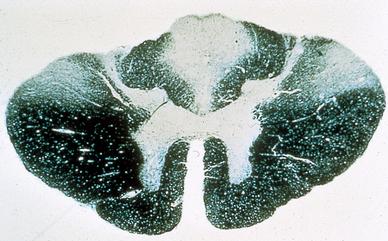
The cross section of the spinal cord shown was obtained at autopsy of a 58-year-old woman who died after falling down a flight of stairs. She was 163 cm (5 ft 4 in) tall and weighed 45 kg (98 lb); BMI was 17 kg/m2. She had a 6-month history of increasing irritability and numbness of her feet. On examination 3 months ago, sensation to pinprick, vibration, and position was decreased in the feet. Which of the following best explains this woman’s symptoms?
CorrectIncorrect -
Question 13 of 20
13. Question
A 4-year-old girl is brought to the physician by her mother because of a 3-month history of a rash. She is at the 65th percentile for height and weight. Physical examination shows marked erythema with coalescing papules and lichenification on the neck, antecubital and popliteal fossae, wrists, and ankles. There is mild crusting of the lesions on the ankles where her shoes rub. Which of the following is the most appropriate initial action by the physician?
CorrectIncorrect -
Question 14 of 20
14. Question
A 42-year-old woman comes to the physician because of a 1-month history of fever and cough productive of sputum. She recently immigrated to the USA from Nepal. Her temperature is 37.8°C (100°F). Crackles are heard in all lung fields. A chest x-ray shows numerous small, nodular opacities. Histologic examination of tissue obtained via transbronchial biopsy shows interstitial infiltrates with lymphocytes, plasma cells, and activated macrophages; acid-fast bacilli also are seen. During the initial phase of the disease in this patient, bacterial proliferation is most likely in which of the following macrophage sites?
CorrectIncorrect -
Question 15 of 20
15. Question
A 22-year-old man comes to the emergency department because of a 1-day history of a rash that has spread from his face to the rest of his body. He also has a 4-day history of temperatures to 39.4°C (103.0°F), severe headache, severe muscle and joint pain, and severe pain behind his eyes. His symptoms began 3 days after he returned to the USA from a 1-month camping trip in Vietnam and Thailand. He has not had runny nose, cough, vomiting, diarrhea, or constipation. He has no history of major medical illness. Before his trip, he received all recommended pretravel vaccinations and began doxycycline for malaria prophylaxis. Current medications are continued doxycycline and acetaminophen. He appears mildly ill. His current temperature is 38.5°C (101.3°F), pulse is 90/min, respirations are 14/min, and blood pressure is 110/70 mm Hg. Physical examination shows a diffuse, erythematous, blanching, macular rash; the rash does not appear over the palms or soles. There is bilateral conjunctival injection and pharyngeal injection without exudates. The remainder of the physical examination shows no abnormalities. Results of laboratory studies are shown:
Hemoglobin
14.6 g/dL
Hematocrit
44%
Leukocyte count
3300/mm3
Platelet count
110,000/mm3
Serum AST
150 U/L
Examination of thick and thin smears for malaria is negative. Which of the following is the most likely causal infectious agent?
CorrectIncorrect -
Question 16 of 20
16. Question
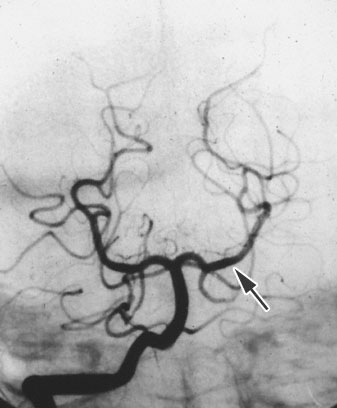
A 40-year-old woman who is right-handed has an obstruction of the vessel indicated by the arrow in the vertebral arteriogram shown. This patient most likely has which of the following?
CorrectIncorrect -
Question 17 of 20
17. Question
An investigator is studying coronary artery disease using an experimental animal. When small boluses of acetylcholine (ACh) and nitroglycerin (NTG) are injected into a coronary artery that appears patent on fluoroscopy, both dilate the vessel. However, when the drugs are injected into another coronary artery that has apparent plaques, NTG dilates the artery, but ACh constricts it. Which of the following best explains these findings?
CorrectIncorrect -
Question 18 of 20
18. Question
A 16-year-old boy is brought to the office because of severe acne. Physical examination shows numerous open and closed comedones over the face, neck, chest, and upper back. Which of the following is the most likely mechanism underlying this hormonally induced condition?
CorrectIncorrect -
Question 19 of 20
19. Question
A 16-year-old boy who is receiving chemotherapy for acute lymphoblastic leukemia is brought to the physician because of a 3-day history of pain with swallowing food. Physical examination shows no abnormalities. Endoscopy shows several 0.5- to 0.8-cm shallow, mucosal ulcers in the mid to lower esophageal region. The lesions are round and sharply demarcated with an erythematous base. Which of the following is the most likely cause of these findings?
CorrectIncorrect -
Question 20 of 20
20. Question
A 1-day-old female newborn is brought to the physician for an initial examination. Physical examination shows an enlarged thyroid gland but no other abnormalities. Newborn screening showed decreased serum thyroxine and increased thyroid-stimulating hormone concentrations. The administration of 123I shows decreased thyroid uptake and decreased saliva-to-serum ratio of 123I. A deficiency of which of the following is the most likely cause of the findings in this patient?
CorrectIncorrect