
NBME 33 – Block 1 (Duplicate 2)
Time limit: 0
Quiz Summary
0 of 20 Questions completed
Questions:
Information
You have already completed the quiz before. Hence you can not start it again.
Quiz is loading…
You must sign in or sign up to start the quiz.
You must first complete the following:
Results
Quiz complete. Results are being recorded.
Results
0 of 20 Questions answered correctly
Your time:
Time has elapsed
You have reached 0 of 0 point(s), (0)
Earned Point(s): 0 of 0, (0)
0 Essay(s) Pending (Possible Point(s): 0)
Categories
- Not categorized 0%
- 1
- 2
- 3
- 4
- 5
- 6
- 7
- 8
- 9
- 10
- 11
- 12
- 13
- 14
- 15
- 16
- 17
- 18
- 19
- 20
- Current
- Review
- Answered
- Correct
- Incorrect
-
Question 1 of 20
1. Question
A 32-year-old woman comes to the physician because of a 4-day history of vaginal itching and discharge. Physical examination shows an eczematous rash with satellite lesions over the labia majora. Pelvic examination shows a vaginal discharge with the consistency of cottage cheese. The most appropriate treatment for this patient is an oral medication with which of the following mechanisms of action?
CorrectIncorrect -
Question 2 of 20
2. Question
A 35-year-old African American woman comes to the physician for a follow-up examination after a chest x-ray taken before an elective procedure showed hilar adenopathy. She does not smoke. Physical examination shows no abnormalities. Serum studies show a calcium concentration of 11.2 mg/dL and parathyroid hormone concentration of 8 pg/mL (N=10−65). Examination of a biopsy specimen of a lymph node shows noncaseating granulomas. Which of the following is the most likely cause of the hypercalcemia in this patient?
CorrectIncorrect -
Question 3 of 20
3. Question
An observational cohort study is conducted to assess the relationship between the use of helmets and head injuries after bicycle collisions. A total of 100 cyclists who use helmets and 100 cyclists who do not use helmets are selected from a local cycling club. Records from hospitals and emergency departments are used to track the history of head injuries in the subjects. Results show:
Head Injury
Yes
No
Total
Helmet Used
Yes
10
90
100
No
50
50
100
Total
60
140
200
Which of the following best represents the relative risk for head injuries in cyclists who do not use helmets compared to helmet wearers?
CorrectIncorrect -
Question 4 of 20
4. Question
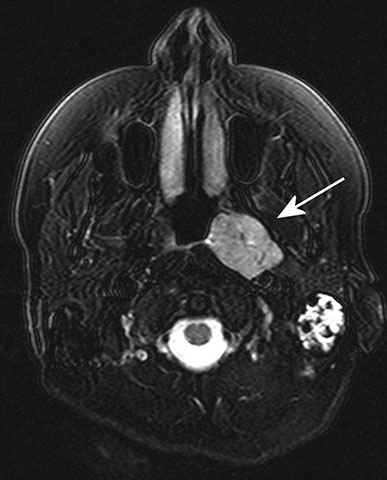
A 75-year-old man is brought to the physician because of a 2-month history of increasingly severe discomfort in his left ear. Audiometry shows severe conductive deafness of the left ear. Auriscopy shows a bulging tympanic membrane of the left ear. Indirect laryngoscopy shows a mass in the nasopharynx on the left. A T2-weighted MRI of the brain is shown; the arrow indicates a mass. This mass has most likely caused occlusion of which of the following structures?
CorrectIncorrect -
Question 5 of 20
5. Question
A 7-year-old girl is brought to the physician because of watery, pruritic eyes and a runny nose for 8 hours. She has a history of hay fever, asthma, milk allergies, and atopic dermatitis. Physical examination shows hyperemic conjunctiva and nasal mucosa with serous, clear secretions. The result of an immunologic skin test to foreign antigens is positive. Which of the following inflammatory cell types most likely initiated this patient’s reaction?
CorrectIncorrect -
Question 6 of 20
6. Question
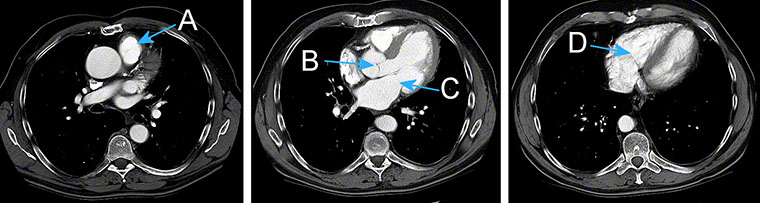
A 25-year-old man comes to the physician for a health maintenance examination. His pulse is 75/min, and blood pressure is 110/70 mm Hg. Cardiac examination shows a loud S1 with a presystolic, low-pitched, rumbling murmur at the apex. A series of CT scans of the chest of a healthy person is shown; the cardiac valves are indicated by the letters A through D. Which of the following labeled cardiac valves is most likely abnormal in this patient?
 CorrectIncorrect
 -
Question 7 of 20
7. Question
A 63-year-old man with alcohol-associated cirrhosis is brought to the office because of a 1-week history of increased lethargy and confusion. He has adopted lifestyle changes that include abstinence from alcohol and appropriate dietary modifications. Physical examination shows lapses in sustained muscle contraction when the arms are outstretched. An increase in the dietary intake of which of the following best explains the new findings in this patient?
CorrectIncorrect -
Question 8 of 20
8. Question
A 45-year-old woman comes to the physician because of a 4-month history of intermittent facial flushing, wheezing, abdominal pain, and diarrhea. She does not appear to be in acute distress. Physical examination shows no abnormalities. Serum studies show an increased serotonin concentration. A CT scan of the abdomen shows a mass in the appendix and multiple masses in the lungs and liver. Which of the following pathologic changes is most likely to be found involving the tricuspid and pulmonic valves of this patient’s heart as a result of this condition?
CorrectIncorrect -
Question 9 of 20
9. Question
A 5-year-old boy is brought to the office because of a 1-day history of dark urine. Two weeks ago, he had an episode of group A streptococcal pharyngitis and received appropriate therapy. Today, his blood pressure is 110/70 mm Hg. Physical examination shows no abnormalities. Urinalysis shows 0–5 WBC/hpf, many RBCs, and many RBC casts. This patient’s condition is most likely mediated by which of the following?
CorrectIncorrect -
Question 10 of 20
10. Question
An investigator from the Centers for Disease Control and Prevention (CDC) is studying the efficacy of the influenza vaccine during a specific year. The majority of the circulating influenza viruses during that influenza season in the USA were influenza A (H3N2). The influenza vaccine used in the USA that year included the following strains:
Influenza A (H1N1)
[A/California/7/2009 (H1N1)pdm09-like virus]
Influenza A (H3N2)
[A/Texas/50/2012 (H3N2)-like virus]
Influenza B
[B/Massachusetts/2/2012-like virus]
The CDC expected early in the season that this influenza vaccine would have lower than expected efficacy in the US population. Which of the following is the most likely cause of the decreased efficacy of the influenza vaccine in the USA during this season?
CorrectIncorrect -
Question 11 of 20
11. Question
A 19-year-old woman is brought to the emergency department 1 hour after the sudden onset of palpitations, sweating, tremor, a choking sensation, chest pain, nausea, dizziness, and numbness of her hands. Her temperature is 37°C (98.6°F), pulse is 100/min, respirations are 18/min, and blood pressure is 110/70 mm Hg. Neurologic and mental status examinations show no abnormalities. Laboratory studies show:
Hemoglobin
14.6 g/dL
Hematocrit
45%
Serum
Glucose
80 mg/dL
Thyroid-stimulating hormone
2.8 μU/mL
Troponin I
0.2 ng/mL (N<0.4)
Her symptoms resolve within 1 hour without treatment. She continues to have similar episodes during the next 5 years and worries about having them. Which of the following is the most likely diagnosis?
CorrectIncorrect -
Question 12 of 20
12. Question
A 1500-g (3-lb 5-oz) male newborn is delivered by cesarean section at 28 weeks’ gestation after his mother sustained accidental trauma to the abdomen that resulted in near total loss of amniotic fluid. Apgar scores are 1 and 3 at 1 and 5 minutes, respectively. Physical examination shows cyanosis. Interventional intubation and mechanical ventilation are started, but the newborn dies 15 minutes after birth. Which of the following findings in the lungs and chest are most likely on autopsy?
CorrectIncorrect -
Question 13 of 20
13. Question
A 19-year-old man is admitted to the hospital because of deep venous thrombosis of the left thigh. He had a similar episode 4 years ago that was treated with a 6-month course of apixaban. His father and his older brother have a history of deep venous thrombosis. Further analysis shows hypercoagulability. This patient’s condition is most likely caused by factor V resistance to cleavage by which of the following?
CorrectIncorrect -
Question 14 of 20
14. Question
A 16-year-old boy with asthma is brought to the clinic for a routine examination. He feels well. Medications are twice-daily inhaled budesonide, daily oral montelukast, and as-needed inhaled albuterol. He does not smoke cigarettes, drink alcohol, or use illicit drugs. He appears well. He is at the 90th percentile for height, weight, and BMI. Temperature is 37.0°C (98.6°F), pulse is 70/min, respirations are 16/min, and blood pressure is 125/75 mm Hg. Pulse oximetry on room air shows an oxygen saturation of 100%. End-expiratory wheezes are heard bilaterally. It is most appropriate to obtain specific additional history regarding which of the following at this time?
CorrectIncorrect -
Question 15 of 20
15. Question
A 10-year-old girl is brought to the physician by her mother because of a 6-month history of acne, increased facial and body hair, and a deepening voice. Her blood pressure is 132/88 mm Hg. Physical examination shows hirsutism and clitorimegaly. Serum studies show a decreased potassium concentration and increased 11-deoxycortisol concentration. Further studies show a deficiency in the activity of 11β-hydroxylase. The most likely cause of the hypertension in this patient is an increased serum concentration of which of the following?
CorrectIncorrect -
Question 16 of 20
16. Question
A 58-year-old man is brought to the emergency department 30 minutes after he was involved in a motor vehicle collision. Physical examination shows inability to raise the right upper extremity. A CT scan shows a nondisplaced fracture of the right clavicle, in addition to a 4.5-cm multiloculated mass in the left kidney and a 4.5-cm aneurysmal dilation of the abdominal aorta. There is also irregular lymphadenopathy of the left para-aortic (lumbar) lymph nodes. Laboratory studies show a serum calcium concentration of 13.7 mg/dL. Which of the following is the most likely cause of the serum calcium findings in this patient?
CorrectIncorrect -
Question 17 of 20
17. Question
A 5-month-old boy is brought to the physician because of a 2-day history of fever, wet cough, and rash. His temperature is 39°C (102.2°F). Physical examination shows lymphadenopathy, pustules over the upper and lower extremities, and hepatosplenomegaly. Flow cytometric analysis of whole blood shows the absence of reduction of dihydrorhodamine by the patient’s cells. This patient’s condition is most likely caused by a defect in the production of which of the following by phagocytes?
CorrectIncorrect -
Question 18 of 20
18. Question
A 72-year-old woman comes to the physician for a follow-up examination. She has a history of coronary artery disease, hypercholesterolemia, and mild hypertension. She had smoked 1 pack of cigarettes daily for 40 years before she quit 2 years ago. Her pulse is 68/min and regular, respirations are 16/min, and blood pressure is 180/72 mm Hg. Physical examination shows diminished ankle and pedal pulses bilaterally. There is no peripheral edema. Cardiac examination shows a grade 2/6 coarse crescendo-decrescendo murmur that is best heard at the base. There is a soft S4 gallop. Bruits are also heard over the right periumbilical area and left femoral artery. Serum studies show:
Na+
140 mEq/L
K+
3.2 mEq/L
Cl−
102 mEq/L
HCO3−
30 mEq/L
Urea nitrogen
24 mg/dL
Creatinine
1.7 mg/dL
The physician considers adding lisinopril to the patient’s medication regimen. Which of the following sets of physiologic changes is most likely in this patient if this therapy is initiated?
Option
Blood Pressure
Serum Creatinine
Serum K⁺
A
Increased
No change
No change
B
Increased
Decreased
Decreased
C
No change
Increased
Increased
D
No change
Decreased
No change
E
Decreased
Increased
Increased
F
Decreased
No change
Decreased
CorrectIncorrect -
Question 19 of 20
19. Question
A 55-year-old woman comes to the physician for a routine health maintenance examination. Pelvic examination shows an enlarged right ovary. After surgical excision of the ovary, the specimen shows a primary malignant neoplasm. This patient is at increased risk for metastasis in which of the following lymph nodes that drains the ovary?
CorrectIncorrect -
Question 20 of 20
20. Question
A previously healthy 65-year-old man comes to the physician because of a 4-week history of weakness and abdominal pain. He worked in a variety of manufacturing plants before retiring 2 years ago. He appears well. Abdominal examination shows a mass in the right upper quadrant. A CT scan of the abdomen shows a 4-cm tumor. He is diagnosed with liver cancer. Exposure to which of the following is the most likely cause of his liver cancer?
CorrectIncorrect