
NBME 32 – Block 4
Time limit: 0
Quiz Summary
0 of 20 Questions completed
Questions:
Information
You have already completed the quiz before. Hence you can not start it again.
Quiz is loading…
You must sign in or sign up to start the quiz.
You must first complete the following:
Results
Quiz complete. Results are being recorded.
Results
0 of 20 Questions answered correctly
Your time:
Time has elapsed
You have reached 0 of 0 point(s), (0)
Earned Point(s): 0 of 0, (0)
0 Essay(s) Pending (Possible Point(s): 0)
Categories
- Not categorized 0%
- 1
- 2
- 3
- 4
- 5
- 6
- 7
- 8
- 9
- 10
- 11
- 12
- 13
- 14
- 15
- 16
- 17
- 18
- 19
- 20
- Current
- Review
- Answered
- Correct
- Incorrect
-
Question 1 of 20
1. Question
A 37-year-old man develops cellulitis involving the right arm after scratching an area of eczema. He has a history of eczema on the hands and forearms from repeated prolonged use of rubberized gloves. Which of the following most likely predisposed the patient to the skin infection?
CorrectIncorrect -
Question 2 of 20
2. Question
A 48-year-old woman is brought to the physician by her son for a follow-up examination. Six months ago, she had a ruptured aneurysm of the anterior communicating artery, resulting in damage to the adjacent basal forebrain region. Her son reports that she is often confused and has difficulty with short-term memory. Physical examination shows no abnormalities. A medication that increases synaptic levels of which of the following neurotransmitters is most likely to be beneficial in ameliorating the effect of damage to this patient’s basal forebrain?
CorrectIncorrect -
Question 3 of 20
3. Question
A 4-month-old boy is brought to the physician by his mother for a well-child examination. He was delivered at term. Pregnancy and delivery were uncomplicated. The mother says that her son is eating well, but he has had no weight gain since his last visit 2 months ago. He is at the 25th percentile for length and weight. His pulse is 120/min, respirations are 22/min, and blood pressure is 80/55 mm Hg. There is no cyanosis. Cardiac examination shows a regular rhythm with a fixed, widely split S2. A short diastolic rumble is heard at the lower left sternal border. The lungs are clear. Which of the following is the most likely cause of this patient’s condition?
CorrectIncorrect -
Question 4 of 20
4. Question
A 60-year-old man with chronic renal insufficiency undergoes coronary artery bypass grafting. The patient was hypotensive during most of the particularly prolonged procedure. Twenty-four hours postoperatively, he is oliguric. His serum creatinine concentration has increased from 2.5 mg/dL to 3.5 mg/dL. Urinalysis shows numerous granular casts, and the fractional excretion of sodium is 2%. This disorder reveals impairment of solute transport in the renal tubules, which is normally driven by which of the following metabolic mechanisms?
CorrectIncorrect -
Question 5 of 20
5. Question
A 25-year-old woman, gravida 3, para 2, at 28 weeks’ gestation comes to the physician for an initial prenatal examination. Ultrasonography shows evidence of placenta previa. Which of the following factors in this patient’s obstetric history would place her at increased risk for this complication?
CorrectIncorrect -
Question 6 of 20
6. Question
A 35-year-old woman is brought to the emergency department because of a 1-month history of fatigue, anxiety, shortness of breath, and difficulty sleeping. Her temperature is 37°C (98.6°F), pulse is 110/min, respirations are 18/min, and blood pressure is 140/60 mm Hg. Physical examination shows proptosis, an enlarged thyroid gland, a fine resting tremor, and 1+ pitting edema of the feet. Crackles are heard at the lung bases. Deep tendon reflexes are brisk. Her serum thyroid-stimulating hormone concentration is 0.001 µU/mL. Which of the following is the most likely cause of the shortness of breath and edema in this patient?
CorrectIncorrect -
Question 7 of 20
7. Question
A 40-year-old man comes to the physician because of a 3-week history of insomnia. Zolpidem is prescribed. Which of the following changes in sleep pattern is most likely to occur in this patient?
CorrectIncorrect -
Question 8 of 20
8. Question
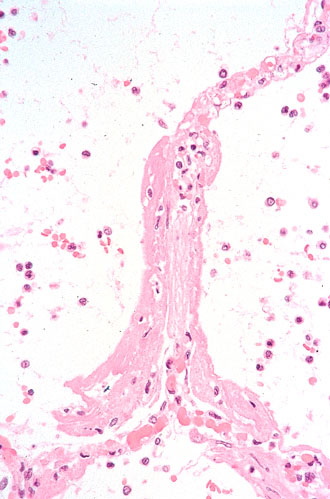
A 65-year-old man dies 4 days after sustaining multiple traumatic injuries in a motor vehicle collision. During the 4 days prior to death, he had been receiving mechanical ventilation with positive end-expiratory pressure but had become progressively hypoxic, hypotensive, and finally unresponsive to cardiopulmonary resuscitative measures. A photomicrograph of a lung specimen obtained at autopsy is shown. Which of the following is the most likely underlying cause of the pathologic changes observed in this man?
CorrectIncorrect -
Question 9 of 20
9. Question
A 16-year-old girl comes to the physician for a health maintenance examination. She has been seeing this physician since she was the age of 5 years. For the past few years, she has been interested in understanding diseases because several of her family members have died from type 2 diabetes mellitus. She expresses a strong interest in pursuing a health care profession to educate people about diabetes prevention. Her parents, who have been happily married since they finished high school, have told her that her plans would take too many years of expensive education. They insist that she relinquish her plans and get married when she finishes high school. She asks the physician what she should do. Which of the following is the most appropriate next step by the physician?
CorrectIncorrect -
Question 10 of 20
10. Question
A study is conducted to evaluate the perceptions of sleep quality and quantity in undergraduate students. A total of 1000 healthy students between the ages of 18 and 23 years are enrolled. Nightly hours of sleep are recorded during a 4-week period using wearable sleep trackers. Data show that the participants sleep for a mean of 7 hours nightly, with a standard deviation of 2 hours per participant. Which of the following is the best estimate of the number of participants in this study who sleep at least 9 hours nightly?
CorrectIncorrect -
Question 11 of 20
11. Question
A 26-year-old woman comes to the emergency department because of a 12-hour history of light-headedness and dizziness. She sits in the waiting room for 2 hours before a physician can see her. On standing, she feels faint and immediately returns to a seated position. Her blood pressure is 98/69 mm Hg and increases to 118/82 mm Hg within 5 minutes. The release of which of the following best explains these findings?
CorrectIncorrect -
Question 12 of 20
12. Question
A 13-year-old girl is brought to the emergency department because of a 12-hour history of fever. On arrival, she is unresponsive. Her temperature is 39.1°C (102.4°F), pulse is 140/min, respirations are 34/min, and blood pressure is 90/60 mm Hg. Physical examination shows multiple small petechiae over the trunk and upper and lower extremities. Laboratory studies show:
Leukocyte count
25,000/mm3 (N=3500–10,500)
Segmented neutrophils
70%
Bands
13%
Lymphocytes
14%
Monocytes
3%
Plasma fibrinogen
78 mg/dL (N=200–400)
Fibrin split products
43 μg/mL (N<10)
Blood cultures grow Neisseria meningitidis. A host response to which of the following bacterial components is the most likely cause of the findings in this patient?
CorrectIncorrect -
Question 13 of 20
13. Question
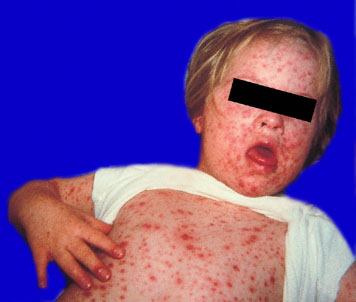
A 7-year-old boy is brought to the physician by his mother because of a 1-day history of a generalized rash and decreased activity. He also has a 2-day history of fever. The mother states that her son’s friend had a similar rash 2 weeks ago. The patient does not appear acutely distressed. His temperature is 38.3°C (100.9°F), pulse is 105/min, and respirations are 22/min. A photograph of the rash is shown. Which of the following is the most likely infectious agent in this patient?
CorrectIncorrect -
Question 14 of 20
14. Question
A 60-year-old man comes to the physician because of a 2-week history of dizziness. He has a 25-year history of hypertension treated with enalapril. Triamterene-hydrochlorothiazide was added to his medication regimen 1 month ago. His blood pressure is 126/80 mm Hg. Neurologic examination shows no focal findings. An ECG shows a 2:1 second-degree atrioventricular block. His serum potassium concentration is 6.4 mEq/L, and serum creatinine concentration is 2 mg/dL. Which of the following best explains the mechanism of the findings in this patient?
Option
Effect on Aldosterone
Channel or Transporter Blocked
A
Decreased formation
Collecting duct Na⁺ channel
B
Decreased formation
Collecting duct K⁺ channel
C
Decreased formation
Na⁺–K⁺–Cl⁻ symport
D
Increased degradation
Collecting duct Na⁺ channel
E
Increased degradation
Collecting duct K⁺ channel
F
Increased degradation
Na⁺–K⁺–Cl⁻ symport
CorrectIncorrect -
Question 15 of 20
15. Question
A 2-year-old girl is brought to the emergency department by her father because of a 1-day history of fever, chills, nausea, vomiting, and increased urinary frequency. She had been treated for a lower urinary tract infection 6 months ago. Her temperature is 39.5°C (103.1°F), pulse is 104/min, and respirations are 20/min. Physical examination shows bilateral flank tenderness. Laboratory studies show:
Leukocyte count
28,400/mm3
Segmented neutrophils
86%
Bands
12%
Lymphocytes
2%
Platelet count
145,000/mm3
Serum
Ca2+
9.1 mg/dL
Urea nitrogen
24 mg/dL
Glucose
102 mg/dL
Creatinine
0.7 mg/dL
A clean-catch midstream specimen shows 2+ protein on a urine dipstick, WBCs with glitter cells too numerous to count, WBC casts, and numerous bacteria. Voiding cystourethrography shows bilateral postmicturition urinary reflux. There is no evidence of hydronephrosis. Which of the following is the most likely cause of this patient’s disease process?
CorrectIncorrect -
Question 16 of 20
16. Question
A 27-year-old nulligravid woman is brought to the emergency department 3 hours after the onset of abdominal pain and nausea. She has no history of gastrointestinal or urinary problems. She has a 3-year history of infertility and has been treated with ovulation induction. Her temperature is 37°C (98.6°F), and blood pressure is 140/70 mm Hg. Abdominal examination shows exquisite left lower quadrant tenderness. Bimanual examination cannot be performed because of guarding. Urine pregnancy test is negative. Urinalysis shows no RBCs, WBCs, or casts. Which of the following is the most likely diagnosis?
CorrectIncorrect -
Question 17 of 20
17. Question
A group of physicians is concerned that there may be many individuals with undiagnosed type 2 diabetes mellitus in their community. They wish to promote greater awareness of this condition in order to increase the number of people being treated. Which of the following types of studies is most appropriate to address this concern?
CorrectIncorrect -
Question 18 of 20
18. Question
A 75-year-old woman comes to the office because of a 2-day history of fever, stiff neck, and severe headache. Her temperature is 39°C (102.2°F). Physical examination shows nuchal rigidity. A lumbar puncture is performed. Laboratory studies show:
Serum glucose
120 mg/dL
Cerebrospinal fluid (CSF)
Pressure, opening
180 mm H2O
Glucose
35 mg/dL
Total protein
200 mg/dL
WBC
150/mm3
A Gram stain of CSF shows small, gram-positive bacilli. Which of the following is the most likely site of entry of the causal infectious agent in this patient?
CorrectIncorrect -
Question 19 of 20
19. Question
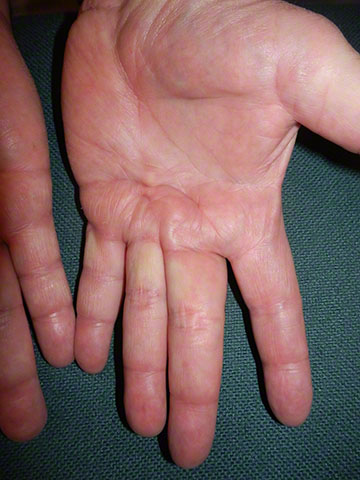
A 54-year old man with hypertension and type 2 diabetes mellitus comes to the office for a routine examination. He says he is unable to flatten the palm of his left hand. He also cannot fully extend the ring or small fingers of his left hand. He is unsure how long he has had these symptoms. He has not had hand pain. He has no recent history of trauma or infection. His medications are losartan, metformin, and long-acting insulin. He is left-hand dominant. He is employed as a construction worker. He appears well. Vital signs are within normal limits. A photograph of the left hand is shown. No other abnormalities are noted. Which of the following is the most likely mechanism of this patient’s condition?
CorrectIncorrect -
Question 20 of 20
20. Question
A 68-year-old woman comes to the office because of a 3-month history of increased daytime and nighttime urination and pain of her low back. She had cervical cancer 15 years ago, at which time she underwent hysterectomy with bilateral salpingo-oophorectomy. She also received external beam radiation to the pelvis. Physical examination shows no palpable abdominal masses. Laboratory studies show increased serum concentrations of urea nitrogen and creatinine and decreased urine osmolality. Renal ultrasonography shows bilateral hydronephrosis and hydroureter, with distal ureteral narrowing bilaterally. Which of the following best explains the polyuria and nocturia in this patient?
CorrectIncorrect