
NBME 32 – Block 4 (Duplicate 1)
Time limit: 0
Quiz Summary
0 of 20 Questions completed
Questions:
Information
You have already completed the quiz before. Hence you can not start it again.
Quiz is loading…
You must sign in or sign up to start the quiz.
You must first complete the following:
Results
Quiz complete. Results are being recorded.
Results
0 of 20 Questions answered correctly
Your time:
Time has elapsed
You have reached 0 of 0 point(s), (0)
Earned Point(s): 0 of 0, (0)
0 Essay(s) Pending (Possible Point(s): 0)
Categories
- Not categorized 0%
- 1
- 2
- 3
- 4
- 5
- 6
- 7
- 8
- 9
- 10
- 11
- 12
- 13
- 14
- 15
- 16
- 17
- 18
- 19
- 20
- Current
- Review
- Answered
- Correct
- Incorrect
-
Question 1 of 20
1. Question
A 48-year-old man is admitted to the hospital because of a bleeding duodenal ulcer. His hemoglobin concentration is 7 g/dL. Transfusion of two units of packed red blood cells is started. One hour later, the patient develops fever, shaking chills, nausea, and vomiting. His temperature is 38.3°C (101°F), pulse is 115/min, respirations are 22/min, and blood pressure is 90/60 mm Hg. The transfusion is stopped. Laboratory studies show:
Patient blood group
A positive
Transfused unit blood group
B positive
Hemoglobin
6 g/dL
Hematocrit
18%
Serum
Bilirubin
Direct
0.1 mg/dL
Indirect
2.5 mg/dL
Haptoglobin
25 mg/dL (N=26–185)
Lactate dehydrogenase
245 U/L
Which of the following is the most likely cause of the increased serum lactate dehydrogenase activity in this patient?
CorrectIncorrect -
Question 2 of 20
2. Question
A 60-year-old woman with type 2 diabetes mellitus is brought to the emergency department 45 minutes after the sudden onset of crushing chest pain while gardening. She is currently treated with metformin. Her temperature is 37.6°C (99.7°F), pulse is 120/min, respirations are 19/min, and blood pressure is 160/80 mm Hg. Physical examination shows diaphoresis. An ECG shows acute inferior T-wave inversion. The most appropriate first-line oral pharmacotherapy for this patient mediates its pharmacologic effect through which of the following enzymes?
CorrectIncorrect -
Question 3 of 20
3. Question
A 52-year-old man who is HIV positive comes to the physician because of a 2-month history of fatigue; he has had a 6.8-kg (15-lb) weight loss during this period. He had a nevus removed from his back 5 years ago. He has smoked 2 packs of cigarettes daily for 25 years. Physical examination shows no abnormalities. A chest x-ray shows a 2.5-cm nodule in the left lower lobe. Histologic examination of a biopsy specimen of the nodule shows an undifferentiated malignant neoplasm composed of large pleomorphic cells. Immunohistochemistry shows the tumor cells to be positive for HMB-45 and S-100, but negative for CD45 and cytokeratin. Which of the following is the most likely diagnosis?
CorrectIncorrect -
Question 4 of 20
4. Question
A 55-year-old man with a long-standing history of type 2 diabetes mellitus undergoes renal transplantation. His renal function deteriorates 2 hours after the procedure. Cyclosporine therapy was started prior to the operation. The kidney is removed for examination. Histologic examination shows acute fibrinoid necrosis with secondary thrombosis throughout the renal vasculature. Which of the following is the most likely cause of the decreased renal function in this patient?
CorrectIncorrect -
Question 5 of 20
5. Question
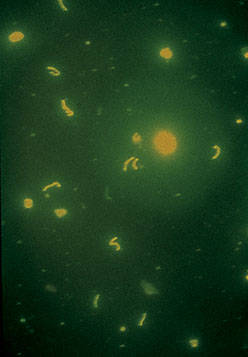
A 56-year-old man has a 3-month history of fever, productive cough, and progressive shortness of breath; he has had a 13-kg (29-lb) weight loss during this period. An x-ray of the chest shows multiple cavities and irregular infiltrates in the apical regions of both upper lobes of lung. An auramine-rhodamine stain of sputum is shown. Which of the following events is required for control of the infection in this patient?
CorrectIncorrect -
Question 6 of 20
6. Question
A 30-year-old man comes to the physician because he has noticed painless swelling in the left testicle for the past few months, which he describes as feeling like “a bag of worms.” Examination of the patient while supine shows no swelling, tenderness, or masses in the left testicle. Which of the following is most likely to be helpful in establishing the diagnosis?
CorrectIncorrect -
Question 7 of 20
7. Question
An investigator conducts a randomized, double-blind, controlled trial to assess the effectiveness of a new lipid-lowering agent. Patients with hypercholesterolemia are randomly selected to receive the new agent or a standard lipid-lowering agent. Four months later, results show that patients treated with the new drug have significantly decreased serum LDL-cholesterol concentrations compared with those who are treated with the standard drug. The investigator concludes that the new agent should be used to prevent myocardial infarction, morbidity, and mortality in patients with hypercholesterolemia. Which of the following raises the most concern regarding the validity of this conclusion?
CorrectIncorrect -
Question 8 of 20
8. Question
A 28-year-old woman with AIDS is admitted to the hospital because of fever and severe shortness of breath. Her temperature is 37.9°C (100.2°F), pulse is 92/min, respirations are 32/min, and blood pressure is 110/70 mm Hg. Rhonchi are heard over all lung fields. A chest x-ray shows hilar lymphadenopathy and diffuse infiltrates. Cytologic examination of sediment obtained via bronchoalveolar lavage shows numerous macrophages filled with small ovoid yeasts. Microscopic examination of a culture performed at 25°C shows numerous microconidia and tuberculate macroconidia. This patient most likely acquired this infection by inhaling which of the following?
CorrectIncorrect -
Question 9 of 20
9. Question
A 68-year-old woman comes to the physician because of shortness of breath for 2 weeks. Physical examination shows jugular venous distention. Crackles are heard at the lung bases bilaterally. Cardiac examination shows a midsystolic click followed by a murmur over the midclavicular line at the fifth left intercostal space, radiating toward the axilla. Which of the following is the most likely cause of this patient’s findings?
CorrectIncorrect -
Question 10 of 20
10. Question
A 45-year-old man is brought to the emergency department because of multiple episodes of diarrhea, skin lesions, and progressive confusion and memory loss during the past 3 weeks. He also has a 1-month history of apathy, fatigue, and insomnia. He recently immigrated to the USA from Western Africa. He appears to be having hallucinations. Physical examination shows bilateral symmetric dermatitis in sun-exposed areas. Oral examination shows stomatitis and glossitis. There is no peripheral neuropathy. He is oriented to person but not to place or time. This patient most likely has a deficiency of which of the following?
CorrectIncorrect -
Question 11 of 20
11. Question
A 64-year-old man comes to the emergency department because of a 2-week history of increasing abdominal girth and a sensation of fullness that is now causing him difficulty breathing. He says that his abdomen feels tight and that his pants no longer fit. Medical history is remarkable for hepatitis C cirrhosis and esophageal varices. His only medication is nadolol. Temperature is 37.0°C (98.6°F), pulse is 98/min, respirations are 20/min, and blood pressure is 102/68 mm Hg. Pulse oximetry on room air shows an oxygen saturation of 96%. Lungs are clear. Abdominal examination shows a tense, distended abdomen that is dull to percussion. Which of the following is the most likely underlying cause of the abdominal findings in this patient?
CorrectIncorrect -
Question 12 of 20
12. Question
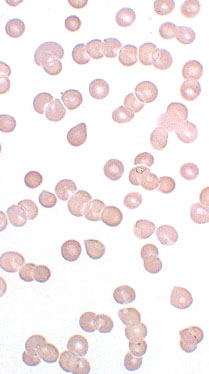
A 67-year-old man has had increasing fatigue, loss of appetite, and a 2.3-kg (5-lb) weight loss over the past 3 months. Laboratory studies show mild normochromic, normocytic anemia (hemoglobin 11.9 g/dL), hypercalcemia (12.3 mg/dL), increased erythrocyte sedimentation rate, and proteinuria. A peripheral blood smear is shown. Which of the following is the most likely diagnosis?
CorrectIncorrect -
Question 13 of 20
13. Question
A 30-year-old woman comes to the physician because of a 3-week history of low back and hip pain. She has been participating in judo classes for 6 months. Physical examination shows the left pelvic bone to be noticeably higher than the right. Muscle testing determines weakness of the left hip abductors. Strengthening of which of the following muscles on the left hip is most likely to help relieve her pain?
CorrectIncorrect -
Question 14 of 20
14. Question
A 25-year-old man who is a medical student comes to the office 1 day after sustaining a needle puncture of his protective vinyl glove and the skin of his left hand. The incident occurred when he was performing paracentesis on a source patient with advanced liver disease caused by hepatitis B. Test results of the source patient are negative for HIV and hepatitis C. The medical student has no history of serious illness and takes no medications. He was vaccinated against hepatitis B on admission to medical school, but he was told at that time that he was a “nonresponder” to the vaccine. Because of this status, he was advised by the physician in the occupational exposure clinic to begin hepatitis B prophylaxis. He appears anxious. Vital signs are within normal limits. Physical examination shows a healing needle puncture wound over the left palm. Failure of prophylaxis is most likely to be identified by an increased serum concentration of which of the following?
CorrectIncorrect -
Question 15 of 20
15. Question
A 29-year-old man with celiac disease comes to the emergency department because of a 6-hour history of abdominal pain and nausea. He has a 3-day history of increased urinary frequency and thirst; he has been drinking five to six large glasses of water daily during this period. He does not take any medications. He appears ill. His temperature is 37.3°C (99.1°F), pulse is 120/min, respirations are 26/min, and blood pressure is 100/60 mm Hg. Physical examination shows mild abdominal tenderness. Laboratory studies show:
Hemoglobin
15.9 g/dL
Hematocrit
49%
Leukocyte count
9200/mm3
Serum
Na+
130 mEq/L
K+
5 mEq/L
Cl–
90 mEq/L
HCO3–
14 mEq/L
Glucose
330 mg/dL
Which of the following serum concentrations is most likely to be decreased in this patient?
CorrectIncorrect -
Question 16 of 20
16. Question
A 54-year-old woman comes to the physician because of a 4-year history of lower abdominal pain. She has been evaluated by two other physicians for the pain. She says, “They both ran many tests but couldn’t find anything wrong.” She seems frustrated. It is most appropriate for the physician to ask which of the following questions at this time?
CorrectIncorrect -
Question 17 of 20
17. Question
A 10-year-old boy is brought to the office by his parents because they are concerned about changes in their son’s behavior during the past 2 years. The patient often flexes his neck backward and forward and blinks three times in a row; this behavior increases in frequency when he is stressed. His teacher says he often clears his throat during class, especially when he is called on to answer a question. The patient’s mother thinks his symptoms began 1 year ago after he had a viral infection, but she is unsure. He has no other history of major medical illness and receives no medications. Growth and development are appropriate for age. He receives grades of A’s and B’s in school. Physical examination shows an eye blink motor tic and intermittent flexion of the neck. A medication with which of the following mechanisms of action is most appropriate to treat this patient’s symptoms?
CorrectIncorrect -
Question 18 of 20
18. Question
A 65-year-old man with type 2 diabetes mellitus and coronary artery disease is brought to the emergency department because of a 5-day history of fever, chills, weakness, and back pain. He recently returned from a 3-month trip to India. He has smoked 2 packs of cigarettes daily for 45 years. Ten years ago, he underwent repair of a 4.5-cm abdominal aortic aneurysm. His temperature is 38.9°C (102°F), pulse is 110/min, respirations are 22/min, and blood pressure is 110/70 mm Hg. Physical examination shows a pulsating abdominal mass. Transesophageal echocardiography shows no vegetations. Ultrasonography shows a 6-cm aortic aneurysm with vacillating plaques and turbulent flow. Blood cultures grow a non–lactose-fermenting, gram-negative rod. Which of the following is the most likely infectious agent?
CorrectIncorrect -
Question 19 of 20
19. Question
A 15-year-old girl has Marfan syndrome. There has been no family history of this disorder, and thorough physical examinations of both parents show no phenotypic expression of the disorder. Which of the following will be the most likely mode of transmission of this disorder to the first offspring of this patient?
CorrectIncorrect -
Question 20 of 20
20. Question
A 70-year-old woman comes to the physician because of progressive shortness of breath during the past 2 months. She was diagnosed with chronic obstructive pulmonary disease 6 years ago. The condition has not responded to intermittent albuterol use. She has smoked 1 pack of cigarettes daily for 50 years. Her temperature is 37°C (98.6°F), pulse is 104/min, respirations are 28/min, and blood pressure is 106/70 mm Hg. Physical examination shows distant breath sounds and scant wheezing but no crackles or rhonchi. It is most appropriate to add a drug from which of the following classes to this patient’s medication regimen?
CorrectIncorrect