
NBME 32 – Block 3
Time limit: 0
Quiz Summary
0 of 20 Questions completed
Questions:
Information
You have already completed the quiz before. Hence you can not start it again.
Quiz is loading…
You must sign in or sign up to start the quiz.
You must first complete the following:
Results
Quiz complete. Results are being recorded.
Results
0 of 20 Questions answered correctly
Your time:
Time has elapsed
You have reached 0 of 0 point(s), (0)
Earned Point(s): 0 of 0, (0)
0 Essay(s) Pending (Possible Point(s): 0)
Categories
- Not categorized 0%
- 1
- 2
- 3
- 4
- 5
- 6
- 7
- 8
- 9
- 10
- 11
- 12
- 13
- 14
- 15
- 16
- 17
- 18
- 19
- 20
- Current
- Review
- Answered
- Correct
- Incorrect
-
Question 1 of 20
1. Question
A 5-year-old boy is brought to the physician because his teacher has noted brief episodes during which he is unresponsive. An EEG taken during one of these episodes shows an abnormal cortical pattern consisting of sharp spikes and blunt waves recurring at a frequency of approximately 3 cycles per second. An appropriate treatment includes administration of drugs that block voltage-gated channels permeable to which of the following ions?
CorrectIncorrect -
Question 2 of 20
2. Question
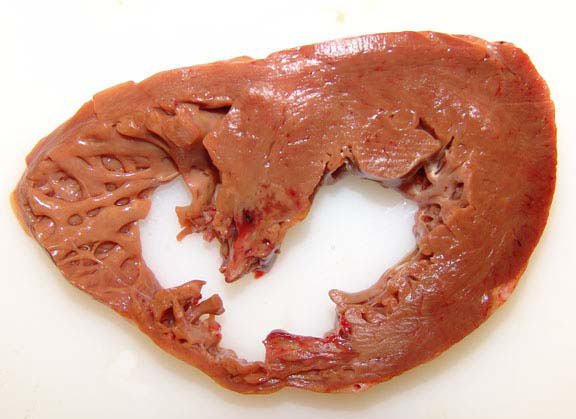
A 54-year old man is admitted to the intensive care unit for treatment of an acute myocardial infarction. Three days later, he has the sudden onset of recurrent chest pain and shortness of breath. His pulse is 120/min and weak, and his blood pressure is 60/30 mm Hg. On examination, he has jugular venous distention. A loud holosystolic murmur is heard. Despite appropriate intervention, the patient dies. A photograph of a 1-cm transverse section of the heart obtained during autopsy is shown. Which of the following was the most likely cause of this man’s death?
CorrectIncorrect -
Question 3 of 20
3. Question
A 51-year-old woman comes to the physician because of a 6-month history of irregular and occasionally heavy vaginal bleeding. Menses had occurred at 14- to 30-day intervals. Physical and pelvic examinations show no abnormalities. The result of a pregnancy test is negative. Ultrasonography and an endometrial biopsy specimen show evidence of endometrial proliferation. A diagnosis of chronic anovulation is made. The continuous influence of which of the following hormones contributes to the endometrial proliferation as the cause of abnormal bleeding in this patient?
CorrectIncorrect -
Question 4 of 20
4. Question
A 48-year-old man who works in a chemical factory is brought to the physician because of a 1-month history of intermittent headache, dizziness, and chest pain. The headache and dizziness most often occur when he returns to work after the weekend. His pulse is 92/min, respirations are 20/min, and blood pressure is 105/65 mm Hg. The lungs are clear to auscultation. An ECG shows no abnormalities. Laboratory studies show an increased methemoglobin concentration; serum liver enzyme activities are within the reference ranges. The most likely cause of these findings is exposure to which of the following agents?
CorrectIncorrect -
Question 5 of 20
5. Question
An investigator is studying the relationship between chronic otitis media in young children and parental history of this condition. From the records of a large pediatric practice, 50 children between the ages of 1 and 3 years are identified who had at least three middle ear infections during the preceding year. Fifty children in the same age group, treated by the same practice for other illnesses, are also identified. The parents of the children in both groups are interviewed to determine their history of chronic otitis media. Of the children with recurrent ear infections, 30 had a family history of chronic otitis media, compared with 20 of the children treated for other illnesses. Which of the following best describes this study design?
CorrectIncorrect -
Question 6 of 20
6. Question
A 62-year-old woman comes to the physician for an initial examination. She has no history of major medical illness. Her father died of a myocardial infarction at the age of 57 years, and her brother had a nonfatal myocardial infarction 2 years ago at the age of 53 years. Physical examination shows no abnormalities. The physician recommends mammography and blood work, including serum lipid studies, to assess the patient’s risk for coronary artery disease. The patient agrees to mammography but refuses the blood work. She says, “I don’t see any reason to get the blood tests done. I know that I’m at a low risk for a heart attack because I’m a woman. Besides, I hate getting stuck by needles.” Which of the following is the most appropriate response by the physician?
CorrectIncorrect -
Question 7 of 20
7. Question
A newborn girl is delivered at term with no complications. Apgar scores are 8 and 10 at 1 and 5 minutes, respectively. Physical examination shows no abnormalities. An increase of which of the following is most likely to provide the strongest stimulus for the rapid closure of the ductus arteriosus in this newborn?
CorrectIncorrect -
Question 8 of 20
8. Question
A 32-year-old man comes to the physician because of a 6-month history of progressive fatigue and mild shortness of breath with exertion. He takes no medications. He started following a strict vegan diet 14 years ago, and he has eaten no animal or dairy products since then. He is 175 cm (5 ft 9 in) tall and weighs 68 kg (150 lb); BMI is 22 kg/m2. His pulse is 92/min, and blood pressure is 100/60 mm Hg. Physical examination shows pale skin, conjunctivae, and nail beds. Laboratory studies show:
Hemoglobin
7.5 g/dL
Hematocrit
23%
Mean corpuscular volume
70 μm3
Leukocyte count
7500/mm3
Platelet count
300,000/mm3
A peripheral blood smear shows small, pale erythrocytes with normal-appearing leukocytes and platelets. A deficiency of which of the following nutrients best explains this patient’s anemia?
CorrectIncorrect -
Question 9 of 20
9. Question
A 48-year-old woman is brought to the urgent care clinic by her husband 20 minutes after she collapsed in the bathroom. She has a 1-week history of diarrhea and a 1-day history of dizziness when standing. Her temperature is 38.1°C (100.5°F), pulse is 110/min, respirations are 22/min, and blood pressure is 90/50 mm Hg. The lungs are clear. Urinalysis shows a specific gravity of 1.030 and osmolality of 1100 mOsmol/kg H2O. Which of the following physiologic responses is most likely in this patient at this time?
CorrectIncorrect -
Question 10 of 20
10. Question
A 36-year-old man collapses and has a 5-minute loss of consciousness at 22,309 ft while climbing in the Himalayas. Another climber administers a norepinephrine injection and supplemental oxygen to the man and he regains consciousness. Despite reporting shortness of breath and exhaustion, he is able to descend to the camp at 20,341 ft. He has a history of asthma currently treated with an inhaled bronchodilator. Temperature is 36.0°C (96.8°F), pulse is 106/min, respirations are 28/min, and blood pressure is 110/65 mm Hg. Pulse oximetry on room air shows an oxygen saturation of 72%. Crackles are heard bilaterally. Cardiac examination discloses no abnormalities. Which of the following is most likely to be increased in this patient?
CorrectIncorrect -
Question 11 of 20
11. Question
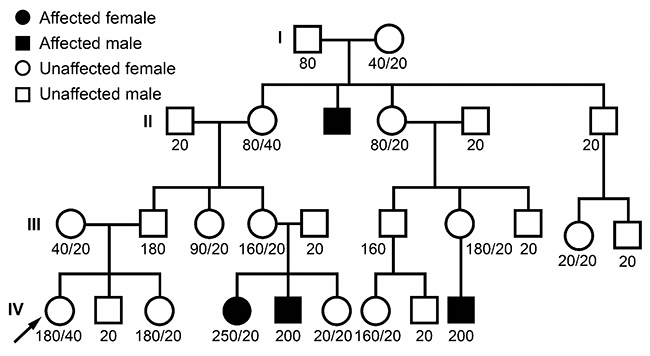
A 25-year-old nulligravid woman (individual IV-1 in the pedigree shown) and her 28-year-old husband come to the office for counseling prior to conception. Previous reproductive endocrinologic evaluation of the husband showed no abnormalities. The woman has a family history of fragile X syndrome. The genotype of the CGG trinucleotide repeat length in the 5′-untranslated exon of the FMR1 gene for each individual in the family is indicated. Based on these findings, the repeat length boundaries between normal and premutation and between premutation and full mutation is closest to which of the following?
CorrectIncorrect -
Question 12 of 20
12. Question
A 6-year-old girl has cellulitis of the face. She has a history of recurrent bacterial infections. A study is done to evaluate chemotaxis:
Source of Neutrophils
Source of Serum
% Chemotaxis
N
N
100
P
P
5
P
N
100
N
P
5
N = Normal P = Patient
Which of the following deficiencies best explains these findings?
CorrectIncorrect -
Question 13 of 20
13. Question
A 12-year-old girl is brought to the emergency department because of a 12-hour history of nausea, vomiting, and severe abdominal pain. Her temperature is 38.9°C (102°F), pulse is 120/min, respirations are 18/min, and blood pressure is 140/90 mm Hg. Abdominal examination shows marked pain on palpation of the right lower quadrant with rebound tenderness. The patient undergoes appendectomy. The appendix is edematous and erythematous. Extensive yellow-white serosal exudates are seen. Which of the following substances was integral to the development of the erythema in the appendix?
CorrectIncorrect -
Question 14 of 20
14. Question
A 45-year-old man undergoes renal transplantation. After the operation, treatment with acyclovir, basiliximab, cyclosporine, prednisone, and sirolimus is started. Which of the following drugs that this patient is receiving inhibits the mammalian target of rapamycin (mTOR)?
CorrectIncorrect -
Question 15 of 20
15. Question
A 60-year-old man is admitted to the hospital because of intermittent atrial fibrillation. After the appropriate treatment is administered and the patient is stabilized, oral anticoagulant therapy is initiated for prevention of embolic stroke secondary to his cardiac condition. Two days later, he develops necrosis of the tissue on his buttocks. Which of the following is the most likely cause of the necrosis in this patient?
CorrectIncorrect -
Question 16 of 20
16. Question
One day after an operation for a gunshot wound, a 48-year-old man develops an increased heart rate, increased central venous and radial pulse pressures, and a continuous abdominal bruit. Which of the following is the most likely diagnosis?
CorrectIncorrect -
Question 17 of 20
17. Question
A 16-year-old boy comes to the physician because of a 3-year history of enlarged, tender, and painful breasts. He says that he does not need to shave often. He was adopted. He is 188 cm (6 ft 2 in) tall and weighs 86 kg (190 lb); BMI is 24 kg/m2. Physical examination shows bilateral gynecomastia and small, firm testes. Serum studies show a follicle-stimulating hormone concentration of 50 mIU/mL, luteinizing hormone concentration of 20 mIU/mL, and testosterone concentration of 6.25 nmol/L (N=10–35). This patient most likely has an abnormality at which of the following locations?
CorrectIncorrect -
Question 18 of 20
18. Question
A 50-year-old woman develops a small pulmonary embolus 12 hours after undergoing surgical removal of a bunion. Treatment with heparin and warfarin is begun. One day later, heparin is inadvertently discontinued, while warfarin is continued. Twenty-four hours later, she develops another pulmonary embolus. Which of the following best explains the second embolic episode?
CorrectIncorrect -
Question 19 of 20
19. Question
A study is conducted to assess the effect of a low-calorie diet on the incidence of type 2 diabetes mellitus among adults at high risk for the disease. Two thousand healthy participants are randomized to follow either a prescribed low-calorie diet or their regular diet. Six months later, each patient is evaluated for new-onset type 2 diabetes mellitus. The results are shown in the table:
Outcome
Type 2
No Type 2
Diabetes Mellitus
Diabetes Mellitus
Total
Intervention
Low-calorie diet
3
997
1000
Regular diet
9
991
1000
Total
12
1988
2000
Which of the following best represents the absolute risk reduction for developing type 2 diabetes mellitus associated with the low-calorie diet after 6 months?
CorrectIncorrect -
Question 20 of 20
20. Question
A 45-year-old woman comes to the physician because of fever and a generalized itchy rash during the past 2 days. She has been receiving trimethoprim-sulfamethoxazole therapy since she was diagnosed with a urinary tract infection 3 days ago. Her temperature is 38.2°C (100.8°F), pulse is 72/min, and blood pressure is 132/68 mm Hg. Physical examination shows a diffuse maculopapular rash over the trunk, extending to the proximal portions of the upper and lower extremities. Laboratory studies show:
Hemoglobin
14.2 g/dL
Hematocrit
43%
Leukocyte count
9000/mm3
Segmented neutrophils
78%
Eosinophils
8%
Lymphocytes
14%
Serum creatinine
1.5 mg/dL
Urine
WBC
20–30/hpf
Leukocyte esterase
3+
Which of the following is the most likely cause of these laboratory findings?
CorrectIncorrect