
NBME 32 – Block 1
Time limit: 0
Quiz Summary
0 of 20 Questions completed
Questions:
Information
You have already completed the quiz before. Hence you can not start it again.
Quiz is loading…
You must sign in or sign up to start the quiz.
You must first complete the following:
Results
Quiz complete. Results are being recorded.
Results
0 of 20 Questions answered correctly
Your time:
Time has elapsed
You have reached 0 of 0 point(s), (0)
Earned Point(s): 0 of 0, (0)
0 Essay(s) Pending (Possible Point(s): 0)
Categories
- Not categorized 0%
- 1
- 2
- 3
- 4
- 5
- 6
- 7
- 8
- 9
- 10
- 11
- 12
- 13
- 14
- 15
- 16
- 17
- 18
- 19
- 20
- Current
- Review
- Answered
- Correct
- Incorrect
-
Question 1 of 20
1. Question
A 10-year-old boy is unable to be awakened by his mother in the morning. He has a 3-year history of type 1 diabetes mellitus and receives frequent injections of insulin daily. His blood glucose concentration measured by glucometer is 25 mg/dL. His mother has been instructed to administer glucagon in this situation. Following subcutaneous administration of the drug, he awakens and his blood glucose concentration increases to 180 mg/dL. As a result of this treatment, which of the following enzymes was most likely converted to its inactive form in this patient?
CorrectIncorrect -
Question 2 of 20
2. Question
A 1-week-old boy is admitted to the hospital because of an 8-hour history of vomiting and lethargy. He is at the 10th percentile for length, weight, and head circumference. His respirations are 40/min; other vital signs are within normal limits. Physical examination shows mild central cyanosis. There is no evidence of infection. His serum total calcium concentration is 7 mg/dL (N=8.8–10.8). Echocardiography shows defects consistent with tetralogy of Fallot. Array comparative genomic hybridization shows an autosomal deletion. This patient’s clinical phenotype is best explained by which of the following embryologic mechanisms?
CorrectIncorrect -
Question 3 of 20
3. Question
An investigator is conducting a study of the epidemiology of hepatocellular carcinoma in the USA over the past 25 years. An increased incidence of this disease with viral infection is found. Which of the following viruses is most likely to be identified in this study?
CorrectIncorrect -
Question 4 of 20
4. Question
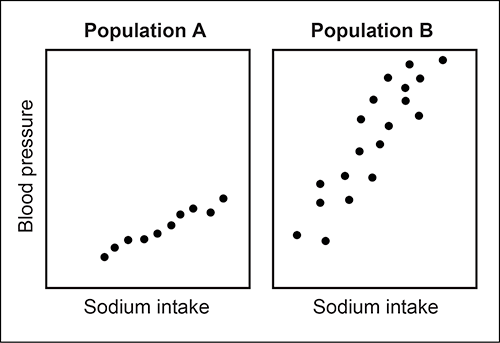
Investigators are studying the relationship between dietary salt consumption and blood pressure in two populations, Population A and Population B. Data analysis yields the graphs shown. Which of the following is the most appropriate conclusion when comparing the correlation coefficients for dietary salt consumption and blood pressure between these two populations?
Option
Correlation in Both Populations
Population A
Population B
A
Negative
Higher
Lower
B
Negative
Lower
Higher
C
Positive
Higher
Lower
D
Positive
Lower
Higher
E
Direct comparisons cannot be made between these populations
—
—
CorrectIncorrect -
Question 5 of 20
5. Question
A 74-year-old man is admitted to the hospital because of a 6-week history of splenomegaly. The patient also has had fatigue for 15 weeks. Laboratory studies show:
Hemoglobin
11.1 g/dL
Hematocrit
33%
Leukocyte count
3900/mm3
Platelet count
110,000/mm3
Cells were not obtained during an effort to aspirate the bone marrow. Flow cytometry of peripheral blood shows a population of cells to be CD20+ and CD103+. Which of the following is the most likely diagnosis?
CorrectIncorrect -
Question 6 of 20
6. Question
A 79-year-old woman is brought to the physician because of two episodes of impaired vision of the right eye during the past 5 days. She experienced dimming in this eye after it seemed as if a curtain or shade had come down over the eye. Each episode lasted for less than 1 minute and then resolved spontaneously. She has hypertension and hyperlipidemia treated with atenolol and simvastatin. Her blood pressure is 138/96 mm Hg. Ophthalmologic examination of both eyes shows arteriolar narrowing. Cardiovascular and neurologic examinations show no abnormalities. The most likely cause of her condition is stenosis of which of the following arteries?
CorrectIncorrect -
Question 7 of 20
7. Question
A 52-year-old man is brought to the physician by his wife because of a 6-month history of cough productive of yellow-green, foul-smelling, purulent sputum. He has a history of recurrent severe pneumonia since the age of 16 years. Rhonchi are present in both lungs, but they are heard loudest in the left lower lobe. The airways contain thick, obstructing mucus. Which of the following is the most likely diagnosis?
CorrectIncorrect -
Question 8 of 20
8. Question
A 19-year-old woman is brought to the emergency department because of a 1-day history of high-grade fever; dizziness; and a diffuse, red, sunburn-like rash. Two days earlier, she underwent rhinoplasty to repair a deviated septum and her right naris was packed because of bleeding. Her temperature is 39.5°C (103°F), and blood pressure is 80/50 mm Hg. Culture of a smear obtained from the nares grows coagulase-positive, gram-positive cocci. The toxin responsible for this patient’s signs and symptoms induces the production of large amounts of cytokines through which of the following mechanisms?
CorrectIncorrect -
Question 9 of 20
9. Question
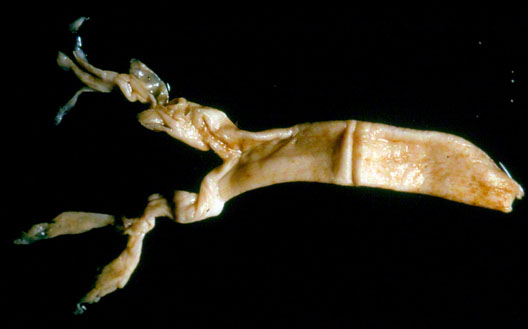
A 46-year-old man comes to the emergency department because of a 2-day history of fever, sore throat, and pain with swallowing. He recently emigrated from Russia and has no history of major medical illness. His temperature is 38.4°C (101.1°F), pulse is 90/min, respirations are 19/min, and blood pressure is 120/85 mm Hg. Physical examination shows a markedly swollen neck, enlarged cervical lymph nodes, and a grayish coating on the tonsils. Culture of tracheal aspirate grows a gram-positive bacillus. The patient is admitted to the hospital. Six days later, his respiratory function quickly deteriorates, and, despite appropriate intervention, he dies. At autopsy, a structure is removed from the surface of the trachea and proximal mainstem bronchi; the structure is shown in the photograph. Which of the following organs in this patient was most likely also affected by the infectious agent?
CorrectIncorrect -
Question 10 of 20
10. Question
A 35-year-old man comes to the physician because of pain and swelling of his right arm where he scraped it on a tree branch 2 days ago. His temperature is 38.3°C (101°F). Examination of the right forearm shows edema around a fluctuant erythematous lesion at the site of trauma. The area is extremely tender to palpation. Which of the following mediators of acute inflammation had the greatest role in producing the pain in this patient’s arm?
CorrectIncorrect -
Question 11 of 20
11. Question
A sedentary 28-year-old man with recently diagnosed hypertension comes to the physician for a follow-up examination. His last three blood pressure readings averaged 145/85 mm Hg. He lives with two other men who do not like to cook. Their usual diet consists of pizza, fried chicken, or hamburgers for dinner. He typically has a salami sandwich for lunch. He has no family history of hypertension or cardiac disease. Which of the following is the most appropriate next step by the physician?
CorrectIncorrect -
Question 12 of 20
12. Question
A 46-year-old man comes to the physician because of a 6-week history of generalized malaise and shivering; he also has had a 5-kg (11-lb) weight gain during this period. He tells the physician that he has been trying to eat healthy foods and has been consuming large amounts of seaweed lately. Physical examination shows an enlarged thyroid gland. His serum thyroid-stimulating hormone concentration is increased. The physician recommends that the patient decrease his seaweed intake, and the patient’s symptoms improve 2 weeks later. Which of the following effects of iodine best explains this patient’s original symptoms?
CorrectIncorrect -
Question 13 of 20
13. Question
A 56-year-old man who is a colonel in the US Air Force and stationed at a missile silo in North Dakota comes to the clinic because of a 2-day history of severe back pain that began while he was shoveling snow. He rates the pain as 7 on a 10-point scale. The pain radiates to the back of his right thigh and calf. He spent the past 2 days on the couch because of the pain. There has been no weakness, fevers, weight loss, or change in bowel or bladder function during this period. He has a 10-year history of intermittent low back pain. Rest and ibuprofen therapy previously resulted in relief but has been ineffective during this time. He has no other history of major medical illness and takes no other medications. He appears to be in pain but can walk without assistance. He is 178 cm (5 ft 10 in) tall and weighs 95 kg (210 lb); BMI is 30 kg/m2. Pulse is 110/min; other vital signs are within normal limits. Physical examination shows paraspinal tenderness to palpation adjacent to the lumbar spine. Ankle jerk reflex is absent on the right. Sensation to pinprick is mildly decreased over the bottom of the right foot. Additional neurologic testing is most likely to show a deficit in which of the following?
CorrectIncorrect -
Question 14 of 20
14. Question
A 16-year-old boy is brought to the emergency department because of a 3-day history of diarrhea and mild abdominal bloating. He has six to eight large, brown, nonbloody, foul-smelling, watery stools daily. He has not had fever, nausea, vomiting, abdominal pain, or blood in his stools. Six days ago, he returned from a 2-week camping trip with his family in the Ozark Mountains of southern Missouri. During the trip, they cooked and ate food they brought with them, and drank filtered water from streams. His vital signs are within normal limits. Physical examination shows no abnormalities. Test of the stool for occult blood is negative. Microscopic examination of a stool specimen shows binucleated trophozoites. The most appropriate first-line pharmacotherapy for this patient is a drug with which of the following mechanisms of action?
CorrectIncorrect -
Question 15 of 20
15. Question
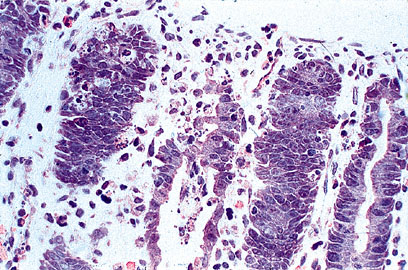
A 65-year-old man with a history of chronic myeloid leukemia comes to the physician because of a 3-day history of fever, abdominal pain, and diarrhea. Three months ago, he received a bone marrow transplant. His temperature is 38°C (100.4°F). Physical examination shows an erythematous maculopapular rash. A photomicrograph of a small-intestine biopsy specimen is shown. Which of the following mechanisms best explains the process shown?
CorrectIncorrect -
Question 16 of 20
16. Question
A 35-year-old man comes to the office for a follow-up examination. Six months ago, he was diagnosed with hypertension, hyperlipidemia, major depressive disorder, and type 2 diabetes mellitus complicated by proteinuria. He had not seen a physician for 15 years before that visit. Medications are metformin, lisinopril, atorvastatin, and citalopram. He is 180 cm (5 ft 11 in) tall and weighs 118 kg (260 lb); BMI is 36 kg/m2. Temperature is 37.7°C (99.9°F), pulse is 86/min, respirations are 14/min, and blood pressure is 150/90 mm Hg. Pulse oximetry on room air shows an oxygen saturation of 97%. Physical and mental status examinations disclose no abnormalities. Hemoglobin A1c is 9.2%. It is most appropriate to obtain additional history regarding which of the following at this time?
CorrectIncorrect -
Question 17 of 20
17. Question
A 22-year-old woman who is unemployed comes to the physician because of a 3-month history of abdominal pain and constipation. She also has had abdominal bloating and cramping after eating small amounts of food. She says that she has a bowel movement only once weekly, even with the use of laxatives, and the bowel movements are formed and hard. She appears pale and is dressed in multiple layers. She is 168 cm (5 ft 6 in) tall and weighs 45 kg (100 lb); BMI is 16 kg/m2. Her temperature is 36.5°C (97.7°F), pulse is 55/min, respirations are 10/min, and blood pressure is 90/60 mm Hg. Physical examination shows a soft, nontender abdomen and hypoactive bowel sounds. The anterior superior iliac spines are prominent. Which of the following is the most likely cause of this patient’s symptoms?
CorrectIncorrect -
Question 18 of 20
18. Question
A 72-year-old man comes to the emergency department because of a 1-hour history of substernal chest pain. He describes the pain as 10 on a 10-point scale. Coronary angiography shows a 90% occlusion of the left main coronary artery. He undergoes immediate coronary artery bypass grafting. He has hypertension and hypercholesterolemia. Results of preoperative laboratory studies are shown:
Hemoglobin
8.4 g/dL
Hematocrit
25%
Leukocyte count
10,500/mm3
Platelet count
75,000/mm3
Serum creatinine
0.8 mg/dL
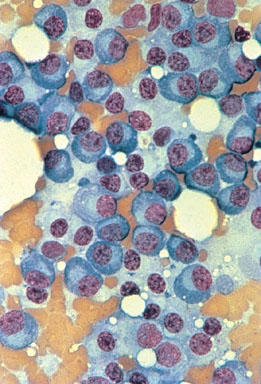
After a sternotomy, the medial aspect of the left 3rd rib fractures immediately when the left hemithorax is elevated to mobilize the left internal thoracic artery. A 4-cm mass is observed adjacent to the left internal thoracic artery, involving the inner aspect of the rib at the site of the fracture. Photomicrograph of a biopsy specimen of the mass is shown. Which of the following is the most likely diagnosis?
CorrectIncorrect -
Question 19 of 20
19. Question
A 62-year-old man with cirrhosis comes to the physician because of a 1-week history of blood in his stool. Anoscopy shows several large internal hemorrhoids. Further evaluation shows portal hypertension. The most likely cause of the hemorrhoids in this patient is increased blood flow between which of the following portal and systemic venous structures?
CorrectIncorrect -
Question 20 of 20
20. Question
A 32-year-old nulligravid woman is being evaluated for infertility for the past 2 years. Her menstrual periods occur every 24 to 26 days. An endometrial biopsy taken on cycle day 20 has a pathologic reading consistent with cycle day 14. Which of the following is the most likely diagnosis?
CorrectIncorrect