
NBME 16 – Block 3 (Duplicate 2)
Time limit: 0
Quiz Summary
0 of 20 Questions completed
Questions:
Information
You have already completed the quiz before. Hence you can not start it again.
Quiz is loading…
You must sign in or sign up to start the quiz.
You must first complete the following:
Results
Quiz complete. Results are being recorded.
Results
0 of 20 Questions answered correctly
Your time:
Time has elapsed
You have reached 0 of 0 point(s), (0)
Earned Point(s): 0 of 0, (0)
0 Essay(s) Pending (Possible Point(s): 0)
Categories
- Not categorized 0%
- 1
- 2
- 3
- 4
- 5
- 6
- 7
- 8
- 9
- 10
- 11
- 12
- 13
- 14
- 15
- 16
- 17
- 18
- 19
- 20
- Current
- Review
- Answered
- Correct
- Incorrect
-
Question 1 of 20
1. Question
A 32-year-old man comes to the clinic because of a 2-year history of fear that he is making inappropriate comments at work and an inability to stop worrying about them. The patient “constantly” worries that he is saying the “wrong thing,” and he routinely asks coworkers and friends if his comments at work are appropriate. He says they frequently assure him that he did not say anything inappropriate, but they describe his constant checking as “obnoxious.” The patient states that he wishes he could stop asking about his behavior, but he says “self-assurance” isn’t enough; he “needs to be sure what others are thinking” about him. He has no history of serious illness and takes no medications. Both of his parents have generalized anxiety disorder. Physical examination of the patient discloses no abnormalities. On mental status examination, the patient has good insight and repeatedly asks questions during the interview such as, “Was that offensive?,” “Did I over-share?,” and “Am I saying that right?” Which of the following is the most likely diagnosis?
CorrectIncorrect -
Question 2 of 20
2. Question
A 25-year-old man who is a veteran of the US Army comes to the office because of frequent nightmares and difficulty sleeping since he was sexually assaulted by two soldiers in his unit 3 years ago while on deployment. He says that in his nightmares, he re-experiences the assault and wakes up “sweating, with my heart beating really fast, and feeling like I was back in our old barracks.” He has not had hypervigilance or avoidance of any specific situations. He says he enjoys his current job as a music promoter and has been promoted twice during the past year. He notes he has been happily married to a supportive spouse for the past 5 years, and they hope to have children soon. He has no history of serious illness and takes no medications. He appears well, appears his stated age, and is socially engaged. Vital signs are within normal limits. Physical examination discloses no abnormalities. Mental status examination discloses a euthymic affect. Which of the following is the most appropriate pharmacotherapy at this time?
CorrectIncorrect -
Question 3 of 20
3. Question
A 24-year-old primigravid woman at 41 weeks’ gestation is admitted to the hospital in active labor. She had been laboring at home with her partner and a midwife, who recommended she come to the hospital because labor has not progressed during the past 12 hours. The patient reports that contractions have occurred every 5 to 7 minutes for the past 12 hours, with good fetal movement and no leakage of vaginal fluid. Vital signs are within normal limits. The fetus is in a vertex presentation, confirmed by bedside ultrasonography. Fetal heart tracing is category 1. Tocodynamometer shows irregular contractions every 6 to 7 minutes. The attending physician recommends artificial rupture of membranes and labor augmentation with intravenous oxytocin, requiring continuous fetal monitoring. The patient wishes to continue to try for a natural delivery with no medical interventions. Which of the following ethical principles should the physician consider to guide management at this time?
CorrectIncorrect -
Question 4 of 20
4. Question
A 22-year-old man comes to the clinic for screening for sexually transmitted infections. He is asymptomatic and says he feels well. During the past year, he has had two episodes of chlamydia. He has no other history of serious illness or known allergies. Immunizations, including for human papillomavirus, are up-to-date. Current medication is only a multivitamin. He has had 80 lifetime male and female sexual partners since the age of 18 years; he uses condoms inconsistently. He lives in an apartment with two roommates and works in a coffee shop. Vital signs are within normal limits. Physical examination discloses no abnormalities. In addition to recommending more consistent condom use, which of the following is the most effective method of HIV prevention to recommend for this patient?
CorrectIncorrect -
Question 5 of 20
5. Question
A 16-year-old girl is brought to the emergency department 3 hours after she was sexually assaulted by a male acquaintance. She says she drank five cocktails at a party, became ill, and lost consciousness. When she awoke, she was naked, her vulvovaginal area was sore, and there was blood on the bed. Menses occur at regular 28-day intervals. Her last menstrual period was 12 days ago. She was last sexually active 2 years ago. Examination shows abrasions along the posterior fourchette. The remainder of the examination shows no abnormalities. Microscopy of vaginal secretions shows motile sperm. In addition to appropriate antibiotic therapy, administration of which of the following is the most appropriate recommendation at this time?
CorrectIncorrect -
Question 6 of 20
6. Question
A 4-year-old boy is brought to the emergency department by his mother 1 hour after she found him playing with his grandfather’s medications. At the time he was found, there were pills on the floor and one empty bottle. The grandfather has hypertension, type 2 diabetes mellitus, and coronary artery disease. The grandfather’s current medications include aspirin, atorvastatin, docusate sodium, labetalol, and metformin. On arrival, the child is awake but sleepy. His temperature is 37.1°C (98.8°F), pulse is 120/min, respirations are 32/min, and blood pressure is 88/60 mm Hg. Pulse oximetry on room air shows an oxygen saturation of 100%. Physical examination shows no other abnormalities. Results of arterial blood gas analysis are shown:
pH
7.49
Pco2
22 mm Hg
Po2
95 mm Hg
HCO3−
22 mEq/L
This patient most likely ingested which of the following medications?
CorrectIncorrect -
Question 7 of 20
7. Question
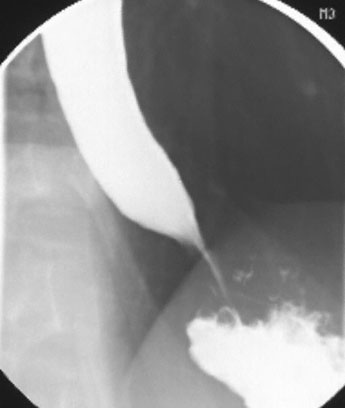
A previously healthy 47-year-old man comes to the physician because of a 3-month history of progressive difficulty swallowing, resulting in a 6-kg (13.2-lb) weight loss. During the past 2 weeks, he has had occasional regurgitation of ingested food. He has not had difficulty breathing or hoarseness. He takes no medications. He does not smoke cigarettes or drink alcohol. His temperature is 37°C (98.6°F), pulse is 75/min, respirations are 18/min, and blood pressure is 122/78 mm Hg. Examination of the neck shows no masses or lymphadenopathy. Cardiopulmonary examination shows no abnormalities. A chest x-ray shows an air-fluid level posterior to the cardiac silhouette. Results of a barium swallow are shown. Esophagogastroduodenoscopy shows esophagitis in the distal esophagus but no stricture or masses. Which of the following is most likely to confirm the diagnosis?
CorrectIncorrect -
Question 8 of 20
8. Question
Patient Information
Age: 32 years
Gender: F, self-identified
Race/Ethnicity: Guatemalan, self-identified
Site of Care: clinic
History
Reason for Visit/Chief Concern: “I’d like a check-up before I get pregnant.”
History of Present Illness:
• nulligravid
• wants evaluation before attempting to conceive with her husband
• menses occur at regular 30-day intervals
• husband uses condoms but plans to stop after this visit “if everything is okay”
Past Medical History:
• exercise-induced bronchospasm
• environmental allergies
Medications:
• albuterol inhaler prn prior to exercise
• fexofenadine prn for allergies
• multivitamin
Allergies:
• penicillin (unknown reaction)
Family History:
• mother: alive with type 2 diabetes mellitus
• father: alive with hypertension
Psychosocial History:
• immigrated to the United States from Guatemala with her husband 5 years ago
• does not smoke cigarettes, drink alcoholic beverages, or use other substances
Physical Examination
Temp
Pulse
Resp
BP
O2 Sat
Ht
Wt
BMI
36.9°C
72/min
18/min
124/76 mm Hg
—
157 cm
69 kg
28 kg/m2
(98.4°F)
(5 ft 2 in)
(152 lb)
• Appearance: well
• Skin: warm and dry
• Pulmonary: clear to auscultation; no wheezes or crackles
• Cardiac: regular rhythm; normal S1 and S2; no murmurs, rubs, or gallops
• Abdominal: nondistended; normal bowel sounds; soft; nontender
• Extremities: no edema; full range of motion
Diagnostic Studies
Blood
Hematocrit
34%
Hemoglobin
12.2 g/dL
WBC
5600/mm3
Platelet count
223,000/mm3
Question: Which of the following is the most appropriate initial step for this patient?
CorrectIncorrect -
Question 9 of 20
9. Question
An 82-year-old man is brought to the clinic because of a 6-week history of fainting with exertion. These episodes are preceded by sweating. He also has had increasingly severe chest pain and shortness of breath with exertion during the past 4 months. His last visit to a physician was 5 years ago. He has no history of serious illness and uses no medications or substances. He is 163 cm (5 ft 4 in) tall and weighs 69 kg (152 lb); BMI is 26 kg/m2. Temperature is 37.0°C (98.6°F), pulse is 90/min and regular, respirations are 15/min, and blood pressure is 150/90 mm Hg. Pulse oximetry on room air shows an oxygen saturation of 100%. The patient is alert and fully oriented. Cardiac examination discloses a grade 3/6 crescendo-decrescendo systolic murmur that is best heard at the second right intercostal space; the murmur radiates to the carotid arteries bilaterally. S1 is normal, but S2 is not heard. Neurologic examination discloses no abnormalities. Which of the following factors in this patient’s history most strongly indicates a poor prognosis without intervention?
CorrectIncorrect -
Question 10 of 20
10. Question
Three months after treatment for pseudomonal pneumonia, a 37-year-old man comes to the physician because of a daily cough productive of copious sputum since that time. He has a history of several episodes of right lower lobe pneumonia during childhood and recurrent right lower lobe pneumonia during adulthood. He smoked two packs of cigarettes daily for 14 years but quit 7 years ago. Inspiratory crackles are heard over the right lower lobe. An x-ray of the chest shows dilated, thickened airways in the right lower lobe. Which of the following is the most likely diagnosis?
CorrectIncorrect -
Question 11 of 20
11. Question
A 12-year-old girl is brought to the clinic by her cousin after telling the cousin that she tried to complete suicide last night by swallowing a handful of ibuprofen tablets. The patient says she has had mild dizziness and abdominal pain since she woke up this morning. She was diagnosed with major depressive disorder 2 months ago. Her only prescribed medication is sertraline, which has mildly improved her symptoms. Today she reveals that she was sexually abused by a family member 2 years ago but had not felt able to mention it until today; she says she cannot stop thinking about the abuse. She is tearful. Which of the following is the most appropriate next step in management?
CorrectIncorrect -
Question 12 of 20
12. Question
Patient Information
Age: 5 years
Sex: M
Race/Ethnicity: unspecified
Site of Care: emergency department (ED)
History
Reason for Visit/Chief Concern: unrestrained backseat passenger in motor vehicle collision
History of Present Illness:
• car was stopped at a traffic light when it was hit from the rear by a car driving 40 miles per hour
• was found moaning in the back seat by emergency personnel
• was placed in spinal immobilization and a cervical collar was applied at the scene
• 100% oxygen via nonrebreather mask administered en route to the ED
• patient’s mother was the driver and was transported unconscious to another hospital
Past Medical History:
• unknown
Medications:
• unknown
Vaccinations:
• unknown
Allergies:
• unknown
Psychosocial History:
• unknown
Physical Examination
Temp
Pulse
Resp
BP
O2 Sat
Ht
Wt
BMI
36.8°C
124/min
32/min
102/70 mm Hg
91%
—
—
—
(98.2°F)
on 100% O2 via NRB face mask
• Appearance: unresponsive; lying on spine board; cervical collar in place
• Skin: pale and mottled
• HEENT: PERRL; no trauma to face noted; oropharynx without
lesions; nares patent
• Pulmonary: bilateral breath sounds heard on auscultation
• Cardiac: no murmurs, rubs, or gallops
• Abdominal: soft; no masses
• Extremities: deformation of the left forearm with good distal pulse
• Neurologic: unresponsive to painful stimuli in upper and lower extremities
Question: Which of the following is the most appropriate next step in management?
CorrectIncorrect -
Question 13 of 20
13. Question
Physician A is approached by Physician B at the hospital 18 hours after Physician B “threw out” his low back. Physician B is on service, and he says that none of his partners are available to cover for him. He cannot get an appointment with his physician for 3 days. He appears desperate, agitated, and in distress; his pager is buzzing repeatedly. He is walking stiffly and seems to be in severe pain every time he moves. He asks, “Could I impose on you to write me a prescription for 60 oxycodone tablets to help me until I can see my physician?” Physician A denies this request, saying he has a policy against prescribing controlled substances outside of the office. Later that afternoon, Physician A runs into one of his physician partners, who confides that the Physician B had asked him yesterday for 60 oxycodone tablets. The two physician partners are concerned that Physician B may have a drug problem. Which of the following is the most appropriate next step by the physician partners?
CorrectIncorrect -
Question 14 of 20
14. Question
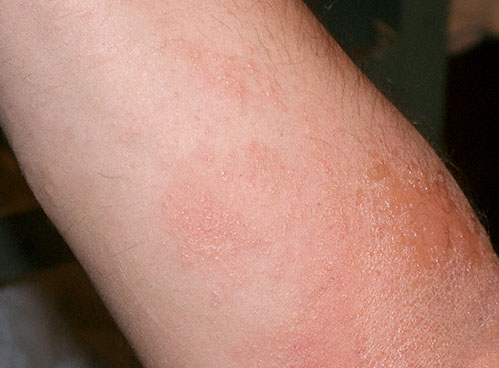
A 37-year-old woman comes to the clinic because of a 4-day history of severe redness, itchiness, and streaks of blistering over her forearms and hands. She has had no other symptoms. Medical history is unremarkable. Medications are an oral contraceptive and as-needed ibuprofen. The patient lives in a heavily wooded area and says she has been gardening during the past several days. She exercises daily by running on trails close to her home. She is 163 cm (5 ft 4 in) tall and weighs 58 kg (128 lb); BMI is 22 kg/m2. Temperature is 36.5°C (97.7°F), pulse is 58/min, respirations are 16/min, and blood pressure is 108/62 mm Hg. A photograph of the right arm is shown; similar findings are present on the left arm and both hands. Which of the following is the most likely primary mediator of this patient’s symptoms?
CorrectIncorrect -
Question 15 of 20
15. Question
An 82-year-old man is brought to the emergency department from the independent-living center where he resides because of a 1-day history of worsening lower abdominal pain and leakage of urine on awakening this morning. He is independent in his activities of daily living and had felt well previously. He initially attributed his abdominal pain to constipation and took milk of magnesia, which resulted in minimal bowel movement but no improvement in his symptoms. He also reports a 4-month history of occasional urinary hesitancy and nocturnal frequency. Medical history is notable for hypertension. He says he has not been evaluated by a physician “in years” and takes no medications. He does not smoke cigarettes or drink alcoholic beverages. He appears to be in mild distress. Temperature is 37.0°C (98.6°F), pulse is 90/min and regular, respirations are 16/min, and blood pressure is 170/90 mm Hg. Lungs are clear to auscultation. Palpation of the abdomen shows a tender, firm mass extending from the suprapubic region to the umbilicus area and measuring 11 cm in width. There is no edema of the extremities. The remainder of the examination shows no abnormalities. Results of dipstick urinalysis are shown:
Nitrites
Negative
WBCs
Negative
RBCs
4+
Test of the stool for occult blood is negative. Which of the following is the most likely diagnosis?
CorrectIncorrect -
Question 16 of 20
16. Question
A 26-year-old man, who has been recovering in the hospital since undergoing a laparoscopic appendectomy 6 hours ago, is now being evaluated because of mild shortness of breath and dizziness upon standing. Medical history otherwise is unremarkable. Oxycodone therapy was initiated on admission, but the patient takes no routine medications. He does not drink alcoholic beverages or use illicit drugs. The patient appears pale and anxious. Vital signs are temperature 36.9°C (98.5°F), pulse 95/min, respirations 20/min, and blood pressure 88/50 mm Hg. Pulse oximetry on room air shows an oxygen saturation of 99%. Cardiopulmonary examination discloses no abnormalities. Palpation of the abdomen discloses mild tenderness of the right lower quadrant and at the incision sites. Which of the following is the most appropriate next step in management?
CorrectIncorrect -
Question 17 of 20
17. Question
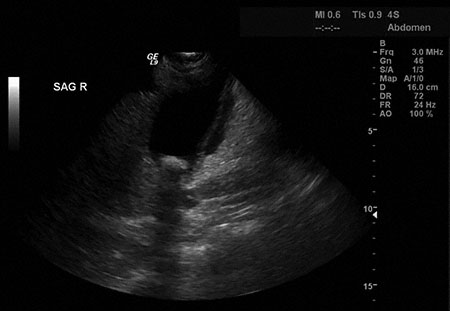
A 38-year-old woman is brought to the emergency department because of a 5-hour history of severe upper midabdominal pain, nausea, and vomiting. She rates the pain as an 8 on a 10-point scale. She has vomited three times since the onset of the pain; the vomit did not contain blood. She has had two similar episodes during the past 3 months but they were less severe and resolved without treatment. She has no history of serious illness. The patient does not use any medications. She drinks one glass of wine weekly but does not smoke cigarettes; she does not use any other substances. BMI is 25 kg/m2. Temperature is 38.7°C (101.7°F), pulse is 102/min, respirations are 16/min, and blood pressure is 136/84 mm Hg. Pulse oximetry on room air shows an oxygen saturation of 98%. The patient is lying down and appears to be in pain. Abdominal examination discloses tenderness to palpation over the epigastric region and right upper quadrant. The tenderness is more severe with palpation while the patient is breathing deeply. The remainder of the physical examination discloses no abnormalities. Results of laboratory studies are shown:
Serum
Alkaline phosphatase
67 U/L
Bilirubin, Total
0.5 mg/dL
Blood
WBC
15,200/mm3
Neutrophils, segmented
87%
Lymphocytes
13%
Abdominal ultrasonography is shown. After administering hydration with 0.9% saline and pain control with morphine sulfate, which of the following is the most appropriate next step in management?
CorrectIncorrect -
Question 18 of 20
18. Question
A 35-year-old primigravid woman at 11 weeks’ gestation comes to the emergency department because of a 4-hour history of vaginal bleeding and pelvic pain. She had severe cramping and bleeding at home, with passage of a golf ball–sized clot; the bleeding and cramping have markedly improved since the clot passed. Two weeks ago, pelvic ultrasonography showed an intrauterine pregnancy with a fetal heart rate of 160/min, but she has not yet established routine prenatal care. Medical history is remarkable for hypothyroidism. Current medications are levothyroxine and a prenatal vitamin. Temperature is 36.8°C (98.2°F), pulse is 72/min, respirations are 14/min, and blood pressure is 124/76 mm Hg. She appears tearful. Abdominal examination shows no abnormalities. Pelvic examination shows a closed cervix with a small amount of bleeding from the cervical os. Urine pregnancy test result is positive. Pelvic ultrasonography shows no intrauterine pregnancy; there is a small amount of blood in the uterus and normal-appearing adnexa. Which of the following laboratory studies is most appropriate to obtain at this time?
CorrectIncorrect -
Question 19 of 20
19. Question
A 67-year-old man comes to the office for an annual health maintenance examination. He reports no symptoms. Medical history is remarkable for hypertension treated with lisinopril and chlorthalidone. His most recent colonoscopy at age 56 years showed no abnormalities; serum prostate-specific antigen (PSA) concentration at that time was 0.5 ng/mL (N<4.0). He smoked one-half pack of cigarettes daily for 3 years but quit 44 years ago. He drinks one to two beers twice weekly. He does not use illicit drugs. He works as a banker. He is married and is monogamous with his wife. He has four children who are healthy, and four grandchildren. He received a tetanus-diphtheria-acellular-pertussis (Tdap) vaccine 5 years ago when his first grandchild was born. The patient is 180 cm (5 ft 11 in) tall and weighs 82 kg (180 lb); BMI is 25 kg/m2. Temperature is 36.6°C (97.8°F), pulse is 68/min, respirations are 12/min, and blood pressure is 125/78 mm Hg. Physical examination discloses no abnormalities. In addition to repeat colonoscopy, which of the following is the most appropriate next step?
CorrectIncorrect -
Question 20 of 20
20. Question
A 52-year-old woman comes to an urgent care center in Denver, Colorado, because of a 1-day history of intermittent nose bleeds. She has no other history of abnormal bleeding and is otherwise asymptomatic. She has hypertension and hyperlipidemia. Her medications are lisinopril and simvastatin. She has smoked one pack of cigarettes daily for 25 years. She drinks two glasses of wine daily. She does not use illicit drugs. Temperature is 36.4°C (97.6°F), pulse is 85/min, respirations are 18/min, and blood pressure is 156/78 mm Hg. Pulse oximetry on room air shows an oxygen saturation of 98%. On examination, the turbinates appear bloody. There are no nasal masses or ulcerations. The nasal septum is intact. The remainder of the examination shows no abnormalities. Results of laboratory studies are shown:
Hemoglobin
14.2 g/dL
Platelet count
220,000/mm3
Prothrombin time
12 sec (INR=1.0)
Partial thromboplastin time
24 sec
Which of the following factors in this patient’s history most increased her risk for developing this condition?
CorrectIncorrect