
NBME 16 – Block 2 (Duplicate 1)
Time limit: 0
Quiz Summary
0 of 20 Questions completed
Questions:
Information
You have already completed the quiz before. Hence you can not start it again.
Quiz is loading…
You must sign in or sign up to start the quiz.
You must first complete the following:
Results
Quiz complete. Results are being recorded.
Results
0 of 20 Questions answered correctly
Your time:
Time has elapsed
You have reached 0 of 0 point(s), (0)
Earned Point(s): 0 of 0, (0)
0 Essay(s) Pending (Possible Point(s): 0)
Categories
- Not categorized 0%
- 1
- 2
- 3
- 4
- 5
- 6
- 7
- 8
- 9
- 10
- 11
- 12
- 13
- 14
- 15
- 16
- 17
- 18
- 19
- 20
- Current
- Review
- Answered
- Correct
- Incorrect
-
Question 1 of 20
1. Question
A 3-year-old boy is brought to the office by his father because of a 2-month history of intermittently bloody stools. The father describes the stools as hard balls and says that there are often streaks of blood on the outside. The patient has a bowel movement every 1 to 2 days. He is fully toilet trained for urine but refuses to use the toilet to stool. During the past week, his appetite has decreased, and he has only been picking at foods. He eats the same meals as his family but does not like most vegetables. The only fruits he eats are bananas and grapes. He drinks 24 to 28 oz of low-fat cow milk daily. His father reports no changes to his urination. Medical history is unremarkable and he receives no medications. Vaccinations are up-to-date. He is 90 cm (2 ft 11 in; 10th percentile) tall and weighs 12.5 kg (27.5 lb; 10th percentile); BMI is 15.4 kg/m2 (30th percentile). Temperature is 37.6°C (99.7°F), pulse is 120/min, respirations are 22/min, and blood pressure is 90/64 mm Hg. Pulse oximetry on room air shows an oxygen saturation of 98%. Bowel sounds are normoactive. There is diffuse mild tenderness to palpation of the abdomen with no rebound tenderness or guarding. The remainder of the physical examination discloses no abnormalities. Which of the following is the most likely diagnosis?
CorrectIncorrect -
Question 2 of 20
2. Question
A 47-year-old woman comes to the office because of a 3-day history of fever, fatigue, and loss of appetite. Five weeks ago, she underwent uncomplicated kidney transplant for end-stage kidney disease caused by type 2 diabetes mellitus. Her postoperative course had been uncomplicated and stable with her current immunosuppression therapy. Medical history is also remarkable for hypercholesterolemia and essential hypertension. Medications are insulin, prednisone, cyclosporine, mycophenolate mofetil, atorvastatin, and irbesartan. Temperature is 38.0°C (100.4°F), pulse is 100/min, respirations are 16/min, and blood pressure is 146/90 mm Hg. Abdominal examination shows a well-healing incision and tenderness to palpation over the right lower quadrant at the transplant site. There is 1+ pedal edema. Results of laboratory studies are shown:
Leukocyte count
4500/mm3
Serum
Na+
130 mEq/L
K+
5.5 mEq/L
Cl−
92 mEq/L
HCO3−
20 mEq/L
Urea nitrogen
34 mg/dL
Creatinine
3.1 mg/dL
Glucose
180 mg/dL
Which of the following is the most likely explanation for these findings?
CorrectIncorrect -
Question 3 of 20
3. Question
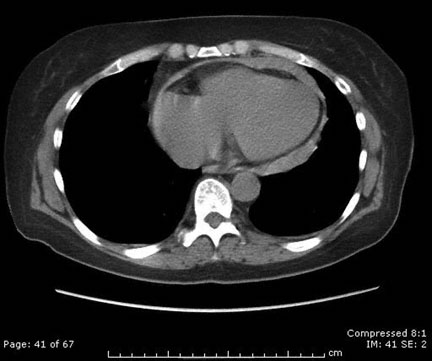
A 27-year-old man comes to the office because of a 2-day history of moderate chest pain and shortness of breath. He also has a 1-week history of a cough and low-grade fever that have not improved. He has no personal or family history of major medical illness. Temperature is 38.0°C (100.4°F), pulse is 92/min, respirations are 20/min, and blood pressure is 95/65 mm Hg. Pulse oximetry on room air shows an oxygen saturation of 97%. The lungs are clear to auscultation. Distant heart sounds are heard, and an anterior friction rub is heard and palpated. Results of laboratory studies, including complete blood count, and serum concentrations of electrolytes, urea nitrogen, and creatinine, are within the reference ranges. CT scan of the chest is shown. Which of the following is the most likely cause of these findings?
CorrectIncorrect -
Question 4 of 20
4. Question
A 12-year-old boy is brought to the physician for a routine examination. He has a history of aortic root enlargement, mitral valve prolapse, and lens dislocation that was surgically repaired at 2 years of age. His father and one of his three siblings have similar histories and physical findings. He is at the 95th percentile for height and 25th percentile for weight. Examination shows long fingers and toes, hyperextensible joints, pectus excavatum, and scoliosis. Which of the following best describes the mode of inheritance of this patient’s condition?
CorrectIncorrect -
Question 5 of 20
5. Question
A 19-year-old man comes to the emergency department because of a 3-hour history of severe chest pain below the sternum. The pain is described as sharp and pleuritic and radiates to his back. He also reports pain with swallowing and shortness of breath. He says he “drank a lot of alcohol” at a party yesterday evening and had several episodes of nonbloody vomiting this morning; his current symptoms began 1 hour later. He has gastroesophageal reflux disease and generalized anxiety disorder. Medications are omeprazole and escitalopram. The patient has no known allergies. He drinks alcoholic beverages “heavily” on weekends; he does not smoke cigarettes or use any other substances. He is 178 cm (5 ft 10 in) tall and weighs 77 kg (170 lb); BMI is 24 kg/m2. Temperature is 37.6°C (99.6°F), pulse is 138/min, respirations are 20/min, and blood pressure is 87/40 mm Hg. Pulse oximetry on room air shows an oxygen saturation of 95%. The patient appears confused but is in no respiratory distress. Pulmonary examination discloses tachypnea with shallow inspirations. Cardiac examination discloses tachycardia and normal S1 and S2. There is tenderness to palpation of the anterior chest wall. Bowel sounds are normal. Abdomen is diffusely tender to palpation. The remainder of the physical examination discloses no abnormalities. Which of the following is the most appropriate next step in management?
CorrectIncorrect -
Question 6 of 20
6. Question
A 25-year-old woman comes to the office because of a 1-month history of a lump in her neck. The lump has remained unchanged in size during this time. She has not had pain, difficulty swallowing, or difficulty breathing. Medical history is remarkable for generalized anxiety disorder diagnosed 5 years ago. Her only medication is an oral contraceptive. She had been receiving care from a mental health counselor for 3 years but discontinued seeing the counselor 3 months ago because of financial difficulties. Family history is remarkable for papillary thyroid cancer in the patient’s mother. The patient is 173 cm (5 ft 8 in) tall and weighs 57 kg (125 lb); BMI is 19 kg/m2. Temperature is 37.1°C (98.7°F), pulse is 88/min, respirations are 17/min, and blood pressure is 101/72 mm Hg. Palpation of the neck discloses a firm, 2-cm nodule in the right lobe of the thyroid gland. There is a mild tremor in both hands. Results of laboratory studies show a serum TSH concentration of 3.5 µU/mL and free T4 concentration of 1.2 ng/dL. Ultrasonography of the thyroid gland shows a 2-cm hypoechoic nodule in the right inferior lobe. Which of the following is the most appropriate next step in management?
CorrectIncorrect -
Question 7 of 20
7. Question

A 5-minute-old boy is admitted to the neonatal intensive care unit because of absent breath sounds on the left, significant respiratory distress with increased work of breathing, and profound hypoxia that developed 5 minutes after birth. The patient was born at 36 weeks’ gestation to a 21-year-old primigravid woman via normal spontaneous vaginal delivery. The pregnancy was uncomplicated despite no prenatal care. The newborn’s temperature is 37.2°C (99.0°F), pulse is 170/min, and respirations are 40/min. Pulse oximetry on room air shows an oxygen saturation of 82%. The patient is intubated. Physical examination discloses fair breath sounds on the right and absent breath sounds on the left. Bowel sounds are auscultated in the left hemithorax. The remainder of the physical examination, including abdominal examination, discloses no abnormalities. Chest x-ray is shown. Which of the following anatomic abnormalities is most likely to be found in this patient?
CorrectIncorrect -
Question 8 of 20
8. Question
An 80-year-old man comes to the office for a routine examination. He says he fell in the grocery store last week but feels well overall. He did not have light-headedness, palpitations, or chest pain before the fall, and he did not hit his head or have loss of consciousness. He has no history of other falls during the past year. He sustained a pulmonary embolism 2 months ago. He has hypertension, stage 2 chronic kidney disease, and osteoarthritis. Medications are amlodipine, lisinopril, dabigatran, and acetaminophen. Temperature is 37.6°C (99.7°F), pulse is 70/min, respirations are 16/min, and blood pressure is 140/80 mm Hg while sitting. Within 2 minutes after standing, pulse is 70/min, and blood pressure is 135/80 mm Hg. He appears well. Examination shows a large ecchymosis on the right upper extremity. Cardiopulmonary examination discloses no abnormalities. He performs a Timed Up and Go test in 30 seconds, indicating he is at increased fall risk. Which of the following is the most appropriate recommendation at this time?
CorrectIncorrect -
Question 9 of 20
9. Question
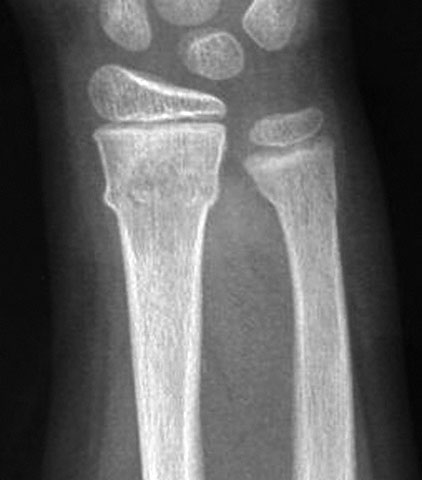
A 15-year-old girl is brought to the emergency department 1 hour after she fell onto her outstretched right arm while playing soccer. She experienced immediate pain. She says she did not think the injury was serious and was able to finish the game. She has not had weakness, numbness, or any other symptoms in her right hand and wrist. On arrival, she is in no distress. Her pulse is 60/min, respirations are 12/min, and blood pressure is 110/60 mm Hg. Examination of the right upper extremity shows moderate tenderness over the distal radius. There is no swelling, erythema, or deformity. Capillary refill time in the fingers of the right hand is 2 seconds. An x-ray of the right wrist is shown. Which of the following is the most appropriate next step in management?
CorrectIncorrect -
Question 10 of 20
10. Question
A 35-year-old woman comes to the clinic because of a 4-month history of progressive fatigue when running or walking long distances. She also has had occasional episodes of mild shortness of breath and light-headedness that resolve with rest. Medical history is remarkable for hypertension and type 2 diabetes mellitus that both resolved 3 years ago after she underwent Roux-en-Y gastric bypass. Since the procedure, she has lost 45 kg (100 lb). Her only medication is a multivitamin with iron, calcium, and vitamin D. She drinks three to four glasses of wine weekly; she does not smoke cigarettes or use other substances. She exercises by walking, running, or doing yoga five times weekly. She is 165 cm (5 ft 5 in) tall and weighs 70 kg (155 lb); BMI is 26 kg/m2. Temperature is 36.5°C (97.7°F), pulse is 98/min, respirations are 14/min, and blood pressure is 110/60 mm Hg. Examination shows no abnormalities except for pale conjunctivae. Results of laboratory studies are shown:
Hematocrit
24%
Hemoglobin
8.0 g/dL
MCV
105 μm3
WBC
4500/mm3
Platelet count
155,000/mm3
Which of the following is the most appropriate next step in management?
CorrectIncorrect -
Question 11 of 20
11. Question
Patient Information
Age: 17 years
Gender: F, self-identified
Race/Ethnicity: unspecified
Site of Care: clinic
History
Reason for Visit/Chief Concern: “I am having trouble sleeping.”
History of Present Illness:
• 2-month history of waking up early in the morning with difficulty falling back to sleep
• over-the-counter melatonin has not helped her sleep
• feels tired all day and sad most of the time
• has no interest in doing things she used to enjoy, such as playing basketball or spending time with her friends
• has been skipping school frequently to stay at home
• worries about what she will do after high school and feels “alone”
• does not feel close with her parents and does not tell them much about what is going on in her life
• feels like she is always eating but is never really hungry; has had a 2.3-kg (5-lb) weight gain since the start of school 3 months ago
Past Medical History:
• mild intermittent asthma well controlled with albuterol
Medications:
• inhaled albuterol prn for difficulty breathing
• melatonin prn for difficulty sleeping
Vaccinations:
• up-to-date
Allergies:
• no known drug allergies
Family History:
• unknown; adopted as an infant and does not know her biological parents
Psychosocial History:
• lives at home with adoptive parents
• currently in the 12th grade
• attracted to males and had a boyfriend that she broke up with 6 months ago; has never been sexually active
• tried alcoholic beverages and cannabis in the past but does not like how they make her feel, so she does not use them regularly
Physical Examination
Temp
Pulse
Resp
BP
O2 Sat
Ht
Wt
BMI
37.0°C
80/min
12/min
110/60 mm Hg
98%
174 cm
80 kg
26.4 kg/m2
(98.6°F)
on RA
(5 ft 9 in)
(176 lb)
89th %ile
95th %ile
95th %ile
• Appearance: quiet, tearful at times; responds briefly to all questions
• Skin: warm and well perfused; no rash; capillary refill time <2 seconds
• HEENT: moist mucous membranes, clear oropharynx
• Pulmonary: clear to auscultation; no wheezes
• Cardiac: regular rhythm; no murmurs
• Abdominal: nondistended; normoactive bowel sounds; soft, nontender
• Neurologic: alert; no focal motor or sensory deficits
• Psychiatric: depressed mood; no active suicidal ideation but says she thinks that “everything would be better if I were not here”
Question: Which of the following is the most appropriate pharmacotherapy at this time?
CorrectIncorrect -
Question 12 of 20
12. Question
The director of a cardiac surgery group at an urban medical center would like to improve its performance related to the control of postoperative blood glucose concentrations. The director reviewed relevant publications from the past 10 years and found that patients who have blood glucose concentrations of less than 150 mg/dL have a decreased risk of infection postoperatively. The director subsequently implements a protocol for perioperative patients that includes hourly blood glucose testing with concomitant titrated intravenous insulin dosing. Two months after this intervention is implemented, the director measures the incidence of hypoglycemia in patients who have undergone cardiac surgery at the medical center. Which of the following best describes this assessment?
CorrectIncorrect -
Question 13 of 20
13. Question
A 50-year-old man comes to the office to request the herpes zoster vaccine. He has mild, persistent asthma well controlled with daily inhaled fluticasone therapy during the past 5 years. He says that he has episodes of wheezing, chest tightness, and cough one to two times weekly; these symptoms awaken him at night once or twice monthly. He has no other history of major medical illness and takes no other medications. Vital signs are within normal limits. Physical examination shows no abnormalities. Prior to administration of the herpes zoster vaccine, the most appropriate next step in treatment is to switch fluticasone to which of the following drugs?
CorrectIncorrect -
Question 14 of 20
14. Question
A 21-year-old woman comes to the clinic because of a 3-week history of progressive fatigue, increased thirst, and increased urinary frequency. She feels thirsty despite drinking more water than usual. Her appetite also has increased during this time, but she thinks she may have lost some weight. She has no history of serious illness or operative procedures and takes no medications. She does not smoke cigarettes or drink alcoholic beverages. She is 163 cm (5 ft 4 in) tall and weighs 50 kg (111 lb), which is a 4.5-kg (10-lb) weight loss since her last examination; BMI is 19 kg/m2. Temperature is 37.0°C (98.6°F), pulse is 110/min, respirations are 20/min, and blood pressure is 110/70 mm Hg. Pulse oximetry on room air shows an oxygen saturation of 98%. Physical examination discloses no abnormalities. Results of which of the following laboratory studies are most likely to be abnormal in this patient?
CorrectIncorrect -
Question 15 of 20
15. Question
A 32-year-old woman comes to the office because of a 1-day history of severe back pain that radiates down her legs, dragging of her right leg, and difficulty emptying her bladder. She also has a 3-day history of tingling and numbness that began in her feet and progressed up her calves and thighs to her waist. She has not had fever, headache, vision changes, or changes in muscle strength in her arms. One week ago, she had an upper respiratory tract infection with nonproductive cough. She takes no medications. Temperature is 37.0°C (98.6°F), pulse is 84/min, respirations are 18/min, and blood pressure is 132/78 mm Hg. She appears anxious but not in distress. Physical examination discloses mild lower abdominal tenderness and midline fullness. Deep tendon reflexes are absent in the lower extremities. Sensation to pinprick is decreased below the umbilicus. Placement of a urinary catheter drains 1 L of clear urine. MRI of the spine is most likely to show which of the following findings in this patient?
CorrectIncorrect -
Question 16 of 20
16. Question
A 22-year-old woman is brought to the emergency department by her boyfriend 30 minutes after he found her unresponsive in the bathroom. He last saw her 20 minutes prior to this, and she had appeared healthy. He says that she has no known history of major medical illness, but that she has used heroin in the past. Her temperature is 37.0°C (98.6°F), pulse is 80/min, and blood pressure is 98/60 mm Hg. She is obtunded and only responds to painful stimuli. Which of the following sets of findings is most likely in this patient at this time?
Option
Respirations (/min)
PCO₂ (mm Hg)
PO₂ (mm Hg)
A
6
80
45
B
10
40
65
C
12
60
80
D
16
80
65
E
20
20
65
CorrectIncorrect -
Question 17 of 20
17. Question
A 27-year-old primigravid woman at 24 weeks’ gestation is brought to the emergency department because of a 2-hour history of contractions every 3 minutes that last 60 seconds. Her pregnancy had been uncomplicated. She has no history of serious illness or operative procedures. The cervix is 4 cm dilated and 75% effaced; the vertex is at –1 station. The membranes are intact. The remainder of the examination shows no abnormalities. The patient asks what can be done to halt preterm labor. The physician reviews a recent randomized trial in which 10% of women in preterm labor who receive a tocolytic agent deliver within 48 hours versus 14% of those in a placebo group (p=0.23). Based on these data, which of the following best describes this patient’s risk for delivering within 48 hours of tocolysis relative to expectant management?
CorrectIncorrect -
Question 18 of 20
18. Question
Patient Information
Age: 10 years
Gender: M, self-identified
Race/Ethnicity: African American, self-identified
Site of Care: office
History
Reason for Visit/Chief Concern: “My left knee hurts.”
History of Present Illness:
• 1-month history of daily left knee pain that has worsened during the past week
• pain is worse later in the day or with activity
• rates pain as a 4 on a 10-point scale; worse with running
• plays soccer and has to occasionally sit out of practice and games because of pain
• application of ice to the knee after playing soccer provides moderate relief
• no known trauma or knee injuries
• no difficulty sleeping
Past Medical History:
• no serious illnesses
Medications:
• ibuprofen prn for pain
Vaccinations:
• up-to-date
Allergies:
• no known drug allergies
Physical Examination
Temp
Pulse
Resp
BP
O2 Sat
Ht
Wt
BMI
37.0°C
86/min
16/min
116/72 mm Hg
100%
139 cm
32 kg
16.6 kg/m2
(98.6°F)
on RA
(4 ft 7 in)
(71 lb)
48th %ile
50th %ile
50th %ile
• Appearance: alert, cooperative, comfortable
• Extremities: no warmth, edema, effusion, or tenderness of the left knee joint; point tenderness of the left tibial tuberosity; left tibial tuberosity appears larger than right; full range of motion of the left lower extremity; examination of the right knee discloses no abnormalities
Question: Which of the following is the most likely diagnosis?
CorrectIncorrect -
Question 19 of 20
19. Question
A previously healthy 52-year-old man is brought to the emergency department because of right lower leg pain that began this morning and has become increasingly severe with walking. He has smoked one pack of cigarettes daily for 30 years and drinks two to three beers daily. Vital signs are within normal limits. Examination of the right leg shows calf tenderness. There is no pedal edema. Serum D-dimer concentration is increased. Which of the following is the most appropriate next step in management?
CorrectIncorrect -
Question 20 of 20
20. Question
A 16-year-old girl is brought to the clinic because of a 6-month history of worsening anxiety and depressed mood. During this time, she also has had insomnia and occasional thoughts of not wanting to live anymore because “I’m just so tired of worrying about everything all of the time; it’s like my brain doesn’t get a break.” She reports constant worry about her academic performance and safety of family members. She has generalized anxiety disorder and sees a therapist weekly. The patient takes no prescription medications. Vital signs are within normal limits. Physical examination discloses no abnormalities. The patient states that she has had suicidal thoughts but has no current plan to harm herself or others. Which of the following is the most appropriate next step in management?
CorrectIncorrect