
NBME 16 – Block 1 (Duplicate 2)
Time limit: 0
Quiz Summary
0 of 20 Questions completed
Questions:
Information
You have already completed the quiz before. Hence you can not start it again.
Quiz is loading…
You must sign in or sign up to start the quiz.
You must first complete the following:
Results
Quiz complete. Results are being recorded.
Results
0 of 20 Questions answered correctly
Your time:
Time has elapsed
You have reached 0 of 0 point(s), (0)
Earned Point(s): 0 of 0, (0)
0 Essay(s) Pending (Possible Point(s): 0)
Categories
- Not categorized 0%
- 1
- 2
- 3
- 4
- 5
- 6
- 7
- 8
- 9
- 10
- 11
- 12
- 13
- 14
- 15
- 16
- 17
- 18
- 19
- 20
- Current
- Review
- Answered
- Correct
- Incorrect
-
Question 1 of 20
1. Question
A 34-year-old man comes to the physician because of a 3-week history of abdominal pain. He is a diesel mechanic. He has smoked 1½ packs of cigarettes daily for 15 years, drinks two cases of beer weekly, and drinks a large pot of coffee daily. Physical examination shows no abnormalities. He says that he is concerned that he might have pancreatic cancer, as one of his coworkers was recently diagnosed with this condition. Which of the following is this patient’s most significant risk factor for pancreatic cancer?
CorrectIncorrect -
Question 2 of 20
2. Question
An 18-month-old boy is brought to the clinic because of a 1-day history of fever and foul-smelling urine. He had a febrile urinary tract infection 6 months ago. He does not receive any medications. Length is at the 75th percentile, weight is at the 90th percentile, and head circumference is at the 90th percentile. Temperature is 38.7°C (101.7°F), pulse is 98/min, respirations are 20/min, and blood pressure is 96/52 mm Hg. He appears mildly fussy. Physical examination shows no other abnormalities. Urinalysis shows 1+ blood and 3+ leukocyte esterase. Urine culture grows greater than 100,000 CFU/mL Escherichia coli. Kidney ultrasonography shows normal-size kidneys for age with no hydronephrosis, masses, or calculi. Voiding cystourethrography shows contrast in the ureter and renal pelvis without dilation on the right side, the bladder without filling defects, and urethra without dilation. Which of the following is the most likely diagnosis?
CorrectIncorrect -
Question 3 of 20
3. Question
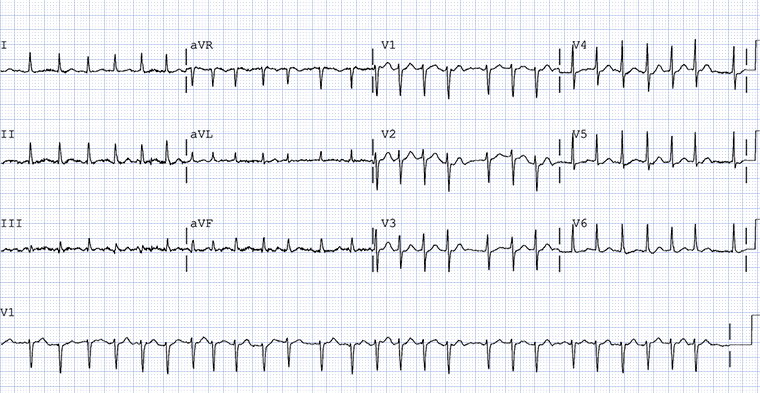
A previously healthy 47-year-old man is brought to the emergency department 45 minutes after the sudden onset of generalized weakness and “fluttering” in his chest. His symptoms began as he was working in a coffee shop. On arrival, he is pale, anxious, and diaphoretic. His pulse is 150/min and irregular, respirations are 22/min, and blood pressure is 100/60 mm Hg. The lungs are clear to auscultation. Cardiac examination discloses irregular tachycardia. The remainder of the examination shows no abnormalities. ECG is shown. Which of the following is the most likely cause of these findings?
CorrectIncorrect -
Question 4 of 20
4. Question
A 45-year-old man has a video telemedicine visit with a physician for a routine examination. He has hypercholesterolemia and says he often feels anxious about work and his family’s finances. He is employed as a business executive and has been working at home since the outbreak of a novel viral illness 9 months ago that resulted in an emergency declaration and stay-at-home orders. When asked how he is coping with the changes in his life, he says, “My wife thinks something is wrong, but I think I’m OK. I can relax when I need to, and I never enjoyed socializing much anyway.” He says he has always worked hard but works “even more now,” which he attributes to the ease of working from home and concerns about the economic future of the company. He adds, “I don’t trust some of my employees to do things the way they should be done.” He describes spending several hours daily organizing files he has brought home from work; he says he feels he cannot stop until “everything is in order” in his home office. The patient says his wife may notice these behaviors more since he started working from home but “I’ve always been like this.” They have had increasingly frequent arguments about his behavior and his unwillingness to spend money on home improvements that his wife wants. He has not had difficulty sleeping. Medications are simvastatin and a multivitamin. Vital signs cannot be obtained. The patient appears fatigued. Limited physical examination discloses no abnormalities. On mental status examination, the patient describes his mood as “anxious”; affect is congruent. Which of the following is the most likely diagnosis?
CorrectIncorrect -
Question 5 of 20
5. Question
A 5-year-old girl is brought to the physician by her mother because of a 3-day history of an increasingly severe rash on her face. Physical examination shows a 6-cm, honey-colored crusting lesion over the right cheek. A Gram stain of the exudate shows gram-positive cocci in chains. This patient is at increased risk for developing which of the following complications?
CorrectIncorrect -
Question 6 of 20
6. Question
A 52-year-old woman is evaluated in an ambulatory surgical center because of rectal bleeding. Two hours ago, she underwent screening colonoscopy; a 1.5-cm pedunculated polyp was removed from the descending colon. She felt well after the procedure but then noticed that she had some bright red blood per rectum. She has not had dizziness or shortness of breath. Vital signs are within normal limits. Rectal examination discloses bright red blood. On repeat colonoscopy, blood is noted to be oozing from the site of the polypectomy. Cautery is applied, and the bleeding stops. Repeat complete blood count shows a stable hemoglobin concentration. When communicating information about this event to the patient, which of the following is the most appropriate initial course of action?
CorrectIncorrect -
Question 7 of 20
7. Question
A 60-year-old man comes to the office for a health maintenance examination. He has a 3-month history of progressive fatigue but otherwise feels well. There is no family history of cancer. The patient has no known occupational exposures and does not smoke cigarettes or drink alcoholic beverages. He is 178 cm (5 ft 10 in) tall and weighs 75 kg (165 lb); BMI is 24 kg/m2. Temperature is 37.0°C (98.6°F), pulse is 75/min, and blood pressure is 130/80 mm Hg. Physical examination shows conjunctival pallor. There is no lymphadenopathy. Cardiopulmonary examination discloses no abnormalities. Abdominal examination shows hepatosplenomegaly. Results of blood laboratory studies are shown:
Hematocrit
30%
Hemoglobin
10 g/dL
WBC
40,000/mm3
Neutrophils, segmented
27%
Lymphocytes
73%
Platelet count
150,000/mm3
Which of the following is the most appropriate next step in diagnosis?
CorrectIncorrect -
Question 8 of 20
8. Question
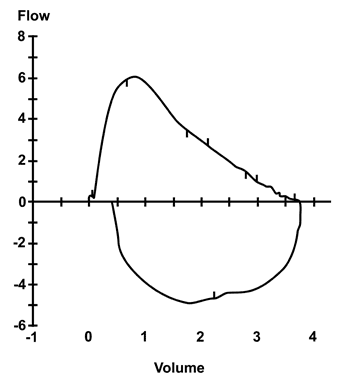
A 15-year-old boy is brought to the emergency department because of a 2-day history of moderate chest pain. He also has a cough that began 1 week ago when he was diagnosed with mycoplasma pneumonia. The cough is worse at night and has not improved with azithromycin therapy. He adds that, since he was diagnosed, when he plays basketball, he begins coughing, his chest feels tight, and he feels unable to breathe. His temperature is 37°C (98.6°F), pulse is 74/min, respirations are 18/min, and blood pressure is 110/68 mm Hg. Pulse oximetry on room air shows an oxygen saturation of 98%. Examination shows no abnormalities. Pulmonary function testing shows:
FEV1
78% of predicted
FVC
96% of predicted
FEV1:FVC ratio
79%
Forced expiratory flow25%–75%
66% of predicted
The flow volume loop is shown. Which of the following best describes this patient’s airway mechanics?
CorrectIncorrect -
Question 9 of 20
9. Question
A previously healthy 5-year-old girl is brought to the physician by her parents because they are concerned about her height. Records show that her growth had proceeded at a normal velocity, along the 50th percentile for age. During the past year, she has grown only 1 cm (0.5 in) but has continued to gain weight. She has a good appetite and eats a variety of foods. She frequently has constipation and says she often feels cold. She has not had fever, vision problems, headache, nausea, diarrhea, or change in urination. She is now at the 3rd percentile for height and 75th percentile for weight. Her temperature is 37°C (98.6°F), pulse is 65/min, respirations are 20/min, and blood pressure is 80/60 mm Hg. The skin is cool and dry. The neck is supple, and there is no lymphadenopathy. The thyroid gland is symmetric and normal in size. Cardiopulmonary examination shows no abnormalities. Patellar and Achilles tendon reflexes are 2+ bilaterally with a slow return phase. The remainder of the examination shows no abnormalities. A complete blood count and urinalysis show no abnormalities. Serum studies show a free thyroxine concentration of 0.2 ng/dL (N=0.8–2.2) and thyroid-stimulating hormone concentration of 150 mIU/L (N=0.7–6.4). Which of the following is the most likely explanation for this patient’s findings?
CorrectIncorrect -
Question 10 of 20
10. Question
A 55-year-old woman comes to the office because she is concerned about her risk for developing Alzheimer disease. She has no history of serious illness and takes no medications. Her father had moderate dementia, Alzheimer type, and died at the age of 88 years of viral pneumonia. Her paternal aunt had severe dementia, Alzheimer type, and died at the age of 80 years. The patient drinks two to three glasses of wine weekly. She works as a successful writer. She is not married, has no close family, and worries that there will be no one to take care of her if she develops dementia. Vital signs are within normal limits. Physical examination shows no abnormalities. Cognitive testing shows no evidence of impairment. Which of the following is the most appropriate next step in management?
CorrectIncorrect -
Question 11 of 20
11. Question
Patient Information
Age: 21 years
Gender: F, self-identified
Race/Ethnicity: White, self-identified
Site of Care: office
History
Reason for Visit/Chief Concern: “I had blurry vision and now I have a headache.”History of Present Illness:
• developed blurred vision in right eye 2 hours ago while taking an examination for graduate school class
• blurriness began in center of visual field and gradually expanded
• blurred vision resolved spontaneously after 20 minutes
• reports 90-minute history of left-sided headache
• describes headache as pounding
• felt nauseated by odor of classmate’s cologne
• managed to complete her examination before coming to office
• now asks to lie down in a dark room because she feels fatigued
Past Medical History:
• asthma
• motion sickness
Medications:
• oral contraceptive
• albuterol (inhaled)
Allergies:
• penicillin (rash)
Family History:
• patient is adopted; family history unknown
Psychosocial History:
• drinks two alcoholic beverages weekly
• occasionally smokes cannabis
• does not smoke cigarettes
• reports increased stress since studying for examination during past 2 days
Physical Examination
Temp
Pulse
Resp
BP
O2 Sat
Ht
Wt
BMI
37.0°C
74/min
18/min
120/72 mm Hg
99%
152 cm
58 kg
25 kg/m2
(98.6°F)
on RA
(5 ft)
(128 lb)
• Appearance: lying supine on examination table
• Skin: no lesions, bruises, or discoloration
• HEENT: no papilledema; pupils reactive to light; visual fields are full to confrontation
• Neck: nontender to palpation; no meningismus
• Pulmonary: mild expiratory wheezes bilaterally
• Cardiac: regular rhythm; no murmurs, rubs, or gallops
• Abdominal: nontender to palpation; no organomegaly
• Neurologic: fully oriented; cranial nerves intact; muscle strength 5/5 in upper and lower extremities
Question: Which of the following is the most appropriate diagnostic study at this time?
CorrectIncorrect -
Question 12 of 20
12. Question
An 85-year-old woman, who has advanced breast cancer, is receiving home hospice care. Her son, who is her primary caregiver, calls her primary physician because she has a 4-hour history of confusion in addition to back pain, which has been increasingly severe during the past week. Medications are sublingual morphine, sublingual lorazepam, topical diclofenac, and bisacodyl suppositories; doses already have been administered for the day. The physician has been caring for this patient for 15 years and knows that she finds comfort in her spirituality, values her independence, has a low tolerance for pain, and has expressed a desire to receive her end-of-life care at home. The patient’s son says that his mother’s eyes are closed, and her eyebrows are furrowed. She continuously attempts to shift her position in bed and is muttering incomprehensibly. Which of the following is the most appropriate next step?
CorrectIncorrect -
Question 13 of 20
13. Question
A 23-year-old woman comes to the emergency department (ED) 4 days after her husband hit her in the left ear and face after he returned home intoxicated. She has had decreased hearing in the left ear since that time. She says the altercation ended with rough, nonconsensual intercourse. Her husband was not wearing a condom. The patient thought her injuries would heal without medical intervention, but she decided to seek treatment when her hearing did not improve. During the interview, she minimizes her injuries and makes excuses for her husband, saying that he is sorry for his actions and has promised to get treatment for his intravenous drug use. Review of the patient’s electronic medical record shows that she has had multiple visits to the ED for physical injuries. She has no other history of serious illness and takes no medications. She does not drink alcohol, smoke cigarettes, or use illicit drugs. The patient appears tearful and subdued. She is 163 cm (5 ft 4 in) tall and weighs 48 kg (105 lb); BMI is 18 kg/m2. Temperature is 37.0°C (98.6°F), pulse is 80/min, respirations are 16/min, and blood pressure is 100/70 mm Hg. Pulse oximetry on room air shows an oxygen saturation of 98%. Physical examination shows partially healed ecchymoses over the left zygomatic arch and forearms. The left tympanic membrane is perforated. Anogenital examination shows lacerations around the anus. Urine pregnancy test result is positive. Which of the following factors would most strongly influence the physician’s decision not to provide this patient with HIV postexposure prophylaxis?
CorrectIncorrect -
Question 14 of 20
14. Question
An 18-year-old woman comes to the emergency department 1 hour after the sudden onset of worsening “waves” of lower abdominal pain, followed by nausea and vomiting. Her symptoms are not affected by body positioning. She has no history of serious illness or operative procedures. She takes no medications. Temperature is 37.0°C (98.6°F), pulse is 125/min, respirations are 25/min, and blood pressure is 135/90 mm Hg. Pulse oximetry on room air shows an oxygen saturation of 100%. Palpation of the abdomen discloses diffuse tenderness with rebound tenderness. Pelvic examination discloses right adnexal fullness and no cervical motion tenderness. Urine pregnancy test result is negative. Pelvic ultrasonography discloses an 8-cm simple cystic right ovarian mass with indeterminate Doppler flow. Which of the following is the most appropriate surgical management of the patient’s right ovary and fallopian tube?
CorrectIncorrect -
Question 15 of 20
15. Question
A 16-year-old girl is brought to the office by her mother because of a 2-day history of nausea, vomiting, and loss of appetite. The patient says that 3 days ago, she ingested half a bottle of her mother’s acetaminophen after her boyfriend broke up with her. She has no history of major medical illness. Her only medication is an oral contraceptive. She appears ill. Her temperature is 37.2°C (99.0°F), pulse is 98/min, respirations are 18/min, and blood pressure is 110/72 mm Hg. Physical examination shows moderate conjunctival icterus, and diffuse jaundice and abdominal tenderness. Examination of a liver biopsy specimen is most likely to show which of the following abnormalities?
CorrectIncorrect -
Question 16 of 20
16. Question
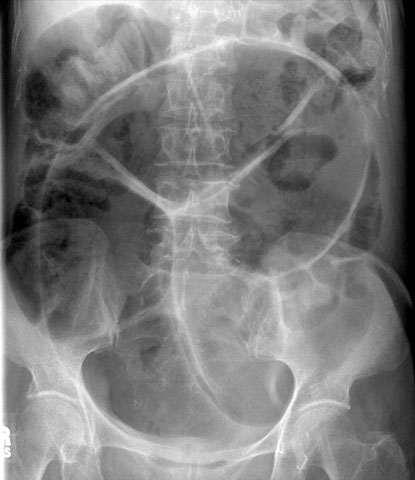
An 82-year-old man with dementia, Alzheimer type, is transferred from a skilled nursing care facility to the hospital because of a progressive abdominal distention for 2 days. During this time, he has not had a bowel movement. He has a history of hypertension. Current medications include a β-adrenergic blocking agent, diuretic, and serotonin agonist. Abdominal examination shows distention without tenderness, rigidity, or guarding. The remainder of the examination shows no abnormalities. X-ray of the abdomen is shown. Which of the following is the most appropriate next step in management?
CorrectIncorrect -
Question 17 of 20
17. Question
A 23-year-old woman comes to the clinic because she believes she is pregnant. Her last menstrual period was 6 weeks ago, and a home urine pregnancy test result was positive. She has type 2 diabetes mellitus that was diagnosed at the age of 14 years. She takes daily insulin glargine and insulin lispro before meals. Her regimen has been unchanged during the past 2 years. Temperature is 37.0°C (98.6°F), pulse is 87/min, respirations are 13/min, and blood pressure is 116/79 mm Hg. Physical examination shows no abnormalities. Serum glucose concentration is 122 mg/dL and hemoglobin A1c is 8.2%. Urine β-hCG test result is positive. This patient’s fetus is at greatest risk for developing which of the following conditions?
CorrectIncorrect -
Question 18 of 20
18. Question
A 35-year-old woman comes to the office because of right knee pain that began suddenly yesterday. She rates her current pain as an 8 on a 10-point scale. She reports no other symptoms. Medical history is remarkable for an episode of bacterial meningitis at age 15 years that resolved with no complications. She takes no medications. She has no known drug allergies. She drinks one glass of wine with dinner 5 nights weekly and occasionally smokes cannabis. She does not smoke cigarettes. She is sexually active and uses condoms inconsistently. Her last menstrual period ended 2 days ago. She is 160 cm (5 ft 3 in) tall and weighs 61 kg (135 lb); BMI is 24 kg/m2. Temperature is 37.0°C (98.6°F), pulse is 74/min, respirations are 16/min, and blood pressure is 110/80 mm Hg. The patient appears well developed and well nourished. Skin examination shows no lesions. Lungs are clear to auscultation. Cardiac examination discloses a regular rhythm with no murmurs, rubs, or gallops. The right knee is moderately erythematous and edematous and is tender to palpation. Range of motion in the right knee is decreased. The remainder of the physical examination discloses no abnormalities. Results of laboratory studies are shown:
Blood
Hematocrit
35%
Hemoglobin
13.0 g/dL
WBC
7500/mm3
Platelet count
162,000/mm3
Synovial Fluid (3.5 mL from right knee)
Appearance
Yellow, opaque
WBCs
20,000/mm3
Neutrophils, segmented
75%
Results of synovial fluid cultures are pending. Which of the following infectious agents is the most likely cause of this patient’s condition?
CorrectIncorrect -
Question 19 of 20
19. Question
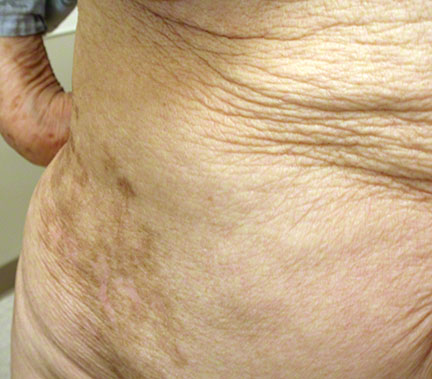
A 62-year-old woman comes to the office because of a 5-month history of persistent painful marks on the right side of her abdomen. She also says her appetite has been decreased since her last office visit 2 years ago. At that visit, the patient was evaluated for painful forehead lesions and was diagnosed with herpes zoster. Acyclovir therapy was prescribed, but the patient was lost to follow-up. Today, she says she took “most” of the acyclovir and that her forehead lesions resolved. Prior to that visit, she had not been evaluated by a physician for more than 15 years. Medical history also is remarkable for cocaine use for 5 years when she was in her 30s. She takes no routine medications. Vaccinations are not up-to-date. She does not smoke cigarettes, drink alcoholic beverages, or use any other substances. She has had multiple sexual partners since her last visit; she uses condoms inconsistently. She is unemployed and has not traveled outside of the United States recently. She is 165 cm (5 ft 5 in) tall and weighs 86 kg (190 lb); BMI is 32 kg/m2. Temperature is 37.1°C (98.7°F), pulse is 89/min, respirations are 18/min, and blood pressure is 130/80 mm Hg. Examination of the skin discloses the findings shown in the photograph. The rash is extremely tender to light touch. The remainder of the physical examination discloses no abnormalities. Which of the following is most likely to have prevented this patient’s condition?
CorrectIncorrect -
Question 20 of 20
20. Question
A previously healthy 27-year-old woman comes to the physician because of a 2-week history of intermittent, severe headaches. She has not had dizziness, vertigo, light sensitivity, nausea, or vomiting. She takes no medications. Her temperature is 37°C (98.6°F), pulse is 70/min, respirations are 18/min, and blood pressure is 190/100 mm Hg. Examination shows no jugular venous distention. No murmurs or gallops are heard on cardiac examination. A bruit is heard in the epigastrium. Serum studies show:
Na+
147 mEq/L
K+
3.0 mEq/L
Cl−
110 mEq/L
HCO3−
28 mEq/L
Creatinine
1.1 mg/dL
A CT scan of the head shows no abnormalities. An increase in which of the following is the most likely cause of this patient’s increased blood pressure?
CorrectIncorrect