
NBME 15- Block 3 (Duplicate 2)
Time limit: 0
Quiz Summary
0 of 20 Questions completed
Questions:
Information
You have already completed the quiz before. Hence you can not start it again.
Quiz is loading…
You must sign in or sign up to start the quiz.
You must first complete the following:
Results
Quiz complete. Results are being recorded.
Results
0 of 20 Questions answered correctly
Your time:
Time has elapsed
You have reached 0 of 0 point(s), (0)
Earned Point(s): 0 of 0, (0)
0 Essay(s) Pending (Possible Point(s): 0)
Categories
- Not categorized 0%
- 1
- 2
- 3
- 4
- 5
- 6
- 7
- 8
- 9
- 10
- 11
- 12
- 13
- 14
- 15
- 16
- 17
- 18
- 19
- 20
- Current
- Review
- Answered
- Correct
- Incorrect
-
Question 1 of 20
1. Question
A 27-year-old man is brought to the emergency department 15 minutes after he was rescued from being trapped under debris for several hours following an earthquake. His right lower extremity was severely injured, and his urine is dark. His pulse is 120/min, respirations are 18/min, and blood pressure is 110/75 mm Hg. Physical examination shows a crush injury to the right lower extremity. Serum creatine kinase activity is 120,000 U/L. Additional laboratory studies are most likely to show which of the following findings in this patient?
CorrectIncorrect -
Question 2 of 20
2. Question
A 28-year-old woman, gravida 2, para 1, at 32 weeks’ gestation is brought to the emergency department because of progressive shortness of breath during the past day. She has had intermittent shortness of breath during the past 2 months that she initially attributed to pregnancy. She has not had fever. Her pregnancy has been otherwise uncomplicated. She has no history of serious illness. Her only medication is a prenatal vitamin. She does not smoke cigarettes. On arrival, she is in respiratory distress but is not using accessory muscles of respiration. She has difficulty speaking full sentences. She is 163 cm (5 ft 4 in) tall. She weighed 57 kg (125 lb) prior to her pregnancy; BMI was 22 kg/m2. She has had a 9-kg (20-lb) weight gain during her pregnancy. Her temperature is 37.5°C (99.5°F), pulse is 120/min and regular, respirations are 30/min, and blood pressure is 120/85 mm Hg. Pulse oximetry on room air shows an oxygen saturation of 90%. Examination shows labored breathing. Diffuse inspiratory and expiratory wheezes are heard. Fundal height is 32 cm. The fetal heart rate is 140/min. In addition to administration of oxygen, which of the following is the most appropriate next step in management?
CorrectIncorrect -
Question 3 of 20
3. Question
A 25-year-old man, who is a welder, comes to the office because of difficulty at work since he was transferred to make emergency repairs on a bridge 1 week ago. He says he always has been very fearful of heights and cannot complete his work each day despite all the safety precautions that are in place. Until this project began, he was able to avoid projects that involved working in high places. He has called in sick for the past 2 days. He fears he will lose his job if he continues to stay home or cause an accident if he returns to work. He has no history of serious illness and takes no medications. Examination shows no abnormalities. Which of the following is the most appropriate next step in management?
CorrectIncorrect -
Question 4 of 20
4. Question
A 22-year-old man who is in the US Army is brought to the military base hospital because of severe groin pain since he was accidentally struck with the stock of a rifle 2 hours ago as he jumped from a personnel carrier. He has no history of major medical illness and takes no medications. Vital signs are within normal limits. Physical examination shows an ecchymotic, edematous scrotum. Urinalysis shows 3+ blood. Doppler ultrasonography of the scrotum shows decreased blood flow to the left testicle. Which of the following is the most appropriate next step in management?
CorrectIncorrect -
Question 5 of 20
5. Question
A 66-year-old woman with rheumatoid arthritis comes to the office because of a 1-year history of daily, slowly progressive, severe pain in her knees. She is now unable to walk more than one block. During the past 5 years, her pain has been controlled with etanercept. She has no other history of serious illness and takes no other medications. Vital signs are within normal limits. Examination of the knees shows nodularity and mild swelling but no warmth. There is mild varus deformity, which is corrected to normal valgus with gentle manipulation. There is moderate tenderness to palpation of the medial and lateral joint lines bilaterally. Range of motion of the knees is to 90 degrees of flexion and produces pain. X-rays of both knees show joint destruction, bony erosions, and 5 degrees of varus malalignment; joint spaces are not visible. Which of the following is the most appropriate recommendation to achieve a good long-term prognosis in this patient?
CorrectIncorrect -
Question 6 of 20
6. Question
A 13-month-old girl is brought to the office because of a 1-month history of progressive loss of developmental skills. During this time, she has become increasingly uncoordinated and has lost her ability to pull to a standing position. She also has had difficulty grasping and reaching. Her parents note that she no longer plays with toys and crayons, has been less interactive, and has had increasingly poor eye contact. She used to babble, imitate sounds, and say “mama” and “dada,” but she has stopped using words. She has not had head trauma, fever, vomiting, or diarrhea. She has no history of serious illness and receives no medications. She was born at term following an uncomplicated pregnancy and spontaneous vaginal delivery. At her last examination 4 months ago, growth and development were appropriate for age. Today, her length and weight have decreased from the 50th to the 25th percentile, and her head circumference has decreased from the 30th to below the 5th percentile. Examination shows no dysmorphic features. The patient is minimally interactive and makes poor eye contact. She is not in acute distress. She does not reach for toys presented to her. When pulled to a standing position, she has poorly coordinated truncal movements and gait, even with support. MRI of the brain shows microcephaly; no other abnormalities are noted. Which of the following is the most likely diagnosis?
CorrectIncorrect -
Question 7 of 20
7. Question
An 18-year-old man comes to the urgent care center because of painful swelling below his right jaw that he first noticed on awakening this morning 2 hours ago. He also reports a 2-day history of malaise and mild headache, which he had attributed to jet lag after arriving in the United States from England 3 days ago to participate in a soccer tournament. He says that yesterday evening he did not feel like eating and had mild chills. Medical history is unremarkable and he takes no medications. Temperature is 37.9°C (100.2°F); other vital signs are within normal limits. Physical examination discloses an enlarged and painful right parotid gland; palpation of the left parotid gland discloses no abnormalities. There is no rash or discoloration of the skin, no pharyngeal erythema, and no axillary or inguinal lymphadenopathy. This patient is at increased risk for development of which of the following?
CorrectIncorrect -
Question 8 of 20
8. Question
A 50-year-old woman is brought to the emergency department because of a 6-day history of confusion, increased thirst, progressive fatigue, and constipation. She also has a 2-month history of moderate low back pain. She has hypertension treated with lisinopril. She is somnolent but easily arousable. She is oriented to person and place but not to time. Temperature is 37.2°C (99.0°F), pulse is 112/min, respirations are 18/min, and blood pressure is 100/60 mm Hg. On examination, the conjunctivae are pale. There is decreased axillary sweat. Cardiopulmonary examination shows no other abnormalities. Results of laboratory studies are shown:
Hemoglobin
9 g/dL
Leukocyte count
4000/mm3
Platelet count
150,000/mm3
Serum
Na+
136 mEq/L
K+
4 mEq/L
Cl−
100 mEq/L
HCO3−
25 mEq/L
Ca2+
13.8 mg/dL
Urea nitrogen
60 mg/dL
Glucose
90 mg/dL
Creatinine
1.4 mg/dL
Protein, total
8.8 g/dL
Albumin
3 g/dL
Intravenous administration of 0.9% saline is begun. Eight hours later, examination findings and laboratory study results are unchanged. In addition to continuing intravenous administration of fluids and beginning furosemide therapy, which of the following is the most appropriate next step in management?
CorrectIncorrect -
Question 9 of 20
9. Question
A 33-year-old woman comes to the clinic to discuss results of a recent Pap smear. She feels well. She has no history of serious illness and takes no medications. She does not smoke cigarettes or use illicit drugs. She drinks two cocktails daily. She is sexually active with three male partners; they use condoms inconsistently. The physician informs the patient that the Pap smear results show atypical squamous cells of undetermined significance, and test results are negative for high-risk human papillomavirus infection. The patient says she wants treatment to cure her infection. In addition to expressing empathy toward the patient, which of the following is the most appropriate next step in management?
CorrectIncorrect -
Question 10 of 20
10. Question
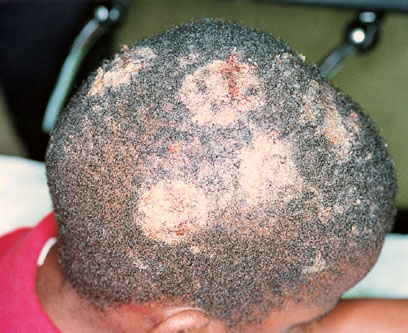
A 7-year-old boy is brought to the office by his mother because of a 1-week history of hair loss and a 1-month history of an enlarging, itchy lesion on his scalp. He has no history of serious illness. Vaccinations are up-to-date. Physical examination shows the findings in the photograph. Microscopic examination of a scraping of the lesion treated with KOH shows branching hyphae. Which of the following is the most appropriate initial pharmacotherapy for this patient?
 CorrectIncorrect
 -
Question 11 of 20
11. Question
A 4-year-old girl is brought to the office by her 26-year-old mother for a well-child examination. The mother says that her daughter is full of energy and is always asking her parents to play with or read to her. She becomes irritable and sulks when her mother refuses. The mother says she is exhausted from taking care of the patient and a 2-year-old son. She says the family has had a difficult year; their home was repossessed by the bank, and they are now living with the father’s parents. The mother becomes tearful as she describes their ongoing financial problems and how much they miss their old home. The mother’s sister and father have major depressive disorder. Physical examination of the patient shows no abnormalities. The mother asks what she can do to best help herself and her family. Which of the following is the most appropriate recommendation?
CorrectIncorrect -
Question 12 of 20
12. Question
A 19-year-old man who is a US Army recruit is brought to the emergency department by his commanding officer 30 minutes after he was found in a supply shed. The patient covered the windows in aluminum foil to “keep enemy radio signals from penetrating the command center.” The commanding officer searched for the recruit after he did not arrive for morning formation. The patient is insisting that he is “battalion commander.” Physical examination and laboratory studies show no other abnormalities. Toxicology screening results are negative. The patient’s parents are contacted, and they state that he has no history of psychiatric illness. Recruits bunking next to him in the barracks are interviewed and state that his behavior has become progressively odd during the past month. Which of the following is the most likely diagnosis?
CorrectIncorrect -
Question 13 of 20
13. Question
A nurse is preparing a 65-year-old man for discharge when the patient has the acute onset of left-sided weakness. Two days ago, he was admitted to the hospital for treatment of dehydration. He has type 2 diabetes mellitus and hypertension. His medications are pioglitazone and lisinopril. His temperature is 37.1°C (98.8°F), pulse is 82/min, respirations are 16/min, and blood pressure is 175/88 mm Hg. Examination shows left lower facial weakness, left hemiplegia, and dysarthria. No other abnormalities are noted. Results of laboratory studies are within the reference ranges. CT scan of the head shows no abnormalities. Which of the following is the most appropriate next step in management?
CorrectIncorrect -
Question 14 of 20
14. Question
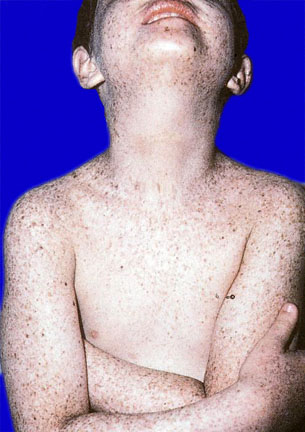
A 4-year-old boy is brought to the office by his parents because of a 2-year history of sunburns and redness of both eyes. His parents say his skin becomes red and irritated after 15 minutes of sun exposure. Whenever he is outside, his eyes become red. Growth and development otherwise have been appropriate for age. Vaccinations are up-to-date. He is at the 50th percentile for height, weight, and BMI. His temperature is 37.0°C (98.6°F), pulse is 106/min, and respirations are 24/min. A photograph of the skin is shown. Ocular examination discloses injection of the conjunctival vessels without discharge bilaterally. Which of the following is most likely to develop in this patient during the next 10 years?
 CorrectIncorrect
 -
Question 15 of 20
15. Question
A 76-year-old man is brought to the clinic by his wife for consultation regarding left total knee replacement. During the past 2 years, he has required a cane to ambulate because of increasingly severe left knee pain. He has hypertension, major depressive disorder, and early stage dementia, Alzheimer type. His medications are nifedipine, sertraline, and aspirin. He lives with his wife, who assists him in all activities of daily living. He is oriented to person and place but not year. Pulse is 78/min, and blood pressure is 160/68 mm Hg. Physical examination shows crepitus and moderate pain on passive range of motion of the left knee. There is no warmth, erythema, or effusion. On mental status examination, he has a happy mood and congruent affect. He registers three of three objects immediately but recalls zero after 1 minute. The patient is provided with information regarding total knee replacement. When he is asked if he understands the benefits of the procedure, he says, “It will fix my knee.” He is then given information about the risks and alternative treatment options. When asked about his understanding, he replies, “It will be OK.” Which of the following is the greatest indication that this patient may not have sufficient capacity for informed consent?
CorrectIncorrect -
Question 16 of 20
16. Question
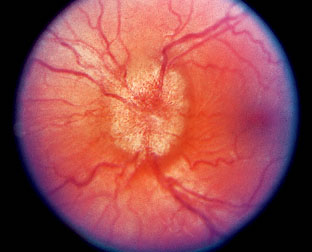
A 23-year-old woman comes to the emergency department because of a 3-month history of increasingly painful circumferential headaches that are most severe when she lies down. During this time, she also has had intermittent episodes of “grayed out” vision with constriction of her visual fields. The episodes last 5 seconds and resolve spontaneously. The patient was treated for Chlamydia trachomatis infection 2 years ago. She has no other history of serious illness and takes no medications. Her diet consists mainly of “junk food.” She appears anxious. She is 157 cm (5 ft 2 in) tall and weighs 124 kg (273 lb); BMI is 50 kg/m2. Her blood pressure is 165/82 mm Hg; other vital signs are within normal limits. Findings on funduscopic examination of the right eye are shown; similar findings are noted in the left eye. The remainder of the examination shows no abnormalities. Lumbar puncture is performed, and opening pressure is 39 cm H2O. Results of cerebrospinal fluid analysis are within the reference ranges. MRI of the brain and MR venography show no abnormalities. Which of the following is most likely to have prevented this patient’s current symptoms?
 CorrectIncorrect
 -
Question 17 of 20
17. Question
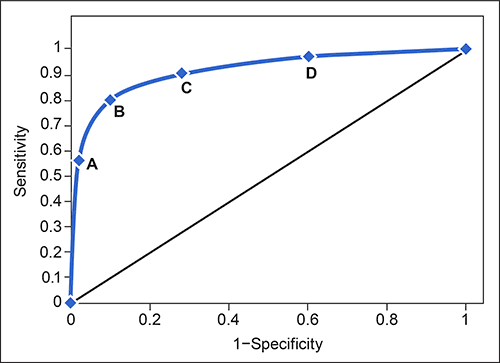
A clinician would like to increase the accuracy of diagnosing streptococcal pharyngitis among his pediatric patients in order to begin treatment sooner. He considers implementing a new diagnostic test for streptococcal pharyngitis and reviews the receiver operator characteristic (ROC) curve shown. Which of the following is the most likely clinical impact of using cut point C instead of cut point B as a positive test?
 CorrectIncorrect
 -
Question 18 of 20
18. Question
A 20-year-old man, who is a US soldier, is evaluated in the hospital 1 day after transfer from a military field hospital following injury from an improvised explosive device. He was thrown approximately 20 feet during the explosion and sustained an open fracture of the right tibia and fibula. He was stabilized and intubated in the field hospital prior to being transferred. CT scans of the head, neck, chest, abdomen, and pelvis have shown no abnormalities. The patient underwent open reduction and external fixation of the fractures and was extubated 1 hour ago. Medical history is unremarkable. Medications are morphine and cephalexin. Temperature is 37.7°C (99.8°F), pulse is 100/min, respirations are 20/min, and blood pressure is 120/80 mm Hg. Pulse oximetry on 4 L/min of oxygen by nasal cannula shows an oxygen saturation of 96%. Physical examination shows an external fixation device on the right lower extremity with a clean dressing. This patient is at greatest risk for which of the following?
CorrectIncorrect -
Question 19 of 20
19. Question
A 67-year-old man comes to the office because of a 3-month history of worsening difficulty swallowing when he eats solid food, especially meats. The patient has no difficulty eating soup and drinking liquids, but swallowing solid foods causes choking. He reports a 9-kg (20-lb) weight loss since his symptoms began, which he attributes to his difficulty with eating. Medical history is remarkable for nephrolithiasis and restless legs syndrome. His only medication is pramipexole. The patient has smoked one-half pack of cigarettes daily for 50 years. He does not drink alcoholic beverages or use illicit drugs. He is 185 cm (6 ft 1 in) tall and weighs 68 kg (150 lb); BMI is 20 kg/m2. Temperature is 37.0°C (98.6°F), pulse is 64/min, respirations are 16/min, and blood pressure is 118/78 mm Hg. Physical examination discloses no abnormalities. Which of the following is the most appropriate next step in evaluation?
CorrectIncorrect -
Question 20 of 20
20. Question
A 17-year-old girl comes to the office because of irregular menstrual periods since menarche at the age of 13 years. Menses occur at 28- to 40-day intervals and last 10 days; they are not painful. Menstrual flow is heavy. Her last menstrual period was 45 days ago. She has no history of serious illness and takes no medications. She became sexually active 6 months ago with one male partner, and they use condoms consistently. The patient is 165 cm (5 ft 5 in) tall and weighs 91 kg (200 lb); BMI is 33 kg/m2. Vital signs are within normal limits. Sexual maturity rating is stage 5 for breast and pubic hair development. Physical examination, including pelvic examination, shows no abnormalities. Which of the following is the most appropriate next step in management?
CorrectIncorrect