
NBME 15- Block 2
Time limit: 0
Quiz Summary
0 of 20 Questions completed
Questions:
Information
You have already completed the quiz before. Hence you can not start it again.
Quiz is loading…
You must sign in or sign up to start the quiz.
You must first complete the following:
Results
Quiz complete. Results are being recorded.
Results
0 of 20 Questions answered correctly
Your time:
Time has elapsed
You have reached 0 of 0 point(s), (0)
Earned Point(s): 0 of 0, (0)
0 Essay(s) Pending (Possible Point(s): 0)
Categories
- Not categorized 0%
- 1
- 2
- 3
- 4
- 5
- 6
- 7
- 8
- 9
- 10
- 11
- 12
- 13
- 14
- 15
- 16
- 17
- 18
- 19
- 20
- Current
- Review
- Answered
- Correct
- Incorrect
-
Question 1 of 20
1. Question
A 27-year-old man who recently received the diagnosis of HIV infection comes to the physician for a routine follow-up examination. He feels well and has had no HIV-related complications. Highly active antiretroviral therapy has not yet been initiated. His childhood immunizations are up-to-date, and he has had no vaccinations during the past 10 years. He has no history of chickenpox during childhood and tested negative for varicella-zoster virus antibodies at his last visit. Examination today shows no abnormalities. His CD4+ T-lymphocyte count is 180/mm3 (Normal≥500), and plasma HIV viral load is 50,000 copies/mL. In addition to avoiding exposure to chickenpox or shingles, which of the following is the most appropriate next step regarding prevention of varicella-zoster infection in this patient?
CorrectIncorrect -
Question 2 of 20
2. Question
A 32-year-old woman is scheduled for elective surgical correction of bladder prolapse. A recent echocardiogram showed mitral valve prolapse but no mitral valve insufficiency. She has no history of serious illness, and she takes no medications on a regular basis. Her temperature is 36.8°C (98.2°F), pulse is 84/min, respirations are 12/min, and blood pressure is 90/58 mm Hg. The lungs are clear to auscultation. A grade 2/6, systolic ejection murmur is heard at the cardiac base, and two early systolic clicks are heard at the left sternal border. Which of the following is the most appropriate antibiotic prophylaxis for this patient?
CorrectIncorrect -
Question 3 of 20
3. Question
A 27-year-old woman, gravida 1, para 1, comes to the physician 1 day after an episode of light-headedness while she was jogging. She has a long-standing history of heavy menses treated with a prescription iron supplement until 8 months ago. She has had hemorrhoids since the birth of her son 2½ years ago. She is otherwise healthy. Vital signs are within normal limits with no orthostatic changes. Examination shows no abnormalities except a mild flow murmur. Laboratory studies show:
Hemoglobin
8.2 g/dL
Hematocrit
24%
Mean corpuscular volume
76/μm3
Leukocyte count
5300/mm3
Which of the following is the most appropriate next step in management?
CorrectIncorrect -
Question 4 of 20
4. Question
A 14-year-old girl is brought to the physician for a well-child examination. She appears well nourished. Menarche has not occurred. She is at the 35th percentile for height and weight. She has grown 8 cm during the past year. On examination, breast and pubic hair development are sexual maturity rating stage 3. The patient is concerned because all of her friends have begun menstruating and appear more developed than she does. Which of the following is the most appropriate next step in management?
CorrectIncorrect -
Question 5 of 20
5. Question
An 18-year-old woman comes to the physician because of a 5-year history of recurrent, painful sores in her mouth and vagina. Multiple over-the-counter topical preparations have provided only temporary resolution of the sores. She is unable to identify any predisposing factors. One year ago, she had an episode of “walking pneumonia” treated with azithromycin. She has been otherwise healthy. Her mother has type 2 diabetes mellitus but is otherwise well. The patient has never been sexually active. Her temperature is 37°C (98.6°F), pulse is 84/min, respirations are 16/min, and blood pressure is 132/72 mm Hg. Examination shows scattered white plaques over the buccal mucosa and palate that are friable and bleed when scraped with a cotton swab. The toenails are yellow and thickened. Pelvic examination shows thick, white vaginal discharge and erythematous vaginal mucosa. There is mild cervical motion tenderness and no adnexal tenderness or masses. Which of the following is the most likely cause of this patient’s condition?
CorrectIncorrect -
Question 6 of 20
6. Question
A previously healthy 4-year-old girl is brought to the physician because of a 1-week history of abdominal pain and diarrhea. Her stools have been streaked with blood. She has not had fever. She has received all recommended immunizations except for hepatitis B vaccine (HBV). She is pale and irritable. Her temperature is 37.5°C (99.5°F), pulse is 160/min, respirations are 26/min, and blood pressure is 128/84 mm Hg. Examination shows generalized moderate edema. Laboratory studies show:
Hematocrit
24%
Reticulocyte count
10%
Platelet count
40,000/mm3
Serum
Urea nitrogen
90 mg/dL
Creatinine
7.8 mg/dL
Which of the following is most likely to have prevented this patient’s condition?
CorrectIncorrect -
Question 7 of 20
7. Question
A 47-year-old Russian man comes to the physician because of a 3-week history of chest pain after walking three blocks. He describes the pain as a tightness in the left side of his chest. He has hypertension and type 2 diabetes mellitus. Current medications include omeprazole and paroxetine. His pulse is 90/min, and blood pressure is 150/90 mm Hg. Examination shows no abnormalities. Serum studies show a total cholesterol concentration of 230 mg/dL, HDL-cholesterol concentration of 40 mg/dL, and LDL-cholesterol concentration of 170 mg/dL. An ECG shows no abnormalities. Which of the following is the most appropriate next step in diagnosis?
CorrectIncorrect -
Question 8 of 20
8. Question
A hospitalized 57-year-old woman with type 2 diabetes mellitus has had an increase in her serum creatinine concentration from 1.0 to 2.4 mg/dL during the past 3 days. She was admitted to the hospital 7 days ago for treatment of pneumonia. She had severe shortness of breath and hypotension on admission; she was intubated and mechanically ventilated for 2 days. Six days ago, a CT scan of the chest with contrast showed pneumonia at both lung bases. She is now breathing 3 L/min of oxygen via nasal cannula and has mild shortness of breath. Her blood pressure has been stable for 6 days. Her urine output has been 1 L/d during the past 2 days. Current medications include ceftriaxone, azithromycin, albuterol, insulin, and lisinopril. Pulse oximetry while breathing 3 L/min of oxygen via nasal cannula shows an oxygen saturation of 94%. Crackles are heard at both lung bases. Urinalysis shows:
Protein
1+
RBC
10/hpf
WBC
9/hpf
Casts
none
A Wright stain of urine shows eosinophils. Which of the following is the most likely diagnosis?
CorrectIncorrect -
Question 9 of 20
9. Question
A 6-year-old boy who has cerebral palsy is brought to the office for a routine health maintenance examination. His parents are concerned that he has never been able to walk. The parents report that the child has been healthy and has not had weight loss, developmental regression, change in appetite or activity level, or pain in his joints. The child’s mental development seems normal to his parents. The mother says that her son undergoes weekly physical therapy. Today, head circumference is at the 25th percentile for age; height and weight are at the 5th percentile for age. Vital signs are temperature 36.8°C (98.4°F), pulse 90/min, respirations 22/min, and blood pressure 100/60 mm Hg. Examination of the upper extremities shows no abnormalities. Hips are adducted. There is moderate lower extremity spasticity and three beats of clonus at both ankles and knees. The parents are considering educational options for the following year for their son and his twin sister, who is not affected with cerebral palsy. The father asks, “What is the public school’s obligation to my children?” Which of the following is the most appropriate response to the parents?
CorrectIncorrect -
Question 10 of 20
10. Question
A previously healthy 22-year-old man comes to the physician because he has had watery, nonbloody diarrhea five times daily for 3 days. He also has had nausea, decreased appetite, and abdominal cramps during this period. He returned yesterday from a trip to Mexico. His temperature is 37.5°C (99.5°F), pulse is 80/min, respirations are 14/min, and blood pressure is 128/80 mm Hg. There are no orthostatic blood pressure or pulse changes. The mucous membranes are moist. Abdominal examination shows diffuse mild tenderness to palpation without masses or rebound. Which of the following is the most likely causal organism?
CorrectIncorrect -
Question 11 of 20
11. Question
A 42-year-old woman has had progressive shortness of breath with exertion over the past 2 months. Cardiac examination shows a prominent cardiac impulse along the left sternal border and a fixed split S2. A grade 1/6, low-pitched diastolic murmur is heard along the left sternal border. Which of the following is the most likely cause of these findings?
CorrectIncorrect -
Question 12 of 20
12. Question
Fifteen minutes ago, a 19-year-old man sustained a gunshot wound to the right temporal region with an exit wound at the left temporal region. He was intubated at the scene and received supplemental oxygen and intravenous fluids. On arrival, his pulse is 60/min, and blood pressure is 170/100 mm Hg. His pupils are fixed and dilated, and he does not respond to stimuli. Which of the following is the most appropriate next step to determine brain death?
CorrectIncorrect -
Question 13 of 20
13. Question
A randomized, double-blind, controlled trial is conducted to assess the effectiveness of a new drug to treat duodenal ulcer disease. The study requires that patients are symptomatic and have evidence of duodenal ulcer disease on upper endoscopy. After informed consent is obtained, patients are randomly assigned to receive the new drug or a placebo via a random numbers table. Upper endoscopy will be performed on each patient at the end of the study. The end points are patient-reported symptoms and results of the upper endoscopy. Which of the following raises the most concern about this trial?
CorrectIncorrect -
Question 14 of 20
14. Question
A 27-year-old woman, gravida 2, para 1, at 34 weeks’ gestation comes to the physician because she is concerned about her baby’s growth. Her friends comment regularly about the small size of her abdomen. Her first child was delivered at 39 weeks’ gestation and weighed 3000 g (6 lb 10 oz); he now is at the age of 16 months and has had normal growth and development. Her last menstrual period and ultrasound measurements are compatible with a current estimated gestational age of 34 weeks. Her husband is 168 cm (5 ft 6 in) tall. She is 140 cm (4 ft 7 in) tall and currently weighs 46 kg (102 lb). Abdominal examination shows a uterus consistent in size with a 32-week gestation and a well-engaged vertex. Ultrasonography shows a fetus consistent in size with a 32-week gestation. Which of the following is the most appropriate next step in management?
CorrectIncorrect -
Question 15 of 20
15. Question
A previously healthy 37-year-old woman is brought to the emergency department 2 hours after the sudden onset of severe pain and light intolerance of the right eye. She has no history of trauma, foreign bodies, or irritating substances in the right eye. She takes no medications and has no known allergies. Her temperature is 37°C (98.6°F). Examination shows mild injection of the right conjunctiva and mild clouding of the anterior chamber. Direct light into the right eye produces severe pain. The pupils are asymmetric. Visual acuity and intraocular pressures are normal bilaterally. Which of the following is the most likely diagnosis?
CorrectIncorrect -
Question 16 of 20
16. Question
A previously healthy 23-year-old woman comes to the physician because of a 3-week history of seeing images after she looks at the television. She occasionally sees colored streaks out of the corners of her eyes. She experimented with a variety of illicit drugs from the ages of 15 to 22 years but has not used any since then. Her temperature is 37°C (98.6°F), pulse is 74/min, respirations are 16/min, and blood pressure is 110/70 mm Hg. On mental status examination, there is no evidence of auditory hallucinations, delusions, or paranoid thinking. Her serum thyroid-stimulating hormone concentration is 3.4 μU/mL. Urine toxicology screening is negative. Which of the following substances is the most likely cause of this patient’s symptoms?
CorrectIncorrect -
Question 17 of 20
17. Question
A 42-year-old man comes to the physician because of intermittent lower abdominal pain, diarrhea, and a 6.8-kg (15-lb) weight loss during the past year. He says that he tires easily. During the past 2 years, he has had a recurrent perirectal abscess treated with antibiotic therapy. Currently, his only medication is a daily multivitamin. He does not appear to be in acute distress. He is 180 cm (5 ft 11 in) tall and weighs 79 kg (175 lb); BMI is 24 kg/m2. His temperature is 37.2°C (99°F), pulse is 84/min, respirations are 16/min, and blood pressure is 145/75 mm Hg. Cardiopulmonary examination shows no abnormalities. A mildly tender abdominal mass is palpated in the right lower quadrant. Results of a barium enema are shown. Which of the following is the most likely diagnosis?
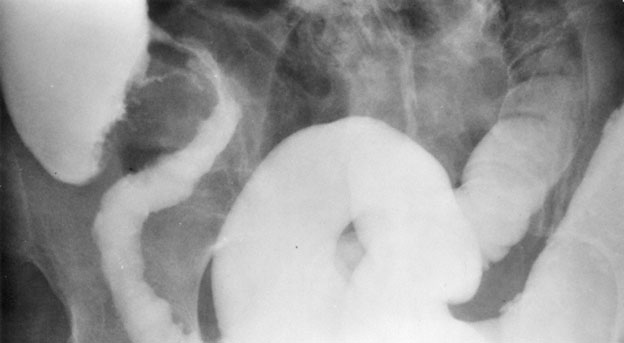 CorrectIncorrect
 -
Question 18 of 20
18. Question
A 72-year-old man is brought to the physician by his wife because of a 5-year history of progressive, waxy, dry, scaly lesions over his back. He has no history of serious illness or known allergies. His only medication is 81-mg aspirin. Examination shows approximately 20 nonpruritic lesions scattered over the back; the lesions range from 1 to 4 cm in diameter. A photograph of one of the lesions is shown. Which of the following is the most appropriate next step in management?
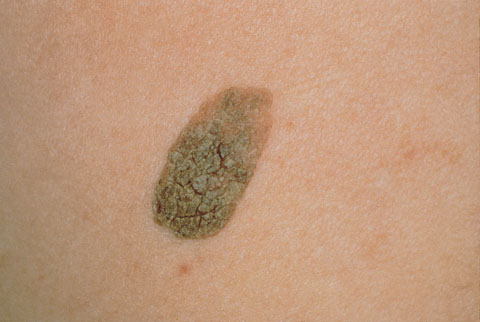 CorrectIncorrect
 -
Question 19 of 20
19. Question
A 6-week-old boy is brought to the emergency department by paramedics after his father found the patient with his eyes rolled back and gasping for air 15 minutes after being put down for a nap. When paramedics arrived, the patient was limp and not breathing. They performed cardiopulmonary resuscitation and intubated him at the scene. Ten minutes later, his pulse was 166/min. The father reports that earlier the child had been fussy and had nasal congestion. The patient was born at term following a forceps-assisted vaginal delivery. On arrival, the patient remains intubated and ventilated by hand-valve mask; there is occasional spontaneous respiratory effort. His temperature is 35.4°C (95.7°F), pulse is 184/min, respirations are 30/min, and blood pressure is 56/34 mm Hg. Examination of the head shows a tense anterior fontanel that is slightly bulging with sutures separated by 3 mm. The pupils are 5 mm and react sluggishly to light. Funduscopic examination shows retinal hemorrhages bilaterally. There is no gag reflex. Deep tendon reflexes are absent throughout; there are no spontaneous movements. The patient does not open his eyes in response to verbal or noxious stimuli; there is minimal movement of the hands and feet in response to noxious stimuli. Which of the following is the most likely diagnosis?
CorrectIncorrect -
Question 20 of 20
20. Question
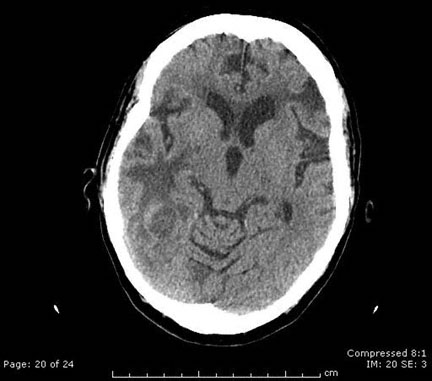
A 72-year-old woman is brought to the emergency department by paramedics 40 minutes after she had a generalized tonic-clonic seizure. On arrival, she is mildly lethargic but able to answer questions. She says she had been feeling well prior to the seizure. She has hypertension and type 2 diabetes mellitus. She had breast cancer treated with lumpectomy and radiation therapy 12 years ago. Medications are lisinopril, atenolol, and glyburide. Her temperature is 36.3°C (97.4°F), pulse is 72/min, respirations are 22/min, and blood pressure is 130/70 mm Hg. Pupils are equal and reactive to light. The lungs are clear to auscultation. Cardiac examination shows no abnormalities. Examination of the left upper and lower extremities shows clonus. On the left, muscle strength is 4/5, deep tendon reflexes are 3+, and Babinski sign is present. Examination of the right upper and lower extremities shows no abnormalities. A CT scan of the head is shown. Intravenous phenytoin is administered. Which of the following is the most appropriate next step in management?
CorrectIncorrect