
NBME 15- Block 2 (Duplicate 1)
Time limit: 0
Quiz Summary
0 of 20 Questions completed
Questions:
Information
You have already completed the quiz before. Hence you can not start it again.
Quiz is loading…
You must sign in or sign up to start the quiz.
You must first complete the following:
Results
Quiz complete. Results are being recorded.
Results
0 of 20 Questions answered correctly
Your time:
Time has elapsed
You have reached 0 of 0 point(s), (0)
Earned Point(s): 0 of 0, (0)
0 Essay(s) Pending (Possible Point(s): 0)
Categories
- Not categorized 0%
- 1
- 2
- 3
- 4
- 5
- 6
- 7
- 8
- 9
- 10
- 11
- 12
- 13
- 14
- 15
- 16
- 17
- 18
- 19
- 20
- Current
- Review
- Answered
- Correct
- Incorrect
-
Question 1 of 20
1. Question
A 32-year-old woman comes to the physician because of severely chapped skin and bleeding of her hands. Since she and her husband divorced 6 months ago, she has had an increasing preoccupation with cleanliness and hygiene. She repeatedly washes her hands after touching anything she believes may be contaminated. She acknowledges that the hand washing is excessive, but when she tries to stop she becomes anxious and feels compelled to wash even more to make up for the omission. Vital signs are within normal limits. Physical examination shows chapped and erythematous hands. No other abnormalities are noted. Mental status examination shows an anxious and depressed mood and dysphoric affect. On further questioning, the patient says she prefers not to go to counseling but is willing to try a medication. Which of the following is the most appropriate pharmacotherapy?
CorrectIncorrect -
Question 2 of 20
2. Question
Researchers plan to conduct a meta-analysis to compare the efficacy of two treatments (A and B) on the incidence of hip fractures in women with osteoporosis over the age of 75 years. Informed consent is not obtained for the meta-analysis. Researchers collect data from published studies of randomized trials. The researchers conclude that Treatment A decreases the incidence of hip fractures compared with Treatment B (results are statistically significant). Which of the following study features raises the most concern about this conclusion?
CorrectIncorrect -
Question 3 of 20
3. Question
Six hours after admission to the hospital for treatment of a pelvic fracture sustained in a motor vehicle collision, a 22-year-old man has bleeding from all intravenous and arterial catheter sites. On arrival, he had hypotension; he has required transfusion of 15 units of packed red blood cells and administration of 8 L of crystalloid solution since admission. His pulse is 100/min, respirations are 16/min, and blood pressure is 100/60 mm Hg. Examination shows a mildly distended abdomen. Which of the following is the most likely cause of this patient’s coagulopathy?
CorrectIncorrect -
Question 4 of 20
4. Question
An 87-year-old man with mild dementia is brought to the emergency department by his daughter after he fell down a flight of stairs. He has been seen in the emergency department because of three similar incidents during the past year. On arrival, he is oriented to person and place but not to time. His daughter remains at the bedside during the entire examination and answers most of the physician’s questions. Examination shows multiple ecchymoses over the trunk and upper extremities. Results of laboratory studies are within the reference ranges. X-rays of the chest and spine show no abnormalities. Prior to discharge, the physician asks the patient about home safety, and the daughter becomes belligerent. She says she will never return to this emergency department again, saying “You do not know how to care for elderly patients.” Which of the following is the most appropriate next step to ensure the safety of this patient?
CorrectIncorrect -
Question 5 of 20
5. Question
A 54-year-old woman with primary biliary cholangitis comes to the emergency department because of a 1-hour history of vomiting blood. Her medications are ursodiol, furosemide, spironolactone, and propranolol. She is awake and fully oriented. Her pulse is 80/min, and blood pressure is 100/60 mm Hg. Cardiopulmonary examination shows no abnormalities. The abdomen is soft and distended with ascites. There is mild edema of the lower extremities. Laboratory studies show:
Hemoglobin
6 g/dL
Platelet count
45,000/mm3
Prothrombin time
22 sec (INR=2.3)
Serum total bilirubin
4 mg/dL
In addition to administration of intravenous fluids, which of the following is the most appropriate next step in management?
CorrectIncorrect -
Question 6 of 20
6. Question
An 84-year-old woman is brought to the physician because of a 6-week history of severely painful, nonhealing ulcers on both legs. During this time, the ulcers have progressively increased in size and number. She has rheumatoid arthritis treated with methotrexate. Her temperature is 37°C (98.6°F), pulse is 72/min and regular, and blood pressure is 120/80 mm Hg. Examination shows mild erythema and pale, full-thickness, punctate ulcers over the lower extremities. Cardiopulmonary examination shows no abnormalities. Which of the following is the most appropriate next step in management?
CorrectIncorrect -
Question 7 of 20
7. Question
An 84-year-old woman comes to the physician for a routine examination. She says she feels well. She has type 2 diabetes mellitus well controlled with metformin. Vital signs are within normal limits. Physical examination, including examination of the neck, shows no masses or abnormalities. Her serum calcium concentration is 11.4 mg/dL; repeat measurement 2 weeks later is 11.3 mg/dL. Which of the following is the most appropriate next step in diagnosis?
CorrectIncorrect -
Question 8 of 20
8. Question
A 68-year-old man with chronic obstructive pulmonary disease is brought to the emergency department by his wife because of a 1-day history of severe shortness of breath and nonproductive cough. His wife reports that her husband has had increasing confusion and lethargy during this time. She says he also has had a 3-day history of fever and cough and a 1-day history of chills. On arrival, the patient is somnolent and difficult to arouse. He appears acutely ill. His temperature is 38.1°C (100.6°F), pulse is 110/min, respirations are 18/min, and blood pressure is 95/50 mm Hg. Pulse oximetry on 2 L/min of oxygen shows an oxygen saturation of 91%. He is using accessory muscles of respiration. Crackles are heard at the right lung base; there are scattered wheezes bilaterally. On cardiac examination, S1 and S2 are normal. The abdomen is soft. On mental status examination, he is drowsy and oriented to person but not to place or time. Laboratory studies show:
Leukocyte count
16,400/mm3
Serum
Na+
143 mEq/L
K+
3.6 mEq/L
Cl−
105 mEq/L
HCO3−
12 mEq/L
Urea nitrogen
37 mg/dL
Creatinine
1.4 mg/dL
Arterial blood gas analysis on 2 L/min of oxygen by nasal cannula shows:
pH
7.04
Pco2
36 mm Hg
Po2
59 mm Hg
The patient is intubated and mechanically ventilated, and intravenous administration of fluids is begun. Which of the following is the most likely cause of the arterial blood gas findings?
CorrectIncorrect -
Question 9 of 20
9. Question
A 21-year-old man comes to the emergency department because of a 3-day history of moderate, diffuse abdominal pain and constipation. During this time, he also has had episodes of nausea and bilious vomiting. He has not had fever, chills, cold intolerance, or skin or hair changes. One year ago, he sustained a pelvic fracture during a motor vehicle collision. His only medication is daily oxycodone; he says he had to double his dose 1 week ago because of worsening pain. He appears uncomfortable. Vital signs are within normal limits. Abdominal examination shows diffuse tenderness to palpation with no rebound or guarding; bowel sounds are decreased. Rectal examination shows normal sphincter tone and brown stool in the vault. Which of the following is the most likely diagnosis?
CorrectIncorrect -
Question 10 of 20
10. Question
A 5-month-old male infant is brought to the physician because of chronic respiratory congestion since birth. Perinatal history showed no abnormalities. Since birth, he has had two episodes of pneumonia, one requiring hospitalization. He has a tendency to cough and choke during feedings with liquids. He is at the 50th percentile for length and the 5th percentile for weight. Examination shows mild persistent intercostal retractions. Scattered wheezes and some crackles are heard on auscultation. Which of the following imaging studies is most likely to confirm the diagnosis?
CorrectIncorrect -
Question 11 of 20
11. Question
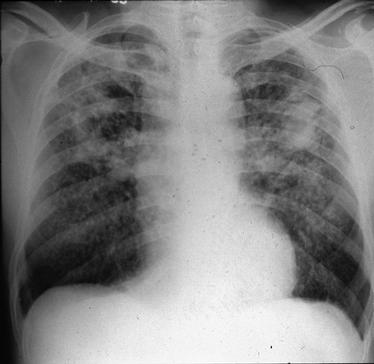
A 72-year-old man comes to the emergency department because of a 4-month history of leg swelling and increasing abdominal girth. He also has a 2-year history of progressive shortness of breath. During the past 3 months, he has needed two pillows to breathe while sleeping. He has no history of serious illness and takes no medications. He has never smoked cigarettes. He worked as a sandblaster in a foundry for 40 years. His pulse is 110/min, respirations are 20/min, and blood pressure is 120/80 mm Hg. Pulse oximetry on room air shows an oxygen saturation of 88%. Jugular venous pressure is 12 cm H2O (N=5–9). Dry crackles are heard diffusely. Cardiac examination shows a normal S1 and a split S2 with a pronounced P2; no murmurs are heard. Abdominal examination shows distention with bulging flanks. The liver is mildly tender; the span is 16 cm. There is 2+ pitting edema to the knee. A chest x-ray is shown. Which of the following is the most appropriate immediate step in management?
 CorrectIncorrect
 -
Question 12 of 20
12. Question
A 3-year-old girl is brought to the physician by her mother because of a 5-day history of blood-tinged, foul smelling vaginal discharge. The patient reports moderate discomfort with wiping after urination. She does not have abdominal or pelvic pain or fever. She has no history of serious illness and receives no medications. Development is appropriate for age. The patient is at the 10th percentile for height and 50th percentile for weight. Her temperature is 37°C (98.6°F), pulse is 62/min, and blood pressure is 100/60 mm Hg. There is no inguinal lymphadenopathy. Abdominal examination shows no tenderness. Pelvic examination shows pink, crusty discharge over the vulva, and pink discharge at the vaginal introitus. There are no lesions or tears. The hymenal ring is annular without clefts. Which of the following is the most appropriate next step in management?
CorrectIncorrect -
Question 13 of 20
13. Question
A 6-week-old boy is brought to the physician for a well-child examination. He was born at term following an uncomplicated pregnancy and spontaneous vaginal delivery. He weighed 3175 g (7 lb) at birth. Apgar scores were 8 and 10 at 1 and 5 minutes, respectively. He is exclusively breast-fed. He is at the 90th percentile for length, 50th percentile for weight, and 60th percentile for head circumference. Examination shows diffuse jaundice. His serum total bilirubin concentration is 8.1 mg/dL, with a direct component of 5.2 mg/dL. Which of the following is the most appropriate next step in management?
CorrectIncorrect -
Question 14 of 20
14. Question
An 8-year-old boy is brought to the physician for a well-child examination. At the age of 3 months, he underwent surgical repair of posterior urethral valves. Since that time, he has been treated for chronic kidney disease. He receives no medications. His pulse is 100/min, and blood pressure is 120/80 mm Hg. Examination shows no other abnormalities. Which of the following serum concentrations is most likely to be increased in this patient?
CorrectIncorrect -
Question 15 of 20
15. Question
A 38-year-old man comes to the physician because of a 10-month history of progressive shortness of breath, wheezing, and cough productive of clear sputum. He has not had fever, weight loss, or cough productive of bloody sputum. He has no history of serious illness and takes no medications. The patient has smoked one-half pack of cigarettes daily for 10 years. He does not appear to be in acute distress. His respirations are 16/min. Pulse oximetry on room air shows an oxygen saturation of 96%. Examination shows a barrel-shaped chest. Diffuse inspiratory crackles and expiratory wheezes are heard. Spirometry shows an FEV1 of 50% of predicted and an FVC of 70% of predicted. A chest x-ray shows hyperlucency of the lung fields, a flattened diaphragm, and a large retrosternal air space. During his lifetime, this patient is at increased risk for which of the following?
CorrectIncorrect -
Question 16 of 20
16. Question
A 73-year-old woman, who resides in a skilled nursing care facility, is brought to the emergency department by staff because of a 6-hour history of confusion. She has schizoaffective disorder treated with risperidone. The staff members say that she usually is alert and fully oriented. Her temperature is 39.4°C (103°F), pulse is 84/min, respirations are 16/min, and blood pressure is 116/78 mm Hg. Physical examination shows muscle rigidity in all the extremities. On mental status examination, she is minimally cooperative and moans incoherently. She is oriented to person but not to place or time. Serum studies show a creatine kinase concentration of 2000 U/L. Which of the following is the most appropriate next step in management?
CorrectIncorrect -
Question 17 of 20
17. Question
A 33-year-old primigravid woman at 19 weeks’ gestation comes to the office for a routine prenatal visit. She feels well, and pregnancy has been uncomplicated. Ultrasonography 1 week ago showed a dichorionic-diamniotic intrauterine twin gestation. She has smoked one to two cigarettes weekly during pregnancy. Her pulse is 90/min, and blood pressure is 105/65 mm Hg. Fundal height is 22 cm. Twin A has a heart rate of 130/min, and twin B has a heart rate of 140/min. There is no lower extremity edema. Urine dipstick shows trace protein. This patient is at greatest risk for which of the following pregnancy complications?
CorrectIncorrect -
Question 18 of 20
18. Question
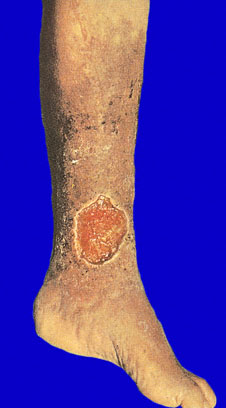
A 56-year-old man comes to the office because of a 3-month history of an enlarging painful ulcer on his left ankle. The ulcer occasionally exudes a clear, yellow fluid. He has cleaned the ulcer daily with soap and lukewarm water and applied an over-the-counter topical antibiotic to the area, with minimal relief. He has not had fever or chills or sustained any recent trauma. He has type 2 diabetes mellitus, coronary artery disease, hypertension, and hyperlipidemia. His medications are metformin, glipizide, atorvastatin, enalapril, hydrochlorothiazide, metoprolol, isosorbide mononitrate, and aspirin. He has no known drug allergies. He smoked one and one-half packs of cigarettes daily for 33 years but quit 5 years ago. He is 180 cm (5 ft 11 in) tall and weighs 90 kg (198 lb); BMI is 28 kg/m2. Vital signs are within normal limits. He does not appear to be in acute distress. A photograph of the left lower extremity is shown. Dorsalis pedis pulses are 2+ bilaterally; posterior tibial pulses cannot be palpated. Monofilament testing shows decreased sensation over the feet; proprioception is intact. Which of the following is the most likely diagnosis?
 CorrectIncorrect
 -
Question 19 of 20
19. Question
A 15-year-old girl is brought to the office for a well-child examination. Menarche has not occurred. She has no history of serious illness and takes no medications. Immunizations are up-to-date. Vital signs are within normal limits. She is below the 3rd percentile for height and at the 25th percentile for weight. Breast development is sexual maturity rating stage 2; there is no axillary or pubic hair. The remainder of the examination shows no abnormalities. Which of the following is most appropriate to determine if this patient is a candidate for growth hormone therapy?
CorrectIncorrect -
Question 20 of 20
20. Question
A 31-year-old woman, gravida 2, para 2, comes to the office for a health maintenance examination. She says she has not eaten or drunk anything during the past 8 hours. Two years ago, she underwent bilateral tubal ligation. She has no known drug allergies. Her only medication is a daily multivitamin. She has smoked one pack of cigarettes daily for 16 years. She drinks two glasses of wine monthly. Her children are aged 5 and 11 years. She works at a doughnut shop. She is 157 cm (5 ft 2 in) tall and weighs 91 kg (200 lb); BMI is 37 kg/m2. Her pulse is 76/min, and blood pressure is 165/100 mm Hg. Examination shows facial hair and truncal obesity. Her fingerstick blood glucose concentration is 130 mg/dL. Which of the following is the most likely diagnosis?
CorrectIncorrect