
NBME 15- Block 1 (Duplicate 1)
Time limit: 0
Quiz Summary
0 of 20 Questions completed
Questions:
Information
You have already completed the quiz before. Hence you can not start it again.
Quiz is loading…
You must sign in or sign up to start the quiz.
You must first complete the following:
Results
Quiz complete. Results are being recorded.
Results
0 of 20 Questions answered correctly
Your time:
Time has elapsed
You have reached 0 of 0 point(s), (0)
Earned Point(s): 0 of 0, (0)
0 Essay(s) Pending (Possible Point(s): 0)
Categories
- Not categorized 0%
- 1
- 2
- 3
- 4
- 5
- 6
- 7
- 8
- 9
- 10
- 11
- 12
- 13
- 14
- 15
- 16
- 17
- 18
- 19
- 20
- Current
- Review
- Answered
- Correct
- Incorrect
-
Question 1 of 20
1. Question
A 32-year-old man comes to the emergency department because of feelings of sadness and despair since his wife left him for another man 5 days ago. He also has had decreased appetite, difficulty sleeping, poor concentration, decreased energy, and no interest in the activities he previously enjoyed. He does not drink alcohol or use illicit drugs. Vital signs are within normal limits. Physical examination shows no abnormalities. He has a sad mood and dysphoric affect. He has had thoughts of ending his life but has no plan to kill himself. Which of the following is the most likely diagnosis?
CorrectIncorrect -
Question 2 of 20
2. Question
A 57-year-old woman with cirrhosis secondary to chronic hepatitis C is hospitalized because of tense ascites. Her medications are propranolol, furosemide, and spironolactone. On admission, her serum creatinine concentration is 1 mg/dL. Five liters of ascitic fluid is removed on therapeutic paracentesis. Intravenous furosemide and oral spironolactone therapy are begun. During the next 2 days, the patient has a 3.6-kg (8-lb) weight loss. Her pulse is 85/min and regular, and blood pressure is 100/65 mm Hg. Examination shows scleral icterus. Breath sounds are decreased at both lung bases. Abdominal examination shows moderate ascites. Laboratory studies show:
Prothrombin time
30 sec (INR=2.1)
Serum
Na+
115 mEq/L
K+
3.8 mEq/L
Cl−
79 mEq/L
HCO3−
28 mEq/L
Urea nitrogen
30 mg/dL
Creatinine
2.1 mg/dL
Albumin
2.3 g/dL
Urine volume
<500 mL
In addition to discontinuing spironolactone and furosemide, which of the following is the most appropriate next step in management?
CorrectIncorrect -
Question 3 of 20
3. Question
A 77-year-old woman with dementia, Alzheimer type, is transferred to the emergency department from a skilled nursing care facility because of a 1-day history of abdominal distention, vomiting, and a right groin mass. She has a 15-year history of type 2 diabetes mellitus controlled with diet. She is not oriented to person, place, or time. Her temperature is 37.6°C (99.7°F), pulse is 95/min, respirations are 15/min, and blood pressure is 120/75 mm Hg. Examination shows decreased skin turgor. The abdomen is soft, distended, and mildly tender. Bowel sounds are high pitched. There is a 3-cm, tender, nonreducible mass below the right inguinal ligament. X-rays of the chest and abdomen show dilated loops of small bowel with no gas in the colon; there is a gas-filled loop near the right inguinal ligament. An emergency operation is planned. Which of the following is the most appropriate antibiotic therapy prior to this patient’s operation?
CorrectIncorrect -
Question 4 of 20
4. Question
A 77-year-old woman is brought to the emergency department 2 hours after the sudden onset of shortness of breath. She has hyperlipidemia treated with atorvastatin and hypertension treated with lisinopril, hydrochlorothiazide, and amlodipine. She is 163 cm (5 ft 4 in) tall and weighs 55 kg (120 lb); BMI is 21 kg/m2. Her temperature is 37.2°C (98.9°F), pulse is 104/min, respirations are 24/min, and blood pressure is 194/102 mm Hg. Pulse oximetry on room air shows an oxygen saturation of 83%. Crackles are heard at both lung bases. There is an S4. Her serum creatinine concentrations 1 year ago and today are 1.5 mg/dL and 2 mg/dL, respectively. Intravenous furosemide is administered, and her symptoms improve. Echocardiography shows no abnormalities. Which of the following is the most appropriate next step in diagnosis?
CorrectIncorrect -
Question 5 of 20
5. Question
A 67-year-old woman comes to the physician because of a 2-week history of persistent cough productive of white sputum. The cough awakens her from sleep and is not relieved by an over-the-counter cough suppressant. Last night, she had an episode of sweating and flushing that occurred immediately following a coughing episode. During the past 3 days, she has had three episodes of vomiting after coughing. One month ago, she had nasal congestion, low-grade fever, and sneezing that resolved spontaneously. She did not have postnasal drainage. She has no history of serious illness and takes no medications. She smoked one-half pack of cigarettes daily for 5 years but quit 40 years ago. She volunteers at a soup kitchen once weekly. The patient appears healthy and is not coughing. Her temperature is 37.8°C (100°F), pulse is 91/min, respirations are 14/min, and blood pressure is 120/78 mm Hg. Pulse oximetry on room air shows an oxygen saturation of 95%. Cardiopulmonary examination shows no abnormalities. Her leukocyte count is 22,000/mm3 (39% segmented neutrophils, 1% bands, and 60% lymphocytes). Which of the following is the most likely diagnosis?
CorrectIncorrect -
Question 6 of 20
6. Question
A 50-year-old woman with chronic obstructive pulmonary disease (COPD) comes to the office to discuss smoking cessation. The patient says she has tried to quit smoking five times in the past but has been discouraged because each time she resumed smoking. Medical history is also significant for hypertension. Medications include ipratropium, albuterol, and amlodipine. The patient has smoked two packs of cigarettes daily for the past 35 years. BMI is 18 kg/m2. Vital signs are temperature 36.7°C (98.0°F), pulse 70/min, respirations 16/min, and blood pressure 120/70 mm Hg. Physical examination discloses clubbing of the fingers. Auscultation of the lungs discloses scattered wheezes. The patient says she is willing to make another attempt to quit smoking and to set a quit date. Which of the following is the most appropriate next step?
CorrectIncorrect -
Question 7 of 20
7. Question
A 22-year-old man comes to the physician for a health maintenance examination. He has no history of serious illness and takes no medications. He has no known allergies. At the age of 3 years, he underwent orchiopexy for cryptorchidism. The patient does not smoke cigarettes or drink alcohol. His temperature is 36.8°C (98.2°F), pulse is 58/min, respirations are 12/min, and blood pressure is 104/68 mm Hg. Examination shows a well-healed scar in the right inguinal region. No other abnormalities are noted. This patient is at increased risk for which of the following disorders?
CorrectIncorrect -
Question 8 of 20
8. Question
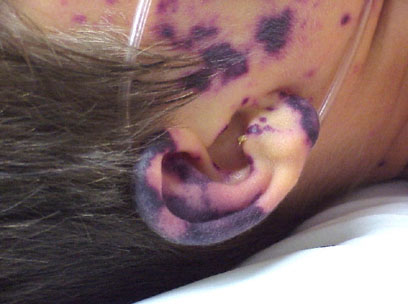
A previously healthy 20-year-old man is brought to the emergency department because of a 12-hour history of increasing fever and confusion. He has never seen a physician. He takes no medications. His temperature is 40°C (104°F), pulse is 110/min, respirations are 18/min, and blood pressure is 100/70 mm Hg. On arrival, he is delirious. Examination shows a diffuse rash over the body. A photograph of the rash is shown. There is moderate nuchal rigidity. The remainder of the examination shows no abnormalities. Immunization against which of the following is most likely to have prevented this patient’s condition?
 CorrectIncorrect
 -
Question 9 of 20
9. Question
A 62-year-old woman comes to the physician because of a 2-day history of moderate left-sided lower abdominal pain. She also has had nausea and loss of appetite during this time. She has not had vomiting. She has hypertension well controlled with hydrochlorothiazide. Her temperature is 38.4°C (101.1°F), pulse is 98/min, respirations are 14/min, and blood pressure is 120/78 mm Hg. Abdominal examination shows tenderness to palpation of the left lower quadrant; there is no guarding or rebound. Bowel sounds are decreased. Rectal examination shows no abnormalities. Test of the stool for occult blood is negative. Laboratory studies show:
Hemoglobin
13.2 g/dL
Hematocrit
36%
Leukocyte count
14,000/mm3
Platelet count
350,000/mm3
Results of other laboratory studies are within the reference ranges. Chest and abdominal x-rays show no abnormalities. Which of the following is the most appropriate next step in management?
CorrectIncorrect -
Question 10 of 20
10. Question
A 47-year-old man comes to the physician for a follow-up examination. He has hypertension treated with ramipril and gout treated with allopurinol. He has not had a gout flare during the past 6 months. His only other medication is aspirin. He is 180 cm (5 ft 11 in) tall and weighs 109 kg (240 lb); BMI is 34 kg/m2. His blood pressure is 152/95 mm Hg. Examination shows truncal obesity. Six months ago, his serum creatinine concentration was 1.4 mg/dL. Serum studies today show:
Na+
134 mEq/L
K+
4.8 mEq/L
Cl–
104 mEq/L
HCO3–
24 mEq/L
Urea nitrogen
43 mg/dL
Glucose
107 mg/dL
Creatinine
1.5 mg/dL
Uric acid
6.4 mg/dL
Which of the following is the most appropriate additional pharmacotherapy?
CorrectIncorrect -
Question 11 of 20
11. Question
A 25-year-old woman, gravida 2, para 1, at 20 weeks’ gestation comes to the physician for a routine prenatal visit. She has hypertension well controlled with labetalol. Her first pregnancy was uncomplicated and ended in spontaneous vaginal delivery of a newborn at term. Her only other medication is a prenatal vitamin. Her blood pressure is 120/80 mm Hg. Examination shows no peripheral edema. Urinalysis shows no glucose or protein. This patient is at greatest risk for which of the following pregnancy complications?
CorrectIncorrect -
Question 12 of 20
12. Question
A 10-year-old boy with attention-deficit/hyperactivity disorder is brought to the physician by his parents for a follow-up examination. He has a 5-year history of hyperactivity, impulsivity, and distractibility at home and school. Cognitive behavioral therapy for the patient and his parents has yielded mild improvement in the patient’s symptoms. The patient has no other history of serious illness and takes no medications. A maternal cousin has epilepsy, and a maternal uncle died at the age of 25 years while playing basketball. The patient’s vital signs are within normal limits. Physical examination shows no abnormalities. The patient fidgets throughout the examination. Mental status examination shows easy distractibility. The parents say they are considering pharmacotherapy for the patient but are concerned about the potential adverse effects of psychostimulants. In addition to discussing the risks and benefits of pharmacotherapy for this patient’s condition, which of the following is the most appropriate next step before initiating psychostimulant therapy?
CorrectIncorrect -
Question 13 of 20
13. Question
A 21-year-old woman is brought to the emergency department because of a 3-day history of vomiting and malaise and a 6-day history of abdominal cramping. One week ago, she had a medically induced abortion at 44 days’ gestation, with use of oral mifepristone and vaginal misoprostol. She has no history of serious illness and takes no medications. She follows a vegetarian diet. She appears ill. Temperature is 39.0°C (102.0°F), pulse is 151/min, respirations are 32/min, and blood pressure is 89/56 mm Hg. Physical examination discloses coarse breath sounds, a soft, nondistended abdomen, and 1+ pitting edema. Results of laboratory studies are shown:
Hemoglobin
16 g/dL
Hematocrit
49%
Leukocyte count
39,500/mm3
Platelet count
498,810/mm3
Serum
Na+
135 mEq/L
K+
4.9 mEq/L
Cl−
104 mEq/L
HCO3−
17 mEq/L
Urea nitrogen
25 mg/dL
Glucose [2-h postprandial]
99 mg/dL
Creatinine
1.8 mg/dL
Blood cultures grow gram-positive rods. Which of the following infectious agents is the most likely cause of these findings?
CorrectIncorrect -
Question 14 of 20
14. Question
A 65-year-old woman is admitted to the hospital because of a 1-day history of fever, and edema and erythema of the right arm. She says that overnight her right arm began throbbing and the redness worsened. She also had chills and increasingly severe arm pain throughout the night. Her temperature reached 38.9°C (102°F) at home. One year ago, she had stage II breast cancer treated with right partial mastectomy, lymphadenectomy, and radiation therapy. She was treated with a compression sleeve for lymphedema of the right upper extremity postoperatively. She has osteoarthritis of the shoulders and hands, which limits the use of her upper extremities. She says her symptoms have always been present since the operation, but the swelling has worsened since yesterday. Her temperature is 38.3°C (101°F), pulse is 88/min, respirations are 14/min, and blood pressure is 150/80 mm Hg. Examination shows a bright red, well-demarcated area from 3 cm below the elbow to 3 cm above the ulnar prominence; it is exquisitely tender to light touch. The patient has moderate tenderness to palpation of the right upper extremity. There are no open areas over the skin or fingers. Laboratory studies show:
Hemoglobin
11.4 g/dL
Hematocrit
35%
Mean corpuscular volume
82 μm3
Leukocyte count
19,200/mm3
Platelet count
260,000/mm3
Which of the following is the most likely infectious agent?
CorrectIncorrect -
Question 15 of 20
15. Question
A 22-year-old woman comes to the clinic because her sexual partner told her that he was treated for Chlamydia trachomatis infection 1 week ago. They have not had sexual intercourse since he was treated. She has been sexually active and monogamous with this partner for 2 months and uses a vaginal contraceptive ring correctly and condoms inconsistently. The patient was treated for C. trachomatis infection 4 months ago, but she did not return for follow-up testing for reinfection. She has no other history of serious illness and currently takes no medications. Physical examination, including pelvic examination, shows no abnormalities. Testing for C. trachomatis is done. Which of the following is the most appropriate next step in management?
CorrectIncorrect -
Question 16 of 20
16. Question
A 57-year-old man comes to the office because of a 3-week history of generalized itchiness and yellow eyes. He has not had abdominal pain, fever, or night sweats. He has no history of serious illness and takes no medications. He smoked two packs of cigarettes daily for 20 years but quit 17 years ago. Vital signs are within normal limits. Examination shows conjunctival icterus. The abdomen is soft and nontender; there are no masses. A CT scan of the abdomen and pelvis shows a 3-cm mass at the head of the pancreas and dilated common bile and intrahepatic bile ducts. Endoscopic retrograde cholangiopancreatography (ERCP) shows no mucosal abnormality. A stent is placed in the common bile duct. Results of bile culture and cytology are negative. Results of a fine-needle biopsy of the mass show no abnormalities. Which of the following is the most appropriate next step in management?
CorrectIncorrect -
Question 17 of 20
17. Question
An 18-year-old man is brought to the emergency department by paramedics 20 minutes after he sustained a gunshot wound to his head. En route to the hospital, he was intubated, mechanically ventilated, and administered 2 L of intravenous 0.9% saline. On arrival, he is unresponsive. His Glasgow Coma Scale score is 3. Examination shows fixed and dilated pupils. Findings of brain death are confirmed by a neurosurgeon and trauma surgeon. The most appropriate person to approach this patient’s family about organ donation is which of the following?
CorrectIncorrect -
Question 18 of 20
18. Question
A 42-year-old woman who underwent an endoscopic sinus operation 30 minutes ago has the sudden onset of tachycardia and hypotension. The procedure was completed under general anesthesia without complications, and estimated blood loss was 25 mL. She has a 10-year history of asthma treated with oral prednisone. She is awake and responsive. Her temperature is 38.1°C (100.5°F), pulse is 120/min and regular, respirations are 18/min, and blood pressure is 75/50 mm Hg. Pulse oximetry on 2 L/min of oxygen by nasal cannula shows an oxygen saturation of 90%. Examination shows no abnormalities. An ECG shows sinus tachycardia with no acute ST-segment changes. In addition to administration of intravenous fluids, which of the following is the most appropriate next step in management?
CorrectIncorrect -
Question 19 of 20
19. Question
A 32-year-old woman comes to the office because of a painless mass in the right side of her neck that she first noticed 2 months ago. The mass has not increased in size since she first saw it, and she reports no other masses. Medical history is unremarkable, and she takes no medications. She is 170 cm (5 ft 7 in) tall and weighs 57 kg (125 lb); BMI is 20 kg/m2. Vital signs are within normal limits. Examination shows a 2-cm mass in the right upper lobe of the thyroid gland. There is no lymphadenopathy. Which of the following is the most appropriate next step in evaluation?
CorrectIncorrect -
Question 20 of 20
20. Question
A 10-year-old boy is brought to the office by his mother for a well-child examination. He has no history of serious illness and receives no medications. He is in no distress. He is at the 75th percentile for height, 50th percentile for weight, and 20th percentile for BMI. Vital signs are within normal limits. On cardiac examination, a mid-systolic ejection murmur is heard best at the left sternal border; there is an S4. No other abnormalities are noted. Echocardiography is most likely to show which of the following?
CorrectIncorrect