
NBME 14 – Block 4 (Duplicate 1)
Time limit: 0
Quiz Summary
0 of 20 Questions completed
Questions:
Information
You have already completed the quiz before. Hence you can not start it again.
Quiz is loading…
You must sign in or sign up to start the quiz.
You must first complete the following:
Results
Quiz complete. Results are being recorded.
Results
0 of 20 Questions answered correctly
Your time:
Time has elapsed
You have reached 0 of 0 point(s), (0)
Earned Point(s): 0 of 0, (0)
0 Essay(s) Pending (Possible Point(s): 0)
Categories
- Not categorized 0%
- 1
- 2
- 3
- 4
- 5
- 6
- 7
- 8
- 9
- 10
- 11
- 12
- 13
- 14
- 15
- 16
- 17
- 18
- 19
- 20
- Current
- Review
- Answered
- Correct
- Incorrect
-
Question 1 of 20
1. Question
A 27-year-old man with asthma comes to the emergency department because of progressive shortness of breath and wheezing for 24 hours. His symptoms began 1 week ago with increasing wheezing. Treatment with inhaled β-adrenergic agonists and corticosteroids has been ineffective. He appears mildly dehydrated and in moderate to severe respiratory distress with labored breathing and use of accessory muscles. His pulse is 90/min, respirations are 30/min, and blood pressure is 130/80 mm Hg. Arterial blood gas analysis on room air shows:
pH
7.25
Pco2
51 mm Hg
Po2
65 mm Hg
HCO3−
20 mEq/L
Which of the following is the most likely cause of these findings?
CorrectIncorrect -
Question 2 of 20
2. Question
A 16-year-old girl comes to the office because of a 1-month history of green, sticky discharge from the right nipple. She initially noticed the discharge on her bra and was also able to express it manually. She has not had breast pain or skin changes. During the past 3 months, she has had a 4.5-kg (10-lb) weight gain despite no change in appetite. She also has had frequent frontal headaches since beginning oral contraceptive therapy 3 months ago. Six months ago, she was diagnosed with major depressive disorder and was started on fluoxetine therapy. Menses occur at regular 28-day intervals. Her last menstrual period was 2 weeks ago. She is sexually active with one partner and uses condoms inconsistently. On examination, scant greenish discharge can be expressed from the right breast. The remainder of the examination shows no abnormalities. Which of the following is the most likely diagnosis?
CorrectIncorrect -
Question 3 of 20
3. Question
A 14-year-old girl is brought to the physician by her mother because she has never had a menstrual period. The patient has no history of serious illness and takes no medications. Thelarche began 18 months ago. Her mother’s menarche was at the age of 13 years. The patient plays soccer and runs 3 miles weekly. She is at the 50th percentile for height, 10th percentile for weight, and 25th percentile for BMI. Breast and pubic hair development are sexual maturity rating stage 4. Which of the following is the most appropriate next step in management?
CorrectIncorrect -
Question 4 of 20
4. Question
A hospitalized 57-year-old man is confused, agitated, and combative 2 days after undergoing laparoscopic resection for hepatocellular carcinoma. His medications are omeprazole, propranolol, and hydrocodone. He has drunk one gallon of Scotch whiskey weekly for 3 years. He has used heroin once daily for 3 years. His temperature is 38.5°C (101.3°F), pulse is 112/min, respirations are 24/min, and blood pressure is 170/100 mm Hg. Physical examination shows a tremor of the hands. On mental status examination, he is not oriented to person, place, or time and reports seeing cockroaches on the hospital bed. Laboratory studies show:
Platelet count
46,000/mm3
Prothrombin time
15.8 sec (INR=1.4)
Serum
Albumin
2.2 g/dL
Total bilirubin
3.1 mg/dL
AST
66 U/L
ALT
98 U/L
Ammonia
11 μg/dL
Urine toxicology screening is negative. Administration of which of the following is the most appropriate initial step in management?
CorrectIncorrect -
Question 5 of 20
5. Question
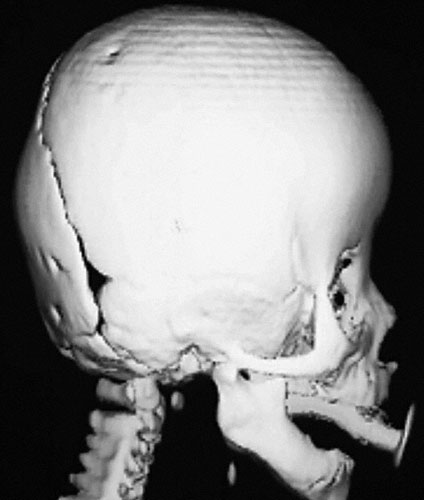
A 4-month-old female infant is brought to the office by her mother for a well-child examination. She was born at term following an uncomplicated pregnancy and vaginal delivery. She is breast-feeding well and gaining weight. She has been smiling and cooing and has begun rolling onto her side. The mother says she noticed an asymmetric appearance to her daughter’s face and head 4 weeks ago that has slightly worsened since that time. The patient otherwise has been well. Family history is noncontributory. The infant is 63 cm (25 in; 50th percentile) long and weighs 6200 g (13 lb 11oz; 50th percentile); head circumference is 40 cm (16 in; 25th percentile). Vital signs are within normal limits. Physical examination shows an open and flat anterior fontanel and a palpable ridge between the right parietal and temporal bones. The right eye and eyebrow appear superiorly displaced compared with the left. The remainder of the physical examination discloses no abnormalities. CT scan of the head is shown. Which of the following is the most likely diagnosis?
CorrectIncorrect -
Question 6 of 20
6. Question
A 57-year-old woman comes to the physician because she has felt sad and tearful and has thought about killing herself for the past 2 weeks. Her symptoms began 1 week after losing $25,000 during a weekend of gambling. She reports that she had boundless energy all week and gambled continuously throughout the weekend without needing to sleep. She says, “I felt great even when I was losing and did not realize what I had done until a week later.” Twice yearly for the past 10 years, she has had similar gambling episodes but has never lost this much money before. Physical examination shows no abnormalities. On mental status examination, she is distraught and tearful. She says that she has not developed a plan to take her own life but admits to wishing for a “convenient car accident.” Which of the following is the most likely diagnosis?
CorrectIncorrect -
Question 7 of 20
7. Question
A previously healthy 57-year-old woman comes to the emergency department because of a 2-week history of fever, nonproductive cough, and increasing shortness of breath. She is no longer able to walk up one flight of stairs without resting. She takes no medications. She does not smoke cigarettes, drink alcohol, or use illicit drugs. She has been sexually active with multiple partners, and they use condoms inconsistently. She appears cachectic and in moderate respiratory distress. Her temperature is 39.1°C (102.4°F), pulse is 120/min, respirations are 32/min, and blood pressure is 104/68 mm Hg. Examination shows submental and cervical lymphadenopathy. There is diffuse white exudate over the buccal mucosa. Pulmonary examination shows good air movement; no crackles or rhonchi are heard. The remainder of the examination shows no abnormalities. Her hemoglobin concentration is 7.8 g/dL, and leukocyte count is 3800/mm3. Arterial blood gas analysis on room air shows:
pH
7.48
Pco2
30 mm Hg
Po2
68 mm Hg
An x-ray of the chest shows no abnormalities. Which of the following is the most likely causal organism?
CorrectIncorrect -
Question 8 of 20
8. Question
A 24-year-old nulligravid woman comes to the physician because of a 3-day history of pain with urination and urinary frequency. She has a 1-year history of frequent bladder infections characterized by similar symptoms. The infections occur after sexual intercourse and resolve with antibiotic therapy. She has no other history of serious illness and takes no medications. She is currently sexually active with one male partner, and they use condoms consistently. Examination shows bladder tenderness and urethral elevation; no other abnormalities are noted. Urine culture grows Escherichia coli. Which of the following is most likely to prevent recurrence of these symptoms?
CorrectIncorrect -
Question 9 of 20
9. Question
An asymptomatic 32-year-old man comes to the physician 2 days after his male sexual partner was diagnosed with gonorrhea. He has not had penile discharge or dysuria. Over the past 4 months, he and his partner have had unprotected sexual intercourse several times weekly. Four months ago, HIV testing of the patient and his partner was negative. Examination shows no abnormalities. A Gram stain of mucus from a urethral swab is negative for diplococci. A urethral culture is ordered. He gives written consent for HIV antibody testing and serologic testing for syphilis. Which of the following is the most appropriate next step in therapy?
CorrectIncorrect -
Question 10 of 20
10. Question
An unconscious 32-year-old woman is found by a nurse outside the emergency department. There is a gunshot wound to her right temple. She does not have an advance directive or an organ donor card among her possessions. On arrival, she is unresponsive and has a Glasgow Coma Scale score of 3. Her pulse is 48/min, respirations are 8/min, and blood pressure is 180/100 mm Hg. Pupils are dilated and nonreactive to light. She is intubated, and mechanical ventilation is started. After fluid resuscitation, her hemodynamic status is stabilized. A CT scan of the head shows a large intracranial hematoma with a massive midline shift. After consulting with a neurosurgeon, the most appropriate next step is to contact which of the following?
CorrectIncorrect -
Question 11 of 20
11. Question
A 45-year-old woman comes to the office because of a wound on her right foot that she first noticed 8 weeks ago. During the past 3 days, it has increased in size and depth and has become moderately painful. She does not recall any injury to her foot. She has type 2 diabetes mellitus and hypertension. Her medications are insulin, atorvastatin, lisinopril, and daily aspirin. She is 163 cm (5 ft 4 in) tall and weighs 95 kg (210 lb); BMI is 36 kg/m2. Temperature is 38.9°C (102.0°F), pulse is 80/min, respirations are 16/min, and blood pressure is 140/95 mm Hg. Examination shows a 3 × 3-cm full-thickness wound over the second and third metatarsal heads of the plantar aspect of the right foot; there is necrotic tissue and eschar but no exposed tendon or bone. The plantar aspect of the right forefoot is tender to palpation. Dorsalis pedis and posterior tibial pulses in the right lower extremity are 1+. Semmes-Weinstein 5.07 monofilament testing shows absent sensation over the right foot. Which of the following is the most appropriate next step in diagnosis?
CorrectIncorrect -
Question 12 of 20
12. Question
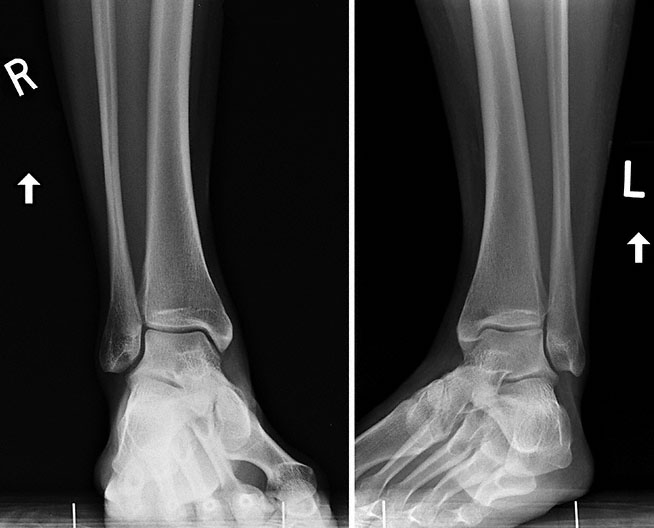
A 27-year-old woman comes to the physician because of a 6-month history of increasing pain and progressive swelling and stiffness of her ankles. Despite nightly application of ice to her ankles, ibuprofen therapy, and decreased activity during the past 3 months, her pain has worsened, she has had swelling of her ankles throughout the day, and she has had morning stiffness of her ankles. She has sustained no recent trauma to her ankles. She had a severe right ankle sprain in college. Her only other medication is an oral contraceptive. She is an avid tennis player and plays twice weekly. Vital signs are within normal limits. Examination shows swelling and moderate effusion of both ankles. Range of motion of both ankles is full but produces mild pain. X-rays of the ankles are shown. Which of the following is the most likely cause of this patient’s symptoms?
CorrectIncorrect -
Question 13 of 20
13. Question
A previously healthy 24-year-old woman comes to the physician because of a 2-week history of fatigue and easy bruising. Her temperature is 37°C (98.6°F), pulse is 100/min, respirations are 20/min, and blood pressure is 100/60 mm Hg. Examination shows ecchymoses over the lower extremities. Laboratory studies show:
Hemoglobin
9.2 g/dL
Leukocyte count
53,000/mm3
Lymphocytes
10%
Myeloblasts
90%
Platelet count
63,000/mm3
Serum
Creatinine
1.9 mg/dL
Lactate dehydrogenase
2233 U/L
A bone marrow biopsy specimen confirms acute myelogenous leukemia. Which of the following is the most appropriate next step?
CorrectIncorrect -
Question 14 of 20
14. Question
A 20-year-old man comes to the physician because of a 3-year history of bruising without any trauma. He has not had bleeding from his nose or mouth. He has no history of serious illness and takes no medications. Vital signs are within normal limits. Examination shows ecchymoses in various stages of healing over the upper extremities. Results of a complete blood count are within the reference range. His prothrombin time is 20 seconds (INR=2), and partial thromboplastin time is 25 seconds. This patient most likely has a deficiency of which of the following?
CorrectIncorrect -
Question 15 of 20
15. Question
A 42-year-old woman comes to the physician because of a 3-year history of ringing in her ears. The sound gradually intensified during the first year and has been unchanged since that time. The ringing is more noticeable when she is in a quiet environment but otherwise does not fluctuate throughout the day. She reports that her hearing is otherwise normal. She has hypertension treated with lisinopril. She has smoked one pack of cigarettes daily for 25 years and drinks one glass of wine daily. Her blood pressure is 130/80 mm Hg; other vital signs are within normal limits. Examination of the external auditory canals shows no abnormalities. Finger-rub testing shows no abnormalities. Audiometry shows mild high-frequency hearing loss bilaterally. Which of the following is the most appropriate next step in diagnosis?
CorrectIncorrect -
Question 16 of 20
16. Question
A 1-year-old boy is brought to the office because his parents are concerned that his birthmarks have been increasing in size and number during the past 6 months. Growth and development are appropriate for age. Immunizations are up-to-date. He has no history of serious illness and receives no medications. Examination shows ten 6- to 10-mm tan-brown maculae over the patient’s trunk, axillae, and all extremities. Which of the following is the most appropriate next step in diagnosis?
CorrectIncorrect -
Question 17 of 20
17. Question
An 18-year-old basketball player is brought to the emergency department 1 hour after collapsing during a game. He was successfully resuscitated at the scene. On arrival, he is awake and alert. His temperature is 37.1°C (98.8°F), pulse is 80/min and regular, respirations are 12/min, and blood pressure is 120/80 mm Hg. Examination shows no abnormalities. An ECG shows left ventricular hypertrophy. Echocardiography shows systolic anterior motion of the anterior leaflet of the mitral valve causing a subaortic obstruction. Which of the following is the most appropriate next step in management?
CorrectIncorrect -
Question 18 of 20
18. Question
Three hours after undergoing placement of an intravenous line using routine universal precautions and beginning intravenous fluid therapy, a hospitalized 2-year-old girl has the onset of a generalized itching rash. She was admitted to the hospital today because of a 3-day history of fever and diarrhea. As a newborn, she underwent surgical repair of a myelomeningocele and creation of a ventriculoperitoneal shunt. She is not currently receiving any medications. Vital signs 3 hours ago and now are:
3 Hours Ago
Now
Temperature
38°C (100.4°F)
37.8°C (100°F)
Pulse (/min)
110
160
Respirations (/min)
24
40
Blood pressure (mm Hg)
105/65
80/50
Examination shows diffuse, raised, erythematous lesions with pale centers. The upper and lower extremities appear mottled. Capillary refill time is 5 to 6 seconds. The remainder of the examination, including funduscopic and neurologic examinations, shows no abnormalities. Which of the following is most likely to have prevented this patient’s current condition?
CorrectIncorrect -
Question 19 of 20
19. Question

A previously healthy 29-year-old man comes to the physician because of a 6-week history of intermittent, increasingly severe upper abdominal pain. He has not had fever, chills, weight loss, or intolerance to fatty food. Over-the-counter famotidine has provided minimal relief. He has smoked one pack of cigarettes daily for 10 years. His temperature is 37°C (98.6°F), pulse is 68/min, respirations are 18/min, and blood pressure is 120/82 mm Hg. Abdominal examination shows epigastric tenderness to palpation. The remainder of the examination shows no abnormalities. Test of the stool for occult blood is positive. Esophagogastroduodenoscopy shows a 1.5-cm ulcer along the lesser curvature of the stomach; there is no active bleeding. Biopsy results are shown. Smoking cessation is recommended. In addition to lansoprazole therapy, which of the following is the most appropriate pharmacotherapy?
CorrectIncorrect -
Question 20 of 20
20. Question
A 2-week-old boy is brought to the physician because of a 5-day history of a progressive rash that began at a site on his scalp where an electrode was attached during labor. Despite application of topical antibiotic ointment, the rash has spread to his trunk and extremities. He was born at term following an uncomplicated vaginal delivery. Apgar scores were 8 and 9 at 1 and 5 minutes, respectively. Initial examination showed no abnormalities. He is currently at the 30th percentile for length, 75th percentile for weight, and 25th percentile for head circumference. Vital signs are within normal limits. Examination shows erythematous patches with overlying vesicles containing clear or cloudy fluid over the entire body. Appropriate treatment of this patient is most likely to prevent which of the following acute manifestations of his condition?
CorrectIncorrect