
NBME 14 – Block 2 (Duplicate Quiz)
Time limit: 0
Quiz Summary
0 of 20 Questions completed
Questions:
Information
You have already completed the quiz before. Hence you can not start it again.
Quiz is loading…
You must sign in or sign up to start the quiz.
You must first complete the following:
Results
Quiz complete. Results are being recorded.
Results
0 of 20 Questions answered correctly
Your time:
Time has elapsed
You have reached 0 of 0 point(s), (0)
Earned Point(s): 0 of 0, (0)
0 Essay(s) Pending (Possible Point(s): 0)
Categories
- Not categorized 0%
- 1
- 2
- 3
- 4
- 5
- 6
- 7
- 8
- 9
- 10
- 11
- 12
- 13
- 14
- 15
- 16
- 17
- 18
- 19
- 20
- Current
- Review
- Answered
- Correct
- Incorrect
-
Question 1 of 20
1. Question
A 24-year-old woman, gravida 1, para 1, comes to the physician because she has not had a menstrual period for 12 months and has been unable to conceive during this time. Her son was born by spontaneous vaginal delivery 18 months ago, and she breast-fed him for 6 months. One month after delivery, she had profuse vaginal bleeding and underwent emergency dilatation and curettage for retained placental fragments. She has not used any contraception since her delivery and currently takes no medications. She and her husband have sexual intercourse twice weekly. Analysis of the husband’s semen has shown no abnormalities. The patient’s vital signs are within normal limits. Physical examination shows no abnormalities. Pelvic examination shows a normal cervix, uterus, and adnexa. Laboratory studies show:
Hematocrit
42%
Leukocyte count
8800/mm3
Serum
Thyroid-stimulating hormone
1.1 μU/mL
Follicle-stimulating hormone
10 mIU/mL
Luteinizing hormone
12 mIU/mL
Pelvic ultrasonography shows normal ovaries, no free fluid in the pelvis, and no distinct endometrial stripe. Treatment with oral progesterone for 10 days produces no uterine bleeding. Which of the following is the most appropriate next step in management?
CorrectIncorrect -
Question 2 of 20
2. Question
A previously healthy 7-year-old boy is brought to the office because of a 1-week history of diffuse, mild abdominal pain and bloody diarrhea. He has a constant urge to pass stools despite passing 10 small, bloody stools daily. During this time, he has had decreased oral intake. He last urinated 12 hours ago. He has not had fever or vomiting. No other family members are ill. The patient appears tired. His temperature is 37.7°C (99.8°F), pulse is 120/min, respirations are 26/min, and blood pressure is 120/85 mm Hg. Examination shows pallor and tacky mucous membranes. The lungs are clear to auscultation. A grade 2/6 systolic murmur is heard. The abdomen is soft and diffusely tender to palpation; there is no guarding or rebound. Examination of the perianal area shows no abnormalities. Laboratory studies show:
Hemoglobin
7 g/dL (N=11.5−14.5)
Hematocrit
21% (N=33%−43%)
Leukocyte count
12,000/mm3
Platelet count
14,000/mm3
Serum
Na+
147 mEq/L
K+
4.2 mEq/L
Cl−
118 mEq/L
HCO3−
14 mEq/L
Urea nitrogen
72 mg/dL
Creatinine
8.2 mg/dL (N=0.22–0.59)
Which of the following is the most likely infectious agent?
CorrectIncorrect -
Question 3 of 20
3. Question
A previously healthy 5-year-old boy is brought to the physician because of progressive muscle weakness over the past 6 months. Examination shows a fish-like mouth with a high-arched palate, wasting of distal muscles, and hypotonia. Deep tendon reflexes are intact and symmetric. Which of the following is the most likely diagnosis?
CorrectIncorrect -
Question 4 of 20
4. Question
A 77-year-old man comes to the physician for an initial visit. He has a history of gout and surgical repair of a hernia. He has been told that he has a mild cardiac murmur, and he thinks that he had rheumatic fever as a child. He takes no medications. His pulse is 80/min, respirations are 14/min, and blood pressure is 150/92 mm Hg. A grade 4/6 systolic murmur is heard best at the second right intercostal space; it decreases in intensity with Valsalva maneuver and with handgrip and increases in intensity when he squats. There is an S4, and a systolic thrill is palpable at the base. Which of the following is the most likely cause of these findings?
CorrectIncorrect -
Question 5 of 20
5. Question
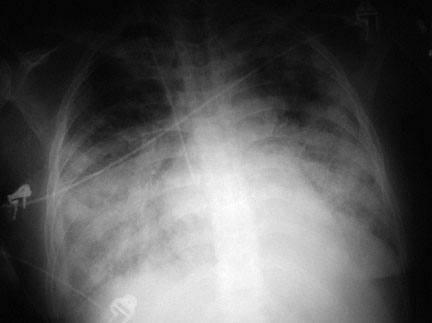
A 42-year-old woman is brought to the emergency department by paramedics 30 minutes after she was struck by a car while she was riding her bicycle. She has no history of serious illness and takes no medications. She is alert and fully oriented. She has moderate left upper abdominal and flank pain. Temperature is 37.1°C (98.8°F), pulse is 118/min, respirations are 24/min, and blood pressure is 88/60 mm Hg. Pulse oximetry on room air shows an oxygen saturation of 94%. There is a 5 × 7-in, tender ecchymosis over the left upper abdominal quadrant and left flank. Bowel sounds are normal. The remainder of the physical examination shows no abnormalities. Neurologic examination shows no focal findings. After administration of 2 L of lactated Ringer solution, pulse is 105/min, and blood pressure is 95/70 mm Hg. Transfusion of 2 units of packed red blood cells is begun. Thirty minutes later, pulse is 80/min, and blood pressure is 124/80 mm Hg. Pulse oximetry on an Fio2 of 1.0 via nonrebreather face mask shows an oxygen saturation of 100%. CT scan of the abdomen shows a grade 3 splenic laceration. The patient is admitted to the surgical intensive care unit for nonoperative management. Three hours later, she has progressive difficulty breathing. Temperature is 37.2°C (99.0°F), pulse is 90/min, respirations are 30/min, and blood pressure is 110/70 mm Hg. Pulse oximetry now shows an oxygen saturation of 87%. On pulmonary examination, breath sounds and diffuse crackles are heard bilaterally. Heart sounds are normal. Abdominal examination is unchanged. Chest x-ray is shown. Which of the following is the most likely cause of this patient’s current condition?
CorrectIncorrect -
Question 6 of 20
6. Question
A 54-year-old woman comes to the office because of a 2-day history of increasingly severe pain in her right ear; she rates the pain as a 9 on a 10-point scale. She also has a mild ringing sensation in her right ear. She adds that this morning, her usual cereal tasted awful to her, and she vomited once. She has no symptoms in her left ear and has not had fever, headache, neck stiffness, or symptoms of an upper respiratory tract infection. Her most recent vaccination was 3 years ago for influenza. She has no history of serious illness, takes no medications, and has no known allergies. She is 165 cm (5 ft 5 in) tall and weighs 72 kg (158 lb); BMI is 26 kg/m2. Temperature is 37.3°C (99.1°F), pulse is 84/min, respirations are 16/min, and blood pressure is 125/85 mm Hg. Examination of the left pinna and tympanic membrane discloses no abnormalities. Examination of the right ear shows erythema and edema of exterior auditory canal and pinna; light touch of the right pinna produces pain. The right tympanic membrane cannot be observed because of pain and edema. Cranial nerve testing discloses a widened right palpebral fissure. The patient has decreased ability to close her right eye, wrinkle her forehead, and smile. Visual acuity and visual field testing disclose no abnormalities. Sensation to light touch and pinprick is intact over the face. The remainder of the examination discloses no abnormalities. Which of the following conditions is most likely to develop in this patient during the next 24 hours?
CorrectIncorrect -
Question 7 of 20
7. Question
A 12-year-old girl is brought to the emergency department by paramedics 10 minutes after she was stabbed in the chest with a steak knife by another girl after school. The patient’s medical history is unknown. She is gasping for breath but able to say her name. Her temperature is 37.0°C (98.6°F), pulse is 140/min, respirations are 36/min, and blood pressure is 80 mm Hg. Pulse oximetry on an Fio2 of 1.0 by nonrebreather face mask shows an oxygen saturation of 86%. Examination discloses a 2-cm stab wound to the left of the lower sternum. Jugular venous pressure is 12 cm H2O (N=5–9). Breath sounds are equal bilaterally. Heart sounds are decreased. The abdomen is soft, nondistended, and nontender. Pulses are decreased in all extremities. Pericardiocentesis yields 30 mL of non-clotting blood. In addition to intravenous fluid resuscitation and typing and crossmatching of the patient’s blood, which of the following is the most appropriate next step in management?
CorrectIncorrect -
Question 8 of 20
8. Question
A 68-year-old woman comes to the office for a routine examination. She says she has felt well. Medical history is remarkable for hypertension and type 2 diabetes mellitus. Medications are hydrochlorothiazide, atorvastatin, and insulin. Pulse is 70/min, respirations are 14/min, and blood pressure is 130/60 mm Hg. Physical examination discloses a 2-cm mass in the right groin below the inguinal ligament; the mass is mildly tender to palpation and does not reduce with attempts at manual reduction. The mass is not fluctuant. The patient says she has noticed this abnormality during the past several weeks but has not been bothered by it. The remainder of the physical examination discloses no abnormalities. Fasting serum glucose concentration obtained in preparation for today’s visit is within the reference range. Which of the following is the most appropriate recommendation at this time?
CorrectIncorrect -
Question 9 of 20
9. Question
An 18-year-old woman comes to the physician to request a prescription for an oral contraceptive. She has been sexually active since the age of 17 years and has never used contraception. Menarche was at the age of 12 years. Menses occur at regular 29-day intervals. Her last menstrual period was 2 weeks ago. She has received all appropriate childhood immunizations but none since the age of 6 years. She has smoked one pack of cigarettes daily for 1 year. Physical examination, including pelvic examination, shows no abnormalities. In addition to recommending condom use by her partners, which of the following is the most appropriate next step in management?
CorrectIncorrect -
Question 10 of 20
10. Question
A 77-year-old man with chronic obstructive pulmonary disease (COPD) comes to the physician for a follow-up examination. He had bronchitis 3 years ago treated with amoxicillin and prednisone. He has not been hospitalized during the past 3 years. He has a history of shortness of breath and cough but says these symptoms have subsided since he quit smoking cigarettes 5 years ago. His only medication is inhaled ipratropium. Pulmonary function testing shows an FVC of 85% of predicted and FEV1 of 75% of predicted. The patient says he heard about a new inhaled medication, called BreatheEZ, for management of COPD and asks if he would benefit from this medication. The physician recalls a recent randomized controlled trial evaluating the efficacy of BreatheEZ in 7500 patients with COPD. Patients were randomized to receive BreatheEZ or placebo and observed for 4 years. Data show:
BreatheEZ
Placebo
Age, years ± SD
65 ± 7.2
65 ± 7.4
FVC, % of predicted
64
66
FEV1, % of predicted
31
30
Current smoker, % of patients
54
50
Former smoker, % of patients
46
50
Number of COPD exacerbations during 12 months prior to study
3
3
Medications at baseline (% of patients)
Inhaled corticosteroid
75
77
Long-acting β-adrenergic agonist
69
67
Inhaled anticholinergic
50
54
Bronchodilator
24
22
Oral corticosteroid
8
9
≥3 Medications
40
43
Analysis shows a mortality rate of 12.2% for the patients receiving BreatheEZ and 15.4% for patients receiving placebo (hazard ratio of 0.79, 95% confidence interval of 0.63–0.98). Based on these data, which of the following is the most appropriate action regarding BreatheEZ for this patient?
CorrectIncorrect -
Question 11 of 20
11. Question
A 44-year-old woman comes to the physician because of a 4-month history of dryness of her mouth. During this time, she often has consumed liquids to aid in swallowing food. She has not had a sore throat or fever. She has not sustained head or neck trauma. She has rheumatoid arthritis. Her medications are low-dose prednisone and ibuprofen. Vital signs are within normal limits. Skin turgor is normal. Examination shows erythematous, dry oral mucosa and atrophy of the filiform papillae on the dorsum of the tongue. Results of serum anti-Ro and anti-La antibody assays are positive. The patient is given water to drink. Which of the following is the most appropriate pharmacotherapy?
CorrectIncorrect -
Question 12 of 20
12. Question
A 27-year-old woman, gravida 2, para 1, at 12 weeks’ gestation comes to the physician for her first prenatal visit. Eighteen months ago, her first pregnancy ended in preterm low-transverse cesarean delivery at 32 weeks’ gestation because of fetal bradycardia following the onset of contractions. A Pap smear 16 months ago showed a low-grade squamous intraepithelial lesion; she has not had a Pap smear since then. Three years ago, she underwent loop electrosurgical excision of the cervical transformation zone for cervical intraepithelial neoplasia (CIN) 3. She has a 10-year history of cocaine use but has not used cocaine during the past 12 months. She used cocaine intermittently during her first pregnancy. She smoked one pack of cigarettes daily for 10 years but quit 6 months ago. She is 163 cm (5 ft 4 in) tall. She weighed 49 kg (108 lb) prior to her pregnancy; BMI was 18 kg/m2. She has had a 1.8-kg (4-lb) weight gain during her pregnancy. Examination shows a uterus consistent in size with a 12-week gestation. The fetal heart rate is reassuring. This patient is at greatest risk for which of the following complications during pregnancy?
CorrectIncorrect -
Question 13 of 20
13. Question
A 13-year-old girl is brought to the physician by her parents because of changes in behavior during the past 6 months. Her parents say that during this time she has been hostile and unpleasant, frequently crying and screaming about being treated unfairly no matter what they do. She also has alienated her friends. Her grades have declined from mostly B’s to C’s and D’s, and she has stopped participating in sports. The patient says she is tired and does not sleep; her parents report she is sleeping more than usual. They add that she has been eating more, resulting in a 10-kg (22-lb) weight gain, which bothers her. They say she was a “worrier” when she was younger, but her worrying has decreased during the years. The patient is at the 45th percentile for height and 60th percentile for weight. Vital signs are within normal limits. Physical examination shows no abnormalities. On mental status examination, she describes her mood as “okay” but appears dysphoric and has an irritable affect. She looks at her hands and responds slowly using monosyllabic words. She says, “I don’t think I’m depressed. I’m bored and angry because no one likes me. I used to want to be an actress, but nothing ever works out for me. I could do it if my parents would let me.” Her thought process is goal directed. She says that adults, especially her parents, do not understand her and make unreasonable demands. There is no evidence of psychosis. Which of the following is the most likely diagnosis?
CorrectIncorrect -
Question 14 of 20
14. Question
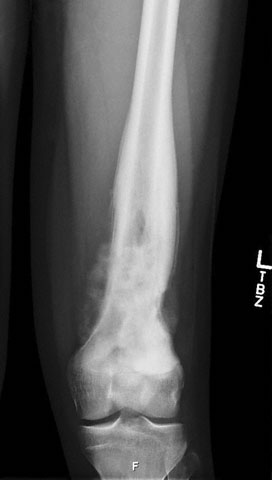
A 15-year-old boy is brought to the office because of a 2-month history of increasingly frequent left lower thigh pain. The pain began after the patient injured his leg during a soccer game. He has no history of serious illness and takes no medications. Examination shows moderate tenderness of the lateral distal aspect of the left femur. His serum alkaline phosphatase activity is 550 U/L (N=130–525), and serum lactate dehydrogenase activity is 360 U/L (N=120–330). An x-ray of the left thigh is shown. In addition to an MRI of the left femur, which of the following is the most appropriate next step in diagnosis?
CorrectIncorrect -
Question 15 of 20
15. Question
A previously healthy 18-month-old boy is brought to the emergency department because of a 6-day history of fever. His temperature is 38.5°C (101.3°F), pulse is 100/min, respirations are 24/min, and blood pressure is 95/60 mm Hg. Examination shows cracked, red lips and palmar erythema and edema. Cervical lymph nodes are enlarged. There is pharyngeal erythema and bilateral conjunctivitis without injection adjacent to the corneal limbus. Rapid streptococcal testing is negative. Laboratory studies show:
Hematocrit
45%
Leukocyte count
10,500/mm3
Segmented neutrophils
55%
Lymphocytes
40%
Monocytes
5%
Platelet count
300,000/mm3
Erythrocyte sedimentation rate
35 mm/h
In addition to intravenous immune globulin, which of the following is the most appropriate pharmacotherapy?
CorrectIncorrect -
Question 16 of 20
16. Question
A 35-year-old man, who works as an orthopaedic surgeon, comes to the office because of a 1-day history of severe low back pain after lifting heavy furniture. He has no history of serious illness and takes no medications. He requests a prescription for oxycodone because he is scheduled to give a lecture at a national meeting tomorrow and is worried he will be in “too much pain” to participate without medication. Vital signs are within normal limits. Examination shows no abnormalities. Which of the following is the most appropriate next step in management by the physici
CorrectIncorrect -
Question 17 of 20
17. Question
A 37-year-old woman comes to the physician in January for immunizations 6 weeks before beginning her new job as a nurse’s aide in a skilled nursing care facility. She has no history of serious illness and takes no medications. She has no known allergies. Four years ago, she completed the hepatitis B vaccine series and received a tetanus booster. She lives with her husband and two healthy school-aged children. Examination shows no abnormalities. Which of the following is most appropriate to administer at this visit?
CorrectIncorrect -
Question 18 of 20
18. Question
A 23-year-old man is brought to the emergency department after driving his automobile into a bridge abutment. Paramedics state that at the scene his blood pressure was 100/80 mm Hg, that he was alert, and that the steering wheel was broken. On examination in the emergency department now, he is stuporous, cyanotic, and hypotensive, and has distended neck veins. Breath sounds are absent bilaterally. The trachea is midline. Which of the following is the most appropriate initial management?
CorrectIncorrect -
Question 19 of 20
19. Question
A 57-year-old man, who is an accountant, comes to the physician because of progressive shortness of breath during the past 6 months. He says he has difficulty breathing after walking more than one city block and when walking up one flight of stairs. He reports that during these episodes, he feels that he needs to breathe rapidly. He also has had a dry cough. He has not had chest pain, diaphoresis, nocturnal symptoms, or worsening of the symptoms when lying down. He has a 5-year history of hypertension treated with enalapril and hydrochlorothiazide. He has never smoked cigarettes. His temperature is 37°C (98.6°F), pulse is 89/min, respirations are 18/min, and blood pressure is 145/82 mm Hg. Pulse oximetry on room air shows an oxygen saturation of 90%. Crackles are heard at both lung bases. A high-resolution CT scan of the chest shows a reticulogranular appearance at the bases bilaterally with minimal fibrosis. Pulmonary function tests show moderately severe decreased diffusion capacity. Examination of bronchoalveolar lavage fluid shows many segmented neutrophils that are negative for bacteria, fungi, and acid-fast bacilli. In addition to supplemental oxygen, administration of which of the following is the most appropriate next step?
CorrectIncorrect -
Question 20 of 20
20. Question
A 57-year-old man comes to the physician because of severe right shoulder pain since having a generalized tonic-clonic seizure 3 days ago. He first noted the pain in the emergency department, where he was brought after the seizure. He reports no other history of shoulder pain or injury. He has a 40-year history of a seizure disorder treated with phenytoin; his only other medication is acetaminophen for shoulder pain. On examination, passive and active range of motion of the right shoulder elicits pain. External rotation of the right shoulder is limited to 10 degrees. An AP x-ray of the shoulder obtained in the emergency department 3 days ago showed no abnormalities. Which of the following is the most appropriate next step in management?
CorrectIncorrect