
NBME 14 – Block 1
Time limit: 0
Quiz Summary
0 of 20 Questions completed
Questions:
Information
You have already completed the quiz before. Hence you can not start it again.
Quiz is loading…
You must sign in or sign up to start the quiz.
You must first complete the following:
Results
Quiz complete. Results are being recorded.
Results
0 of 20 Questions answered correctly
Your time:
Time has elapsed
You have reached 0 of 0 point(s), (0)
Earned Point(s): 0 of 0, (0)
0 Essay(s) Pending (Possible Point(s): 0)
Categories
- Not categorized 0%
- 1
- 2
- 3
- 4
- 5
- 6
- 7
- 8
- 9
- 10
- 11
- 12
- 13
- 14
- 15
- 16
- 17
- 18
- 19
- 20
- Current
- Review
- Answered
- Correct
- Incorrect
-
Question 1 of 20
1. Question
A 15-year-old boy is brought to the physician because of a 3-day history of fever, sore throat, and fatigue. He has hemophilia A and requires recombinant factor VIII therapy, as needed. His temperature is 38.2°C (100.8°F), pulse is 90/min, respirations are 24/min, and blood pressure is 100/70 mm Hg. Examination shows exudative tonsillopharyngitis and bilateral lymphadenopathy. There is tenderness to palpation of the right upper quadrant of the abdomen. The liver span is 14 cm. The spleen tip is palpated at the left costal margin. Which of the following is the most appropriate next step in management?
CorrectIncorrect -
Question 2 of 20
2. Question
A 12-month-old girl is brought to the physician 6 hours after the onset of swelling of the lips and an itchy rash over her face and hands; she is drooling and has vomited twice during this period. Her mother says that her daughter had a similar rash once before, but it resolved spontaneously within 1 hour. The girl is breast-fed and eats some table foods. Prior to her symptoms today, she ate ice cream for the first time. She appears alert and active. Examination shows multiple erythematous macular lesions over the face, neck, hands, and wrists. Bilateral end-expiratory wheezing is heard on auscultation. Which of the following is most likely to confirm the diagnosis?
CorrectIncorrect -
Question 3 of 20
3. Question
A 37-year-old man comes to the physician because of a 2-week history of fever, progressive fatigue, abdominal pain, nausea, and vomiting. He also has had dark urine and clay-colored stools during this time. Six weeks ago, he traveled to Central America where he ate the local food, including raw shellfish and vegetables. His temperature is 38°C (100.4°F), pulse is 90/min and regular, respirations are 20/min, and blood pressure is 110/85 mm Hg. Examination shows scleral icterus. The liver is tender and palpated 6 cm below the right costal margin. Laboratory studies show:
Hemoglobin
15 g/dL
Mean corpuscular volume
100 μm3
Serum
Total bilirubin
7.1 mg/dL
Alkaline phosphatase
105 U/L
AST
2000 U/L
ALT
1500 U/L
Without treatment, which of the following is the most likely outcome of this patient’s condition?
CorrectIncorrect -
Question 4 of 20
4. Question
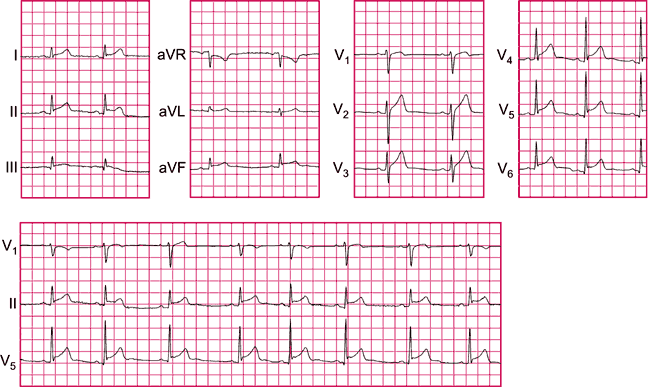
A 35-year-old woman with systemic lupus erythematosus is brought to the emergency department because of a 3-day history of sharp midchest pain that worsens with inspiration and lying on her back. Her only medication is hydroxychloroquine. She appears mildly uncomfortable. Her temperature is 38.1°C (100.5°F), pulse is 96/min, respirations are 14/min, and blood pressure is 135/87 mm Hg. Examination shows a malar rash. The lungs are clear to auscultation. On cardiac examination, a scratchy, high-pitched sound is heard over the lower left sternal border. There is erythema, swelling, and warmth of the wrists. An ECG is shown. Which of the following is the most appropriate initial pharmacotherapy?
CorrectIncorrect -
Question 5 of 20
5. Question
A 70-year-old man is brought to the office by his niece because of a 6-month history of frequent falls. She says he has fallen backward suddenly while walking approximately once monthly during this time. She adds that he has a tendency to look down at his feet while walking. Recently, his speech has become slurred and he has had several choking episodes while eating. He also has had difficulty reading. He has not had light-headedness on standing, difficulty with urination, constipation, changes in mood, or hallucinations. Physical examination shows mild nuchal rigidity and symmetric rigidity of all extremities. There is no tremor. There is impaired visual gaze that is worse when the patient attempts to look down. He has decreased stride length on gait testing and impaired balance while turning. His speech is soft. He has poor enunciation and impaired letter fluency. No other abnormalities are noted. Which of the following is the most likely diagnosis?
CorrectIncorrect -
Question 6 of 20
6. Question
A 35-year-old primigravid woman is brought to the emergency department (ED) by paramedics after a neighbor called emergency services because the patient was being disruptive and combative. En route to the ED, fingerstick blood glucose concentration was 45 mg/dL; intravenous 50% dextrose was administered, and her mental status improved. On arrival, she is fully oriented. She has a 10-year history of type 2 diabetes mellitus treated with insulin. She says she is pregnant but does not know when she had her last menstrual period. She has not yet initiated prenatal care. She has smoked two packs of cigarettes daily for 23 years. She does not drink alcohol or use illicit drugs. Vital signs are within normal limits. On examination, the uterus is nontender; fundal height is 2 cm below the umbilicus. Fetal heart rate is 146/min. Pelvic ultrasonography shows a single intrauterine fetus consistent in size with a 17-week gestation; the thighs and legs are fused, and there are two femoral and two tibial bones within a single soft-tissue and muscular compartment. The amniotic fluid index is 2 cm (N=10–20). Which of the following is the most likely outcome of this patient’s pregnancy?
CorrectIncorrect -
Question 7 of 20
7. Question
A 92-year-old woman is brought to the emergency department because of a 1-week history of generalized fatigue and weakness. She has been a resident in a skilled nursing care facility for 30 years and is nonambulatory. This morning, she became agitated when the medical staff carefully lifted her arms and legs to move her on the bed. She has intestinal malabsorption syndrome, pulmonary fibrosis, dementia, and global deconditioning. She receives chronic parenteral nutrition. She appears pale and is oriented to person but not to place or time. She can follow simple commands. Palpation of the upper extremities and thighs produces pain. She can flex and extend the elbows and wrists and dorsiflex and plantarflex the ankles and extend the toes bilaterally. Sensation is intact over the extremities. Skeletal survey shows pseudofractures of the femur and proximal ulna bilaterally. Which of the following serum concentrations is most likely to be increased in this patient?
CorrectIncorrect -
Question 8 of 20
8. Question
A 37-year-old woman comes to the emergency department 2 hours after cutting her hand while working in the garden. She received a tetanus vaccine 3 months ago. Examination shows a clean wound. After the wound is treated, the patient insists on receiving another tetanus shot. The physician explains that the previous vaccine adequately protects her, but the patient insists that it be repeated. Which of the following is the most appropriate next step?
CorrectIncorrect -
Question 9 of 20
9. Question
A 32-year-old woman is brought to the emergency department because of a 1-hour history of palpitations, tremors, light-headedness, and sweating. She has not had loss of consciousness, chest pain, or shortness of breath. She has had similar episodes in the past, which were relieved by eating and with rest. Her only medication is lorazepam as needed for generalized anxiety disorder. There is no family history of similar episodes. Her temperature is 37°C (98.6°F), pulse is 124/min, respirations are 24/min, and blood pressure is 138/90 mm Hg. Physical and mental status examinations show no abnormalities. Serum studies show:
Na+
138 mEq/L
K+
4 mEq/L
Cl−
99 mEq/L
HCO3−
24 mEq/L
Mg2+
1.9 mEq/L
Ca2+
9.1 mg/dL
Glucose
45 mg/dL
Phosphorus
3.8 mg/dL
Which of the following is the most appropriate next step in diagnosis?
CorrectIncorrect -
Question 10 of 20
10. Question
A previously healthy 1-year-old boy is brought to the emergency department because of difficulty breathing for 12 hours. Over the past 2 days, he has had a cough and clear nasal discharge. His temperature is 36.5°C (97.7°F), pulse is 180/min, respirations are 60/min, and blood pressure is 70/46 mm Hg. He appears extremely anxious and apprehensive. Examination shows cool, pale, and mottled extremities. Pulses are thready. Scattered wheezes and bilateral basilar crackles are heard on auscultation of the chest; there is a gallop with no murmur. The liver is tender and palpated 6 cm below the right costal margin. Capillary blood gas analysis while breathing supplemental oxygen shows:
pH
7.02
Pco2
28 mm Hg
Po2
80 mm Hg
An x-ray of the chest shows mild cardiomegaly and hilar infiltrates. Which of the following is the most likely diagnosis?
CorrectIncorrect -
Question 11 of 20
11. Question
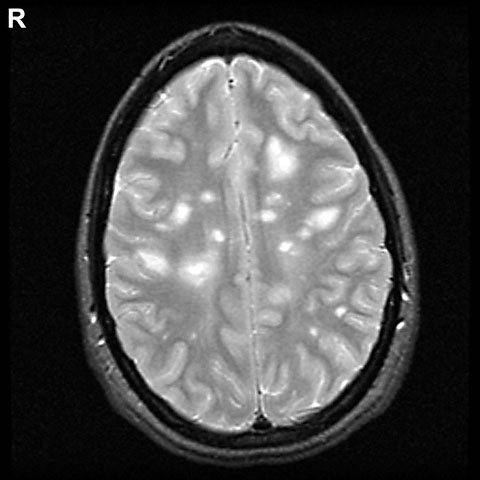
A 24-year-old woman comes to the physician because of a 3-day history of progressive right-sided weakness and numbness. One year ago while traveling overseas, she had loss of vision in the left eye that developed gradually during the course of 1 week, persisted for 1 month, and resolved gradually and spontaneously during the following 3 weeks. At its worst, her vision in the left eye was severely blurred and colors appeared washed out. Her vision recovered completely, and she did not see a physician. She has not had similar symptoms since that time. She has no other history of serious illness and takes no medications. Examination shows mild weakness of the right lower aspect of the face. Muscle strength is 4/5 in the right extremities. Sensation to light touch is mildly decreased over the right side of the face and body. Examination shows no abnormalities on the left. An MRI of the brain is shown. Which of the following is the most appropriate pharmacotherapy to decrease the recurrence of similar symptoms in this patient?
CorrectIncorrect -
Question 12 of 20
12. Question
A 28-year-old woman comes to the physician because of a 4-month history of mild lower abdominal pain that is relieved with defecation. During this time, she also has had nonfatty, nongreasy diarrhea with mucus but no blood. She does not have bowel movements during the night. She is otherwise asymptomatic. She has generalized anxiety disorder treated with citalopram. There is no family history of colon cancer. The patient’s vital signs are within normal limits. The abdomen is not distended or tender. There are no masses, and bowel sounds are normal. Results of a complete blood count are within the reference ranges. Results of serum antiendomysial IgA and anti-tissue transglutaminase antibody testing are negative. Tests of the stool for occult blood, ova, parasites, and leukocytes are negative. Sigmoidoscopy shows no abnormalities. Which of the following is the most appropriate next step in management?
CorrectIncorrect -
Question 13 of 20
13. Question
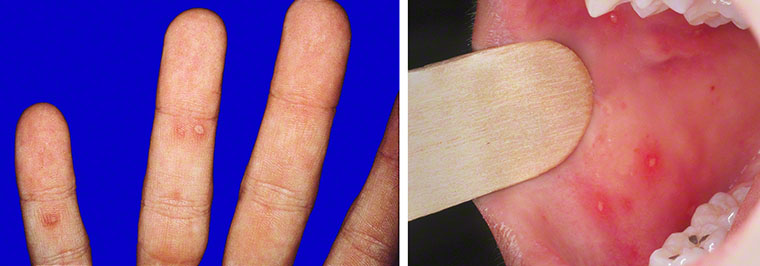
A 6-year-old boy is brought to the emergency department by his parents because of a 2-day history of fever, sore throat, a rapidly spreading rash, and decreased oral intake. During the past 12 hours, he has refused to eat or drink and has not voided. Medical history is remarkable for a 3-day hospitalization at age 2 months for enterovirus meningitis. The patient currently receives no medications and vaccinations are up-to-date. He appears uncomfortable. He is at the 60th percentile for height and 50th percentile for weight; BMI is at the 40th percentile. Temperature is 39.0°C (102.2°F), pulse is 100/min, respirations are 18/min, and blood pressure is 110/70 mm Hg. Pulse oximetry on room air shows an oxygen saturation of 98%. Physical examination discloses oral lesions and dry mucous membranes. There is a blanching rash over the upper and lower extremities and buttocks. The lesions appear as shown in the photographs. Cardiopulmonary examination discloses no abnormalities. Abdominal examination discloses no tenderness or hepatosplenomegaly. Which of the following is the most appropriate initial diagnostic study?
CorrectIncorrect -
Question 14 of 20
14. Question
A 16-year-old girl is brought to the office by her mother because of a 1-year history of increasing facial hair growth and acne. Menses have occurred at irregular 60- to 90-day intervals since menarche at the age of 12 years. She takes no medications. She is 168 cm (5 ft 6 in) tall and weighs 70 kg (155 lb); BMI is 25 kg/m2. Examination shows acne vulgaris over the forehead and chin. Her Ferriman-Gallwey score for hair growth is 10 (N<8). Her serum testosterone concentration is 45 ng/dL (N<5–40). Results of other serum studies, including thyroid-stimulating hormone, prolactin, and dehydroepiandrosterone sulfate concentrations, are within the reference ranges. Which of the following is the most likely cause of this patient’s condition?
CorrectIncorrect -
Question 15 of 20
15. Question
A randomized clinical trial is planned to determine whether a new form of chemotherapy increases the survival time for patients with pancreatic cancer. The investigators intend to randomize 300 patients aged 40 to 70 years into two groups. One group will receive the new chemotherapy and the other group will receive standard therapy. Patients will be observed for up to 5 years. Interim analyses will be conducted on an annual basis, and the trial will be terminated if sufficient evidence of efficacy is noted at any of the interim analyses. This interim analysis plan will most likely lead to which of the following?
CorrectIncorrect -
Question 16 of 20
16. Question
Six weeks after undergoing triple coronary artery bypass grafting after suffering an acute myocardial infarction, a 57-year-old man comes to the office with his wife for a follow-up examination. Since the surgery, the patient has had left leg pain and numbness and a 9-kg (20-lb) weight loss. He reports that he has not been sleeping well and has had an intermittent cough. His energy has been decreased and he has lost interest in his usual activities. He has not had chest pain. A low-impact exercise program was prescribed at the time of discharge. The patient’s wife says that he has not maintained the suggested exercise program, stating that he was too tired. Medications include atenolol, atorvastatin, and 81-mg aspirin daily. He is 173 cm (5 ft 8 in) tall and weighs 91 kg (200 lb); BMI is 30 kg/m2. Vital signs are temperature 37.0°C (98.6°F), pulse 62/min, respirations 14/min, and blood pressure 140/80 mm Hg. Physical examination discloses well-healed surgical incisions. Total serum cholesterol concentration is 180 mg/dL, and fasting blood glucose concentration is 128 mg/dL. Which of the following is the most appropriate change in the patient’s therapy?
CorrectIncorrect -
Question 17 of 20
17. Question
A 42-year-old primigravid woman at 26 weeks’ gestation comes to the physician for a routine prenatal visit. She feels well, and her pregnancy has been uncomplicated. Prior to conception, she used an oral contraceptive and drank two cups of coffee daily. She plans to resume using an oral contraceptive and drinking coffee after delivery. She states that after delivery, she will be taking a 6-month maternity leave from work and plans to breast-feed exclusively during this time. Examination shows a uterus consistent in size with a 26-week gestation. The most appropriate recommendation for the infant during breast-feeding is supplementation with which of the following?
CorrectIncorrect -
Question 18 of 20
18. Question
A 57-year-old man comes to the physician for a routine examination. He feels well. He has mild hypertension and type 2 diabetes mellitus. He underwent an uncomplicated total right knee arthroplasty 2 years ago. Repair of a chipped molar tooth is scheduled in 1 week, and the patient requests antibiotics to prevent infection around his prosthetic joint. General health screening measures are up-to-date. The patient is allergic to penicillin. Current medications are hydrochlorothiazide, enalapril, and insulin. His temperature is 37°C (98.6°F), pulse is 85/min, respirations are 12/min, and blood pressure is 145/84 mm Hg. Examination shows a well-healed scar over the right knee. Which of the following is the most appropriate next step in management?
CorrectIncorrect -
Question 19 of 20
19. Question
A 52-year-old woman with long-standing alcohol use disorder is brought to the emergency department because of a 2-day history of severe abdominal cramps, fever, nausea, vomiting, and tremulousness. She has drunk 1 L of vodka daily during the past week; her last glass of vodka was 2 days ago. On arrival, the patient is mildly confused and is unable to provide further history. She is oriented to person and place but not to time. Her temperature is 37.7°C (99.9°F), pulse is 110/min, respirations are 18/min, and blood pressure is 152/92 mm Hg. Examination shows marked scleral icterus. Abdominal examination shows tenderness to palpation over the right upper quadrant. The liver span is 14 cm. There is no fluid wave or asterixis. Laboratory studies show:
Prothrombin time
32 sec (INR=4.5)
Serum
Protein, total
6.2 g/dL
Albumin
2.2 g/dL
Total bilirubin
19.8 mg/dL
Alkaline phosphatase
130 U/L
AST
210 U/L
ALT
101 U/L
Which of the following is the most appropriate pharmacotherapy?
CorrectIncorrect -
Question 20 of 20
20. Question
A 70-year-old woman is brought to the emergency department from the nursing care facility where she resides, because of a 2-day history of low-grade fever, decreased appetite, and lethargy. She has type 2 diabetes mellitus and cognitive impairment. Her only medication is metformin. The patient is drowsy and responds to questions with inconsistent answers. She is 152 cm (5 ft) tall and weighs 64 kg (140 lb); BMI is 27 kg/m2. Her temperature is 38.0°C (100.4°F), pulse is 90/min, respirations are 20/min, and blood pressure is 100/60 mm Hg. Cardiopulmonary examination shows no abnormalities. Examination of the left lower extremity shows a rapidly expanding area of red, shiny skin on the shin with a small fluid-filled bulla. The area is exquisitely tender and warm to the touch. In addition to intravenous antibiotic therapy, which of the following is the most appropriate next step in management?
CorrectIncorrect