
NBME 13 – Block 4
Time limit: 0
Quiz Summary
0 of 20 Questions completed
Questions:
Information
You have already completed the quiz before. Hence you can not start it again.
Quiz is loading…
You must sign in or sign up to start the quiz.
You must first complete the following:
Results
Quiz complete. Results are being recorded.
Results
0 of 20 Questions answered correctly
Your time:
Time has elapsed
You have reached 0 of 0 point(s), (0)
Earned Point(s): 0 of 0, (0)
0 Essay(s) Pending (Possible Point(s): 0)
Categories
- Not categorized 0%
- 1
- 2
- 3
- 4
- 5
- 6
- 7
- 8
- 9
- 10
- 11
- 12
- 13
- 14
- 15
- 16
- 17
- 18
- 19
- 20
- Current
- Review
- Answered
- Correct
- Incorrect
-
Question 1 of 20
1. Question
A 57-year-old woman with metastatic cancer of the sigmoid colon is admitted to the hospital because of a 2-day history of progressive swelling and pain of her right arm. Ten days ago, she underwent partial resection of the liver and placement of a right subclavian venous port. She currently takes no medications. Examination today shows a swollen, tender right forearm and hand. Venous duplex ultrasonography shows thrombosis of the right axillary and subclavian veins. The port and catheter are removed, and intravenous unfractionated heparin therapy (UHT) is begun. After 2 days of UHT, the patient’s pain has decreased. Laboratory studies on admission and after 2 days of UHT show:
On Admission
2 Days After Admission
Hemoglobin (g/dL)
9.8
9.6
Hematocrit (%)
28
27
Leukocyte count (/mm3)
8900
12,600
Platelet count (/mm3)
260,000
61,000
Prothrombin time (sec)
12 (INR=1)
13 (INR=1.1)
Partial thromboplastin time (sec)
32
87
Which of the following is the most likely explanation for these laboratory findings?
CorrectIncorrect -
Question 2 of 20
2. Question
A 37-year-old woman, gravida 1, para 1, comes to the physician for a postpartum examination 6 weeks after spontaneous vaginal delivery of a 3220-g (7-lb 1-oz) newborn. Delivery was complicated by a vaginal laceration, which was repaired. She states that she has had occasional fecal incontinence and flatus since delivery; she has not had urinary incontinence, fever, diarrhea, constipation, or pelvic pain. She has Crohn disease treated with prednisone; her last flare-up of symptoms was 6 months before delivery. Her temperature is 37°C (98.6°F). Physical examination shows that the sutures in the vaginal mucosa are healing well. There is a 3-cm defect in the rectal mucosa with communication with the vagina. The anal sphincter is partially torn. Without treatment, which of the following is the most likely outcome for this patient?
CorrectIncorrect -
Question 3 of 20
3. Question

A 42-year-old man comes to the physician 12 hours after the onset of increasing mild epigastric pain and decreased appetite. He has not eaten during this period. He has vomited greenish material 10 times during the past 4 hours. He has not had fever or chills. He was treated for malaria 25 years ago. He currently takes no medications. He immigrated to the USA from Ghana 20 years ago. He does not smoke or drink alcohol. He appears ill and is in mild distress. His temperature is 37.8°C (100.1°F), pulse is 110/min, respirations are 20/min, and blood pressure is 108/70 mm Hg. Examination shows dry mucous membranes. Cardiopulmonary examination shows no abnormalities. The abdomen is soft with mild epigastric tenderness. There is no hepatosplenomegaly. Bowel sounds are high pitched. A 3-cm tender mass is palpated in the right groin. Test of the stool for occult blood is negative. Laboratory studies show:
Hematocrit
51%
Leukocyte count
11,400/mm3
Segmented neutrophils
78%
Lymphocytes
19%
Monocytes
3%
Platelet count
225,000/mm3
Serum
Na+
133 mEq/L
K+
4.2 mEq/L
Cl−
91 mEq/L
HCO3−
30 mEq/L
Urea nitrogen
29 mg/dL
Glucose
177 mg/dL
Creatinine
1.2 mg/dL
Abdominal x-rays are shown. In addition to placement of a nasogastric tube, which of the following is the most appropriate next step in management?
CorrectIncorrect -
Question 4 of 20
4. Question
A 12-year-old boy is brought to the emergency department 15 minutes after his parents found him restless and confused in their basement. He also had slurred speech. He has no history of serious illness and takes no medications. While waiting to be examined, he falls asleep but is easily arousable. Physical examination shows nystagmus. Muscle strength is 4/5 throughout. On mental status examination, he is oriented to person and place but not to time. He reports no hallucinations. There is no evidence of delusions. Urine toxicology screening is negative. Use of which of the following substances is the most likely cause of this patient’s condition?
CorrectIncorrect -
Question 5 of 20
5. Question
A 27-year-old man comes to the physician because of a painful lesion on his left palm that has been enlarging during the past 9 months. Two years ago, he underwent cauterization with liquid nitrogen for a wart-like lesion at the same site; the lesion decreased in size but never completely resolved. Since the procedure, he has had episodes of skin breakdown with clear, malodorous drainage. He is unable to grip objects with his left hand because of the pain. His temperature is 37°C (98.6°F). Examination of the left hand shows a 4 × 3-cm, erythematous, irregularly shaped lesion overlying the hypothenar eminence that rises 1 cm above the skin surface and is fixed to underlying tissue. The center of the lesion is necrotic with a serosanguineous, malodorous discharge. Sensation to pinprick is decreased over the palmar surface of the left small fingertip. The remainder of the examination shows no abnormalities. X-rays of the left hand show no abnormalities. An MRI of the hand shows a large, irregularly shaped mass extending from the skin of the hypothenar eminence into the Guyon canal and the carpal tunnel. Results of an open biopsy of the lesion show high-grade epithelioid sarcoma. A staging CT scan shows no evidence of metastases. Which of the following is the most appropriate next step in management?
CorrectIncorrect -
Question 6 of 20
6. Question
An 18-year-old man is brought to the emergency department by his friends 45 minutes after sustaining injuries on his dirt bike. He reports that when landing the bike after a jump, he lost his seating and suddenly straddled the center bar of the bike, which resulted in severe pain between his legs. For 15 minutes after being injured, he was unable to ambulate. He has had similar accidents twice in the past, but the resulting pain was not as prolonged or severe. The patient is in distress. His pulse is 128/min, respirations are 14/min, and blood pressure is 152/80 mm Hg. Examination shows lacerations and ecchymoses over the face and hands. Visual examination of the scrotum shows diffuse edema and ecchymoses; the scrotum cannot be palpated because of pain. Which of the following is most likely to confirm the diagnosis?
CorrectIncorrect -
Question 7 of 20
7. Question
A 12-month-old boy is brought to the physician by his mother for a well-child examination. His mother is concerned because she does not think he is gaining an adequate amount of weight. His diet consists of cow milk-based formula and solid foods. He has four bulky, light-colored stools and six wet diapers daily. He is at the 10th percentile for height, 5th percentile for weight, and 75th percentile for head circumference. He has had a 90-g (3-oz) weight gain since his most recent visit 3 months ago. Development is appropriate for age. Examination shows a paucity of subcutaneous fat and thin hair. Which of the following is the most appropriate next step in management?
CorrectIncorrect -
Question 8 of 20
8. Question
A 42-year-old woman comes to the physician because she had a 2-hour episode of shortness of breath yesterday after walking for two blocks. She has not had chest pain and has no previous history of shortness of breath with exertion or at night. She has a 6-year history of poorly controlled hypertension. Her current medications are a diuretic, β-adrenergic blocking agent, and calcium-channel blocking agent. There is no family history of coronary artery disease. The patient does not smoke cigarettes. Her pulse is 85/min and irregularly irregular, respirations are 16/min, and blood pressure is 170/90 mm Hg. The lungs are clear to auscultation. On cardiac examination, S1 and S2 are normal. No murmurs are heard. Serum studies show a total cholesterol concentration of 130 mg/dL and LDL-cholesterol concentration of 90 mg/dL. An ECG shows atrial fibrillation and left ventricular hypertrophy. Which of the following is the most appropriate next step in diagnosis?
CorrectIncorrect -
Question 9 of 20
9. Question

An 82-year-old woman is admitted to the hospital because of a 4-day history of dyspnea, cough productive of brown sputum, nausea, fever, and chills. She has hypertension, type 2 diabetes mellitus, and hypercholesterolemia. Her medications are amlodipine, benazepril, and atorvastatin. She has no known sick contacts. One week ago, she returned from a 15-day vacation where she stayed in a hotel for 5 days and was on a 10-day Caribbean cruise. She does not smoke cigarettes, drink alcohol, or use illicit drugs. She lives alone and is able to perform activities of daily living without difficulty. She is 163 cm (5 ft 4 in) tall and weighs 70 kg (155 lb); BMI is 27 kg/m2. Her temperature is 38.1°C (100.6°F), pulse is 116/min, respirations are 24/min, and blood pressure is 120/65 mm Hg. Pulse oximetry on room air shows an oxygen saturation of 89%. Pulmonary examination shows dullness to percussion over the lower lobe of the left lung. Laboratory studies show a leukocyte count of 15,000/mm3, serum urea nitrogen concentration of 19 mg/dL, and serum creatinine concentration of 0.9 mg/dL. Her hemoglobin concentration, serum electrolyte concentrations, and results of urinalysis are within the reference ranges. A chest x-ray and Gram stain of sputum are shown. Which of the following is the most likely infectious agent?
CorrectIncorrect -
Question 10 of 20
10. Question
A previously healthy 15-year-old girl is brought to the physician because of vaginal discharge and abdominal pain for 3 days. She has not had fever or dysuria. Menarche was at 12 years of age, and her last menstrual period was 1 week ago. She is sexually active and uses an oral contraceptive. Her temperature is 38°C (100.4°F), pulse is 80/min, respirations are 16/min, and blood pressure is 100/60 mm Hg. Abdominal examination shows normal bowel sounds with mild right lower quadrant tenderness without rebound, masses, or hepatosplenomegaly. Pelvic examination shows a friable cervix with a moderate amount of yellow discharge and scant blood. There is mild cervical motion tenderness but no adnexal tenderness or masses. Gram stain of the cervical discharge shows gram-negative intracellular diplococci. Urine β-hCG is negative. The patient does not want her parents to know that she is ill. Which of the following is the most appropriate course of action?A previously healthy 15-year-old girl is brought to the physician because of vaginal discharge and abdominal pain for 3 days. She has not had fever or dysuria. Menarche was at 12 years of age, and her last menstrual period was 1 week ago. She is sexually active and uses an oral contraceptive. Her temperature is 38°C (100.4°F), pulse is 80/min, respirations are 16/min, and blood pressure is 100/60 mm Hg. Abdominal examination shows normal bowel sounds with mild right lower quadrant tenderness without rebound, masses, or hepatosplenomegaly. Pelvic examination shows a friable cervix with a moderate amount of yellow discharge and scant blood. There is mild cervical motion tenderness but no adnexal tenderness or masses. Gram stain of the cervical discharge shows gram-negative intracellular diplococci. Urine β-hCG is negative. The patient does not want her parents to know that she is ill. Which of the following is the most appropriate course of action?
CorrectIncorrect -
Question 11 of 20
11. Question
A 52-year-old man comes to the emergency department because of swelling of his lips for 5 hours. He has not had difficulty breathing or any other symptoms. Six hours ago, he ate a Thanksgiving meal, which included turkey, gravy, stuffing, cranberries, sweet potatoes, pearl onions, and pumpkin pie. Before dinner, he ate salmon hors d’oeuvres. He has hypertension and hyperlipidemia. Current medications include 81-mg aspirin, atorvastatin, and lisinopril. On arrival, he is not in distress. Vital signs are within normal limits. Examination shows edema of the lips. There is no stridor or wheezes. Results of initial laboratory studies are within the reference range. In addition to administration of an antihistamine, which of the following is the most appropriate next step in management?
CorrectIncorrect -
Question 12 of 20
12. Question
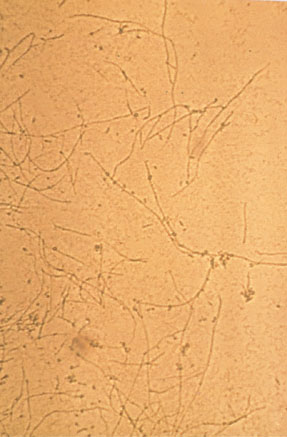
A 27-year-old woman comes for a follow-up examination 8 days after completing a course of amoxicillin for treatment of sinusitis. She has been feeling well but recently noticed a painful white patch in her mouth. Examination shows a 1.5-cm white patch behind the tongue; the patch cannot be scraped off. A photomicrograph of the KOH preparation is shown. Which of the following is the most appropriate pharmacotherapy?
CorrectIncorrect -
Question 13 of 20
13. Question
A 42-year-old woman comes to the physician for a routine health maintenance examination. She received the diagnosis of glomerulonephritis 1 year ago, which was successfully treated with corticosteroids, with resolution of her kidney failure and proteinuria. At her last visit 1 month ago, her blood pressure was 110/70 mm Hg. Her serum creatinine concentration at that time was 0.9 mg/dL, and urine dipstick was negative for protein and blood. Her only medications are lisinopril and a daily multivitamin. She swims 2 miles five times weekly. She is 165 cm (5 ft 5 in) tall and weighs 57 kg (126 lb); BMI is 21 kg/m2. Her pulse is 58/min, and blood pressure is 130/86 mm Hg. Examination, including cardiopulmonary examination, shows no other abnormalities. There is no peripheral edema. Laboratory studies show:
Hemoglobin
13.6 g/dL
Serum
Urea nitrogen
10 mg/dL
Creatinine
0.9 mg/dL
Urine
Protein
1+
RBC
0/hpf
WBC
0/hpf
Which of the following is the most appropriate next step to slow progression of this patient’s renal insufficiency?
CorrectIncorrect -
Question 14 of 20
14. Question
A 19-year-old man is brought to the physician by his parents because they are worried about his behavior since he dropped out of college 2 months ago. When he came home, he appeared distracted and preoccupied and would not answer their questions. He would only say that it is unsafe for him to return to school because his professors had been stealing from him and that campus police are searching for him for use in an experiment. His parents state that he has always been shy and more of a loner than their other children but that now he will not even talk to them. He has not had changes in sleep or appetite. He has no history of serious illness and takes no medications. His parents report that his maternal cousin takes medication for “psychiatric problems” and has a history of several psychiatric hospitalizations, but that they are unaware of the diagnosis. The patient is mildly malodorous and unshaven. Vital signs are within normal limits. He will not cooperate with a full physical examination but appears to move all four extremities spontaneously. On mental status examination, he is angry, mumbles to himself, and searches his pockets for something. He says he is not “depressed.” His speech is normal in rate and rhythm. Which of the following is the most likely diagnosis?
CorrectIncorrect -
Question 15 of 20
15. Question
An 80-year-old man is brought to the office by his wife because of a 3-month history of “personality changes.” She says he has become withdrawn and is no longer interested in socializing with friends and family. At a restaurant last night, he sexually groped a waitress. The patient has no history of serious illness and takes no medications. Vital signs are within normal limits. Physical examination shows no abnormalities. Neurologic examination shows no focal findings. On mental status examination, he has a blunted affect and describes his mood as “fine.” He recalls two of three objects after 5 minutes. He makes no errors when performing serial sevens. Serum studies show a thyroid-stimulating hormone concentration of 3.8 mIU/L, thyroxine (T4) concentration of 5 μg/dL, and triiodothyronine (T3) concentration of 117 ng/dL; results of other laboratory studies are within the reference ranges. An MRI of the brain shows focal atrophy of the frontal and temporal lobes. Which of the following is the most appropriate next step in management?
CorrectIncorrect -
Question 16 of 20
16. Question
A 24-year-old woman comes to the office because of a lump in her right breast that her sexual partner first noticed 2 months ago. The patient has no history of serious illness and takes no medications. Her maternal aunt was diagnosed with ovarian cancer at the age of 45 years. Physical examination of the patient shows a 3-cm fluctuant, mildly tender, smooth mass in the lower outer quadrant of the right breast. Pelvic examination shows no abnormalities. Which of the following is the most appropriate next step in diagnosis?
CorrectIncorrect -
Question 17 of 20
17. Question
A 58-year-old man comes to the office because of a 1-day history of progressive weakness of the left leg. He now catches his left great toe on his carpet when he walks. He has not sustained any injury or had any change in his activities. He has not had fever, chills, or bladder or bowel incontinence. He has hypertension, coronary artery disease, and type 1 diabetes mellitus. His medications are metoprolol, amlodipine, and insulin. His daily fingerstick blood glucose concentrations range between 100 mg/dL and 120 mg/dL. He is alert and fully oriented. Vital signs are within normal limits. Cranial nerves are intact. There is no tenderness to palpation of the low back; range of motion is decreased on lateral bending. Results of muscle strength testing show:
Left
Right
Hip abduction
5/5
5/5
Hip flexion
5/5
5/5
Knee extension
5/5
5/5
Knee flexion
5/5
5/5
Ankle plantar flexion
5/5
5/5
Extensor hallucis longus
3/5
5/5
Tibialis anterior
3/5
5/5
Peroneus brevis
3/5
5/5
Passive range of motion of the ankles is full; no pain is elicited on ankle palpation bilaterally. Patellar and Achilles deep tendon reflexes are 2+ bilaterally. Dorsalis pedis pulses are 1+ in the lower extremities. Steppage gait is present. Which of the following is the most likely explanation for these clinical findings?
CorrectIncorrect -
Question 18 of 20
18. Question
A 52-year-old woman with metastatic breast cancer comes to the physician for a follow-up examination. She has a 6-month history of bone pain in the low back and left hip that has been unresponsive to codeine (60 mg every 4 hours) and ibuprofen (800 mg every 8 hours). Six years ago, she underwent a modified radical mastectomy. One year ago, she was diagnosed with metastases to the liver and bone; she is currently receiving chemotherapy. Her pulse is 100/min, respirations are 18/min, and blood pressure is 150/90 mm Hg. Abdominal examination shows an enlarged, tender liver. There is tenderness to percussion over T3–6. Her serum alkaline phosphatase activity is 280 U/L. Which of the following is the most appropriate next step for this patient’s pain control?
CorrectIncorrect -
Question 19 of 20
19. Question
A 47-year-old man comes to the physician because of a 6-month history of progressive shortness of breath on exertion and fatigue. He has type 2 diabetes mellitus, essential hypertension, obstructive sleep apnea, gastroesophageal reflux disease, and hypercholesterolemia. His medications are metformin, benazepril, famotidine, and atorvastatin. He uses a continuous positive airway pressure machine. He does not smoke cigarettes or drink alcohol. He is 168 cm (5 ft 6 in) tall and weighs 127 kg (280 lb); BMI is 45 kg/m2. His temperature is 37°C (98.6°F), pulse is 98/min, respirations are 20/min, and blood pressure is 138/86 mm Hg. Pulse oximetry on room air shows an oxygen saturation of 86%. Examination shows mild circumoral cyanosis. Pulmonary examination shows no abnormalities. On cardiac examination, there is a split S2 and a prominent P2; no murmurs, gallops, or rubs are heard. Abdominal examination shows no hepatomegaly or ascites. There is 2+ pretibial and ankle edema bilaterally. Which of the following is most likely to be decreased in this patient?
CorrectIncorrect -
Question 20 of 20
20. Question
A 27-year-old man is admitted to the hospital for treatment of injuries sustained in a motor vehicle collision. He states that he was feeling “out of it” at the time of the collision but feels better now. He is employed as a truck driver. During the past 6 months, he had three prior collisions but sustained only minor bruises and abrasions. He attributes the collisions to difficulty concentrating, especially when he drives long distances without eating. He has not had chest pain. He has no history of serious illness and takes no medications. He does not drink alcohol or use illicit drugs. He is alert and fully oriented. Examination shows no abnormalities except for tenderness over the left shoulder and muscles of the left upper extremity. His fingerstick blood glucose concentration is 39 mg/dL. Results of laboratory studies are otherwise within the reference ranges. Which of the following is the most appropriate next step in diagnosis?
CorrectIncorrect