
NBME 13 – Block 3 (Duplicate 2)
Time limit: 0
Quiz Summary
0 of 20 Questions completed
Questions:
Information
You have already completed the quiz before. Hence you can not start it again.
Quiz is loading…
You must sign in or sign up to start the quiz.
You must first complete the following:
Results
Quiz complete. Results are being recorded.
Results
0 of 20 Questions answered correctly
Your time:
Time has elapsed
You have reached 0 of 0 point(s), (0)
Earned Point(s): 0 of 0, (0)
0 Essay(s) Pending (Possible Point(s): 0)
Categories
- Not categorized 0%
- 1
- 2
- 3
- 4
- 5
- 6
- 7
- 8
- 9
- 10
- 11
- 12
- 13
- 14
- 15
- 16
- 17
- 18
- 19
- 20
- Current
- Review
- Answered
- Correct
- Incorrect
-
Question 1 of 20
1. Question
A 67-year-old woman is admitted to the hospital because of fever, weakness, light-headedness, and right lower back pain 3 days after beginning nitrofurantoin for a urinary tract infection. She has a 10-year history of recurrent urinary tract infections with enterococci and several gram-negative organisms that have been resistant to ampicillin and cephalosporins. She has no other history of serious illness. She appears acutely ill. Her temperature is 39.5°C (103.1°F), pulse is 120/min, respirations are 24/min, and blood pressure is 98/68 mm Hg. On examination, there is right costovertebral angle tenderness. Urinalysis shows clumps of WBCs too numerous to count. Treatment with piperacillin-tazobactam and gentamicin is begun. In addition to administration of intravenous fluids, which of the following is the most appropriate initial management to decrease this patient’s risk for acute renal failure?
CorrectIncorrect -
Question 2 of 20
2. Question
A 47-year-old woman comes to the physician for a routine health maintenance examination. She has no history of serious illness or abnormal Pap smears. Menses occur at irregular 45-day intervals, last 5 days, and are not painful; menstrual flow is normal. She has no intermenstrual bleeding. Her last visit to a physician was 2 years ago; at that time, a Pap smear showed no abnormalities. She has not been sexually active for 5 years. Her father was diagnosed with colon cancer, cardiovascular disease, hypertension, and type 2 diabetes mellitus in his 60s. The patient is 157 cm (5 ft 2 in) tall and weighs 82 kg (180 lb); BMI is 33 kg/m2. Her blood pressure is 125/75 mm Hg. Physical examination, including pelvic examination, shows no other abnormalities. Which of the following is the most appropriate recommendation?
CorrectIncorrect -
Question 3 of 20
3. Question
A 47-year-old woman comes to the clinic because of a 3-year history of morning fatigue and an uncomfortable sensation in her legs. The sensation is relieved by walking or by tapping her feet if she is sitting. Her husband sleeps in another bed because she frequently shifts and disturbs his sleep. She has a 3-year history of anemia treated with iron supplementation. She has no other history of serious illness and takes no other medications. Her father has major depressive disorder, her mother has type 2 diabetes mellitus and osteoarthritis, and her brother has type 2 diabetes mellitus. On examination of the patient, muscle strength is 5/5 and symmetric in the lower extremities. Sensation to light touch is intact. Straight-leg raise test is negative bilaterally. Which of the following is the most appropriate next step in diagnosis?
CorrectIncorrect -
Question 4 of 20
4. Question
An 87-year-old woman is brought to the emergency department by her daughter because of pain in her hand and wrist after tripping and catching herself with her outstretched right hand. The daughter says the patient has “frail bones” and is taking calcium and vitamin D supplements. Medical history is remarkable for hypertension and degenerative joint disease. Her only other medication is hydrochlorothiazide. She had a tetanus shot 4 years ago. Vital signs are temperature 37.3°C (99.1°F), pulse 86/min, respirations 13/min, and blood pressure 118/65 mm Hg. Pulse oximetry on room air shows an oxygen saturation of 97%. Physical examination shows an ecchymosis and an abrasion of the right palm. There is swelling and diffuse tenderness of the right wrist. X-rays of the right hand and wrist show a scaphoid fracture. Which of the following is the most likely complication of this patient’s fracture?
CorrectIncorrect -
Question 5 of 20
5. Question
A 23-year-old man who is a landscaper comes to the office because of a 3-month history of lethargy, diffuse muscle aches, and knee pain. He also had a rash on his left knee 3 months ago similar to the one shown in the photograph. One month ago, he had an episode of right knee pain that resolved after 5 days. He now has left knee pain. Temperature is 37.6°C (99.7°F), pulse is 100/min, and respirations are 16/min. Physical examination shows swelling of the left knee; there is no rash. Which of the following is the most appropriate next step in management?
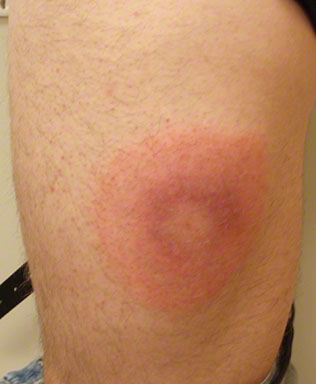 CorrectIncorrect
 -
Question 6 of 20
6. Question
A 16-year-old girl comes to the office alone for a physical examination required for participation in athletics. The patient immediately states that results of a home urine pregnancy test 2 days ago were positive. Her last menstrual period was 2 months ago. She has had mild nausea but no vomiting or fever. Medical history is noncontributory, and she takes no medications. Family history is remarkable for a congenital heart defect, craniosynostosis, and severe cognitive impairment in her brother caused by an unbalanced chromosomal rearrangement; her father is known to be a carrier of a balanced chromosomal translocation and is asymptomatic. The patient lives with her stepmother and biological father, who has full custody. She is at the 50th percentile for height, weight, and BMI. Vital signs are within normal limits. Physical examination shows no abnormalities. Serum β-hCG testing confirms the pregnancy. The patient reports that she does not want to have a child with the same condition as her brother and requests genetic testing for herself. It is most appropriate to obtain informed consent for the requested genetic testing in this patient from which of the following individuals?
CorrectIncorrect -
Question 7 of 20
7. Question
A 37-year-old man is brought to the emergency department 45 minutes after the sudden onset of severe, sharp pain in his back and chest while he was playing basketball. He rates his pain as an 8 on a 10-point scale. After playing for 2 hours, he had the onset of pain and then had loss of consciousness for 45 seconds. He has Marfan syndrome and long-standing gastroesophageal reflux disease treated with a proton pump inhibitor. On arrival, he is alert and oriented to person, place, and time. He is 198 cm (6 ft 6 in) tall and weighs 77 kg (170 lb); BMI is 20 kg/m2. His temperature is 37.8°C (100°F), pulse is 120/min, respirations are 26/min, and blood pressure is 95/65 mm Hg. Examination shows dry mucous membranes. Breath sounds are distant at the left lung base. There is dullness to percussion on the left. Fluid resuscitation is begun. Which of the following is the most appropriate next step in management?
CorrectIncorrect -
Question 8 of 20
8. Question
A 6-year-old boy is brought to the physician because of a 1-year history of progressive hyperactivity and behavior problems. His teacher reports that he frequently disrupts the class. He has asthma treated with an albuterol inhaler as needed. He occasionally has diffuse headaches. His parents say that he snores loudly, occasionally stops breathing, and moves frequently during sleep. He plays soccer and baseball. His parents and teacher say he is disobedient. His father has dyslexia, and a paternal cousin has autistic disorder. Growth and development are appropriate for age. He breathes through his mouth. His respirations are 20/min. Examination shows moderately enlarged tonsils. He can recall three of three objects after 5 minutes. On digit-span testing, he recalls 7 forward and 5 backward. His abstract reasoning is intact. Which of the following is the most appropriate initial step in diagnosis?
CorrectIncorrect -
Question 9 of 20
9. Question
A 24-year-old woman comes to the emergency department because of a 1-week history of weakness and occasional palpitations. She admits that she uses laxatives daily to purge herself after binge eating baked goods. During the last month, she has had to increase the dose of laxative to achieve the same effect. There is no history of vomiting. She appears well hydrated. She is 160 cm (5 ft 3 in) tall and weighs 54 kg (120 lb); BMI is 21 kg/m2. While supine, her pulse is 80/min, and blood pressure is 120/80 mm Hg. While standing, her pulse is 90/min, and blood pressure is 80/55 mm Hg; she reports light-headedness when she first stands up. Examination shows no other abnormalities. Which of the following sets of laboratory findings is most likely in this patient?
Option
Serum K (mEq/L)
pH
PCO₂ (mm Hg)
PO₂ (mm Hg)
HCO₃⁻ (mEq/L)
A
6.5
7.3
25
92
12
B
2.7
7.5
46
86
34
C
3.0
7.3
30
90
14
D
4.0
7.4
40
90
26
E
3.7
7.5
20
88
24
CorrectIncorrect -
Question 10 of 20
10. Question
A 37-year-old woman comes to the physician for a preoperative examination 2 weeks prior to undergoing a splenectomy. She received the diagnosis of immune thrombocytopenic purpura 3 months ago. Her platelet count has ranged between 5000/mm3 and 20,000/mm3 for the past 2 weeks despite treatment with systemic corticosteroids and intravenous immunoglobulin for 2½ months. Her only current medication is prednisone. She has smoked one-half pack of cigarettes daily for 20 years. Examination shows scattered petechiae and multiple small ecchymoses over the upper and lower extremities. This patient should receive which of the following vaccines preoperatively?
Option
Streptococcus pneumoniae
Haemophilus influenzae type b
Neisseria meningitidis
A
NO
NO
YES
B
NO
YES
NO
C
NO
YES
YES
D
YES
NO
NO
E
YES
NO
YES
F
YES
YES
NO
G
YES
YES
YES
CorrectIncorrect -
Question 11 of 20
11. Question
A 42-year-old woman, gravida 2, para 2, comes to the office because of a 1-day history of loss of clear, yellow vaginal fluid while walking; she has soaked two absorbent pads during this time. Two weeks ago, she underwent laparoscopic-assisted total vaginal hysterectomy for menorrhagia, dysmenorrhea, and adenomyosis. Intraoperatively, dissection of the bladder from the cervix was complicated by adhesions. She has mild asthma treated with an albuterol inhaler three to four times monthly. Both her pregnancies ended in low-transverse cesarean deliveries because of breech presentations. She has been taking ibuprofen four times daily and reports good pain control. Temperature is 37.8°C (100.0°F), pulse is 92/min, respirations are 16/min, and blood pressure is 128/78 mm Hg. On examination, the abdomen is nondistended and nontender. There is no blood over the perineum. Which of the following is the most likely cause of this patient’s current condition?
CorrectIncorrect -
Question 12 of 20
12. Question
An asymptomatic 72-year-old woman comes for a follow-up examination after she was found to have an 80% stenosis of the right internal carotid artery. A new study has shown that endarterectomy for asymptomatic stenosis decreases the risk for stroke or death from 10% to 5% at 5 years (p<0.05). Which of the following is the best way to interpret this research for this patient?
CorrectIncorrect -
Question 13 of 20
13. Question
An otherwise healthy 17-year-old girl is brought to the physician by her mother because of a 1-year history of monthly cramps that begin 3 days before the onset of menses and last 5 days. The cramps have increased in severity during the past 4 months, causing her to miss 1 to 2 days of school each month. Menses occur at regular 27- to 30-day intervals and last 4 to 5 days. Menarche was at the age of 14 years. She has never been sexually active. She is 165 cm (5 ft 5 in) tall and weighs 54 kg (118 lb); BMI is 20 kg/m2. Examination shows a nontender abdomen and normal external genitalia. Pelvic examination is limited because of a narrow vaginal introitus. Ultrasonography of the pelvis shows a normal uterus and ovaries. Which of the following is the most appropriate next step in management?
CorrectIncorrect -
Question 14 of 20
14. Question
An 87-year-old man is transferred to the emergency department from a skilled nursing care facility because of progressive confusion during the past 3 weeks. He underwent resection of lung cancer 25 years ago and has a history of deep venous thrombosis. His only medication is warfarin. On arrival, he is not sure where he is or why he is in the emergency department. Vital signs are within normal limits. Examination shows multiple small abrasions and ecchymoses over the body. Pupils are 4 mm and react slowly but symmetrically to light. There is a slight drift to the right upper extremity when the patient holds both upper extremities in front of him. He is unable to perform serial sevens. Which of the following is the most appropriate next step in diagnosis?
CorrectIncorrect -
Question 15 of 20
15. Question
A 52-year-old woman comes to the office for a 6-month health maintenance examination. She has felt generally healthy. Medical history is remarkable for hypertension and mild arthritis. She takes hydrochlorothiazide daily and acetaminophen as needed. She does not smoke cigarettes or drink alcoholic beverages. Vital signs are temperature 36.8°C (98.2°F), pulse 76/min, respirations 18/min, and blood pressure 130/78 mm Hg. Physical examination discloses no abnormalities except for loss of her arch when standing; an arch is present when she stands on her toes. There is also more eversion of the heels than normal when standing and mild swelling over the lateral aspect of the ankles bilaterally. Which of the following is the most appropriate next diagnostic study?
CorrectIncorrect -
Question 16 of 20
16. Question
An 80-year-old woman comes to the physician because of two episodes of vision loss in her right eye that occurred yesterday. Each episode lasted 3 to 5 minutes. She also has a 6-month history of frontal headaches, fatigue, and aching in her right arm with exertion. She is otherwise asymptomatic. She has hypertension and osteoporosis. Her medications are metoprolol, lisinopril, alendronate, and calcium supplementation. She does not appear to be in acute distress. Her pulse is 72/min. Her blood pressure is 120/75 mm Hg in the right upper extremity and 155/85 mm Hg in the left upper extremity. Ophthalmologic and funduscopic examinations show no abnormalities. Peripheral pulses are 2+. Neurologic examination shows no focal findings. Her erythrocyte sedimentation rate is 85 mm/h. Carotid duplex ultrasonography shows stenosis of 20% to 40% of the right carotid artery and of more than 50% of the right subclavian artery. Which of the following is the most appropriate next step in management?
CorrectIncorrect -
Question 17 of 20
17. Question
A 91-year-old man is brought to the emergency department by his wife because he collapsed at home after the onset of a headache. He has chronic obstructive pulmonary disease and claudication in his lower extremities. He underwent removal of bilateral cataracts 5 years ago. Current medications include metoprolol and an albuterol inhaler. He has an advance directive stating that he does not want any heroic, life-prolonging measures. He is intubated and mechanically ventilated. He is unresponsive to painful stimuli. Approximately 10 minutes after arrival, the cardiac monitor shows asystole. Which of the following is the most appropriate next step in management?
CorrectIncorrect -
Question 18 of 20
18. Question
A 57-year-old man comes to the physician for an annual follow-up examination. He has hypertension, hyperglycemia, and hypercholesterolemia. He has had no claudication or chest pain. Current medications include atenolol, simvastatin, and lisinopril. He has smoked one-half pack of cigarettes daily for 40 years. He is 180 cm (5 ft 11 in) tall and weighs 77 kg (170 lb); BMI is 24 kg/m2. His temperature is 37.1°C (98.8°F), pulse is 72/min, respirations are 12/min, and blood pressure is 125/75 mm Hg. Pedal pulses are absent on the right. There is no tenderness. The right ankle brachial index is 0.8 (N>1), and the left ankle brachial index is 1. An ECG shows a normal sinus rhythm and borderline left ventricular hypertrophy. Laboratory studies show:
Hemoglobin A1c
6.5%
Serum
Urea nitrogen
12 mg/dL
Glucose
112 mg/dL
Creatinine
1 mg/dL
Cholesterol, total
150 mg/dL
HDL-cholesterol
45 mg/dL
LDL-cholesterol
80 mg/dL
In addition to recommending smoking cessation, which of the following is the most appropriate next step in management?
CorrectIncorrect -
Question 19 of 20
19. Question
A comatose 2-year-old boy is brought to the emergency department by paramedics after his parents found him submerged in the family swimming pool for an unknown length of time. Cardiopulmonary resuscitation (CPR) at the scene was initiated by neighbors and continued by paramedics en route to the hospital. After a total of 20 minutes of CPR, a normal sinus rhythm is established. On arrival, the patient remains comatose. He is intubated, and mechanical ventilation is begun. At this time, arterial blood gas analysis on an Fio2 of 0.6 shows:
pH
7.10
Pco2
35 mm Hg
Po2
120 mm Hg
His serum sodium concentration is 135 mEq/L. This patient is at greatest risk for which of the following complications during the next 48 hours?
CorrectIncorrect -
Question 20 of 20
20. Question
A 62-year-old man comes to the physician because of a 6-month history of midback pain, numbness and swelling of his legs, and fatigue. He has a 2-week history of swelling of his face and hands. Vital signs are within normal limits. Examination of the lower thoracic spine shows tenderness to percussion. There is 3+ edema of the face, hands, and lower extremities. Sensation to light touch and pinprick is decreased over the lower extremities. His serum creatinine concentration is 3.5 mg/dL. Serum protein electrophoresis shows monoclonal gammopathy. X-rays of the thoracic spine show lytic lesions in three vertebrae. Urinalysis is most likely to show which of the following sets of findings?
Option
Blood
Protein
RBC (/hpf)
WBC (/hpf)
Casts
Microscopic Finding
A
None
None
None
None
Hyaline
None
B
None
4+
None
None
None
Oval fat bodies
C
Trace
1+
0–5
>50
None
WBC clumps
D
1+
1+
0–5
0–5
Pigmented granular
Renal tubular cells
E
1+
1+
5–10
10–20
None
Eosinophils
F
3+
1+
>50
None
RBC
None
G
4+
1+
None
None
Pigmented granular
Squamous epithelial cells
H
4+
1+
10–20 dysmorphic
None
None
None
CorrectIncorrect