
NBME 13 – Block 2
Time limit: 0
Quiz Summary
0 of 20 Questions completed
Questions:
Information
You have already completed the quiz before. Hence you can not start it again.
Quiz is loading…
You must sign in or sign up to start the quiz.
You must first complete the following:
Results
Quiz complete. Results are being recorded.
Results
0 of 20 Questions answered correctly
Your time:
Time has elapsed
You have reached 0 of 0 point(s), (0)
Earned Point(s): 0 of 0, (0)
0 Essay(s) Pending (Possible Point(s): 0)
Categories
- Not categorized 0%
- 1
- 2
- 3
- 4
- 5
- 6
- 7
- 8
- 9
- 10
- 11
- 12
- 13
- 14
- 15
- 16
- 17
- 18
- 19
- 20
- Current
- Review
- Answered
- Correct
- Incorrect
-
Question 1 of 20
1. Question
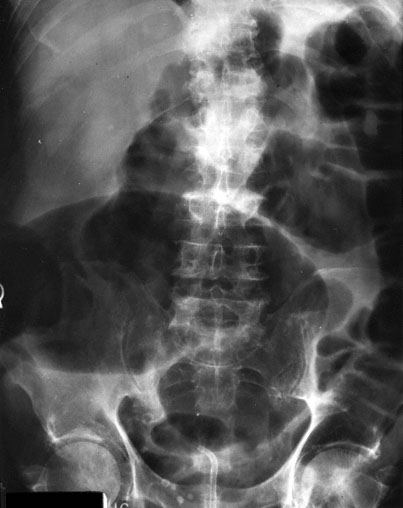
A 62-year-old woman is brought to the emergency department because of a 1-day history of severe abdominal pain. Two weeks ago, she began taking amoxicillin-clavulanate for a respiratory tract infection. One week later, she had fever, bloody diarrhea, and mild abdominal cramps. She discontinued the amoxicillin-clavulanate, and began taking over-the-counter omeprazole and loperamide for relief of the symptoms. Her symptoms have worsened, and she now rates her abdominal pain as a 9 on a 10-point scale. She has a 6-year history of type 2 diabetes mellitus controlled with diet. She was not taking any medications prior to the amoxicillin-clavulanate. She appears acutely ill. She is 165 cm (5 ft 5 in) tall and weighs 104 kg (230 lb); BMI is 38 kg/m2. Her temperature is 38.6°C (101.5°F), pulse is 110/min, respirations are 14/min, and blood pressure is 112/76 mm Hg. Abdominal examination shows distention and diffuse tenderness to palpation and voluntary guarding. The remainder of the examination shows no abnormalities. Her leukocyte count is 28,000/mm3. Test of the stool for Clostridium difficile toxin A is positive. An abdominal x-ray is shown. Which of the following is the most likely cause of this patient’s condition?
CorrectIncorrect -
Question 2 of 20
2. Question
A randomized clinical trial is conducted to assess the risks and benefits of surgery compared with pharmacotherapy for the treatment of symptomatic high-grade carotid artery stenosis. A total of 3000 patients are randomly assigned to undergo surgery or receive pharmacotherapy. After excluding the 98 patients who died during surgery, the investigators found that surgery is associated with a 48% reduction in stroke. Which of the following raises the most concern regarding the validity of this conclusion?
CorrectIncorrect -
Question 3 of 20
3. Question
A 25-year-old man is being observed in the emergency department after he was evacuated from a mountainous area while backpacking alone during a snowstorm. The wilderness search team found him 2 days after he lost his way. The patient was wearing wet clothing, and he was cold, confused, and hallucinating. Initial vital signs were pulse 40/min, respirations 8/min, and blood pressure 80/50 mm Hg. Inclement weather delayed helicopter access for 6 hours. Field treatment included removal of wet clothing, warming with layers of dry clothing and sleeping bags, and later administration of warm liquids. On arrival at the emergency department, the patient was alert, fully oriented, and shivering. Vital signs were core temperature 36.1°C (97.0°F), pulse 68/min, respirations 14/min, and blood pressure 100/70 mm Hg. The patient’s feet were cold to the touch and mildly erythematous from ankle to midfoot. There were mixed erythematous and pale areas distally, as well as mild edema. There were several small blisters filled with bloody fluid over the proximal toes. Sensation was poor in both feet. No gangrene was present. The patient’s feet were immersed in water with a temperature of 42.0°C to 44.0°C. Now, 6 hours later the patient reports severe pain in his feet. The feet are hyperemic to midfoot, with numbness to the ankles. Distally, his feet are pale and have more dark blebs. The patient is worried about his feet and asks what will happen. At this time it is most appropriate to tell him which of the following?
CorrectIncorrect -
Question 4 of 20
4. Question
A 37-year-old woman comes to the emergency department because of fever and shortness of breath for 4 days. She has a history of intravenous drug use. Her temperature is 39°C (102.2°F), and blood pressure is 160/60 mm Hg. Examination shows splinter hemorrhages under several fingernails. A grade 2/6, high-pitched, decrescendo diastolic murmur is heard at the third left intercostal space. Which of the following is the most likely cause of these findings?
CorrectIncorrect -
Question 5 of 20
5. Question
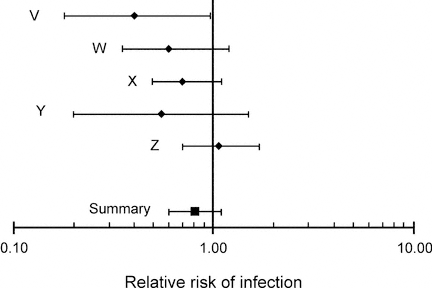
A meta-analysis is conducted of five randomized, blinded, placebo-controlled clinical trials to assess the effectiveness of prophylactic antibiotic use prior to IUD insertion. The number of participants in each trial ranges from 22 to 58. Trials V and W use oral doxycycline. Trials X, Y, and Z use oral clindamycin. The outcome of all trials is the development of postprocedural infection. The results are shown in the graph. On the basis of these data, which of the following is the most accurate conclusion regarding prophylactic antibiotic use prior to IUD insertion?
CorrectIncorrect -
Question 6 of 20
6. Question
An 82-year-old woman is disoriented 6 hours after undergoing a total abdominal hysterectomy and bilateral salpingo-oophorectomy under general anesthesia for endometrial cancer. She was placed on patient-controlled analgesia with hydromorphone postoperatively. Nine years ago, she underwent lumpectomy and axillary dissection followed by radiation therapy for stage I breast cancer. Other medical history includes hypothyroidism, hypertension, and hypercholesterolemia. Her pulse is 72/min, respirations are 7/min, and blood pressure is 127/62 mm Hg. During the examination, the patient stops breathing. The physician calls the rapid response (Code Blue) team. Intravenous administration of naloxone is begun; the patient’s condition improves, and her respirations increase to 22/min. Which of the following is the most appropriate course of action by the hospital staff?
CorrectIncorrect -
Question 7 of 20
7. Question
A 57-year-old woman comes to the physician because of a 3-month history of a nonproductive cough and intermittent flushing of her face and neck. The flushing occurs three times daily and lasts approximately 30 minutes; it is not associated with eating or drinking. Ten years ago, she underwent a cholecystectomy for cholelithiasis. She takes no medications. Her last menstrual period was 5 years ago. She does not smoke or drink alcohol. Her temperature is 36.9°C (98.4°F), pulse is 92/min, respirations are 12/min, and blood pressure is 100/60 mm Hg. Examination shows no abnormalities. An x-ray of the chest shows a 3-cm mass in the left upper lobe. An increased serum concentration of which of the following substances is most likely to contribute to this patient’s symptoms?
CorrectIncorrect -
Question 8 of 20
8. Question
A 72-year-old man comes to the physician because of a 4-year history of nonproductive chronic cough. The cough primarily occurs during eating or drinking; he has frequently coughed up undigested food and pills. He has not had nausea or vomiting or the sensation of food stuck in his throat. He has required admission to the hospital twice during the past 2 years for treatment of aspiration pneumonia. He has arthritis and hypercholesterolemia. His only medication is lovastatin. He does not smoke cigarettes or drink alcohol. Vital signs are within normal limits. During the examination, he is coughing continuously. Examination shows no abnormalities except for a grade 2/6 systolic murmur. Which of the following is the most likely diagnosis?
CorrectIncorrect -
Question 9 of 20
9. Question
A 21-year-old woman comes to the physician because of a 1-day history of redness and itchiness of her right eye. When she awoke this morning, she had mild crusting over her eyelashes. She has not had fever, dry mouth, muscle aches, or rash. She has no allergies or history of serious illness. She takes no medications. She works in a preschool. Vital signs are within normal limits. Examination shows moderate, diffuse injection of the right conjunctiva. Which of the following is the most appropriate pharmacotherapy?
CorrectIncorrect -
Question 10 of 20
10. Question
A 32-year-old woman is brought to the emergency department because of a 24-hour history of increasingly severe lower abdominal pain. She has been unable to eat anything for 12 hours because of nausea. She has been taking sulfasalazine for ulcerative colitis for 6 months. Her temperature is 38.2°C (100.8°F). Examination shows a distended, tympanitic abdomen. There is tenderness to palpation of the lower quadrants. Bowel sounds are decreased. An x-ray of the abdomen shows a dilated colon and gas in the bowel wall. Which of the following is the most appropriate next step in management?
CorrectIncorrect -
Question 11 of 20
11. Question
A 36-year-old woman comes to the office because of a 2-month history of a mildly painful rash around her mouth and vagina, decreased sense of taste, and hair loss. Six months ago, she underwent uncomplicated Roux-en-Y gastric bypass because of obesity. Since that time, she has had a 27-kg (60-lb) weight loss. She has type 2 diabetes mellitus and hypertension. Her medications are metformin and amlodipine. She takes a multivitamin inconsistently. She is 160 cm (5 ft 3 in) tall and weighs 95 kg (210 lb); BMI is 37 kg/m2. Her pulse is 86/min, and blood pressure is 130/80 mm Hg. Examination shows an erythematous, scaling rash in the perioral and perianal areas. There is diffuse thinning of the hair over the scalp. Cardiopulmonary examination shows no abnormalities. The abdomen is obese, and there is diffuse, mild tenderness to palpation. Bowel sounds are normal. Supplementation with which of the following is most likely to have prevented this patient’s condition?
CorrectIncorrect -
Question 12 of 20
12. Question
A 32-year-old man comes to the office because of episodes of the sensation of a racing heart, sweating, difficulty breathing and swallowing, and the fear that he is dying. His symptoms began when he started a new job 4 weeks ago. He has had four episodes during the past 2 weeks. He says these episodes are similar to episodes he had 10 years ago. He has a history of alcohol use disorder but has been abstinent for 2 years. He has no other history of serious illness and takes no medications. His father and paternal grandfather had alcohol use disorder. The patient is calm and cooperative. Pulse is 74/min, respirations are 16/min, and blood pressure is 116/72 mm Hg. Physical examination shows no abnormalities. On mental status examination, he is engaging and says he has not felt depressed. His affect is reactive, and his thought process is goal directed. Serum studies show a thyroid-stimulating hormone concentration of 3 μU/mL and thyroxine (T4) concentration of 5 μg/dL. Which of the following is the most appropriate pharmacotherapy?
CorrectIncorrect -
Question 13 of 20
13. Question
A 42-year-old woman is brought to the emergency department 30 minutes after the sudden onset of left-sided weakness and a moderate headache while exercising at the gym. She reports that the weakness occurred almost immediately after the sudden onset of pain in her right jaw that radiated to the right temple. She has no history of serious illness and takes no medications. She is awake and alert. Her temperature is 37°C (98.6°F), pulse is 90/min, and blood pressure is 150/90 mm Hg. Examination shows left homonymous hemianopia. The right pupil is 2 mm, and the left is 4 mm. Both pupils are reactive to light. There is partial ptosis of the right eye and drooping of the left lower aspect of the face. Muscle strength is 5/5 in the right extremities and 4/5 in the left extremities. Deep tendon reflexes are 2+ in the right extremities and 3+ in the left extremities. Babinski sign is absent on the right and present on the left. Which of the following is the most likely diagnosis?
CorrectIncorrect -
Question 14 of 20
14. Question
A previously healthy 18-year-old primigravid woman at 22 weeks’ gestation comes to the physician because of a genital lesion for 2 days. She is sexually active with multiple partners, but she has no history of sexually transmitted diseases. Examination shows a 1.5-cm, painless, superficial ulcer on the left labium majus. There is nontender, firm inguinal lymphadenopathy. Serologic testing 8 weeks ago was negative for syphilis, Neisseria gonorrhoeae, and Chlamydia trachomatis. Which of the following is the most appropriate pharmacotherapy?
CorrectIncorrect -
Question 15 of 20
15. Question
A 9-month-old boy is brought to the office by his parents for a well-child examination in late autumn. He was born at 34 weeks’ gestation via spontaneous vaginal delivery to a 24-year-old woman, gravida 2, para 2, following an uncomplicated pregnancy. Medical history is noncontributory, and he receives no medications. His growth and development have been appropriate for age, and required vaccinations are up-to-date as of his last well-child visit. The patient is 72 cm (28.5 in; 50th percentile) long and weighs 10 kg (22 lb; 75th percentile). Vital signs are within normal limits. Physical examination discloses no abnormalities. Which of the following is the most appropriate condition to vaccinate against at this time?
CorrectIncorrect -
Question 16 of 20
16. Question
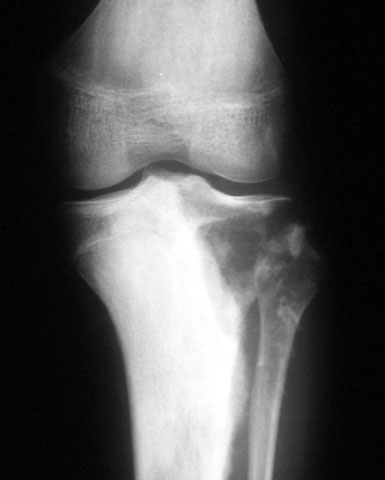
A 17-year-old girl comes to the office because of a 2-month history of increasingly severe pain below her left knee at rest and with exertion. She now has moderate difficulty walking because of the pain. She has no history of trauma or serious illness. She takes no medications. On examination, she is unable to bear her full weight on the left lower extremity. There is warmth and tenderness over the anterolateral aspect of the left proximal tibia. Peripheral pulses are 2+. There is no evidence of instability of the ligaments of the left knee. The remainder of the examination, including neurologic examination, shows no abnormalities. X-ray of the left knee is shown. Which of the following is the most appropriate next step in management?
 CorrectIncorrect
 -
Question 17 of 20
17. Question
A 25-year-old woman comes to the physician because of a 3-day history of low-grade fever, sore throat, generalized muscle aches, and fatigue. She also has had moderate neck pain radiating to her jaw and ears during this period. She has no history of serious illness and takes no medications. She is alert and in no distress. Her temperature is 38.2°C (100.8°F), pulse is 110/min, respirations are 16/min, and blood pressure is 120/80 mm Hg. The thyroid gland is diffusely tender and slightly enlarged. Examination of the head, ears, eyes, nose, and oropharynx shows no abnormalities. Serum studies show a thyroid-stimulating hormone concentration of 0.5 μU/mL and a thyroxine (T4) concentration of 16 μg/dL. A 131I thyroid scan shows decreased uptake. Which of the following is the most appropriate next step in management?
CorrectIncorrect -
Question 18 of 20
18. Question

A previously healthy 4-month-old girl is brought to the emergency department because of a 2-day history of fever. She has been feeding poorly and has vomited four times during the past 24 hours. She has not had diarrhea. Immunizations were up-to-date at the age of 2 months. On arrival, she appears somnolent and is irritable. She is at the 50th percentile for length and head circumference and the 25th percentile for weight. Her temperature is 39.6°C (103.3°F), pulse is 180/min, and respirations are 42/min. Examination shows a full anterior fontanel. The remainder of the examination shows no abnormalities. A lumbar puncture is performed. A Gram stain of the cerebrospinal fluid is shown. Which of the following is the most likely causal organism?
CorrectIncorrect -
Question 19 of 20
19. Question
A 63-year-old man who has chronic obstructive pulmonary disease (COPD) returns to the office for a follow-up visit. His COPD has progressed during the past 3 years. He smoked cigarettes for 48 years but quit 1 year ago; he continues to have chronic cough, dyspnea on exertion, and episodes of wheezing. He says he often sleeps in his recliner so that his snoring and coughing will not bother his wife. Current medications include inhaled albuterol, budesonide, and ipratropium for the past 2 months. He received a pneumococcal polysaccharide vaccine, 23-valent, 2 years ago. He is a retired postal worker and is frustrated because he is no longer able to walk from the car to the poker room at the local community center to play cards with his friends. Today, pulse is 90/min and regular, and blood pressure is 130/78 mm Hg. He appears large and has a barrel-shaped chest. Breath sounds are decreased, and scattered wheezes are heard. No gallops or murmurs are heard on cardiac examination. Leukocyte count is 12,000/mm3 and hemoglobin concentration is 14 g/dL. After the patient receives nebulized albuterol, pulse oximetry on room air shows an oxygen saturation of 86%. Which of the following is the most important factor in this patient’s history and physical examination in determining his prognosis?
CorrectIncorrect -
Question 20 of 20
20. Question
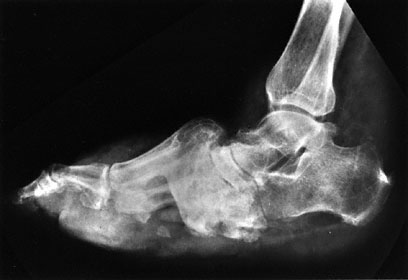
A 52-year-old woman with type 2 diabetes mellitus is admitted to the hospital because of a 3-week history of persistent pain, edema, and erythema of the left foot. She has not sustained trauma to the foot. She has no history of foot ulcers or wounds. Her medications are insulin and aspirin. Vital signs are within normal limits. Examination of the left foot shows diffuse edema, erythema, and warmth; there is no tenderness to palpation. The dorsalis pedis and posterior tibial pulses are 2+ bilaterally. Sensation to touch and pinprick is decreased in a stocking distribution bilaterally. The remainder of the examination shows no abnormalities. Laboratory studies show:
Hematocrit
38%
Leukocyte count
10,500/mm3 with a normal differential
Erythrocyte sedimentation rate
40 mm/h
Serum uric acid
8 mg/dL
Antibiotic therapy is begun. Three days later, examination findings are unchanged. A repeat leukocyte count is within the reference range. Blood cultures obtained before administration of antibiotic therapy show no growth. An x-ray of the left foot is shown. Which of the following is the most likely diagnosis?
CorrectIncorrect