
NBME 13 – Block 1 (Duplicate 2)
Time limit: 0
Quiz Summary
0 of 20 Questions completed
Questions:
Information
You have already completed the quiz before. Hence you can not start it again.
Quiz is loading…
You must sign in or sign up to start the quiz.
You must first complete the following:
Results
Quiz complete. Results are being recorded.
Results
0 of 20 Questions answered correctly
Your time:
Time has elapsed
You have reached 0 of 0 point(s), (0)
Earned Point(s): 0 of 0, (0)
0 Essay(s) Pending (Possible Point(s): 0)
Categories
- Not categorized 0%
- 1
- 2
- 3
- 4
- 5
- 6
- 7
- 8
- 9
- 10
- 11
- 12
- 13
- 14
- 15
- 16
- 17
- 18
- 19
- 20
- Current
- Review
- Answered
- Correct
- Incorrect
-
Question 1 of 20
1. Question
A 12-year-old boy with Crohn disease is brought to the physician because of a 2-week history of fever. His medications are sulfasalazine and prednisone. He is at the 50th percentile for height and 10th percentile for weight. Vital signs are within normal limits. Examination shows a 7-mm perianal skin tag. There is mild tenderness to palpation over the abdomen. Laboratory studies show:
Hematocrit
35% (N=36%–47%)
Leukocyte count
1000/mm3
Platelet count
200,000/mm3
Serum anti–neutrophil cytoplasmic antibody assay
negative
Which of the following is the most likely explanation for these laboratory findings?
CorrectIncorrect -
Question 2 of 20
2. Question
A 32-year-old man comes to the office because of a 1-week history of leg swelling and increasing shortness of breath on exertion. Last night, he had difficulty breathing while lying flat. Two weeks ago, he had muscle pain, dry cough, and fever to 38.3°C (101°F), but his symptoms resolved without treatment. Today, his temperature is 37°C (98.6°F), pulse is 110/min, respirations are 20/min, and blood pressure is 100/70 mm Hg. Jugular venous pressure is 15 cm H2O (N=5–9). Diffuse crackles are heard over the lower half of both lung fields. A grade 2/6 holosystolic murmur is heard best at the apex. There is an S3 gallop. There is 2+ edema of the lower extremities. Echocardiography shows ventricular dilation and an ejection fraction of 20%. In addition to a diuretic, which of the following is the most appropriate pharmacotherapy?
CorrectIncorrect -
Question 3 of 20
3. Question
A 37-year-old primigravid woman at 15 weeks’ gestation comes to the physician for her first prenatal visit. She has no history of serious illness and takes no medications. Pelvic examination shows a uterus consistent in size with a 15-week gestation. Her maternal serum α-fetoprotein concentration is 0.2 multiples of the median. This patient’s fetus is at increased risk for which of the following?
CorrectIncorrect -
Question 4 of 20
4. Question
A 37-year-old man comes to the emergency department 2 hours after the sudden onset of chest pain while using cocaine. He is on parole for charges of drug possession and breaking and entering. He drinks six cans of beer daily. His temperature is 37°C (98.6°F), pulse is 84/min, respirations are 20/min, and blood pressure is 160/95 mm Hg. Physical examination shows diaphoresis. There are old needle track marks on his arms. He is alert and oriented to person, place, and time. There is no evidence of paranoia or hallucinations. During the examination, his girlfriend asks him where he got the cocaine, and he provides the dealer’s name. An ECG shows an evolving anterior wall myocardial infarction. After stabilization, which of the following is the most appropriate next step regarding disclosure of his drug use?
CorrectIncorrect -
Question 5 of 20
5. Question
A 7-year-old girl is admitted to the intensive care unit because of a 5-hour history of confusion, seizures, vomiting, and diarrhea. Her mother says the symptoms began suddenly with no known cause. The patient has no history of serious illness and receives no medications. On examination, she is obtunded. There is dry skin, poor skin turgor, hyperreflexia, and myoclonus. The mother hovers by the patient’s bedside and appears to be concerned about caring for her. For a nonmedical professional, the mother is unusually knowledgeable about medicine, which she demonstrates during frequent conversations with the nursing staff. During the early morning hours on hospital day 1, a nurse enters the patient’s room and finds the mother trying to administer an unknown medication to the patient. Further investigation shows that the mother has a history of psychiatric illness and has been administering her own psychotropic medication to her daughter. Administration of which of the following medications is the most likely explanation for this patient’s presenting symptoms?
CorrectIncorrect -
Question 6 of 20
6. Question
A 37-year-old man who is a sergeant in the US Army comes to the clinic because of a 4-week history of fever, mild cramping abdominal pain, and occasional bloody diarrhea. During this time, he has had a 3-kg (7-lb) weight loss because of decreased appetite. He has not had nausea or vomiting. He has no history of serious illness, has no known allergies, and takes no medications. Four weeks ago, he returned from a deployment to the Caribbean in support of humanitarian efforts after a natural disaster. During the deployment, he frequently ate food and drank water sold by local street vendors. He appears uncomfortable but is not in acute distress. Temperature is 38.0°C (100.4°F), pulse is 88/min, respirations are 12/min, and blood pressure is 128/72 mm Hg. Abdominal examination shows softness with mild right lower quadrant tenderness. There is no hepatosplenomegaly and no rebound or guarding. The remainder of the examination shows no abnormalities. Results of laboratory studies are shown:
Hemoglobin
11.4 g/dL
Hematocrit
33%
Leukocyte count
11,000/mm3
Segmented neutrophils
78%
Bands
2%
Eosinophils
4%
Lymphocytes
15%
Monocytes
1%
Platelet count
210,000/mm3
Serum liver enzyme activities and results of a comprehensive serum metabolic panel are within the reference ranges. Which of the following stool studies is most likely to confirm the diagnosis?
CorrectIncorrect -
Question 7 of 20
7. Question
A 32-year-old man is brought to the physician by his wife because he has fallen several times and has had progressive confusion during the past 3 days. He reports difficulty keeping his balance while walking. He sustained a left femoral fracture in a motor vehicle collision 3 years ago and a right metacarpal fracture in a fight 1 year ago. He has a history of pancreatitis, gastroesophageal reflux disease, and major depressive disorder. Current medications are pantoprazole and sertraline. He is oriented to person and place but not to time. His temperature is 37°C (98.6°F), pulse is 110/min, and blood pressure is 150/90 mm Hg. Examination shows difficulty with conjugate gaze and bilateral weakness on abduction of both eyes. His gait is broad based and ataxic. Laboratory studies show:
Hemoglobin
13 g/dL
Hematocrit
39%
Mean corpuscular volume
98 μm3
Serum
Total bilirubin
1 mg/dL
AST
69 U/L
ALT
65 U/L
Supplementation with which of the following would most likely have prevented this patient’s current condition?
CorrectIncorrect -
Question 8 of 20
8. Question
An 11-year-old boy is brought to the office by his parents because he has refused to attend school during the past 2 months. His parents say he has become increasingly anxious during this time. He has refused to give them an explanation for why he is avoiding school. The patient received 4 months of psychotherapy at the age of 8 years because he insisted on changing his shirt several times before leaving the house to go to school and was always late. According to the parents, he was diagnosed with an anxiety disorder, and his shirt-changing behavior stopped after 10 sessions. He has no other history of serious illness and receives no medications. Physical examination shows no abnormalities. When interviewed alone, the patient explains to the physician that, “My mother has developed diabetes, and I cannot get it out of my head that she will die if I go to school.” He adds that several times daily, he checks to make sure there is enough insulin in the house. Which of the following is the most likely diagnosis?
CorrectIncorrect -
Question 9 of 20
9. Question
A 57-year-old woman, gravida 2, para 2, comes to the physician 3 weeks after noticing a mass in her right breast during self-examination. Ten years ago, she underwent stereotactic biopsy of the left breast that showed a benign adenoma. Menarche was at the age of 13 years, and menses occurred at regular 28-day intervals until menopause 6 years ago. She delivered her first child at the age of 28 years. The patient’s maternal aunt had breast cancer diagnosed at the age of 67 years. Examination of the patient’s right breast shows a 3-cm, fixed, tender, solid mass in the upper outer quadrant. No regional lymphadenopathy is palpated. Examination of the left breast shows a faint surgical scar but no other abnormalities. Which of the following is the strongest predisposing risk factor for breast cancer in this patient?
CorrectIncorrect -
Question 10 of 20
10. Question
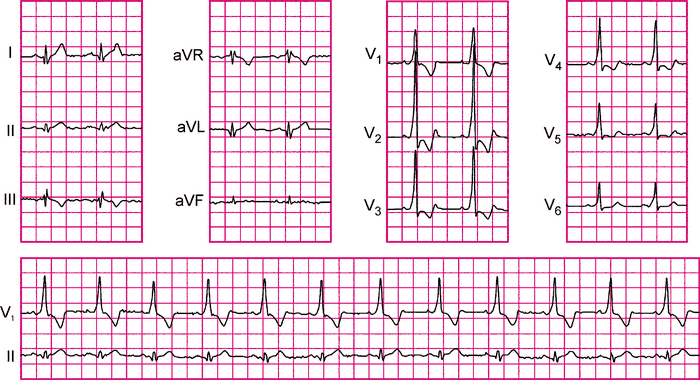
A 19-year-old woman is brought to the office because of a 3-month history of recurrent palpitations and light-headedness. She is a college athlete, and the episodes usually occur during vigorous exercise, last 2 to 3 minutes, and subside spontaneously. She has been in good health and does not take dietary supplements or medications. A complete blood count and serum electrolyte and thyroid-stimulating hormone concentrations are within the reference ranges. An ECG is shown. Which of the following is the most appropriate next step in management?
CorrectIncorrect -
Question 11 of 20
11. Question
A 9-year-old girl is brought to the physician by her mother because of concern that her daughter’s breasts have been enlarging during the past 3 months. The girl is dressed similarly to her mother and says that she enjoys wearing her mother’s clothing, playing with makeup, and “being a girl.” The mother’s only medication is a progestin-only oral contraceptive. The patient is at the 80th percentile for height and weight. Breast development is sexual maturity rating (SMR) stage 2, and pubic hair development is SMR stage 3. There is scant axillary hair. Examination shows no other findings. Which of the following is the most likely cause of this patient’s breast development?
CorrectIncorrect -
Question 12 of 20
12. Question
A 4-year-old boy is brought to the emergency department by his parents because of a 2-day history of increasingly severe pain of his right leg with an associated limp. He has not fallen or sustained any trauma. One week ago, he was treated with amoxicillin for a middle ear infection. He has no history of serious illness and currently takes no medications. He is at the 50th percentile for height and weight. Vital signs are within normal limits. On examination, the patient holds the right hip flexed and externally rotated. Passive range of motion of the right hip is limited by pain. An x-ray of the right hip shows no abnormalities. His leukocyte count is 10,000/mm3, erythrocyte sedimentation rate is 15 mm/h, and serum C-reactive protein concentration is 1.5 mg/L (N=0.08–3.1). Which of the following is the most appropriate treatment for this patient?
CorrectIncorrect -
Question 13 of 20
13. Question
A 9-month-old boy is brought to the office by his parents because they are concerned about swelling in his abdomen that has been present since birth and has increased during the past 2 weeks. The patient’s diet consists of cow milk-based formula, baby food, and some solid food. He has six wet diapers and one bowel movement daily. He has no history of serious illness and receives no medications. He is at the 75th percentile for length, weight, and head circumference. Vital signs are within normal limits. Abdominal examination shows a 2-cm protrusion from the umbilicus that is easily reducible; there is no erythema, induration, or tenderness to palpation. Which of the following is the most appropriate next step in management?
CorrectIncorrect -
Question 14 of 20
14. Question
A pediatric clinic implements a screening test for determining alcohol use in adolescent patients. The screening test has an 85% sensitivity and 95% specificity. A 15-year-old boy has a positive result prior to being examined by the physician. The prevalence of alcohol use in the adolescent patients in this clinic is 10%. Which of the following best explains how the positive result on the screening test affects the probability that this patient consumes alcohol?
CorrectIncorrect -
Question 15 of 20
15. Question
A 27-year-old woman comes to the emergency department because of “boils” on her groin and in her armpits. She has had one previous episode during pregnancy 2 years ago requiring incision and drainage. Examination shows an inflamed, tender, foul-smelling nodule in the left axilla with seropurulent drainage and erythematous papules in the inguinal-femoral region. A 2-week course of broad-spectrum antibiotics is started, and the axillary abscess is drained. Which of the following is the most likely natural course of this disease?
CorrectIncorrect -
Question 16 of 20
16. Question
Patient Information
Age: 62 years
Gender: F, self-identified
Ethnicity: unspecified
Site of Care: office
History
Reason for Visit/Chief Concern: “I’m having chest pain, and my heart is racing; I can’t seem to catch my breath.”
History of Present Illness:
• 3-day history of worsening chest pain, palpitations, and shortness of breath
• reports nonproductive cough and feeling warm, attributed to an upper respiratory tract infection 5 to 7 days ago
• symptoms exacerbated by exertion and lying flat
• symptoms alleviated by rest and sitting up
• has not had similar symptoms previously
Past Medical History:
• 20-year history of hypertension
• 2-year history of osteoporosis
• mild anxiety
Medications:
• amlodipine
• calcium supplement and vitamin D supplementation
• prn: alprazolam for sleep and anxiety
• prn ibuprofen for occasional back pain
• prn guaifenesin for recent viral respiratory infection
Allergies:
• no known drug allergies
Psychosocial History:
• does not smoke cigarettes
• drinks two to four alcoholic beverages weekly
• does not use illicit drugs
• works part-time as a teller at a bank
• sexually active and monogamous with her husband
• no recent travel
Physical Examination
Temp
Pulse
Resp
BP
O2 Sat
Ht
Wt
BMI
36.9°C
115/min
18/min
110/82 mm Hg
94%
162 cm
75 kg
28 kg/m2
(98.5°F)
on RA
(5 ft 4 in)
(165 lb)
• Appearance: awake, alert, interactive
• HEENT: pupils are equal, round, and reactive to light; conjunctivae are anicteric; mucous membranes are moist
• Pulmonary: bilateral basilar crackles approximately one-quarter of the way up the posterior lung fields; no rhonchi or wheezes
• Cardiac: tachycardia with a regular rhythm, S1 and S2, without murmurs, rubs, or gallops; jugular venous pressure 7 cm H2O above the sternal angle
• Abdominal: no abnormalities
• Extremities: no abnormalities
• Neurologic: no abnormalities
Diagnostic Studies
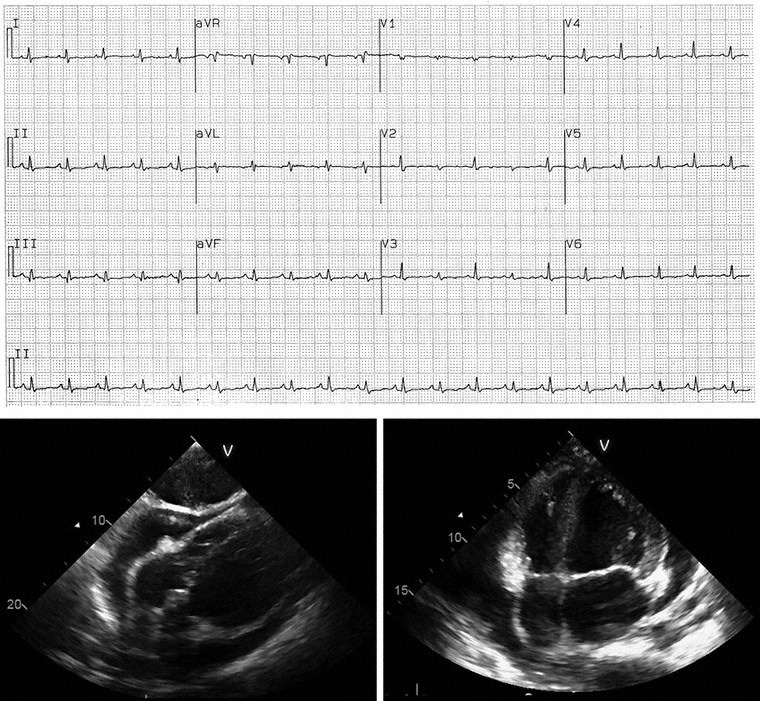
• ECG and parasternal (left) and four-chamber (right) echocardiography views are shown
Question: Which of the following is the most likely diagnosis?
CorrectIncorrect -
Question 17 of 20
17. Question
A study is conducted to evaluate the effectiveness of testing stool for occult blood. One thousand men between the ages of 45 and 60 years who come to the physician for a routine health maintenance examination are enrolled in the study. Results show that 70 of 100 patients with colon cancer have a positive test of the stool for occult blood, and 720 of 900 patients without colon cancer have a negative test of the stool for occult blood. Which of the following is the most accurate conclusion regarding this study?
CorrectIncorrect -
Question 18 of 20
18. Question
A medical director of a multisite internal medicine practice wants to maximize delivery of preventive services to patients. The practice has four sites, each employing one lead physician, one office manager, and 50 internists. Which of the following strategies is most likely to be effective?
CorrectIncorrect -
Question 19 of 20
19. Question
A 2-year-old boy is brought to the physician by his mother because of a 1-week history of rectal tissue protruding from his anus when he strains vigorously during bowel movements. The tissue retracts spontaneously within 1 hour. His mother notes that his stools are hard. He has no history of serious illness and receives no medications. Immunizations are up-to-date. Growth and development are appropriate for age. The patient’s paternal uncle has a history of intermittent abdominal pain and diarrhea; he recently began a gluten-free diet on the advice of a friend. The patient’s family dog recently was treated for worms. Examination of the patient shows no abnormalities; the anus appears normal. Which of the following is the most likely cause of this patient’s symptom?
CorrectIncorrect -
Question 20 of 20
20. Question
A 32-year-old man comes to the physician for a follow-up examination. He was admitted to the hospital 2 months ago for treatment of Pneumocystis jirovecii pneumonia and received the diagnosis of HIV infection at that time. After discharge from the hospital, he completed his antibiotic course but missed scheduled follow-up appointments. He currently takes no medications. He says he feels well. Examination shows no abnormalities. Which of the following is the most appropriate next step in management?
CorrectIncorrect