
NBME 13 – Block 1 (Duplicate 1)
Time limit: 0
Quiz Summary
0 of 20 Questions completed
Questions:
Information
You have already completed the quiz before. Hence you can not start it again.
Quiz is loading…
You must sign in or sign up to start the quiz.
You must first complete the following:
Results
Quiz complete. Results are being recorded.
Results
0 of 20 Questions answered correctly
Your time:
Time has elapsed
You have reached 0 of 0 point(s), (0)
Earned Point(s): 0 of 0, (0)
0 Essay(s) Pending (Possible Point(s): 0)
Categories
- Not categorized 0%
- 1
- 2
- 3
- 4
- 5
- 6
- 7
- 8
- 9
- 10
- 11
- 12
- 13
- 14
- 15
- 16
- 17
- 18
- 19
- 20
- Current
- Review
- Answered
- Correct
- Incorrect
-
Question 1 of 20
1. Question
A 37-year-old woman comes to the physician for evaluation of malnutrition secondary to systemic sclerosis (scleroderma). Six months ago, she had an elective abortion because of her poor medical condition and has had a 9-kg (20-lb) weight loss since that time. She says she has difficulty falling asleep; she awakens daily at 4 am and cannot go back to sleep. She is 173 cm (5 ft 8 in) tall and weighs 48 kg (105 lb); BMI is 16 kg/m2. Physical examination shows no other abnormalities. On mental status examination, she is sad and tearful and reports feeling hopeless. Her serum albumin concentration is 2.2 g/dL. In addition to aggressive nutritional support, which of the following is the most appropriate pharmacotherapy?
CorrectIncorrect -
Question 2 of 20
2. Question
A 72-year-old man comes to the office for a routine examination. He underwent carotid endarterectomy and five-vessel coronary artery bypass grafting 1 and 5 years ago, respectively. He has hypertension, hyperlipidemia, chronic kidney disease, and gastroesophageal reflux disease. Medications are clopidogrel, hydrochlorothiazide, metoprolol, atorvastatin, famotidine, and aspirin. He has smoked two packs of cigarettes daily for 50 years. Temperature is 37.0°C (98.6°F), pulse is 62/min, respirations are 12/min, and blood pressure is 184/96 mm Hg. Examination shows no other abnormalities. Results of laboratory studies are shown:
Hemoglobin
13.6 g/dL
Hematocrit
44%
Leukocyte count
8500/mm3
Serum
Na+
134 mEq/L
K+
4.1 mEq/L
Cl−
98 mEq/L
HCO3−
24 mEq/L
Urea nitrogen
22 mg/dL
Creatinine
1.5 mg/dL
Lisinopril is added to the medication regimen. Two weeks later, the patient returns to the physician for a follow-up visit. Pulse is 64/min, and blood pressure is 136/84 mm Hg. Examination is otherwise unchanged. Results of laboratory studies are shown:
Serum
Urea nitrogen
46 mg/dL
Creatinine
3.6 mg/dL
Urine
Blood
none
Protein
none
Hyaline casts
0–1/hpf
Which of the following is the most likely cause of the change in renal function in this patient?
CorrectIncorrect -
Question 3 of 20
3. Question
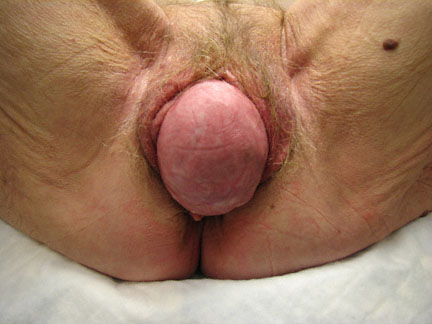
A 62-year-old woman, gravida 3, para 3, comes to the physician because of a 3-month history of a painless mass protruding from her vagina with bowel movements. She has the sensation of incomplete emptying of the bladder unless she pushes the mass back into her vagina. During the past 5 years, she has had increased pelvic pressure with prolonged standing or lifting. She does not have urine loss when coughing or laughing. She has no history of serious illness and takes no medications. All her pregnancies ended in uncomplicated vaginal deliveries. The patient is 160 cm (5 ft 3 in) tall and weighs 50 kg (110 lb); BMI is 20 kg/m2. Vital signs are within normal limits. A photograph of the mass is shown. Examination shows no other abnormalities. Which of the following is the most likely diagnosis?
CorrectIncorrect -
Question 4 of 20
4. Question
A 1-day-old male newborn is evaluated in the hospital nursery. He was born at term to a 23-year-old woman, gravida 1, para 1, following an uncomplicated pregnancy and spontaneous vaginal delivery. Apgar scores were 7 and 8 at 1 and 5 minutes, respectively. He has been bottle-fed but feeds slowly. On examination of the patient’s mother, grip strength is 4/5, and she has difficulty releasing her grip. The mother is adopted; her and the father’s family medical histories are unknown. The patient does not appear to be in distress. He is at the 45th percentile for length, 75th percentile for weight, and 50th percentile for head circumference. His temperature is 35.7°C (96.2°F), pulse is 132/min, respirations are 36/min, and blood pressure is 82/45 mm Hg. Pulse oximetry on room air shows an oxygen saturation of 98%. He does not have a vigorous suck or loud cry. On passive range of motion, muscle tone is decreased throughout. Spontaneous movements are decreased when the patient is awake. Moro reflex is poor. Deep tendon reflexes are absent. The remainder of the examination shows no abnormalities. Which of the following is the most likely diagnosis?
CorrectIncorrect -
Question 5 of 20
5. Question
An 88-year-old woman remains hospitalized 1 day after undergoing an 8-hour total hip replacement. She is 163 cm (5 ft 4 in) tall and weighs 77 kg (169 lb); BMI is 29 kg/m2. Her temperature is 36.8°C (98.2°F), pulse is 73/min, respirations are 12/min, and blood pressure is 152/89 mm Hg. Examination shows edema of the left gluteus maximus and palsy of the sciatic nerve. A urinary catheter is in place and contains red-colored urine. Laboratory studies show:
Serum
Na+
138 mEq/L
K+
6 mEq/L
Cl−
98 mEq/L
HCO3−
20 mEq/L
Ca2+
8 mg/dL
Creatinine
2 mg/dL
Creatine kinase
20,000 U/L
Phosphorus
4.0 mg/dL
Alkaline phosphatase
110 U/L
Urine
Blood
2+
Protein
2+
RBC
4/hpf
WBC
0/hpf
Which of the following is the most appropriate next step in management?
CorrectIncorrect -
Question 6 of 20
6. Question
A 67-year-old man is brought to the emergency department because of a 2-day history of confusion. His wife says he is forgetful and disoriented to time and place. He has small cell carcinoma of the lung, type 2 diabetes mellitus, and hypertension. His medications are lisinopril and metformin. He smoked one and one-half packs of cigarettes daily for 45 years but quit 5 years ago. He drinks six to seven 12-oz beers weekly. On arrival, he has a generalized tonic-clonic seizure. He is unarousable. His blood pressure is 136/76 mm Hg; other vital signs are within normal limits. Examination shows normal skin turgor; there is no edema. Neurologic examination shows no focal findings. Laboratory studies show:
Serum
Na+
110 mEq/L
K+
3.5 mEq/L
Urea nitrogen
10 mg/dL
Glucose
220 mg/dL
Creatinine
0.8 mg/dL
Uric acid
3.6 mg/dL
Urine
Sodium
60 mEq/L
Osmolality
650 mOsmol/kg H2O
Following admission to the hospital, which of the following is the most appropriate next step in management?
CorrectIncorrect -
Question 7 of 20
7. Question
A 67-year-old woman is admitted to the hospital because of severe shortness of breath. She has a 15-year history of emphysema. Her written advance directive states that she does not want mechanical ventilation in the event of respiratory failure. She now states that she has changed her mind and asks the physician to “do everything” for her, including mechanical ventilation if necessary for survival. Her husband states that she never wanted to “live on a machine.” She is oriented to person, place, time, and situation. Her pulse is 110/min, respirations are 28/min and labored, and blood pressure is 90/60 mm Hg. Examination shows diffuse expiratory wheezing. Inspiratory crackles are heard over the right upper and lower lung fields. Arterial blood gas analysis on 100% oxygen by face mask shows:
pH
7.19
Pco2
70 mm Hg
Po2
60 mm Hg
Which of the following is the most appropriate next step in patient care?
CorrectIncorrect -
Question 8 of 20
8. Question
Six hours after undergoing esophagectomy for esophageal cancer, a 52-year-old man’s blood pressure increases from 130/86 mm Hg to 180/100 mm Hg. Despite receiving an epidural infusion of fentanyl, he rates incisional pain as an 8 on a 10-point scale. He is receiving 5% dextrose in 0.45% saline (125 mL/h); including fluids administered intraoperatively, his fluid balance is +4 L. His postoperative urine output is 50 mL. His pulse is 110/min, and respirations are 18/min. Pulse oximetry on room air shows an oxygen saturation of 100%. Examination shows a dry, intact incision site and a patent nasogastric tube that irrigates clear fluid. The lungs are clear to auscultation. The abdomen is flat, and there is exquisite incisional tenderness. The remainder of the examination shows no abnormalities. His hemoglobin concentration is 10.5 g/dL, and hematocrit is 32%. The most appropriate next step in management of this patient’s increased blood pressure is intravenous administration of a medication from which of the following drug classes?
CorrectIncorrect -
Question 9 of 20
9. Question
A 1000-g (2-lb 3-oz) newborn has no spontaneous breathing following delivery at 34 weeks’ gestation. He is intubated and mechanically ventilated, and he is admitted to the neonatal intensive care unit. Pregnancy was complicated by marked oligohydramnios. His temperature is 36.5°C (97.7°F), and pulse is 160/min. Examination shows flat facies. Breath sounds are decreased. Heart sounds are normal. There are no abdominal masses. Which of the following is the most likely cause of these findings?
CorrectIncorrect -
Question 10 of 20
10. Question
A previously healthy 22-year-old man comes to the physician because of a 1-week history of a severe, frequent, nonproductive cough. His temperature is 37.7°C (99.8°F), pulse is 104/min, respirations are 20/min, and blood pressure is 118/72 mm Hg. Pulse oximetry on room air shows an oxygen saturation of 95%. Mild diffuse crackles are heard. The remainder of the examination shows no abnormalities. A chest x-ray shows diffuse bilateral interstitial infiltrates. Which of the following is the most likely causal organism?
CorrectIncorrect -
Question 11 of 20
11. Question
An 80-year-old woman with hypertension and dementia, Alzheimer type, is brought to the emergency department by paramedics from the nursing care facility where she resides because of a 1-day history of vaginal bleeding. The patient is nonverbal. The staff member who accompanied the patient reports the patient fell 2 nights ago while moving from the shower chair to the bathtub. The bleeding was noted today while a nurse’s aide changed the patient’s absorbent pad this morning. Her medications are donepezil, amlodipine, and aspirin. She is 163 cm (5 ft 4 in) tall and weighs 48 kg (105 lb); BMI is 18 kg/m2. Vital signs and oxygen saturation are within normal limits. Examination shows ecchymoses over the upper extremities and thighs; the ecchymoses are more severe on the right thigh than the left. Genitourinary examination shows ecchymoses over the labia majora and torn labia minora at the 7 o’clock position with minimal bleeding. Her hemoglobin concentration is 12 g/dL and platelet count is 150,000/mm3. Which of the following is the most likely explanation for these findings?
CorrectIncorrect -
Question 12 of 20
12. Question
A 67-year-old man comes to the physician for a second measurement of his blood pressure. He had a blood pressure of 165/105 mm Hg in his right arm 9 days ago. He takes no medications. He has smoked two packs of cigarettes daily for 35 years. Today, his blood pressure is 160/100 mm Hg in the right arm and 105/65 mm Hg in the left arm. The remainder of the examination shows no abnormalities. Which of the following is the most likely cause of these blood pressure findings?
CorrectIncorrect -
Question 13 of 20
13. Question
A 68-year-old woman, gravida 2, para 2, comes to the clinic because of a 3-week history of progressive loss of urine control. She says that when she has the urge to void, she sometimes has urine loss before she reaches the bathroom. She now wears absorbent pads daily. She has hypertension well controlled with hydrochlorothiazide and enalapril and osteoarthritis treated with naproxen. Vital signs are within normal limits. Physical examination, including pelvic examination, shows no abnormalities. Which of the following is the most appropriate next step in management?
CorrectIncorrect -
Question 14 of 20
14. Question
A 49-year-old woman comes to the physician because she has not had a menstrual period for 9 months. She has not had vaginal dryness or hot flashes. She has no history of serious illness or abnormal Pap smears. She has had a levonorgestrel IUD in place for 4 years. Her last visit to a physician was 3 years ago. She is 152 cm (5 ft) tall and weighs 54 kg (120 lb); BMI is 23 kg/m2. Her blood pressure is 145/95 mm Hg. Physical examination shows no other abnormalities. On pelvic examination, the IUD string cannot be seen at the cervical os. Which of the following is the most appropriate next step in management?
CorrectIncorrect -
Question 15 of 20
15. Question
A 19-year-old man, who is a college freshman, comes to the student health center because of a 2-year history of intermittent headaches that have been occurring more frequently during the past 6 months and recently have caused him to miss several days of class. He says the headaches affect either the left or right side of his head, and begin with “sparkling lights” in his peripheral vision and sensitivity to light and sound. The headaches often are brought on by strong odors, hunger, and alcohol consumption. The headaches also are associated with nausea. The patient says he often tries to “sleep them off.” The headaches previously occurred once every few months, but now he has as many as four headaches monthly. Acetaminophen has provided no relief. He has no history of serious illness and takes no other medications. Vital signs are within normal limits. Neurologic examination discloses no abnormalities. Daily use of which of the following medications is most appropriate to recommend to prevent or decrease the frequency of this patient’s headaches?
CorrectIncorrect -
Question 16 of 20
16. Question
A previously healthy 9-year-old boy is brought to the emergency department because of acute pain and swelling around the right elbow since sliding into home plate during a baseball game 30 minutes ago. On arrival, his arm is splinted in newspaper and wrapped with duct tape. He is in acute distress. Examination of the right upper extremity shows edema and severe tenderness around the elbow. There is a distal right humeral deformity. Radial pulses are decreased on the right. X-rays of the right upper extremity show a transverse fracture of the right distal humeral metaphysis with posterior displacement of the distal fragment. This patient is at greatest risk for which of the following sequelae?
CorrectIncorrect -
Question 17 of 20
17. Question
A 17-year-old girl is brought to the physician by her mother because she is concerned that her daughter has never had a menstrual period. The mother reports that her own menarche occurred at the age of 13 years. The patient has no history of serious illness and takes no medications. She is in the 11th grade, receives grades of A’s and B’s, and sings in the school choir. She has never been sexually active. She is 173 cm (5 ft 8 in) tall and weighs 66 kg (145 lb); BMI is 22 kg/m2. Her blood pressure is 100/60 mm Hg. Breast development is sexual maturity rating (SMR) stage 5, and pubic hair development is SMR stage 2. Examination of the external genitalia shows no abnormalities. Insertion of a speculum into the vagina is difficult. The cervix cannot be visualized or palpated. The uterus is not palpable. Karyotype analysis shows a 46,XY chromosome. Which of the following is the most appropriate next step in management?
CorrectIncorrect -
Question 18 of 20
18. Question
A 90-year-old woman, who lives alone, is brought to the emergency department after her family found her lying on the floor of her home. She did not have loss of consciousness. She has hypertension and type 2 diabetes mellitus. On arrival, her pulse is 60/min, respirations are 14/min, and blood pressure is 110/60 mm Hg. Examination shows an open fracture of the tibia. Antibiotic therapy is recommended with irrigation, debridement, and surgical stabilization of the tibia with an intramedullary nail. The patient insists that she will allow irrigation, debridement, and antibiotics but refuses the surgical stabilization and requests discharge to home as soon as possible. Her family provides documentation that the patient has appointed her son as her durable power of attorney. Which of the following is the most appropriate next step in management?
CorrectIncorrect -
Question 19 of 20
19. Question
A 21-year-old man comes to the physician for an examination prior to employment. He feels well. He has no history of serious illness and takes no medications. He is in his first year of law school and sleeps 4 to 5 hours nightly; he reports feeling stressed frequently because of the demanding course load. He has smoked one pack of cigarettes daily for 2 years and drinks one beer daily. He is 178 cm (5 ft 10 in) tall and weighs 91 kg (200 lb); BMI is 29 kg/m2. His pulse is 80/min, and blood pressure is 140/100 mm Hg. Examination shows no abnormalities. Serum electrolyte concentrations are within the reference ranges. Urinalysis shows no abnormalities. In addition to a subsequent blood pressure measurement, which of the following is the most appropriate next step in diagnosis?
CorrectIncorrect -
Question 20 of 20
20. Question
An 18-year-old man is brought to the emergency department 25 minutes after being involved in a motor vehicle collision. He was the unrestrained driver. He has shortness of breath and moderate left-sided chest pain. His temperature is 37.5°C (99.5°F), pulse is 110/min, respirations are 24/min, and blood pressure is 110/60 mm Hg. Examination of the chest shows numerous abrasions and tenderness on the left. Breath sounds are decreased on the left. Heart sounds are normal. Abdominal examination shows no abnormalities. Pulse oximetry on 40% oxygen by face mask shows an oxygen saturation of 92%. An x-ray of the chest shows a left pleural effusion. Which of the following is the most appropriate next step in management?
CorrectIncorrect