
CK- NBME 9 – Block 4 (Duplicate Quiz)
Time limit: 0
Quiz Summary
0 of 20 Questions completed
Questions:
Information
You have already completed the quiz before. Hence you can not start it again.
Quiz is loading…
You must sign in or sign up to start the quiz.
You must first complete the following:
Results
Quiz complete. Results are being recorded.
Results
0 of 20 Questions answered correctly
Your time:
Time has elapsed
You have reached 0 of 0 point(s), (0)
Earned Point(s): 0 of 0, (0)
0 Essay(s) Pending (Possible Point(s): 0)
| Average score |
|
| Your score |
|
Categories
- Not categorized 0%
Would you like to submit your quiz result to the leaderboard?
![captcha]()
Loading
- 1
- 2
- 3
- 4
- 5
- 6
- 7
- 8
- 9
- 10
- 11
- 12
- 13
- 14
- 15
- 16
- 17
- 18
- 19
- 20
- Current
- Review
- Answered
- Correct
- Incorrect
-
Question 1 of 20
1. Question
A study is conducted to assess the prevalence of cataracts in all active United States Navy personnel compared with all active Army personnel. The medical records of all active Navy and Army personnel are reviewed for the diagnosis of cataracts. It is most appropriate to calculate which of the following to describe the data obtained in this study?
CorrectIncorrect -
Question 2 of 20
2. Question
A 62-year-old man with alcoholism has blurred vision 3 weeks after treatment of an intra-abdominal abscess secondary to diverticulitis with perforation. He underwent diverting colostomy, colon resection, and abscess drainage. His postoperative course has been complicated by three episodes of sepsis successfully treated with broad-spectrum antibiotics. He is tolerating a regular diet. His temperature is 37.8°C (100°F), pulse is 85/min, respirations are 14/min, and blood pressure is 130/80 mm Hg. Funduscopic examination shows patchy white infiltrates bilaterally and no papilledema. The remainder of the neurologic examination shows no abnormalities. Which of the following is the most likely cause of this patient’s visual problems?
CorrectIncorrect -
Question 3 of 20
3. Question
A previously healthy 32-year-old woman comes to the physician because of a 17-kg (37-lb) weight gain over the past year. During this period, menses have occurred at irregular intervals with light flow. She bruises easily. Her blood pressure is 152/96 mm Hg while sitting. Examination shows dark facial hair on the chin and lateral cheeks and a fat pad at the dorsal base of the neck. Abdominal examination shows violaceous striae and truncal obesity. Her extremities are thin. There are a few old bruises on the forearms and 1+ pitting edema at both ankles. Which of the following is the most appropriate next step in diagnosis?
CorrectIncorrect -
Question 4 of 20
4. Question
A 32-year-old woman comes to the physician because of a 1-week history of vaginal odor and a gray vaginal discharge. Over-the-counter clotrimazole therapy has not resolved her symptoms. Seven days ago, she completed a 14-day course of antibiotic therapy for an ear infection; she does not recall the name of the medication. Menses occur at regular 28-day intervals. She is sexually active with one male partner; they use condoms consistently. Physical examination shows no abnormalities. Pelvic examination shows an erythematous vagina and thin, gray vaginal discharge. The uterus is nontender and normal in size and shape. There is no adnexal tenderness. Which of the following is the most appropriate next step in management?
CorrectIncorrect -
Question 5 of 20
5. Question
A 37-year-old woman, gravida 5, para 4, at 35 weeks’ gestation comes to the physician for a routine prenatal visit. Her pregnancy has been uncomplicated. All of her previous pregnancies ended in cesarean deliveries at term. Physical examination shows a uterus consistent in size with a 35-week gestation. Pelvic ultrasonography at 21 weeks’ gestation showed an anterior placenta previa. This patient is at greatest risk for which of the following pregnancy complications?
CorrectIncorrect -
Question 6 of 20
6. Question
A 23-year-old primigravid woman at 40 weeks’ gestation is admitted to the hospital in labor. The cervix is completely dilated, and the vertex is at -1 station in an occipitoanterior position. One hour later, there is no change in station. Intravenous oxytocin therapy is started. Four hours later, despite good contractions and good pushing, the station remains unchanged. Fetal heart tones remain normal. Which of the following is the most appropriate next step in management?
CorrectIncorrect -
Question 7 of 20
7. Question
A 68-year-old man comes to the office because of a 2-day history of blood and clots in his urine. He has not had pain or other difficulties with urination. He thinks he may have lost several pounds during the past 3 months, but he has not weighed himself recently. He has hypertension and chronic bronchitis, exacerbations of which occur once or twice yearly and require antibiotic therapy; his most recent antibiotic course was completed 1 month ago. Routine medications are amlodipine and hydrochlorothiazide. The patient smoked one pack of cigarettes daily for 40 years but quit 15 years ago. He is 173 cm (5 ft 8 in) tall and weighs 66 kg (145 lb); BMI is 22 kg/m2. Temperature is 37.0°C (98.6°F), pulse is 100/min, and blood pressure is 142/88 mm Hg. Physical examination discloses no abnormalities. CT scan of the abdomen with contrast shows a 2.5-cm enhancing cystic mass lesion with internal necrosis in the mid pole of the left kidney. Chest x-ray shows no abnormalities. Which of the following is the most appropriate next step in management?
CorrectIncorrect -
Question 8 of 20
8. Question
A 65-year-old woman comes to the office because of a 6-month history of moderate upper abdominal pain that radiates to the back and foul-smelling diarrhea. She says the pain is often worse after eating. She also has had occasional nausea and vomiting during this time. She has hypertension and impaired glucose tolerance. Her only medication is lisinopril. She does not smoke cigarettes. She drinks four glasses of wine each evening. Her pulse is 68/min, respirations are 10/min, and blood pressure is 142/87 mm Hg. Abdominal and rectal examinations show no abnormalities. Results of a complete blood count, measurement of serum electrolyte concentrations, measurement of amylase and lipase activities, and liver function tests are within the reference ranges. MR cholangiopancreatography shows calcifications and pancreatic duct obstruction. Which of the following is the most appropriate next step in management?
CorrectIncorrect -
Question 9 of 20
9. Question
A 42-year-old man comes to the physician because of a 2-day history of fever and cough productive of thick yellow sputum. He has no history of serious illness and takes no medications. His temperature is 38.9°C (102°F), pulse is 90/min, respirations are 20/min, and blood pressure is 130/70 mm Hg. On pulmonary examination, crackles are heard at the base of the left lung. The remainder of the examination shows no abnormalities. Laboratory studies show:
Hemoglobin: 14 g/dL
Mean corpuscular volume: 90 µm³
Leukocyte count: 12,000/mm³
Platelet count: 350,000/mm³
Prothrombin time: 12 sec (INR = 1)
Red cell distribution width: 13% (N = 13–15%)
Serum
Total bilirubin: 2.1 mg/dL
Indirect bilirubin: 1.7 mg/dL
AST: 30 U/L
ALT: 30 U/L
Which of the following is the most likely explanation for this patient’s laboratory findings?
CorrectIncorrect -
Question 10 of 20
10. Question
A 27-year-old woman comes to the physician because of a 5-day history of headache, severe, diffuse abdominal pain, and nausea and vomiting. The pain is exacerbated by eating and relieved by vomiting. The vomitus initially consisted of a large amount of semisolid material mixed with a clear green liquid but now consists of clear yellow liquid only. She has not had any other symptoms. She has Crohn disease treated with prednisone; she was instructed to taper her dosage 2 weeks ago. Additional medications include mesalamine and azathioprine. Her last menstrual period was 7 weeks ago. She is sexually active with one male partner, and they use condoms inconsistently. She appears ill and is in moderate distress. Her temperature is 38.4°C (101.2°F), pulse is 120/min, respirations are 22/min, and blood pressure is 90/50 mm Hg. Examination shows dry oral mucosa and pale conjunctivae. The abdomen is distended, diffusely tender, and tympanitic. Bowel sounds are decreased. Pelvic examination shows no abnormalities. Laboratory studies show:
Hematocrit: 31%
Leukocyte count: 15,000/mm³
Serum
Amylase: 300 U/L
Lipase: 9 U/L (N = 14–280)
Which of the following is the most likely diagnosis?
CorrectIncorrect -
Question 11 of 20
11. Question
A 77-year-old man comes to the physician because of a painless mass in front of his right earlobe that he first noticed 3 years ago; it has increased in size during this time. He has not had difficulty chewing or swallowing or changes in his hearing. He has hypertension and type 2 diabetes mellitus. His medications are atenolol, lisinopril, and glipizide. He does not smoke cigarettes or drink alcohol. His temperature is 37°C (98.6°F), pulse is 62/min, respirations are 16/min, and blood pressure is 120/78 mm Hg. Examination shows a 2-cm, firm, irregular, nontender mass at the angle of the right aspect of the mandible. Cranial nerves are intact. There is no cervical lymphadenopathy. Which of the following is the most appropriate next step in management?
CorrectIncorrect -
Question 12 of 20
12. Question
A 28-year-old man is brought to the emergency department because of a 2-day history of mild abdominal discomfort, fever, and diarrhea. He has had three episodes of similar symptoms during the past 2 years. During two episodes, metronidazole therapy provided mild relief. He has no history of serious illness and currently takes no medications. There is no family history of serious illness. The patient has been sexually active with three male partners during the past 3 years; he uses condoms inconsistently. None of his partners has HIV infection. Results of the patient’s HIV antibody test were negative 7 months ago. He works as a waiter and often eats leftover restaurant food. His temperature is 38°C (100.4°F). His blood pressure is 125/80 mm Hg when supine and 110/70 mm Hg when standing. Examination shows dry mucous membranes. The abdomen is mildly distended; on palpation, there is diffuse tenderness and boggy fullness of the right lower quadrant. Bowel sounds are increased. Rectal examination shows multiple perianal fissures. Laboratory studies show a hematocrit of 40%, a leukocyte count of 17,000/mm3, and an erythrocyte sedimentation rate of 49 mm/h. Results of liver function tests are within the reference ranges. Test of the stool is negative for ova and parasites and positive for leukocytes; culture grows no bacteria. An abdominal x-ray shows an enlarged ileocecal mass and a narrow cecal lumen. Which of the following is the most appropriate next step in management?
CorrectIncorrect -
Question 13 of 20
13. Question
A 68-year-old man comes to the office because of a 1-year history of a dry cough and progressive dyspnea on exertion. He has type 2 diabetes mellitus and hypertension. Medications are metformin, atorvastatin, losartan, hydrochlorothiazide, and daily aspirin. The patient smoked one pack of cigarettes daily for 50 years but quit 6 months ago. He says that since that time, his symptoms have been rapidly worsening. He does not drink alcoholic beverages. He is a retired power plant worker for a local electric company. He is 170 cm (5 ft 7 in) tall and weighs 87 kg (193 lb); BMI is 30 kg/m2. Temperature is 37.1°C (98.8°F), pulse is 80/min, respirations are 24/min, and blood pressure is 147/80 mm Hg. Auscultation of the lungs discloses fine, dry inspiratory crackles at the bases and no friction rub. Cardiac examination discloses an increased S2with a right ventricular lift. CT scan of the chest shows 1- to 2-cm bilateral subpleural densities. Which of the following is the most likely diagnosis?
CorrectIncorrect -
Question 14 of 20
14. Question
A 23-year-old woman comes to the physician because of a 3-year history of an intermittent cough productive of copious amounts of yellow-green sputum. She has been taking oral antibiotics; an inhaled, short-acting [3-adrenergic agonist; and an inhaled, long-acting corticosteroid for the past 12 months. The episodes of cough and sputum production recur every 4 to 6 weeks and last 3 to 5 days. She had severe pneumonia at the age of 13 years that required hospitalization and placement of a chest tube. She has no other history of serious illness. She has never smoked cigarettes. She is not in acute distress. Vital signs are within normal limits. Examination shows no clubbing. Occasional end- expiratory wheezes are heard posteriorly; there are no crackles or rhonchi. The remainder of the examination shows no abnormalities. A chest x-ray shows bronchial thickening. Which of the following is the most likely diagnosis?
CorrectIncorrect -
Question 15 of 20
15. Question
A previously healthy 4-year-old boy is brought to the physician because of a 3-day history of fever, cough, and runny nose. He has not had wheezing, vomiting, or diarrhea. He is at the 75th percentile for height and 10th percentile for weight. His temperature is 37.5°C (99.5°F). The skin is warm and pink. Capillary refill time is 2 seconds. Examination shows clear rhinorrhea. Breath sounds are normal. Cardiac examination is shown. The remainder of the examination shows no abnormalities. Which of the following is the most likely diagnosis?
CorrectIncorrect -
Question 16 of 20
16. Question
A 3-year-old girl is brought to the office by her mother because of a 1-month history of moderate leg pain when she runs more than 20 yards. The pain does not occur at rest or when she walks. She was born at term following an uncomplicated pregnancy and spontaneous vaginal delivery. She has no history of serious illness and receives no medications. Immunizations are up-to-date. She is at the 40th percentile for height and 50th percentile for weight. Her pulse is 110/min, and blood pressure is 130/85 mm Hg in both upper extremities. No murmurs are heard on cardiac examination. An epigastric bruit is heard. Pulses are 3+ in the upper extremities and 2+ in the lower extremities. Muscle strength is 5/5 in all extremities. No other abnormalities are noted. Which of the following is the most likely diagnosis?
CorrectIncorrect -
Question 17 of 20
17. Question
A 34-year-old man is brought to the emergency department 30 minutes after he was involved in a motor vehicle collision in which he was the restrained driver. He drove off the road and hit a tree. The air bags did not deploy. On arrival, he appears to be in distress. He has no history of serious illness and takes no medications. Temperature is 35.0°C (95.0°F), pulse is 100/min, respirations are 20/min, and blood pressure is 80/40 mm Hg. Pulse oximetry on room air shows an oxygen saturation of 98%. Examination shows a 2-cm laceration over the right aspect of the forehead and ecchymoses over the face, torso, and all extremities. There is jugular venous distention. Heart sounds are distant. No other abnormalities are noted. Which of the following is the most appropriate next step to confirm the diagnosis?
CorrectIncorrect -
Question 18 of 20
18. Question
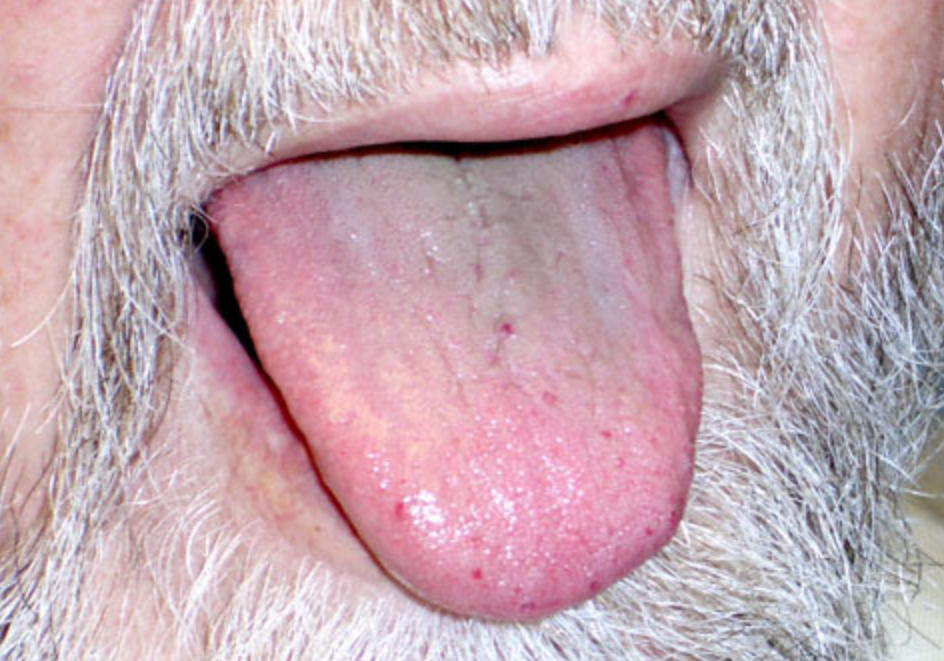
A 67-year-old man comes to the physician for a follow-up examination. Three days ago, he went to the emergency department because of a prolonged nosebleed that was not related to any injuries; after undergoing nasal packing for 4 hours, he was discharged and advised to schedule a follow-up examination with his primary care physician. During the past 3 years, he has had two similar nosebleeds, one of which required cauterization. He has had two episodes of upper gastrointestinal bleeding during the past 10 years. He has psoriasis and osteoarthritis. Current medications include acetaminophen and topical betamethasone cream. He avoids use of aspirin and aspirin-containing medications. He has smoked one pack of cigarettes daily for 45 years. He drinks one alcoholic beverage daily. He does not use illicit drugs. His temperature is 37°C (98.6°F), pulse is 72/min, respirations are 16/min, and blood pressure is 130/76 mm Hg. Jugular venous pressure is 7 cm H20. A photograph of the lips and tongue is shown. The lungs are clear to auscultation. There are no murmurs or gallops. The abdomen is soft and nontender with no hepatosplenomegaly. There is no peripheral edema. Laboratory studies from 3 days ago show:
Hematocrit: 34%
Platelet count: 285,000/mm³
Prothrombin time: 11.6 sec (INR = 1.05)
Serum creatinine: 1.1 mg/dL
Which of the following is the most likely diagnosis?
CorrectIncorrect -
Question 19 of 20
19. Question
A 38-year-old man comes to the physician because of a 3-week history of increasing pressure in his chest and shortness of breath with exertion. He has no history of serious illness and takes no medications. He has smoked one-half pack of cigarettes daily for 20 years and consumes four mixed alcoholic drinks weekly. His pulse is 65/min, and blood pressure is 155/90 mm Hg. Examination shows a brisk carotid upstroke. On cardiac examination, there is a grade 4/6 systolic murmur heard best along the left sternal border at the fourth intercostal space. The murmur increases on Valsalva maneuver and with standing. An ECG shows left ventricular hypertrophy. Which of the following is the most appropriate pharmacotherapy?
CorrectIncorrect -
Question 20 of 20
20. Question
A 62-year-old man comes to the emergency department because of a 35-minute history of severe chest pain. He has had mild intermittent chest pain with exertion during the past 3 weeks. The pain has typically lasted a few minutes and resolved either with rest or spontaneously. He has not had nausea or dyspnea. He has hypertension treated with hydrochlorothiazide and enalapril and type 2 diabetes mellitus treated with insulin glargine. His temperature is 37.1 °C (98.9°F), pulse is 90/min, respirations are 12/min, and blood pressure is 140/86 mm Hg. Physical findings are otherwise normal. An ECG and chest x-ray show no abnormalities. Which of the following is the most appropriate initial step in management?
CorrectIncorrect