
CK- NBME 9 – Block 3 (Duplicate 1)
Time limit: 0
Quiz Summary
0 of 20 Questions completed
Questions:
Information
You have already completed the quiz before. Hence you can not start it again.
Quiz is loading…
You must sign in or sign up to start the quiz.
You must first complete the following:
Results
Quiz complete. Results are being recorded.
Results
0 of 20 Questions answered correctly
Your time:
Time has elapsed
You have reached 0 of 0 point(s), (0)
Earned Point(s): 0 of 0, (0)
0 Essay(s) Pending (Possible Point(s): 0)
| Average score |
|
| Your score |
|
Categories
- Not categorized 0%
- 1
- 2
- 3
- 4
- 5
- 6
- 7
- 8
- 9
- 10
- 11
- 12
- 13
- 14
- 15
- 16
- 17
- 18
- 19
- 20
- Current
- Review
- Answered
- Correct
- Incorrect
-
Question 1 of 20
1. Question
A 52-year-old woman with type 2 diabetes mellitus is brought to the emergency department by her family 24 hours after the onset of vomiting. She has not taken any medications during this period and has become confused during the past 4 hours. She has not had fever or any other symptoms. Her diabetes has been complicated by neuropathy, retinopathy, gastroparesis, and nephropathy. Her prescribed medications include short- and intermediate-acting insulin and gabapentin. She also takes aspirin as needed for headache. On arrival, she is oriented to person but not to place or time. Her temperature is 37.2°C (98.9°F), pulse is 110/min, respirations are 16/min, and blood pressure is 112/78 mm Hg. Examination, including neurologic examination, shows no other abnormalities. Laboratory studies show:
Hemoglobin: 14.1 g/dL
Leukocyte count: 14,200/mm³
Segmented neutrophils: 90%
Bands: 4%
Eosinophils: 1%
Lymphocytes: 3%
Monocytes: 2%
Platelet count: 240,000/mm³
Serum
Na⁺: 127 mEq/L
K⁺: 4.2 mEq/L
Cl⁻: 98 mEq/L
HCO₃⁻: 22 mEq/L
Urea nitrogen: 36 mg/dL
Glucose: 890 mg/dL
Creatinine: 2.6 mg/dL
Arterial blood gas analysis on room air
pH: 7.35
PCO₂: 37 mm Hg
PO₂: 100 mm Hg
Which of the following is the most likely cause of this patient’s confusion?
CorrectIncorrect -
Question 2 of 20
2. Question
A 37-year-old woman comes to the office because of a 2-week history of episodes of anxiety. The anxiety is accompanied by a rapid heartbeat and light-headedness. Pulse is 130/min, and blood pressure is 100/50 mm Hg. Physical examination shows a bilateral hand tremor. Which of the following is the most appropriate next step in management?
CorrectIncorrect -
Question 3 of 20
3. Question
A 57-year-old woman comes to the physician because of vaginal bleeding for 10 days. Her last menstrual period was 9 years ago. She is not receiving hormone replacement therapy. She is 170 cm (5 ft 7 in) tall and weighs 85 kg (188 lb); BMI is 29 kg/m2. Examination shows no other abnormalities. Transvaginal ultrasonography shows a 2.5-cm subserosal leiomyoma uteri and an 18-mm endometrium. There are no ovarian abnormalities. Which of the following is the most appropriate next step in management?
CorrectIncorrect -
Question 4 of 20
4. Question
A 32-year-old primigravid woman at 16 weeks’ gestation is brought to the emergency department 30 minutes after the onset of heavy vaginal bleeding, palpitations, and moderate headache. Her temperature is 37°C (98.6°F), pulse is 110/min, respirations are 18/min, and blood pressure is 150/100 mm Hg. She appears flushed and anxious. The uterus is consistent in size with a 20-week gestation. No fetal heart tones are heard. Urinalysis shows 2+ protein. Ultrasonography shows a uterus with a cystic appearance and 10-cm, cystic adnexal masses bilaterally. Which of the following is the most appropriate next step in management?
CorrectIncorrect -
Question 5 of 20
5. Question
Twelve hours after delivery, a newborn is cyanotic and in respiratory distress. He was born at term to a 27-year-old woman, gravida 2, para 1, following an uncomplicated pregnancy; he weighed 3317 g (7 lb 5 oz). Delivery was complicated by meconium aspiration, and the trachea was suctioned at birth. Apgar scores were 3, 5, and 8 at 1, 5, and 10 minutes, respectively. His temperature is 37.2°C (99°F), pulse is 170/min, respirations are 70/min, and blood pressure is 70/50 mm Hg. Examination shows labored breathing with grunting, nasal flaring, and subcostal and intercostal retractions. The lungs are clear to auscultation. A loud S2 is heard. An x-ray of the chest shows small scattered infiltrates in the lung fields and a normal cardiac silhouette. An ECG shows no abnormalities. Which of the following is the most likely explanation for this patient’s respiratory distress?
CorrectIncorrect -
Question 6 of 20
6. Question
A 62-year-old man with a 6-month history of poorly controlled hypertension comes to the office for a follow-up examination. His blood pressure measurements 1 year ago averaged 140/90 mm Hg; at that time, he was treated with hydrochlorothiazide. He is now taking the maximum doses of enalapril, metoprolol, and hydrochlorothiazide. He also has peripheral vascular disease. His blood pressure today is 170/110 mm Hg. Examination shows narrowing of the retinal arterioles. The lungs are clear to auscultation. Cardiac examination shows an S4at the lower left sternal border. The abdomen is nontender, and a systolic bruit is heard just to the right of the umbilicus. The dorsalis pedis and posterior tibialis pulses are absent bilaterally; there is no lower extremity edema. Laboratory studies show:
Serum
K⁺: 3.6 mEq/L
Urea nitrogen: 25 mg/dL
Creatinine: 1.1 mg/dL
Urine
Protein: 1+
RBC: none
WBC: none
Which of the following is the most appropriate next step in management?
CorrectIncorrect -
Question 7 of 20
7. Question
A 4-year-old boy is brought to the emergency department by his parents because of a 2-day history of increasingly severe pain in his right leg with an associated limp. He has not fallen or sustained any trauma. One week ago, he was treated with amoxicillin for a middle ear infection. He has no history of serious illness and currently takes no medications. He is at the 50th percentile for height and weight. Vital signs are within normal limits. On examination, the patient holds the right hip flexed and externally rotated. Passive range of motion of the right hip is limited by pain. An x-ray of the right hip shows no abnormalities. Which of the following is the most appropriate next step in diagnosis?
CorrectIncorrect -
Question 8 of 20
8. Question
A 52-year-old man is brought to the physician because of a 2-day history of pain at the base of his scrotum, fever, and confusion. He has type 2 diabetes mellitus poorly controlled with insulin. He has no other history of serious illness. He appears lethargic. He is oriented to person but not to place or time. His temperature is 39.2°C (102.6°F), pulse is 120/min, and blood pressure is 118/78 mm Hg. Examination of the scrotum shows several bullae over the scrotum and crepitus of the perineum. The scrotum is edematous and tender. The remainder of the examination shows no abnormalities. His leukocyte count is 16,000/mm3 with a left shift, and serum glucose concentration is 415 mg/dl_. In addition to insulin and antibiotic therapy, which of the following is the most appropriate next step in management?
CorrectIncorrect -
Question 9 of 20
9. Question
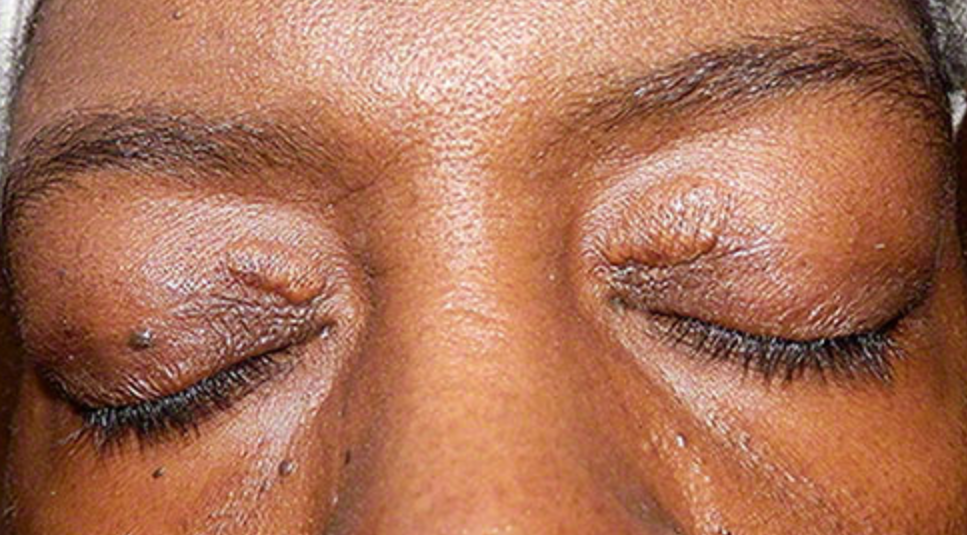
A 43-year-old woman comes to the office because of a 10-year history of enlarging, painless growths on her eyelids. She also has a 1-year history of mild fatigue and occasional bilateral knee pain. She has no history of serious illness and takes no medications. Vital signs are within normal limits. A photograph of the eyelids is shown. The remainder of the examination shows no abnormalities. Which of the following is most likely to confirm the diagnosis?
CorrectIncorrect -
Question 10 of 20
10. Question
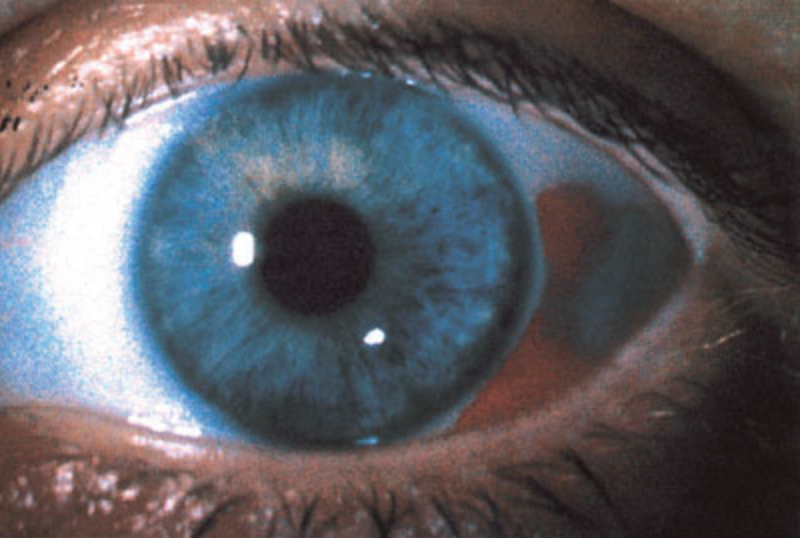
An otherwise healthy 42-year-old woman comes to the physician because her left eye has been red since she awoke 4 hours ago. She has had no changes in her vision and cannot recall any trauma. She takes no medications. Her blood pressure is 110/70 mm Hg. A photograph of the left eye is shown. Her visual acuity is 20/20 in both eyes. Pupils are equal and reactive to light. Ocular movements are full. Visual field testing shows no abnormalities. Which of the following is the most appropriate next step in management?
 CorrectIncorrect
 -
Question 11 of 20
11. Question
A 42-year-old woman comes to the physician because she has been feeling sad and hopeless for the past 2 weeks. She reports having mood swings several times daily and crying suddenly for no reason. She has had difficulty motivating herself and can work no more than 4 hours daily as a retail salesperson before becoming tired. She has been wondering if her condition is hopeless and if she will ever feel better. One month ago, she had sinusitis that was treated with amoxicillin. At the end of treatment 3 weeks ago, weakness in her right arm developed that was attributed to a postinfectious autoimmune neuropathy. Since then, she has been receiving prednisone therapy. She has no other history of serious medical or psychiatric illness. Vital signs are within normal limits. Physical examination shows no abnormalities. Muscle strength is normal in all extremities. On mental status examination, she is alert and oriented. She has a sad mood and is on the verge of crying several times. Which of the following is the most appropriate next step in management?
CorrectIncorrect -
Question 12 of 20
12. Question
A 32-year-old woman is brought to the emergency department 1 hour after an episode of palpitations, sweating, and shortness of breath. The episode occurred while she was at her job working as an administrative assistant. She thought that she was having a heart attack. She reports that her company recently underwent a reorganization, and she has been under increased stress. This is her fourth visit to the emergency department during the past 3 weeks for similar symptoms. At each previous visit, physical examination and laboratory studies showed no abnormalities. Today, her pulse is 88/min, respirations are 17/min, and blood pressure is 130/70 mm Hg. Physical examination shows no abnormalities. On mental status examination, she is tense and fearful. She has a linear thought process. There is no evidence of hallucinations or delusions. Serum cardiac enzyme activity is within the reference range. Her hematocrit is 39%. Pulse oximetry on room air shows an oxygen saturation of 99%. An ECG shows sinus arrhythmia. Which of the following is the most likely diagnosis?
CorrectIncorrect -
Question 13 of 20
13. Question
A 37-year-old man is brought to the emergency department by a coworker 30 minutes after the sudden onset of moderately severe chest pain. His coworker reports that he has become increasingly irritable over the past week. He has no history of diabetes mellitus, coronary artery disease, hyperthyroidism, mood disorder, or intravenous drug abuse. He takes no medications. He is physically fit and exercises regularly. His temperature is 37°C (98.6°F), pulse is 110/min, respirations are 18/min, and blood pressure is 160/100 mm Hg. Physical examination shows diaphoresis. He is alert, oriented, hypervigilant, and irritable. His speech is rapid and pressured. He frequently yells at staff to keep away from him because he believes they are trying to kill him. An ECG shows ST-segment elevation across the precordium. Which of the following is the most likely diagnosis?
CorrectIncorrect -
Question 14 of 20
14. Question
A previously healthy 18-year-old woman comes to the physician because of a lump in her neck that she first noticed 1 month ago. She is otherwise asymptomatic. Examination shows a 3-cm left supraclavicular lymph node that is firm and rubbery. The spleen is palpated 3 cm below the left costal margin. The remainder of the examination shows no abnormalities. Laboratory studies are most likely to show which of the following?
CorrectIncorrect -
Question 15 of 20
15. Question
Investigators would like to assess the effectiveness of a new drug for the treatment of bacterial meningitis in humans. Previous studies have shown that the drug is effective in treating the disease in laboratory animals. The investigators design a study protocol that includes randomization of participants to an experimental group and a control group. Which of the following is the primary consideration regarding use of placebo for the control group?
CorrectIncorrect -
Question 16 of 20
16. Question
A study is planned to compare the efficacy of two sedatives in all children who are receiving mechanical ventilation for respiratory failure in a pediatric intensive care unit. Which of the following is most likely to invalidate the results of the study?
CorrectIncorrect -
Question 17 of 20
17. Question
A study is conducted to determine if a hemoglobin A1c greater than 15% predicts diabetic retinopathy. Results show that 88% of all patients with diabetic retinopathy had a hemoglobin A1c greater than 15%. Which of the following is the most accurate interpretation of these results?
CorrectIncorrect -
Question 18 of 20
18. Question
A study is conducted to assess the relationship between cigarette smoking and the development of lung cancer. One thousand participants who smoke cigarettes and 1000 participants who do not smoke are observed for 15 years. The results show:
Group
Lung Cancer Present
Lung Cancer Absent
Total
Cigarette Smokers
30
970
1000
Nonsmokers
3
997
1000
Total
33
1967
2000
Based on these results, which of the following best approximates the attributable risk of cigarette smoking on the development of lung cancer?
CorrectIncorrect -
Question 19 of 20
19. Question
An asymptomatic 27-year-old man comes to the physician for a routine health maintenance examination. He has a history of inguinal hernia repair during childhood. He takes no medications. His father died at the age of 42 years of an aortic root dissection, and his paternal grandmother died suddenly at the age of 46 years of unknown causes. He is 188 cm (6 ft 2 in) tall and weighs 85 kg (187 lb); BMI is 24 kg/m2. His pulse is 76/min and regular, respirations are 12/min, and blood pressure is 130/70 mm Hg. Examination shows a high narrow palate, mild scoliosis, and a pectus excavatum deformity of the chest. His arm span is 196 cm (6 ft 5 in). The joints of the upper and lower extremities are hyperextensible bilaterally. The feet are flat. In addition to echocardiography, which of the following is the most appropriate next step in evaluation?
CorrectIncorrect -
Question 20 of 20
20. Question
A 37-year-old man is brought to the emergency department 30 minutes after losing consciousness immediately following a scuba diving session. According to another diver, the patient had a normal descent into the water but shortly after seemed confused and made a rapid ascent. The patient uses high-quality scuba diving equipment and has experience in the sport. He has hypertension controlled with diet and exercise. He does not smoke cigarettes or drink alcohol. The patient is unresponsive to voice and minimally responsive to sternal rub. His temperature is 35°C (95°F), pulse is 100/min, respirations are 20/min, and blood pressure is 100/70 mm Hg. Pulse oximetry on room air shows an oxygen saturation of 80%. The skin is cyanotic, and the tongue is pale. Scattered crackles are heard bilaterally. Cardiac examination shows no abnormalities. Which of the following is the most likely diagnosis?
CorrectIncorrect