
CK- NBME 9 – Block 3 (Duplicate 2)
Time limit: 0
Quiz Summary
0 of 20 Questions completed
Questions:
Information
You have already completed the quiz before. Hence you can not start it again.
Quiz is loading…
You must sign in or sign up to start the quiz.
You must first complete the following:
Results
Quiz complete. Results are being recorded.
Results
0 of 20 Questions answered correctly
Your time:
Time has elapsed
You have reached 0 of 0 point(s), (0)
Earned Point(s): 0 of 0, (0)
0 Essay(s) Pending (Possible Point(s): 0)
| Average score |
|
| Your score |
|
Categories
- Not categorized 0%
- 1
- 2
- 3
- 4
- 5
- 6
- 7
- 8
- 9
- 10
- 11
- 12
- 13
- 14
- 15
- 16
- 17
- 18
- 19
- 20
- Current
- Review
- Answered
- Correct
- Incorrect
-
Question 1 of 20
1. Question
A 24-year-old nulligravid college student comes to the emergency department because of a 20-day history of intermittent heavy vaginal bleeding with passage of clots. During this time, she also has had fatigue and light-headedness with no visual changes or headaches. She has no history of easy bruisability. Menarche was at the age of 12 years. During the past 3 years, menses have occurred at irregular 45- to 70-day intervals and last 5 to 7 days. Menses previously occurred at regular 28- to 30-day intervals and lasted 3 to 5 days. She is not sexually active. Her temperature is 37.4°C (99.3°F), pulse is 96/min, respirations are 20/min, and blood pressure is 115/60 mm Hg. Physical examination, including pelvic examination, shows no petechiae or other abnormalities. Her hemoglobin concentration is 8.7 g/dL, and hematocrit is 28%. Which of the following is the most likely cause of this patient’s heavy menses?
CorrectIncorrect -
Question 2 of 20
2. Question
One day after uncomplicated spontaneous vaginal delivery of a healthy newborn at term, a 17-year-old patient, gravida 1, para 1, has severe right nipple pain when attempting to breast-feed. She has no history of serious illness, and her only medication is a prenatal vitamin. She is crying and frustrated. Examination of the right nipple shows erythema and no discharge. Examination of the left nipple shows no abnormalities. Which of the following is the most appropriate recommendation for this patient?
CorrectIncorrect -
Question 3 of 20
3. Question
A 28-year-old woman, gravida 2, para 1, at 12 weeks’ gestation comes to the office for her first prenatal visit. She feels well, and pregnancy has been uncomplicated. Her first pregnancy ended in cesarean delivery at 41 weeks’ gestation because of an active herpes simplex lesion. The newborn weighed 4763 g (10 lb 8 oz) at birth; growth and development have been appropriate for age. The patient has no other history of serious illness and takes no medications. She has a brother and father with type 2 diabetes mellitus. She is 157 cm (5 ft 2 in) tall. She weighed 86 kg (190 lb) prior to pregnancy; BMI was 35 kg/m2. She has had a 4.5-kg (10-lb) weight gain during this pregnancy. Vital signs are within normal limits. Examination shows a uterus consistent in size with a 12-week gestation. Pelvic ultrasonography confirms gestational age. Which of the following is the most appropriate screening test for this patient at this visit?
CorrectIncorrect -
Question 4 of 20
4. Question
A 32-year-old woman, gravida 2, para 1, at 18 weeks’ gestation comes to the office for a routine prenatal visit. She has no history of operative procedures, and pregnancy has been uncomplicated. She has hypothyroidism and asthma. Her medications are levothyroxine, fluticasone, and a prenatal vitamin. Immunizations are up-to-date. Her first pregnancy was uncomplicated and ended in spontaneous vaginal delivery at term 3 years ago. She is married and works as an international airline pilot. Recently, she has made frequent trips to South America and the Pacific Islands for work. Fetal heart rate is 125/min. Examination shows a uterus consistent in size with an 18-week gestation. Fetal anatomic survey shows microcephaly and a clubbed foot. Which of the following is the most appropriate next step in pharmacotherapy?
CorrectIncorrect -
Question 5 of 20
5. Question
A 52-year-old woman, gravida 2, para 2, comes to the physician because of increasingly frequent loss of urine during the past 2 years. She often feels an overwhelming urge to void and completely saturates an absorbent pad before reaching the bathroom. The loss of urine occurs most frequently when she steps out of her car. She also awakens three to four times nightly to void. She has not had any loss of urine with coughing or sneezing. She has hypertension treated with a diuretic. Vital signs are within normal limits. Abdominal examination shows no abnormalities. The external genitalia, vagina, and cervix appear normal. The uterus and adnexa are normal to palpation. There is no loss of urine with Valsalva maneuver or with coughing. Her postvoid residual volume is 50 mL. Urinalysis shows no abnormalities. Which of the following is the most likely diagnosis?
CorrectIncorrect -
Question 6 of 20
6. Question
Four days after admission to the hospital for management of cellulitis of the right lower extremity, a 70-year-old woman has an increased serum creatinine concentration. She has type 2 diabetes mellitus. Her medications are glipizide and a multivitamin; she also has received intravenous nafcillin since admission. She is retired from the military. Vital signs are within normal limits. Examination of the trunk shows no abnormalities. There is edema, erythema, and warmth of the right lower extremity. Examination of the left lower extremity shows no abnormalities. On admission, her serum creatinine concentration was 0.9 mg/dl_. Today, laboratory studies show:
Hemoglobin: 11 g/dL
Hemoglobin A1c: 7.5%
Leukocyte count: 15,000/mm³
Segmented neutrophils: 75%
Bands: 1%
Eosinophils: 8%
Lymphocytes: 14%
Monocytes: 2%
Serum:
Potassium (K⁺): 5 mEq/L
Urea nitrogen: 60 mg/dL
Creatinine: 2.3 mg/dL
Phosphorus: 4.3 mg/dL
Albumin: 2 g/dL
Cholesterol: 250 mg/dL
Urine:
pH: 6.00
Protein: trace
Red blood cells (RBC): 10/hpf
White blood cells (WBC): 20–50/hpf
RBC casts: 0/lpf
WBC casts: 0/lpf
Serum complement concentrations are within the reference ranges. Which of the following is the most appropriate next step in management?
CorrectIncorrect -
Question 7 of 20
7. Question
A 52-year-old woman comes to the emergency department because of a 5-day history of continuous abdominal pain, nausea, and decreased appetite. Nine days ago, she underwent an elective laparoscopic cholecystectomy for symptomatic cholelithiasis. She was discharged from the hospital 7 days ago. Her temperature is 38.2°C (100.8°F), pulse is 108/min, respirations are 20/min, and blood pressure is 102/64 mm Hg. Examination shows jaundice. Abdominal examination shows right upper quadrant tenderness. Bowel sounds are present throughout all quadrants. Laboratory studies show:
Hemoglobin: 12.2 g/dL
Hematocrit: 36%
Leukocyte count: 17,200/mm³
Serum:
Urea nitrogen: 48 mg/dL
Glucose: 186 mg/dL
Creatinine: 1.5 mg/dL
Total bilirubin: 7.2 mg/dL
Alkaline phosphatase: 251 U/L
AST: 84 U/L
Ultrasonography of the abdomen shows no fluid collections. Which of the following is the most appropriate next step in diagnosis?
CorrectIncorrect -
Question 8 of 20
8. Question
A 72-year-old woman comes to the emergency department because of a 3-day history of bright red rectal bleeding. She also has had moderate left-sided lower abdominal cramps that decrease in intensity shortly after the passage of bloody stools. She has no history of similar symptoms. A colonoscopy at the age of 65 years showed mild diverticular disease and no polyps or cancers. She has coronary artery disease and cardiomyopathy with a left ventricular ejection fraction of 15%. Her medications are an ACE inhibitor, a (3-adrenergic blocking agent, oral nitrates, a statin, an aldosterone receptor antagonist, and a loop diuretic. The dose of the loop diuretic was increased 10 days ago during a routine examination because of volume overload. She appears healthy and is not in acute distress. Her temperature is 37°C (98.6°F), pulse is 100/min, respirations are 20/min, and blood pressure is 90/65 mm Hg. There is no jugular venous distention with the patient lying at a 45-degree angle. The lungs are clear to auscultation. Cardiovascular examination shows a displaced point of maximal impulse and a soft S3 gallop. Abdominal examination shows tenderness to deep palpation in the left lower quadrant with minimal guarding; there is no rebound. Bowel sounds are normal. The liver cannot be palpated. Rectal examination shows scant stool with a small amount of blood on the examination glove. There is no edema of the lower extremities. Which of the following is the most likely diagnosis?
CorrectIncorrect -
Question 9 of 20
9. Question
A 47-year-old man comes to the physician for a routine health maintenance examination. He feels well. He has no history of serious illness and takes no medications. His mother was diagnosed with breast cancer at the age of 60 years; his father has hypertension and hyperlipidemia; and his maternal grandmother was diagnosed with colon cancer at the age of 47 years. The patient has smoked one-half pack of cigarettes daily for 25 years and drinks three to four beers on weekends. He does not use illicit drugs. He is 183 cm (6 ft) tall and weighs 90 kg (199 lb); BMI is 27 kg/m2. His pulse is 70/min, and blood pressure is 120/85 mm Hg. Examination shows no abnormalities. Which of the following is the most appropriate recommendation for this patient regarding colon cancer screening?
CorrectIncorrect -
Question 10 of 20
10. Question
A 26-year-old woman is admitted to the hospital because of a 3-month history of abdominal cramps, painful bowel movements, and worsening bloody diarrhea. During this time, she also has had fecal urgency and says she occasionally passes only mucus with some blood. She has had a 4.5-kg (10-lb) weight loss during the past month despite no change in appetite. She has not had nausea or vomiting. She has no history of serious illness and takes no medications. She is 170 cm (5 ft 7 in) tall and weighs 57 kg (125 lb); BMI is 20 kg/m2. Her temperature is 37.8°C (100°F), pulse is 80/min, respirations are 16/min, and blood pressure is 112/68 mm Hg. Cardiopulmonary examination shows no abnormalities. Abdominal examination shows mild, diffuse tenderness; no masses are palpated. Bowel sounds are normal. There is no hepatosplenomegaly. Rectal examination produces pain; there are streaks of blood on the physician’s gloved finger. Laboratory studies show:
Hemoglobin: 9.5 g/dL
Hematocrit: 29%
Mean corpuscular volume (MCV): 75 µm³
Leukocyte count: 9,700/mm³
Erythrocyte sedimentation rate (ESR): 65 mm/h
Serum:
Total protein: 6.3 g/dL
Albumin: 3.5 g/dL
Ferritin: <10 ng/mL
C-reactive protein (CRP): 3.5 mg/L (Normal: 0.08–3.1)
Test of the stool for Clostridium difficile toxin is negative. A stool culture is negative. Colonoscopy shows continuous mucosal inflammation and ulceration from the rectum through the transverse colon. Which of the following is the most appropriate next step in management?
CorrectIncorrect -
Question 11 of 20
11. Question
An 82-year-old woman with hypertension comes to the physician because of a 9-month history of moderate pain in her hips and knees. She has an active lifestyle and lives independently with her husband. Her medications are hydrochlorothiazide, metoprolol, and a calcium supplement. Her blood pressure is 128/84 mm Hg. Examination shows mild limitation on external rotation of both hips. On standing, the patient has pain in the right knee that she rates as an 8 on a 10-point scale. Laboratory studies show:
Hemoglobin: 12.6 g/dL
Hematocrit: 39%
Leukocyte count: 7800/mm³
Serum
Na⁺: 140 mEq/L
K⁺: 3.9 mEq/L
Cl⁻: 110 mEq/L
HCO₃⁻: 26 mEq/L
Urea nitrogen: 12 mg/dL
Creatinine: 1 mg/dL
The patient asks if she can take an over-the-counter nonsteroidal anti-inflammatory drug (NSAID) for her arthritis. If treatment with an NSAID is begun, this patient is at greatest risk for which of the following adverse effects?
CorrectIncorrect -
Question 12 of 20
12. Question
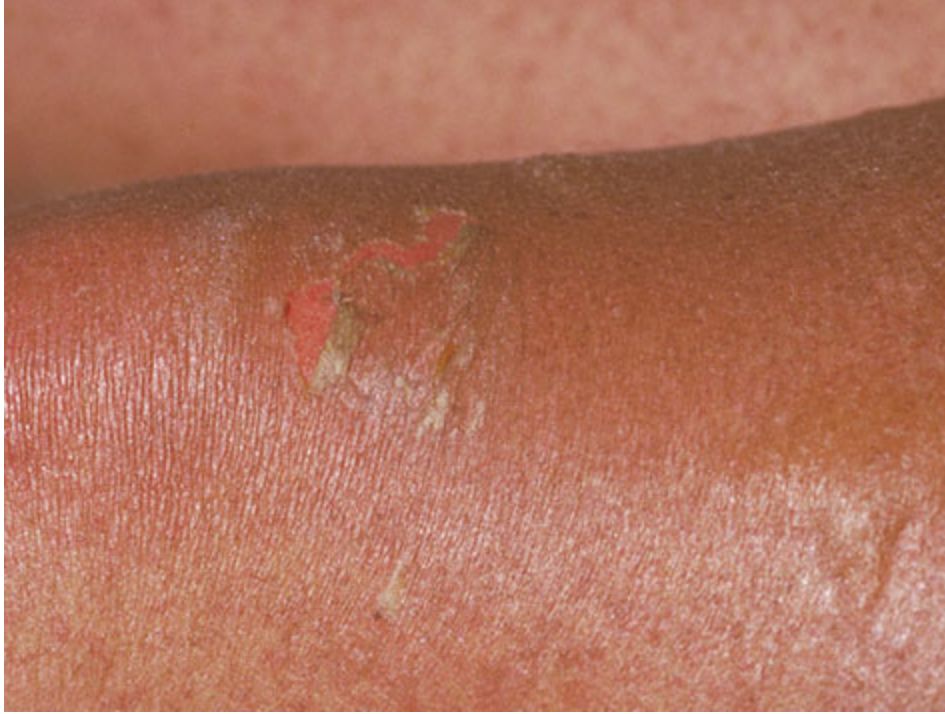
A 20-year-old man comes to the physician because of a 3-day history of a rapidly progressive rash over his extremities and trunk. Initially, he noticed nontender, flat, reddish brown lesions, but now the lesions have formed into blisters and he has burning pain. He has a 7-year history of epilepsy; 10 days ago, he was switched from phenobarbital to carbamazepine therapy after having breakthrough seizures. He has no other history of serious illness and no known allergies. On arrival, he is in distress. His temperature is 37.4°C (99.3°F), pulse is 100/min, respirations are 18/min, and blood pressure is 110/74 mm Hg. Examination shows confluent erythema over the face, trunk, and extremities. A photograph of the skin lesions is shown. The remainder of the examination shows no abnormalities. In addition to discontinuing carbamazepine, which of the following is the most appropriate next step in management?
CorrectIncorrect -
Question 13 of 20
13. Question
A 67-year-old man comes to the physician because of a 2-month history of progressive loss of peripheral vision. He has type 2 diabetes mellitus treated with metformin. He appears to be in mild discomfort. His temperature is 37°C (98.6°F), pulse is 84/min and regular, and blood pressure is 160/98 mm Hg. Ocular movements are intact bilaterally. The pupils are equal, round, and reactive to light. Funduscopic examination shows increased optic cupping bilaterally. Cardiopulmonary examination shows no abnormalities. Which of the following is the most appropriate next step in diagnosis?
CorrectIncorrect -
Question 14 of 20
14. Question
A 47-year-old man is disoriented and having auditory hallucinations 2 days after open reduction and internal fixation of a femoral fracture sustained in a motor vehicle collision. He received perioperative cefazolin, and today his only medication is morphine for pain control. On admission, his blood alcohol concentration was 120 mg/dl_. He has a 25-year history of alcoholism. He has smoked two packs of cigarettes daily for 30 years. His temperature is 38°C (100.4°F), pulse is 120/min, respirations are 26/min, and blood pressure is 175/95 mm Hg. Pulse oximetry on room air shows an oxygen saturation of 94%. Cardiac and abdominal examinations show no abnormalities. Examination of the incision site shows no evidence of infection. On mental status examination, he says that he hears voices. Laboratory studies show a hematocrit of 44% and leukocyte count of 11,000/mm3. An x-ray of the chest shows no abnormalities. Further laboratory studies are most likely to show which of the following electrolyte abnormalities?
CorrectIncorrect -
Question 15 of 20
15. Question
A 16-year-old girl is brought to the office by her mother as a new patient because of weight loss. The mother states that 9 months ago, her daughter became preoccupied with her weight; she then began restricting what she ate and exercising vigorously for several hours daily. The mother adds that her daughter’s performance at school has deteriorated and that she has withdrawn from her friends. According to the mother, the patient had been an excellent student and an obedient daughter, and she has had no behavioral problems until now. The patient’s height is 160 cm (5 ft 3 in); her weight has decreased from 52 kg (114 lb) to 38 kg (84 lb), and her menses have ceased. Current BMI is 15 kg/m2. The patient is soft-spoken and emotionally bland. She expresses little concern about her severe weight loss and malnourished status. She states that she continues to be dissatisfied with her weight and that she would like to lose additional pounds. Temperature is 36.1 °C (97.0°F), pulse is 46/min, and blood pressure is 100/60 mm Hg. Physical examination shows lanugo over the face and body. ECG is ordered. Results of serum laboratory studies are shown:
ALT: 110 U/L
AST: 121 U/L
Na⁺: 130 mEq/L
K⁺: 3 mEq/L
Cl⁻: 93 mEq/L
HCO₃⁻: 34 mEq/L
Protein
Albumin: 2.4 g/dL
This patient and her family should be counseled that she is at increased risk for developing which of the following?
CorrectIncorrect -
Question 16 of 20
16. Question
A 9-year-old girl is brought to the physician by her mother because of behavioral problems at school during the past 6 months. Her teachers report that she refuses to speak or answer questions in front of the class yet answers questions when the teacher approaches her one-on-one. Her mother reports that her daughter will not answer the telephone at home and will not tell waiters what she wants in restaurants. On questioning, the patient states that she worries throughout the school day that others think she is “stupid.” Her mother reports that her daughter interacts normally with her family. Physical examination shows no abnormalities. The patient is quiet and avoids direct eye contact. Which of the following is the most likely diagnosis?
CorrectIncorrect -
Question 17 of 20
17. Question
A 22-year-old woman, gravida 1, para 1, comes to the office in February for a follow-up examination 6 weeks after spontaneous vaginal delivery of a healthy male newborn at term. Pregnancy and delivery were uncomplicated. She says she has been tearful during the past 3 weeks and has not left the house since visiting relatives 2 weeks ago. She says she loves her son and husband, but she has not enjoyed spending time with them during the past 2 weeks. She wakes up every 3 hours at night to breast-feed her infant and is unable to sleep well even when her husband offers to care for their son. She spends most of the day in bed with her infant in a crib nearby; she gets up only to feed and change him. She has no history of serious illness, takes no medications, and has no known allergies. Physical examination shows no abnormalities. On mental status examination, she has a depressed mood and flat affect. She does not have suicidal or homicidal ideation. She has not had audio or visual hallucinations. Which of the following is the most likely diagnosis?
CorrectIncorrect -
Question 18 of 20
18. Question
A 72-year-old man is admitted to the hospital 40 minutes after the onset of presyncope, fatigue, and malaise. He has myelodysplastic syndrome, IgA deficiency, and hypertension. His medications are lisinopril and hydrochlorothiazide. He appears tired but is not in acute distress. His temperature is 37.7°C (99.9°F), pulse is 80/min, respirations are 14/min, and blood pressure is 120/70 mm Hg. Cardiopulmonary examination shows no abnormalities. His hemoglobin concentration is 6 g/dL. Transfusion of packed red blood cells is begun. Five minutes later, he has moderate abdominal pain, nausea, and nonproductive cough. His temperature is 38.2°C (100.7°F), pulse is 124/min and regular, respirations are 28/min, and blood pressure is 80/50 mm Hg. Pulse oximetry on room air shows an oxygen saturation of 94%. Examination shows no jugular venous distention. Diffuse wheezes are heard bilaterally. Cardiac examination shows no abnormalities. Urinary catheterization yields clear urine. The transfusion is discontinued. Which of the following is the most appropriate immediate step in pharmacotherapy?
CorrectIncorrect -
Question 19 of 20
19. Question
A 2-year-old girl is brought to the physician for an examination prior to entering day care. The patient has a history of stridor and expiratory wheezing after drinking cow milk. Examination shows no abnormalities. Which of the following is the most appropriate recommendation?
CorrectIncorrect -
Question 20 of 20
20. Question
History of Present Illness:
Patient has felt well
15-year history of hypertension
15-year history of type 2 diabetes mellitus
Past Medical History:
Otherwise unremarkable
Medications:
Valsartan
Metformin
Atorvastatin
Vaccinations:
Up to date except for pneumococcal, which he has never received
Allergies:
No known drug allergies
Psychosocial History:
Does not smoke cigarettes, drink alcoholic beverages, or use illicit
drugs
Physical Examination:
Temperature: 37.0°C (98.6°F)
Pulse: 82/min
Respirations: 14/min
Blood pressure: 136/82 mm Hg
O₂ saturation: 98% on room air
Height: 178 cm (5 ft 10 in)
Weight: 69 kg (153 lb)
BMI: 22 kg/m²
Pulmonary: clear to auscultation
Cardiac: normal S₁ and S₂; no murmurs, rubs, or gallops
Question: Which of the following is the most appropriate management regarding pneumococcal 23-valent polysaccharide vaccine (PPSV23) and pneumococcal 13-valent conjugate vaccine (PCV13) administration?
CorrectIncorrect