
CK- NBME 9 – Block 1 (Duplicate 1)
Time limit: 0
Quiz Summary
0 of 20 Questions completed
Questions:
Information
You have already completed the quiz before. Hence you can not start it again.
Quiz is loading…
You must sign in or sign up to start the quiz.
You must first complete the following:
Results
Quiz complete. Results are being recorded.
Results
0 of 20 Questions answered correctly
Your time:
Time has elapsed
You have reached 0 of 0 point(s), (0)
Earned Point(s): 0 of 0, (0)
0 Essay(s) Pending (Possible Point(s): 0)
| Average score |
|
| Your score |
|
Categories
- Not categorized 0%
Would you like to submit your quiz result to the leaderboard?
![captcha]()
Loading
- 1
- 2
- 3
- 4
- 5
- 6
- 7
- 8
- 9
- 10
- 11
- 12
- 13
- 14
- 15
- 16
- 17
- 18
- 19
- 20
- Current
- Review
- Answered
- Correct
- Incorrect
-
Question 1 of 20
1. Question
An asymptomatic 37-year-old woman comes to the physician for a follow-up examination after an HIV antibody test was positive. Her last HIV antibody test 5 years ago was negative. She has no previous history of sexually transmitted disease. During the past 10 years, she has been sexually active with eight male partners; she uses an oral contraceptive. She does not know of any partners who are HIV positive. She exercises regularly. Her vital signs are within normal limits. Examination shows no abnormalities. A complete blood count and serum electrolyte, urea nitrogen, and creatinine concentrations are within the reference range. Her CD4+ T-lymphocyte count is 410/mm3 (Normal>500), and plasma HIV viral load is 30,000 copies/mL. Urine pregnancy test is negative. Serologic testing for hepatitis and a PPD skin test are negative. Liver function tests show no abnormalities. Antiretroviral therapy is begun. Which of the following is the most appropriate next step to prevent infections in this patient?
CorrectIncorrect -
Question 2 of 20
2. Question
A 14-year-old boy is brought to the physician by his mother because she has had difficulty awakening him in the morning since the start of the school year 3 months ago. She reports that last year he would always get up on his own. She now has to rouse him several times every morning. She says that he has the same group of friends as he did last year. When interviewed alone, the patient says that during the summer he discovered a talk show at 10 PM that he enjoys watching. He states that he is not tired at 10 PM, which was his bedtime last year. Physical examination shows no abnormalities. Which of the following is the most appropriate next step?
CorrectIncorrect -
Question 3 of 20
3. Question
A 7-year-old boy is brought to the office by his mother because of a 1-month history of urinary incontinence. During this time, he also has passed occasional hard, painful stools. He has not had pain with urination or changes in appetite. He has had occasional episodes of daytime enuresis at school since he was toilet trained at the age of 4 years; until last month, these episodes were rare. He has wet the bed four times weekly during the past month. His mother cannot identify any new stressors at home. He has no history of serious illness and receives no medications. Vaccinations are up-to-date. He receives grades of A’s in school. He is at the 25th percentile for height and weight and 35th percentile for BMI. Vital signs are within normal limits. Examination shows no abnormalities. Urinalysis shows no abnormalities. Which of the following is the most appropriate next step in management?
CorrectIncorrect -
Question 4 of 20
4. Question
A 37-year-old man with hepatitis C and HIV infection comes to the physician because of a 2-week history of edema and generalized fatigue. He has not had fever, vomiting, or any other symptoms. He is taking antiretroviral therapy. One month ago his CD4+ T-lymphocyte count was 240/mm3 (N>500). He was treated for Mycobacterium avium- intracellulare complex infection 2 years ago. His blood pressure is 150/96 mm Hg. Examination shows pitting edema from the midcalves to the feet bilaterally. Laboratory studies show:
Serum
Urea nitrogen: 20 mg/dL
Creatinine: 1.8 mg/dL
Urine
Blood: negative
Protein: 4+
Microscopic examination of urine shows no cells or casts. Which of the following is the most appropriate next step in management?
CorrectIncorrect -
Question 5 of 20
5. Question
A 32-year-old man comes to the physician because of severe throbbing headaches that have been increasing in frequency over the past 3 months. He has a 10-year history of similar headaches that typically last 6 to 12 hours and are associated with nausea, vomiting, and photophobia. The headaches used to occur approximately every 6 months but now occur twice weekly. He is unable to identify any precipitating factors. Over-the-counter medications have been ineffective. He is otherwise healthy and active. His temperature is 37°C (98.6°F), pulse is 72/min, and blood pressure is 120/75 mm Hg. Examination shows no abnormalities. Which of the following is the most appropriate prophylaxis for his headaches?
CorrectIncorrect -
Question 6 of 20
6. Question
A 52-year-old woman with systemic sclerosis (scleroderma) comes to the physician because she has had an increasingly painful ulcer on her left small toe for the past month. The ulcer was caused by minor trauma. She has not had fever or chills. A 10-day course of oral ciprofloxacin and daily application of topical antibiotic cream have not resolved the ulcer. Despite acetaminophen and ibuprofen therapy, she rates her pain as a 7 on a 10-point scale. Her other medications are prednisone and hydroxychloroquine. Her temperature is 37.2°C (99°F), pulse is 84/min and regular, and blood pressure is 145/85 mm Hg. Examination shows skin changes over the face and hands consistent with scleroderma. The left small toe is erythematous and edematous. There is a 1-cm, shaggy, fibrinous, full-thickness ulcer on the dorsum of the proximal interphalangeal joint; there is crepitus on palpation of the joint. The bone is visible. Cellulitis extends along the dorsum of the foot. The posterior tibial pulse is palpable. Culture of the ulcer grows methicillin-resistant Staphylococcus aureus. Which of the following is the most appropriate next step in management?
CorrectIncorrect -
Question 7 of 20
7. Question
An asymptomatic 37-year-old woman comes to the physician for a follow-up examination. She has a 19-year history of hypertension that has been difficult to control with medication. She has measured her blood pressure at home every morning for the past 3 weeks; readings have ranged between 148/92 mm Hg and 166/96 mm Hg. She currently takes no medications. She does not smoke or drink alcohol. She exercises four times weekly. She is employed as a police officer and describes her work as stressful. She is 173 cm (5 ft 8 in) tall and weighs 59 kg (130 lb); BMI is 20 kg/m2. Her blood pressure is 160/94 mm Hg in both arms while sitting and 162/92 mm Hg in the right arm while standing. The remainder of the examination shows no abnormalities. Laboratory studies show:
Serum Na⁺: 141 mEq/L
Serum K⁺: 3.2 mEq/L
Serum Cl⁻: 103 mEq/L
Serum HCO₃⁻: 30 mEq/L
Urea nitrogen: 15 mg/dL
Creatinine: 0.9 mg/dL
Aldosterone : renin ratio: 42
Urine aldosterone: 34 µg/24 h (Normal = 3–20)
An MRI of the abdomen shows no abnormalities. The most appropriate next step in management is to add which of the following to this patient’s regimen?
CorrectIncorrect -
Question 8 of 20
8. Question
An 87-year-old man comes to the physician because of a 1-year history of difficulty starting his urinary stream and occasional postvoid dribbling. He typically arises to void two times nightly. He has a 30-year history of type 2 diabetes mellitus complicated by orthostatic hypotension secondary to autonomic dysfunction. Current medications include lisinopril and glyburide. His blood pressure is 140/80 mm Hg while supine and 100/60 mm Hg while standing. Examination shows an enlarged prostrate. Which of the following is the most appropriate pharmacotherapy for this patient’s urinary symptoms?
CorrectIncorrect -
Question 9 of 20
9. Question
A 37-year-old premenopausal woman undergoes a modified radical mastectomy with transverse rectus abdominis musculocutaneous (TRAM) flap reconstruction for a 4-cm infiltrating ductal carcinoma in the upper outer quadrant of the right breast. The axillary dissection yields two positive lymph nodes of 22 that were removed. The tumor is progesterone-receptor positive with a low S phase. Which of the following factors is most predictive of this patient’s survival?
CorrectIncorrect -
Question 10 of 20
10. Question
A male newborn is cyanotic immediately after delivery. He was born at term to a healthy 27-year-old woman, gravida 3, para 2, after an uncomplicated pregnancy and vaginal delivery. Examination shows no respiratory effort and poor muscle tone. His pulse is 60/min. Positive pressure ventilation and aggressive stimulation are begun. Examination 5 minutes later shows active movement of the extremities, grimacing in response to pain, acrocyanosis, and a strong cry. His pulse is now 120/min. Which of the following is the most appropriate next step in management?
CorrectIncorrect -
Question 11 of 20
11. Question
A 32-year-old woman comes to the physician because of a 1-month history of diarrhea, abdominal bloating, and loss of appetite resulting in a 3.6-kg (8-lb) weight loss. She reports three to four semiliquid stools daily. She has not had fever, abdominal pain, or rectal bleeding. She returned from a scuba diving vacation in Mexico 6 weeks ago; her boyfriend who accompanied her has not had similar symptoms. Abdominal and rectal examinations show no abnormalities. Which of the following is the most likely causal organism?
CorrectIncorrect -
Question 12 of 20
12. Question
A4000-g (8-lb 13-oz) newborn has respiratory distress immediately after emergency cesarean delivery because of a prolapsed umbilical cord. He was born at term to a 24-year-old primigravid woman whose pregnancy was complicated by gestational diabetes. The newborn’s temperature is 36.7°C (98°F), pulse is 180/min, respirations are 60/min, and blood pressure is 60/40 mm Hg. Examination shows ecchymoses over the face and upper chest. There are mild subcostal and intercostal retractions. The remainder of the examination shows no abnormalities. An x-ray of the chest shows a left pleural effusion. A chest tube is inserted, and fluid is obtained; analysis shows clear fluid with numerous lymphocytes. Three days later, the newborn is breast-feeding without difficulty. Drainage from the chest tube is now milky. Which of the following is the most likely cause?
CorrectIncorrect -
Question 13 of 20
13. Question
A 37-year-old woman comes to the physician for a routine health maintenance examination. She has no history of abnormal Pap smears or sexually transmitted diseases. Her only medication is an oral contraceptive. Pelvic examination shows no abnormalities. Results of a Pap smear show atypical glandular cells. Which of the following is the most appropriate next step in management?
CorrectIncorrect -
Question 14 of 20
14. Question
An 8-year-old boy is brought to the emergency department because of blood in his urine for 24 hours. His older brother and maternal uncle have a chronic bleeding disorder characterized by recurrent hemarthroses and soft-tissue bleeding. Examination shows no abnormalities. Laboratory studies show:
Hematocrit: 32%
Leukocyte count: 8,000/mm³
Segmented neutrophils: 68%
Lymphocytes: 32%
Platelet count: 225,000/mm³
Bleeding time: 5 min
Prothrombin time: 12 sec (INR = 1)
Partial thromboplastin time: 50 sec
Plasma fibrinogen: 250 mg/dL (Normal = 200–400)
Which of the following is the most likely cause of this patient’s prolonged bleeding?
CorrectIncorrect -
Question 15 of 20
15. Question
A new blood test to diagnose temporal arteritis is being evaluated using 100 patients with biopsy-proven temporal arteritis and 100 participants who do not have this disease. The blood test is found to have a sensitivity of 75% and specificity of 25%. Which of the following are the positive and negative predictive values of this test?
Option
Positive Predictive Value (%)
Negative Predictive Value (%)
A
25
50
B
25
75
C
50
50
D
50
75
E
75
25
F
75
75
CorrectIncorrect -
Question 16 of 20
16. Question
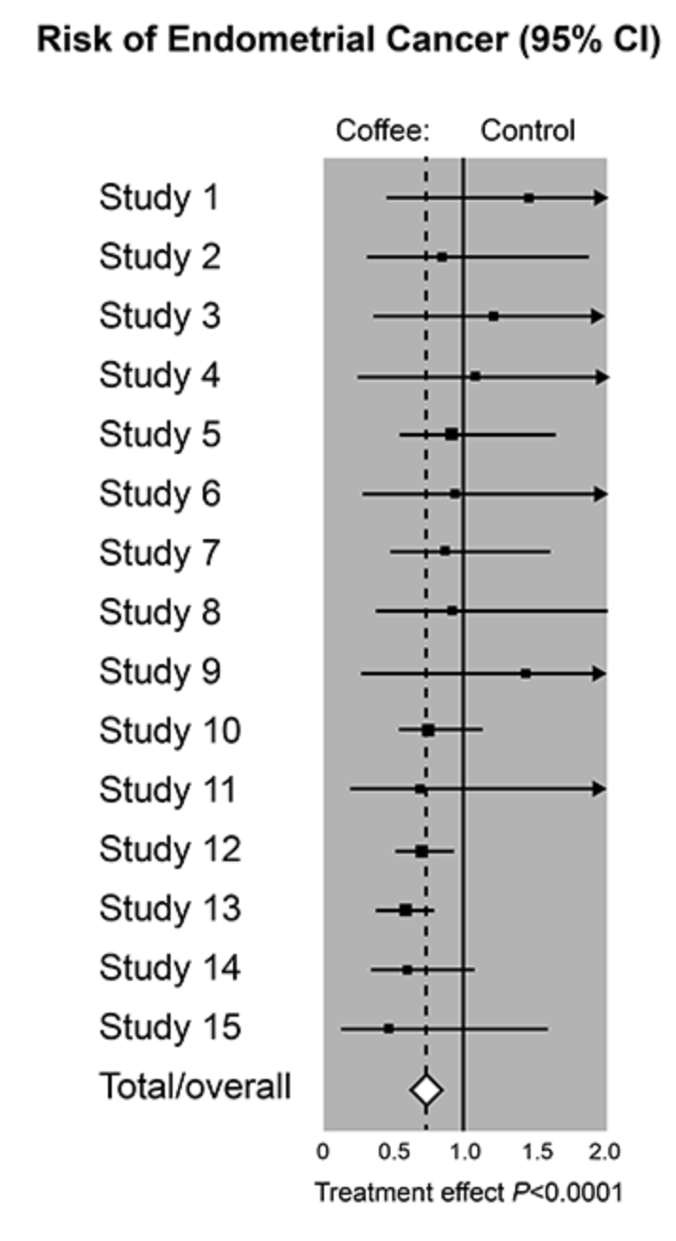
A series of small studies are conducted during a 12-year period comparing daily consumption of one to three cups of coffee with the 5-year development of endometrial cancer; these studies yield mixed or nonsignificant results. A subsequent meta¬analysis of 15 of these studies is conducted. Each study met prespecified criteria. The results are shown. Which of the following is the most appropriate interpretation of the meta-analysis of coffee consumption and the risk for endometrial cancer?
Option
Risk for Endometrial Cancer
Statistical Significance
A
Decreased
Not significant
B
Decreased
Significant
C
Increased
Not significant
D
Increased
Significant
CorrectIncorrect -
Question 17 of 20
17. Question
Three years after a state passed legislation eliminating mandatory helmet use for motorcycle riders, an investigator is studying the incidence of head injuries in motorcycle riders involved in motor vehicle collisions. The state’s motor vehicle department data during the past 3 years are analyzed. Results show that motorcycle riders between the ages of 18 and 25 years who did not wear a helmet were more likely to die during a collision; the same age group also had an increased morbidity rate from nonlethal head traumas. Which of the following is the most appropriate outcome measure to determine the overall public health impact of eliminating mandatory helmet use in motorcycle riders in the state?
CorrectIncorrect -
Question 18 of 20
18. Question
A 13-year-old boy is brought to the office by his parents for a well-child examination. He is at the 10th percentile for height and 97th percentile for weight. The physician has counseled the patient about diet and exercise in the past, but his parents state that he has not changed his eating patterns. The parents add that he has become less involved in school activities, his grades are declining, and he is being bullied at school about his weight. Which of the following is the most appropriate next step in management?
CorrectIncorrect -
Question 19 of 20
19. Question
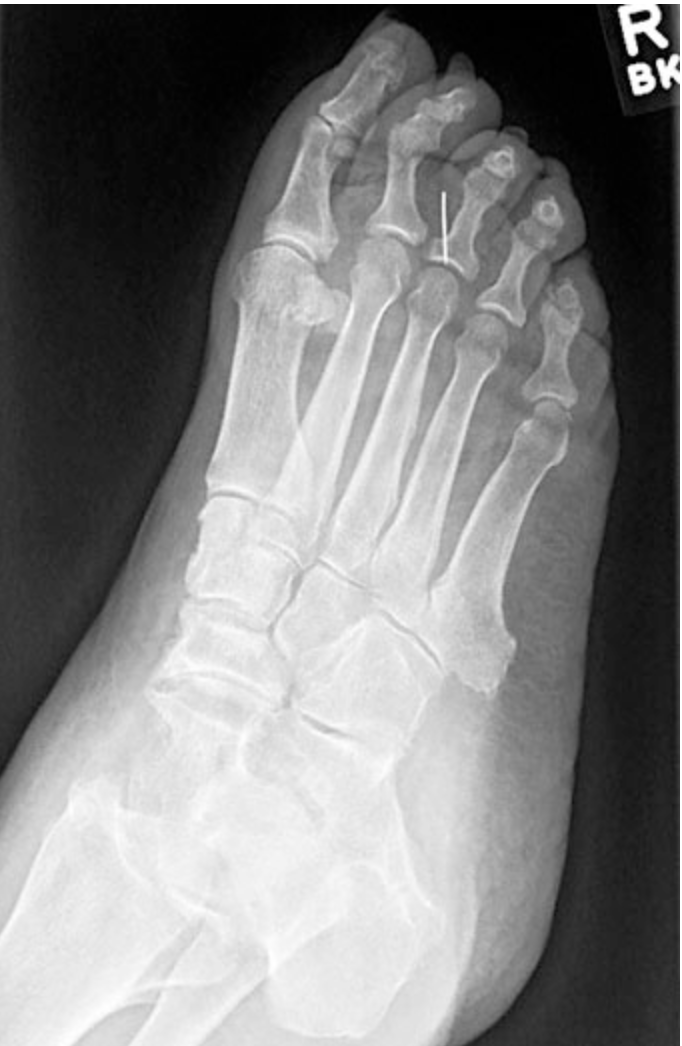
A 52-year-old woman comes to the physician because of a 1-week history of swelling of the ball of her right foot. She remembers that she saw a small area of blood on the floor after she rose to take a break from sewing. She was not wearing shoes at the time. When she looked, she did not see anything on her feet. She has type 2 diabetes mellitus, retinopathy, and hypertension. She does not measure her blood glucose concentration regularly; her last hemoglobin A1c4 weeks ago was 10%. Her medications are metformin, glyburide, and hydrochlorothiazide. She is 157 cm (5 ft 2 in) tall and weighs 109 kg (240 lb); BMI is 44 kg/m2. Her temperature is 37.8°C (100°F), and blood pressure is 145/85 mm Hg. Examination shows a 2-mm, superficial wound over the plantar aspect of the right foot between the second and third metatarsophalangeal joints. There is edema and tenderness to palpation over the right forefoot, particularly over the third metatarsophalangeal joint. Dorsalis pedis pulses are not palpable bilaterally. Semmes-Weinstein 5.07 monofilament testing shows decreased sensation over both feet. An x-ray of the right foot is shown. Which of the following is most likely to have prevented this patient’s current condition?
 CorrectIncorrect
 -
Question 20 of 20
20. Question
A 27-year-old nulligravid woman comes to the physician because she has been unable to conceive for 2 years. She also has had pain with sexual intercourse over the past 6 months. She has been otherwise healthy. Menarche was at the age of 13 years, and menses have occurred at regular 28-day intervals. Her last menstrual period was 1 week ago. Her temperature is 37°C (98.6°F), pulse is 80/min, respirations are 20/min, and blood pressure is 120/80 mm Hg. Abdominal examination shows right lower quadrant tenderness. Pelvic examination shows a 5-cm, tender, right adnexal mass. Laboratory studies show:
Hemoglobin: 12 g/dL
Leukocyte count: 9,000/mm³
Segmented neutrophils: 60%
Bands: 5%
Lymphocytes: 30%
Monocytes: 5%
Erythrocyte sedimentation rate (ESR): 15 mm/h
A urine pregnancy test is negative. Ultrasonography shows a 5-cm right adnexal mass containing low-level, homogeneous, internal echos. A biopsy specimen of the mass is most likely to show which of the following?
CorrectIncorrect