
CK- NBME 12 – Block 4
Time limit: 0
Quiz Summary
0 of 20 Questions completed
Questions:
Information
You have already completed the quiz before. Hence you can not start it again.
Quiz is loading…
You must sign in or sign up to start the quiz.
You must first complete the following:
Results
Quiz complete. Results are being recorded.
Results
0 of 20 Questions answered correctly
Your time:
Time has elapsed
You have reached 0 of 0 point(s), (0)
Earned Point(s): 0 of 0, (0)
0 Essay(s) Pending (Possible Point(s): 0)
Categories
- Not categorized 0%
- 1
- 2
- 3
- 4
- 5
- 6
- 7
- 8
- 9
- 10
- 11
- 12
- 13
- 14
- 15
- 16
- 17
- 18
- 19
- 20
- Current
- Review
- Answered
- Correct
- Incorrect
-
Question 1 of 20
1. Question
A 32-year-old woman comes to the physician because of a 2-week history of fatigue and increased urination. She has had a 2.3-kg (5-lb) weight loss despite eating more during this time. She has had two urinary tract infections in the past. She takes no medications. She does not smoke cigarettes, drink alcohol, or use illicit drugs. The patient is alert and fully oriented. She is 165 cm (5 ft 5 in) tall and weighs 52 kg (115 lb); BMI is 19 kg/m2. Her temperature is 36.5°C (97.7°F), pulse is 100/min, respirations are 20/min, and blood pressure is 90/60 mm Hg. Pulse oximetry on room air shows an oxygen saturation of 100%. The oropharynx is dry. The remainder of the examination shows no abnormalities. Laboratory studies show:
Serum
Na+
142 mEq/L
K+
5.4 mEq/L
Cl-
104 mEq/L
HCO3-
16 mEq/L
Glucose
800 mg/dL
Creatinine
1.3 mg/dL
Urine
Specific gravity
1.030
Bilirubin
none
Protein
none
RBC
0–5/hpf
WBC
25–50/hpf
Nitrites
positive
Leukocyte esterase
positive
Glucose
>1000 mg/24 h
Which of the following serum hormonal profiles is most consistent with this patient’s presentation?
Option
Insulin
Glucagon
Catecholamines
A
Decreased
Decreased
Decreased
B
Decreased
Increased
Decreased
C
Decreased
Decreased
Increased
D
Decreased
Increased
Increased
E
Increased
Increased
Decreased
F
Increased
Decreased
Increased
G
Increased
Decreased
Decreased
H
Increased
Increased
Increased
CorrectIncorrect -
Question 2 of 20
2. Question
A 5-year-old girl is brought to the physician as a new patient for an examination prior to starting kindergarten. She was noted to have high blood pressure by a previous physician 3 years ago. Her blood pressure 2 years ago was within normal limits. She has not been seen by a physician since that time because her mother did not have adequate health insurance. The patient is at the 50th percentile for height and 15th percentile for weight. Her temperature is 36.7°C (98°F), pulse is 80/min, respirations are 25/min, and blood pressure is 140/90 mm Hg. A bruit is heard over the right aspect of the midabdomen. No other abnormalities are noted. Renal arteriography shows stenosis of the right renal artery. Which of the following is the most appropriate next step in management?
CorrectIncorrect -
Question 3 of 20
3. Question
A 42-year-old woman, gravida 1, para 1, comes to the office for a routine examination. She is concerned about her risk for coronary artery disease. She has irritable bowel syndrome and migraines. Medications are sumatriptan and ibuprofen as needed. Her father has hypertension and hyperlipidemia. Her paternal uncle was diagnosed with coronary artery disease at the age of 50 years. The patient smoked one pack of cigarettes daily for 10 years but quit 7 years ago. She drinks two glasses of wine weekly. She does not use illicit drugs. She runs 3 miles one to three times weekly. She is 168 cm (5 ft 6 in) tall and weighs 77 kg (170 lb); BMI is 27 kg/m2. Blood pressure is 118/70 mm Hg. Examination shows no other abnormalities. Results of fasting serum studies are shown:
Glucose
82 mg/dL
Cholesterol, total
255 mg/dL
HDL-cholesterol
85 mg/dL
LDL-cholesterol
155 mg/dL
Triglycerides
70 mg/dL
The risk assessment score for her 10-year probability of coronary artery disease is 0.4%. The patient is counseled about maintaining a diet low in saturated fat and continuing her exercise regimen. Which of the following is the most appropriate next step in management?
CorrectIncorrect -
Question 4 of 20
4. Question
An investigator would like to determine if a new medication for chronic obstructive pulmonary disease (COPD) decreases hospitalization rates in adults who come to the emergency department (ED) because of an exacerbation. All patients with COPD who come to the ED because of an exacerbation will be invited to participate in the study. Patients will be randomly assigned to receive the new medication plus standard therapy or standard therapy alone during the hours that a study nurse is present (7 am to 7 pm daily). Patients who come to the ED outside of these hours will not be enrolled in the study. Physicians treating the patients will be blinded to the group assignments. Outcomes will be assessed by a physician not involved in the care of the patients. Which of the following is the greatest limitation of this study design?
CorrectIncorrect -
Question 5 of 20
5. Question
A 57-year-old man is brought to the emergency department by his neighbors, who found him lying unconscious in a puddle of vomit in his apartment. He has a 20-year history of alcohol use disorder. On arrival, he is lethargic and reports shortness of breath. He is unable to provide a medical history. His temperature is 39°C (102.2°F), pulse is 98/min, respirations are 28/min, and blood pressure is 132/76 mm Hg. Diffuse crackles are heard bilaterally. Arterial blood gas analysis on room air shows:
pH
7.44
Pco2
30 mm Hg
Po2
48 mm Hg
An x-ray of the chest shows pulmonary infiltrates bilaterally. Which of the following is the most appropriate next step in management?
CorrectIncorrect -
Question 6 of 20
6. Question
A 37-year-old woman is scheduled for arthroscopic repair of a right medial meniscus tear. Her procedure is the surgeon’s last scheduled operation of the day. All previous procedures this day involved the left knee. In the operating room, the resident prepares the left knee for the operation. The operation is discontinued after the surgeon discovers no meniscus tear, and the patient is informed about the error. Which of the following is the best approach to prevent future errors of this type?
CorrectIncorrect -
Question 7 of 20
7. Question
A 52-year-old woman comes to the office because of a 6-week history of moderate epigastric pain and an intermittent mild, midsternal burning sensation when she eats. She has had a 4.5-kg (10-lb) weight loss during the past 6 months despite no change in appetite. During this time, she also occasionally has had dark stools. She has type 2 diabetes mellitus, hypertension, and osteoarthritis. Her medications are metformin, hydrochlorothiazide, and ibuprofen. She has smoked one pack of cigarettes daily for 36 years. She appears malnourished. She is 163 cm (5 ft 4 in) tall and weighs 54 kg (120 lb); BMI is 21 kg/m2. Her pulse is 86/min, and blood pressure is 110/65 mm Hg. Examination shows mild epigastric tenderness. There is no hepatosplenomegaly. The remainder of the examination shows no abnormalities. Her hematocrit is 30%, leukocyte count is 6200/mm3, and platelet count is 530,000/mm3. Serum electrolyte concentrations are within the reference ranges. In addition to discontinuing ibuprofen therapy, which of the following is the most appropriate next step in management?
CorrectIncorrect -
Question 8 of 20
8. Question
A 67-year-old man comes to the physician because of a 6-month history of increasing difficulty walking. He has not had pain or numbness. He has no history of serious illness or recent infection. Examination of the lower extremities shows atrophy; muscle strength is 3/5 bilaterally. Deep tendon reflexes are increased in the lower extremities. Sensation is intact. Which of the following is the most likely diagnosis?
CorrectIncorrect -
Question 9 of 20
9. Question
A 14-year-old girl is brought to the physician because of an 18-hour history of persistent right-sided lower abdominal pain. She has not had fever, vomiting, or diarrhea. She has no history of serious illness or operative procedures. Menarche was at the age of 12 years, and menses occur at regular 28-day intervals. Her last menstrual period was 2 weeks ago. She is not sexually active. Her temperature is 37°C (98.6°F), pulse is 72/min, respirations are 14/min, and blood pressure is 120/80 mm Hg. Abdominal examination shows mild tenderness with guarding over the right lower quadrant. There is no distention, and bowel sounds are normal. The remainder of the examination shows no abnormalities. Her hemoglobin concentration is 13.9 g/dL, and leukocyte count is 8000/mm3 with a normal differential. Urinalysis shows no abnormalities. Abdominal ultrasonography shows a small amount of fluid in the pelvis. Which of the following is the most likely diagnosis?
CorrectIncorrect -
Question 10 of 20
10. Question
A 62-year-old man, who underwent right below-the-knee amputation 36 years ago, comes to the emergency department because of a 1-month history of an ulcer on the end of the residual limb. His amputation was the result of injuries he sustained while serving in the military. He says his prosthetic socket has “felt loose and has been rubbing recently.” During the past 6 months, he has had progressive difficulty walking because of sharp pain that radiates up his leg. The pain has been occurring earlier during his walks; it slowly improves with rest. He previously walked 1 mile daily for exercise and could walk several miles without stopping. He has not had vomiting, fever, chills, or malaise. He has type 2 diabetes mellitus treated with diet. One month ago, his hemoglobin A1c was 6%. Vital signs are within normal limits. Examination of the right lower extremity shows mild erythema and a 1 × 1-cm ulcer, with a depth of 3 mm, over the anteromedial aspect of the limb. There is viable soft tissue, and margins are clear. The limb is warm. The popliteal pulse is 1+. In addition to a recommendation for non-weight bearing and avoidance of direct pressure to the site, which of the following is the most appropriate next step in management?
CorrectIncorrect -
Question 11 of 20
11. Question
A 40-year-old man comes to the physician 6 days after noticing a nonpainful lump in his neck. He also has a 2-week history of palpitations. He is otherwise asymptomatic. He has no history of serious illness and takes no medications. His temperature is 37.2°C (99°F), pulse is 110/min, respirations are 16/min, and blood pressure is 134/60 mm Hg. Examination shows a 1.4-cm, firm thyroid nodule. His serum thyroid-stimulating hormone concentration is less than 0.05 mIU/L, and serum free thyroxine concentration is 3.5 ng/dL (N=0.9–1.7). Which of the following is the most appropriate next step in management?
CorrectIncorrect -
Question 12 of 20
12. Question

A previously healthy 24-year-old man comes to the emergency department because of a 12-hour history of increasing pain to the left of the center of his chest. Initially, the pain was mild and occurred only when he breathed deeply. Now, the pain is more severe and constant. He rates the pain as an 8 on a 10-point scale. The pain increases when he lies on his back, decreases when he leans forward, and does not radiate. He has not had palpitations, shortness of breath, nausea, vomiting, or sweating. He says that he is “recovering from a head cold,” which he has had for 14 days. He appears moderately uncomfortable but is in no respiratory distress. His temperature is 37.6°C (99.6°F), pulse is 66/min and regular, respirations are 20/min, and blood pressure is 152/88 mm Hg. Examination, including cardiovascular examination, shows no abnormalities. His serum creatine kinase activity is 420 mg/dL with an MB fraction of 12% (N<5%). An ECG is shown. Which of the following is the most appropriate next step in diagnosis?
CorrectIncorrect -
Question 13 of 20
13. Question
A 21-year-old man is brought to the emergency department by paramedics because of a 10-hour history of altered mental status. The mother says the patient was “fine” last night. This morning, he did not wake up at his usual time; when she went to check on him, she could not get him to wake up. He has no history of serious medical or psychiatric illness and takes no medications. His mother says he does not smoke cigarettes, drink alcohol, or use illicit drugs. On arrival, he is lethargic but not in respiratory distress. He is responsive to painful stimuli. His temperature is 36.7°C (98.0°F), pulse is 120/min, respirations are 26/min, and blood pressure is 135/85 mm Hg. Pulse oximetry on room air shows an oxygen saturation of 100%. Physical examination shows no other abnormalities. Laboratory studies are shown:
Serum
Na+
143 mEq/L
K+
3.8 mEq/L
Cl−
110 mEq/L
HCO3−
13 mEq/L
Urea nitrogen
14 mg/dL
Glucose
120 mg/dL
Osmolality
290 mOsmol/kg H2O
Urine
Glucose
none
Ketones
3+
Arterial blood gas analysis is shown:
pH
7.43
Pco2
22 mm Hg
Po2
96 mm Hg
Which of the following is the most likely diagnosis?
CorrectIncorrect -
Question 14 of 20
14. Question
A 25-year-old man is brought to the emergency department 1 hour after sustaining a gunshot wound to the abdomen. He has pain at the bullet entry site. He is awake, alert, and appropriately conversant. His temperature is 38.8°C (101.8°F), pulse is 85/min, respirations are 18/min, and blood pressure is 128/70 mm Hg. Abdominal examination shows a bullet wound 5 cm to the right of the umbilicus. There is moderate tenderness over the entry site. The remainder of the examination shows no abnormalities. During operative exploration, 250 mL of succus entericus and eight small bowel holes are found in the abdomen; the bowel holes are treated by resection of 12 cm of proximal ileum. The intestine is reconstructed with a stapled anastomosis. The midline abdominal fascia is sutured closed. Which of the following methods of skin and soft tissue wound management at this point is most likely to decrease the risk for postoperative wound infection?
CorrectIncorrect -
Question 15 of 20
15. Question
A previously healthy 37-year-old woman comes to the physician because of a 2-year history of her hands and fingers turning a bluish color with exposure to cold. The discoloration has been occurring with increasing frequency and now occurs with exposure to air conditioning and cold water. Examination of the hands shows no abnormalities. The brachial and radial pulses are present bilaterally. When the hands are rinsed in cold water, the fingers become bluish then bright red with rewarming. Which of the following is the most appropriate next step in management?
CorrectIncorrect -
Question 16 of 20
16. Question
A 60-year-old man comes to the office for a routine examination. Medical history is remarkable for hypertension and alcohol use disorder. Medications are amlodipine and omeprazole. He has smoked one pack of cigarettes daily for 40 years, and he drinks approximately twelve beers daily. Vital signs are within normal limits. Physical examination discloses no abnormalities. Results of serum studies are most likely to show which of the following?
CorrectIncorrect -
Question 17 of 20
17. Question
An 87-year-old woman comes to the physician because of a 3-week history of nausea and general malaise. She has hypertension. One month ago, her blood pressure was 160/95 mm Hg and hydrochlorothiazide therapy was begun. Her only other medication is 81-mg aspirin. She is 157 cm (5 ft 2 in) tall and weighs 50 kg (110 lb); BMI is 20 kg/m2. Today, her pulse is 78/min; her blood pressure is 155/92 mm Hg in the right upper extremity and 153/90 mm Hg in the left upper extremity. The remainder of the examination shows no abnormalities. Serum studies show:
Na+
125 mEq/L
K+
3.2 mEq/L
Cl–
87 mEq/L
HCO3–
25 mEq/L
Ca2+
9.6 mg/dL
Urea nitrogen
14 mg/dL
Glucose
107 mg/dL
Creatinine
0.6 mg/dL
Which of the following is the most appropriate next step in pharmacotherapy?
CorrectIncorrect -
Question 18 of 20
18. Question
A 15-year-old girl is brought to the office by her mother because of a 3-day history of pain with urination and an increasingly frequent and urgent need to urinate. She has had three episodes of urinary tract infection during the past year. She has no other history of serious illness and currently takes no medications. The patient appears subdued and avoids eye contact. The physician asks the mother to leave the office for the remainder of the interview, and she initially is reluctant. When she leaves the room, the physician asks the patient about her sexual history. The patient appears anxious and asks, “If I answer these questions, will you promise not to tell my mom?” Which of the following is the most appropriate physician response?
CorrectIncorrect -
Question 19 of 20
19. Question
A 37-year-old man with a 2-year history of intermittent right knee pain comes to the office because of a 2-month history of increased knee pain that began after he collided with another person while skiing. The pain has particularly worsened during the past 2 days and has made bearing weight on his right leg difficult. Immediately following the collision, he felt a sharp pain in the middle of his kneecap and sustained several scrapes and cuts on his kneecap, which stopped bleeding within minutes but have continued to slowly ooze a clear discharge thereafter. Medical history otherwise is noncontributory. His only medications are a daily multivitamin and occasional acetaminophen for pain. His temperature is 38°C (100.4°F), pulse is 76/min, and blood pressure is 110/60 mm Hg. Examination shows an erythematous right knee that is warm to touch. The patella is ballotable, and there is moderate joint effusion. Bending the right knee 10 to 15 degrees causes pain; the patient cannot tolerate bending it any further. Which of the following is most likely diagnosis?
CorrectIncorrect -
Question 20 of 20
20. Question
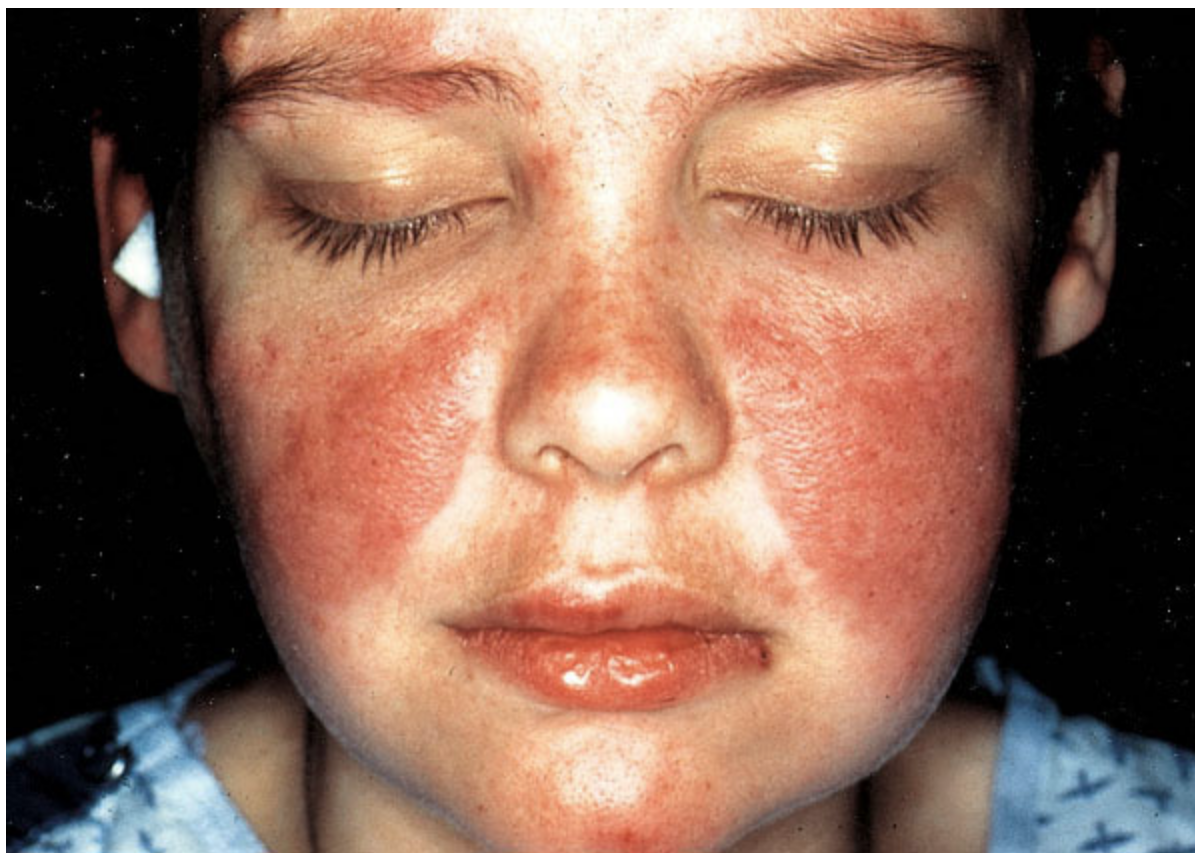
A 15-year-old girl is brought to the office because of a 2-week history of a facial rash and fatigue. She has a 9-day history of stiffness and swelling of her fingers on awakening in the morning. She has no history of serious illness and takes no medications. She appears tired and has mild chest pain with deep inspiration. Temperature is 38.0°C (100.4°F), pulse is 94/min and regular, respirations are 24/min, and blood pressure is 112/76 mm Hg. A photograph of the patient’s face is shown. There are three nontender ulcers over the soft palate. Diffuse 1- to 2-cm lymph nodes are palpated in the anterior and posterior cervical chains. The lungs are clear to auscultation. Heart sounds are normal. Examination of the extremities shows mild erythema, tenderness, and swelling of the proximal interphalangeal and metacarpophalangeal joints, knees, and metatarsophalangeal joints. Urinalysis shows 2+ protein and 1+ blood. Which of the following is most appropriate in determining management for this patient?
 CorrectIncorrect