
CK- NBME 12 – Block 3 (Duplicate 1)
Time limit: 0
Quiz Summary
0 of 20 Questions completed
Questions:
Information
You have already completed the quiz before. Hence you can not start it again.
Quiz is loading…
You must sign in or sign up to start the quiz.
You must first complete the following:
Results
Quiz complete. Results are being recorded.
Results
0 of 20 Questions answered correctly
Your time:
Time has elapsed
You have reached 0 of 0 point(s), (0)
Earned Point(s): 0 of 0, (0)
0 Essay(s) Pending (Possible Point(s): 0)
Categories
- Not categorized 0%
- 1
- 2
- 3
- 4
- 5
- 6
- 7
- 8
- 9
- 10
- 11
- 12
- 13
- 14
- 15
- 16
- 17
- 18
- 19
- 20
- Current
- Review
- Answered
- Correct
- Incorrect
-
Question 1 of 20
1. Question
A 77-year-old man comes to the physician because of a 2-week history of increasing back pain. Eight years ago, he was diagnosed with prostate cancer. Gonadotropin inhibitor therapy was begun, and he was asymptomatic until 2 months ago; metastatic lesions at L3 and T8 were confirmed at that time. Ibuprofen therapy sufficiently controlled the pain for 1 month, after which oxycodone (5 mg every 4 hours) and laxatives were added to the medication regimen. At his last visit 1 month ago, he reported his pain as between 0 and 2 on a 10-point scale. He now describes his pain as 4 to 5 on a 10-point scale. Which of the following is the most appropriate next step in management?
CorrectIncorrect -
Question 2 of 20
2. Question
An 18-year-old woman comes to the physician for a follow-up examination. She has a 5-year history of asthma treated with inhaled albuterol as needed and inhaled beclomethasone daily. She has never required treatment in the hospital for an acute episode. She says that her asthma is worse after she spends prolonged periods of time indoors and after she visits homes of friends who own cats. Her house has hardwood floors, which she and her family clean every week. She sleeps with her windows closed and changes her bedding regularly. She does not smoke or drink alcohol. Examination shows no abnormalities. The lungs are clear to auscultation. Skin testing shows allergies to dust mites and cat dander. The physician advises the patient to avoid direct contact with cats. Which of the following environmental changes is likely to be most helpful in preventing exacerbations of this patient’s asthma?
CorrectIncorrect -
Question 3 of 20
3. Question
A 44-year-old man comes to the office because of a 6-month history of intermittent moderate headache. He has had one to two headaches weekly since residents of the neighboring apartment got a dog that barks a lot. He says he has had recurrent thoughts about killing the dog during the past 6 months, but he has no intent or plan to harm the animal. He worries that his headaches are punishment for these thoughts about killing; he says he realizes this does not make sense but remains concerned. He vacuums 2 hours daily because he is worried that dog hair is coming into his apartment. He has no history of serious illness. His only medication is acetaminophen, which resolves his headaches. He drinks two to three 12-oz beers on weekends. His pulse is 72/min, respirations are 16/min, and blood pressure is 150/105 mm Hg. Physical examination shows no other abnormalities. Mental status examination shows an anxious affect. Which of the following is the most likely diagnosis?
CorrectIncorrect -
Question 4 of 20
4. Question
A 27-year-old primigravid woman at 32 weeks’ gestation comes to the emergency department because of a 2-day history of progressive drooping of the right side of her face, an inability to close her right eye, and right-sided facial pain. She has not had loss of hearing or balance. Her pregnancy had been uncomplicated. She has no personal or family history of serious illness. Her temperature is 37°C (98.6°F), pulse is 88/min, respirations are 16/min, and blood pressure is 140/82 mm Hg. Examination of the face shows paralysis on the right side and an inability to close the right eye. The patient moves her head stiffly; there is no nuchal rigidity. Heart sounds are normal. A grade 2/6 holosystolic murmur is heard best at the apex. The abdomen is soft. The fundal height is 32 cm. There is mild edema of the lower extremities. Muscle strength is normal. Deep tendon reflexes are 2+. Which of the following is the most appropriate next step in management?
CorrectIncorrect -
Question 5 of 20
5. Question
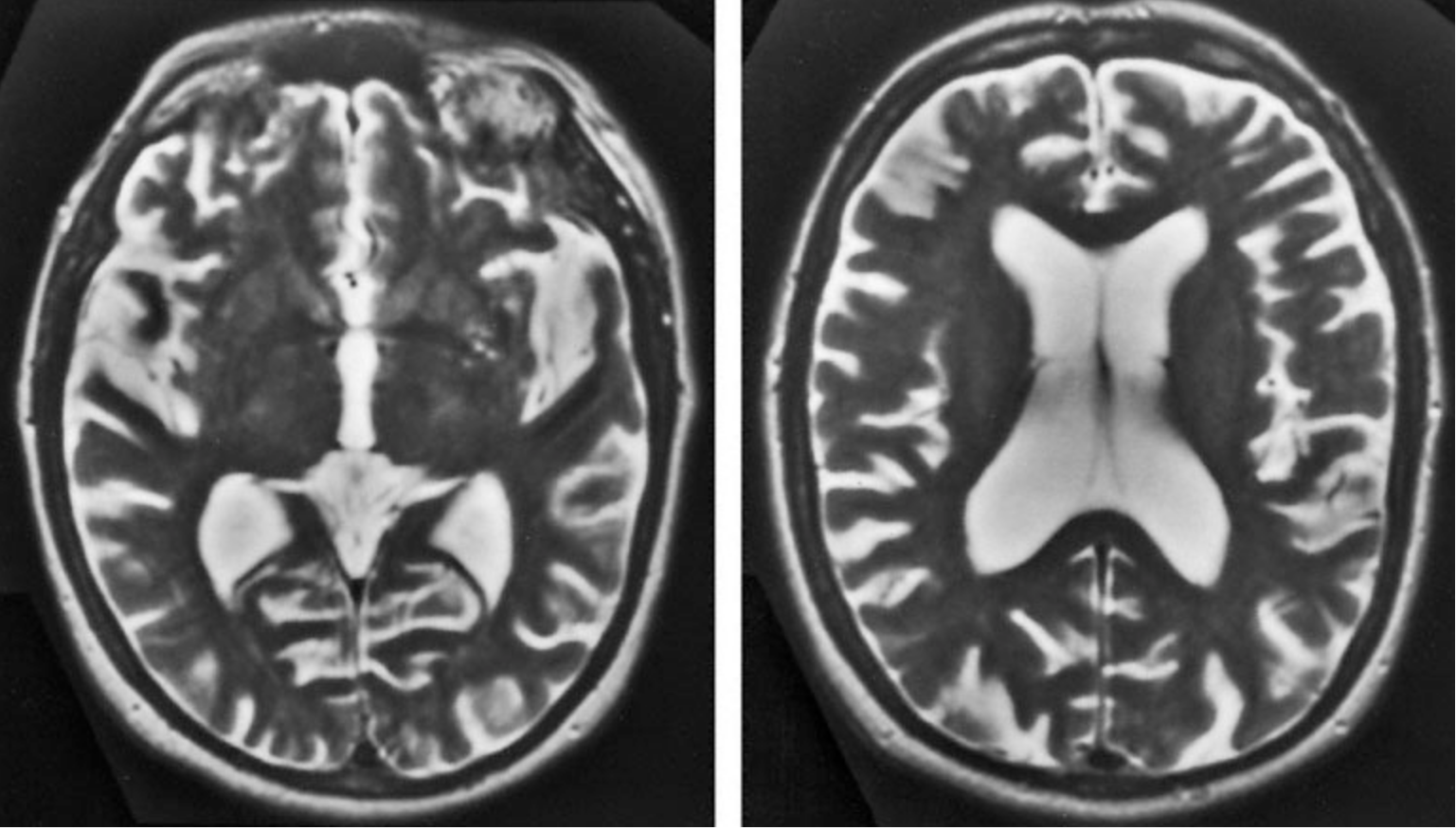
A 73-year-old woman is brought to the clinic by her husband because of a 6-month history of progressive memory difficulty. During this time, she has misplaced objects more frequently than usual and has had trouble following recipes. Six days ago, she became lost while walking their dog in their neighborhood. Today, she forgot that their daughter had called the previous day. The patient has type 2 diabetes mellitus and hypertension. Her medications are metformin and lisinopril. She does not smoke cigarettes or drink alcohol. Vital signs are within normal limits. Physical examination shows no abnormalities. On mental status examination, she is oriented to person but not to place or time. She recalls zero of three objects after 5 minutes. She makes four errors when performing serial sevens. She can name the US President and Vice President. She can name eight animals in 1 minute. The remainder of the examination shows no abnormalities. Results of a complete blood count, her erythrocyte sedimentation rate, and results of liver and thyroid function tests are within the reference ranges. VDRL testing for syphilis is negative. MRIs of the brain are shown. Which of the following is the most appropriate next step in management?
 CorrectIncorrect
 -
Question 6 of 20
6. Question
A previously healthy 77-year-old man comes to the emergency department because of a 6-hour history of increasingly severe, nonradiating lower abdominal pain. He also has had urinary urgency during this time but has not been able to void for 8 hours. He has not had fever, chills, diarrhea, nausea, or vomiting. Vital signs are within normal limits. On examination, there is fullness in the midline from the umbilicus to the pubic symphysis; the area is tender to palpation, but there are no peritoneal signs. Rectal examination shows an enlarged prostate; sphincter tone is normal, and no masses are palpable. Which of the following is the most likely diagnosis?
CorrectIncorrect -
Question 7 of 20
7. Question
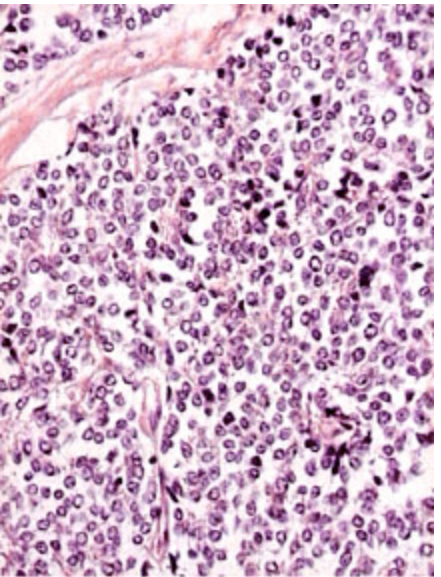
A 6-year-old boy is brought to the emergency department by his parents because of a 2-hour history of severe right leg pain and refusal to walk. They say he has intermittently reported pain in his leg during the past 2 weeks. He has no history of trauma or serious illness and receives no medications. Growth and development are appropriate for age. His temperature is 38.1°C (100.5°F), pulse is 100/min, and blood pressure is 100/80 mm Hg. There is warmth and tenderness to palpation of the proximal aspect of the right tibia with an associated firm mass. Distal pulses are intact. Range of motion of the right knee is limited by pain. Muscle strength in the right lower extremity is 4/5 because of pain and 5/5 elsewhere. Sensation is intact. Laboratory studies show a hemoglobin concentration of 10 g/dL, leukocyte count of 20,000/mm3, and erythrocyte sedimentation rate of 10 mm/h. X-rays show a 6-cm, poorly defined lytic lesion in the proximal tibial metadiaphysis with adjacent periosteal reaction. The results of a biopsy are shown. Which of the following is the most likely diagnosis?
 CorrectIncorrect
 -
Question 8 of 20
8. Question
A 48-year-old man is admitted to the hospital for management of acute respiratory failure. He has a 4-day history of fever, an increase in thick, yellow-green sputum production, and diffuse muscular aches. During the past 2 years, he has produced 2 to 3 tablespoons of yellow sputum daily. He has smoked two packs of cigarettes daily for 30 years. He is 183 cm (6 ft) tall and weighs 134 kg (295 lb); BMI is 40 kg/m2. On admission, his temperature is 38.6°C (101.5°F), pulse is 120/min, respirations are 30/min, and blood pressure is 170/100 mm Hg. Pulse oximetry on room air shows an oxygen saturation of 60%. On admission, an AP portable x-ray shows bilateral diffuse interstitial infiltrates without consolidation. He does not respond to high-flow oxygen therapy. He is intubated and mechanically ventilated. Examination shows hyperresonance to percussion and wheezes bilaterally. Ceftriaxone and levofloxacin are administered, and his symptoms improve. On hospital day 4, he is extubated. His temperature is 37.6°C (99.7°F), pulse is 100/min, respirations are 22/min, and blood pressure is 150/96 mm Hg. Pulse oximetry while sitting shows an oxygen saturation greater than 95%. Six hours later, the patient’s oxygen saturation is 86%. The patient is lying in bed and says he feels fine. Physical examination shows no wheezing, crackles, or rhonchi. There is no peripheral edema. A repeat chest x-ray shows improvement. Which of the following is the most appropriate next step in management to improve this patient’s oxygen saturation?
CorrectIncorrect -
Question 9 of 20
9. Question
A 24-year-old female medical student sustains a deep laceration of her left index finger while assisting the surgeon during an operation on a patient with cervical cancer. The surgical patient has a history of multiple sexual partners and intravenous drug use; it is not yet known if she is HIV positive. Examination of the medical student shows a 2-cm, bleeding laceration; the bleeding stops with compression. Which of the following is the most appropriate next step in management pending results of HIV testing on the surgical patient?
CorrectIncorrect -
Question 10 of 20
10. Question
A 10-month-old female infant is brought to the office by her parents for a follow-up examination 3 weeks after undergoing staged repair of a left complete unilateral cleft lip and palate. The procedure and recovery were uncomplicated, and the infant was discharged home 2 days later. The parents report she is feeding well with a traditional bottle nipple and now also consumes some soft baby foods. She has not had fever, pain, or nasal regurgitation. She receives no medications. Today, she is at the 25th percentile for length and weight. Vital signs are normal. Physical examination discloses a well-healing surgical incision on the left upper vermilion and philtrum; the palate also appears to be healing well without wound dehiscence or palatal holes. This patient’s parents should be informed that she is at increased risk for developing which of the following?
CorrectIncorrect -
Question 11 of 20
11. Question
A 22-year-old man is brought to the physician by his parents because he has become newly preoccupied with religion during the past year. He lives with his parents and attends a community college. Two months ago, he stopped attending his classes. His parents report that he spends most of the day in his room alone reading religious scripture. He shows no interest in activities he once enjoyed, no longer spends time with his friends, masturbates frequently and obviously, and spends most of the night walking around his room laughing and talking to himself. He has no history of serious illness and takes no medications. Vital signs are within normal limits. Physical examination shows no abnormalities. On mental status examination, he has a depressed mood and animated affect. His speech is pressured, and responses to questions are tangential. He reports hearing a voice during the past 2 months that he believes is “the voice of God.” He says that he feels confused and has thoughts about ending his life because he cannot understand if God truly wants him to become the next Messiah. Which of the following is the most likely diagnosis?
CorrectIncorrect -
Question 12 of 20
12. Question
A 26-year-old primigravid woman has spontaneous rupture of the membranes at 30 weeks’ gestation. She is afebrile and has no contractions. A sterile speculum examination shows a closed cervix and a pool of clear fluid in the vagina. Which of the following is the most likely complication?
CorrectIncorrect -
Question 13 of 20
13. Question
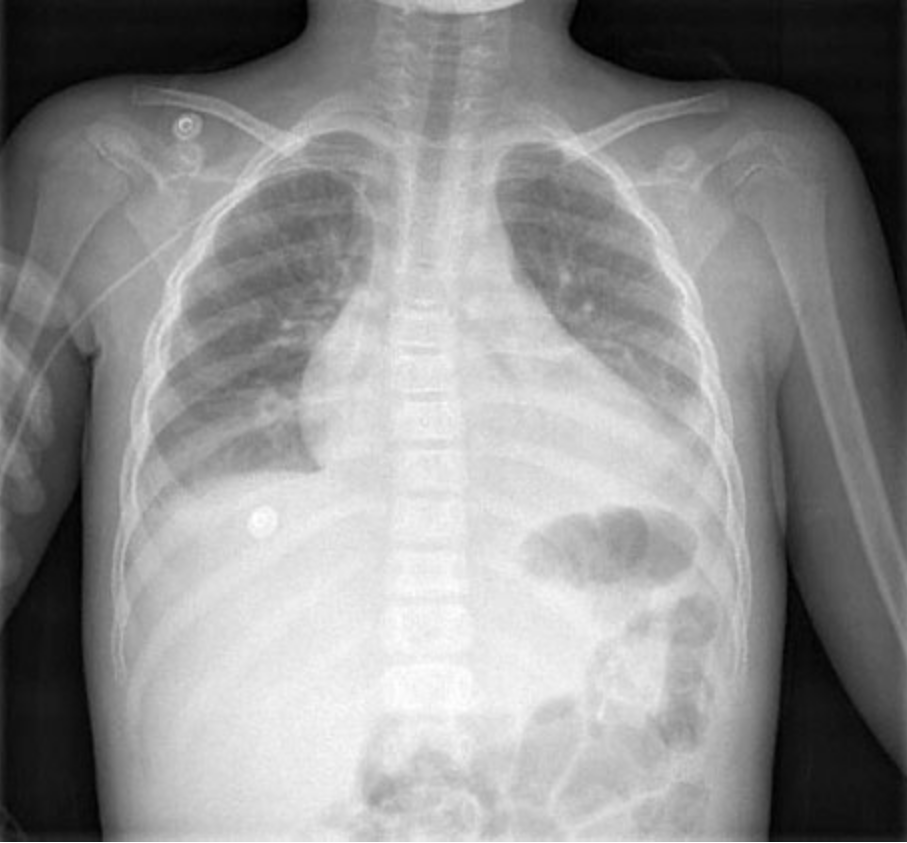
An 8-year-old African American girl with sickle cell disease is brought to the physician by her mother because of a 12-hour history of cough and difficulty breathing. Her medications are penicillin and folic acid. Her temperature is 39°C (102.2°F), pulse is 130/min, respirations are 40/min, and blood pressure is 105/60 mm Hg. Pulse oximetry on room air shows an oxygen saturation of 94%. On pulmonary examination, crackles are heard in the upper lobes. Breath sounds are decreased at the lung bases bilaterally. The remainder of the examination shows no abnormalities. An x-ray of the chest is shown. Which of the following is the most appropriate next step in diagnosis?
 CorrectIncorrect
 -
Question 14 of 20
14. Question
A 58-year-old man is admitted to the hospital for treatment of anemia. Two days ago, he had excessive blood loss following colon polyp removal via colonoscopy. Today, his hemoglobin concentration is 6.5 g/dL and hematocrit is 19.5%. Two months ago, in order to decrease transfusion errors, a blood lock system was implemented in which the patient ID must be entered into the lock to open the blood container; the container cannot be opened without the correct ID. Requiring staff to enter the patient’s ID to open the blood lock is best described as which of the following?
CorrectIncorrect -
Question 15 of 20
15. Question
Twenty-four hours after admission to the hospital for treatment of temperatures to 38.5°C (101.3°F) and abdominal pain, a 22-year-old man has a decrease in his temperature. Two weeks ago, he went on a 5-day trip to South America and had diarrhea for 7 days. He has no previous history of serious illness. On admission, a CT scan of the abdomen showed a 5-cm mass in the right lobe of the liver; the mass was filled with fluid. He has received metronidazole, ampicillin, and gentamicin since admission. His current temperature is 37.4°C (99.3°F), and blood pressure is 120/75 mm Hg. The abdomen is flat with moderate right upper quadrant tenderness and guarding. There are no peritoneal signs. A serum titer for antibodies to Entamoeba histolytica is positive at 1:128. Which of the following is the most appropriate next step in management?
CorrectIncorrect -
Question 16 of 20
16. Question
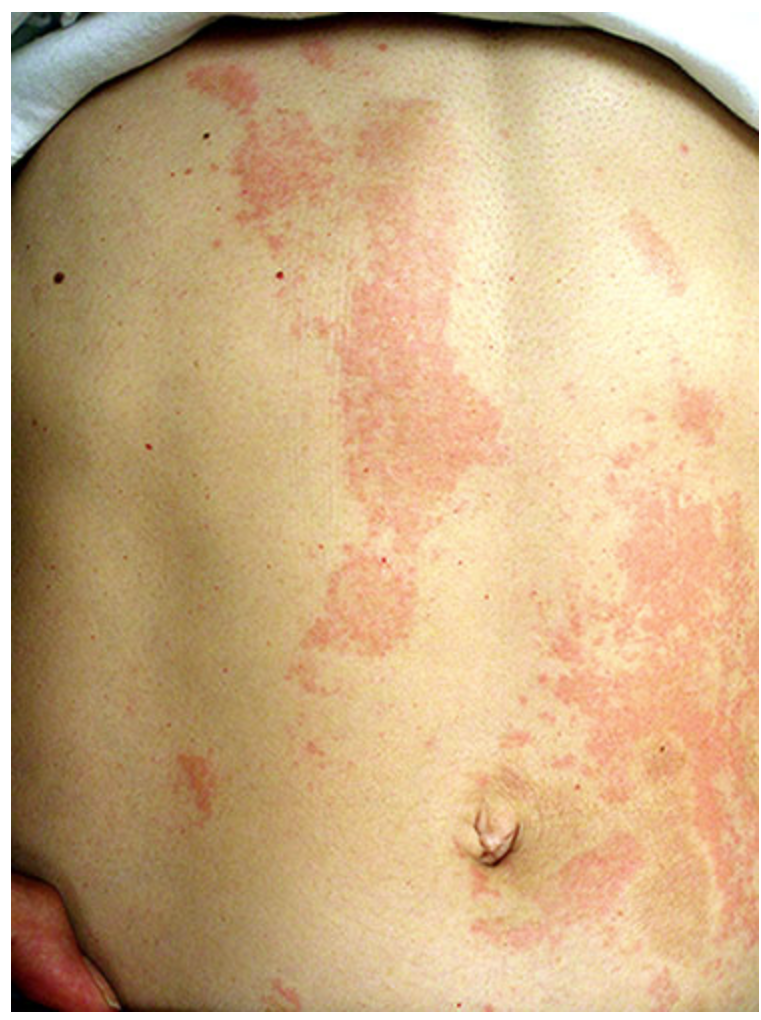
A previously healthy 23-year-old woman is brought to the emergency department 20 minutes after the sudden onset of shortness of breath, moderate abdominal pain, nausea, and an itchy rash over the abdomen. Her symptoms began after she ate a sugar cookie given to her by a friend. The patient had a peanut allergy as a child and before eating the cookie, she asked her friend to taste it. Neither she nor her friend tasted or smelled peanuts. The patient’s only medication is an oral contraceptive. Her last menstrual period was 1 week ago. She has smoked one pack of cigarettes daily for 5 years. She drinks three 12-oz beers on weekends. She has been staying at different friends’ homes during the past 2 months while searching for an apartment and has been using unfamiliar laundry detergents. She is in mild respiratory distress but is able to speak in full sentences. Her pulse is 110/min, respirations are 28/min, and blood pressure is 100/60 mm Hg. Pulse oximetry on room air shows an oxygen saturation of 94%. A photograph of the rash is shown. Scattered wheezes are heard bilaterally. Cardiac examination shows no abnormalities. Abdominal examination shows mild, diffuse tenderness to palpation; there is no rebound or guarding. Which of the following is the most appropriate initial pharmacotherapy?
 CorrectIncorrect
 -
Question 17 of 20
17. Question
A 67-year-old man comes to the physician because he has noticed blood in his urine for the past 2 weeks. He has no prior history of blood in his urine. He has not had pain or any other symptoms. He has hypertension controlled with a diuretic and hypercholesterolemia controlled with a lipid-lowering agent. His blood pressure is 120/76 mm Hg. Examination shows no abnormalities. Urinalysis shows RBCs that are too numerous to count. Which of the following is the most appropriate next step in diagnosis?
CorrectIncorrect -
Question 18 of 20
18. Question
A 39-year-old man comes to the office because of a 1-month history of intermittent regurgitation and constipation. He has regurgitated undigested food four times weekly. He previously had daily bowel movements; during the past month, he has had a bowel movement every 3 to 4 days. He also has a 1-year history of progressive difficulty swallowing. He says initially he had difficulty swallowing solids. He now also has difficulty swallowing liquids. When he eats, he occasionally has moderate pain in the lower sternal area that radiates upward. He emigrated from Brazil 5 years ago. Vital signs are within normal limits. Examination shows no abnormalities. A chest x-ray shows a dilated esophagus with an air-fluid level. Which of the following is the most likely diagnosis?
CorrectIncorrect -
Question 19 of 20
19. Question
A hospitalized 27-year-old woman with sickle cell crisis has shortness of breath and nonproductive cough 4 hours after transfusion of 1 unit of packed red blood cells. Her only medication is morphine. Her temperature is 38°C (100.4°F), pulse is 126/min, respirations are 28/min, and blood pressure is 98/58 mm Hg. Pulse oximetry on room air shows an oxygen saturation of 88%. Examination shows central cyanosis. Diffuse crackles are heard bilaterally. Heart sounds are normal. Arterial blood gas analysis on room air shows:
pH
7.47
Pco2
38 mm Hg
Po2
55 mm Hg
A chest x-ray shows bilateral pulmonary infiltrates. Which of the following is the most likely cause of these findings?
CorrectIncorrect -
Question 20 of 20
20. Question
A 22-year-old man comes to the physician because of a severe nosebleed and a generalized rash for the past 24 hours. He has a 1-month history of fatigue and generalized weakness. His temperature is 36.7°C (98°F), pulse is 100/min, respirations are 18/min, and blood pressure is 142/72 mm Hg. Examination of the skin shows diffuse petechiae over the entire body. There is diffuse lymphadenopathy and mild hepatosplenomegaly. The nares are packed with gauze, and there is no active bleeding. Laboratory studies show:
Hematocrit
28%
Leukocyte count
36,000/mm3
Segmented neutrophils
10%
Lymphocytes
25%
Lymphoblasts and other immature forms
65%
Platelet count
15,000/mm3
Serum
Urea nitrogen
20 mg/dL
Creatinine
1.2 mg/dL
Uric acid
15.2 mg/dL
A biopsy specimen of bone marrow shows acute lymphoblastic leukemia. In addition to vigorous hydration and alkalinization of the urine, which of the following is most appropriate to administer to prevent acute renal failure during chemotherapy in this patient?
CorrectIncorrect