
CK- NBME 12 – Block 1 (Duplicate 1)
Time limit: 0
Quiz Summary
0 of 20 Questions completed
Questions:
Information
You have already completed the quiz before. Hence you can not start it again.
Quiz is loading…
You must sign in or sign up to start the quiz.
You must first complete the following:
Results
Quiz complete. Results are being recorded.
Results
0 of 20 Questions answered correctly
Your time:
Time has elapsed
You have reached 0 of 0 point(s), (0)
Earned Point(s): 0 of 0, (0)
0 Essay(s) Pending (Possible Point(s): 0)
Categories
- Not categorized 0%
- 1
- 2
- 3
- 4
- 5
- 6
- 7
- 8
- 9
- 10
- 11
- 12
- 13
- 14
- 15
- 16
- 17
- 18
- 19
- 20
- Current
- Review
- Answered
- Correct
- Incorrect
-
Question 1 of 20
1. Question
A 47-year-old woman comes to the physician because of a 2-month history of substernal chest tightness and shortness of breath associated with exercise and relieved by rest. She previously walked 2 miles daily, but now she is limited to walking one-half block because of chest pain, dyspnea, and light-headedness. She has never smoked and drinks one to two beers daily. Her temperature is 36.8°C (98.2°F), pulse is 98/min, respirations are 20/min, and blood pressure is 110/82 mm Hg. Jugular venous pressure is 8 cm H2O. Crackles are heard at both lung bases. The point of maximal impulse is increased but not displaced; S1 is normal, but S2 is decreased. There is a grade 3/6, harsh systolic murmur at the cardiac base. Serum studies show a total cholesterol concentration of 210 mg/dL, HDL-cholesterol concentration of 95 mg/dL, and LDL-cholesterol concentration of 100 mg/dL. Which of the following is the most likely cause of this patient’s heart failure?
CorrectIncorrect -
Question 2 of 20
2. Question
A 30-year-old man who is in the US Army is brought to the emergency department of a military hospital 40 minutes after being hit by a motor vehicle traveling 25 mph while he was walking. On arrival, he is unconscious. Temperature is 36.0°C (96.8°F), pulse is 113/min, respirations are 22/min, and blood pressure is 80/55 mm Hg. Pulse oximetry on room air shows an oxygen saturation of 90%. On examination, the abdomen is rigid. He is resuscitated with 8 units of packed red blood cells, 6 units of fresh frozen plasma, and 2 units of platelets. Emergency laparotomy shows transection of the small bowel 5 cm proximal to the cecum. Laboratory studies done 45 minutes after arriving in the surgical intensive care unit show an activated partial thromboplastin time of 42 seconds and a prothrombin time of 25 seconds (INR=3.2). Which of the following is the most likely cause of the coagulation abnormalities in this patient?
CorrectIncorrect -
Question 3 of 20
3. Question
A 25-year-old woman, gravida 1, para 1, comes to the office because of a 3-month history of chronic moderate perianal pain and bleeding that began 3 days after she gave birth via cesarean delivery. Before the onset of her symptoms, she had constipation associated with the use of postdelivery oxycodone therapy. The constipation resolved after she discontinued the medication, but her bowel movements have been painful and she has noticed blood on the toilet tissue. One week ago, the patient’s obstetrician prescribed topical hydrocortisone and diltiazem, which provide temporary relief but do not resolve her symptoms. The patient’s medical history otherwise is unremarkable and she takes no other medications. Family history is unremarkable. Vital signs are temperature 37.2°C (99.0°F), pulse 80/min, respirations 20/min, and blood pressure 130/80 mm Hg. Examination of the anus shows a deep wound in the posterior midline with exposure of the internal sphincter muscle and an associated 1.5-cm skin tag. Which of the following is the most appropriate next step in management?
CorrectIncorrect -
Question 4 of 20
4. Question
A 42-year-old man is brought to the emergency department by paramedics 1 hour after his girlfriend found him confused and agitated in his home. The girlfriend says that when she spoke with him on the telephone last night, she noted no problems, but she became worried when he did not answer his telephone 3 hours ago. He has a 3-year history of chronic back pain for which he takes oxycodone. He also has major depressive disorder and seasonal allergies treated with citalopram and diphenhydramine, respectively. On arrival, he is confused, screaming loudly, and actively pulling against wrist restraints. His temperature is 38°C (100.4°F), pulse is 163/min, respirations are 24/min, and blood pressure is 215/105 mm Hg. Physical examination shows diaphoresis and tremulousness. The pupils are dilated. Which of the following is the most likely cause of this patient’s confusion?
CorrectIncorrect -
Question 5 of 20
5. Question
A 21-year-old woman, gravida 2, para 1, at 36 weeks’ gestation is admitted to the hospital in labor. She received no prenatal care. She has no history of operative procedures. She reports that she occasionally used cocaine before she knew she was pregnant but has abstained from illicit drug use during the past 8 months. On admission, the cervix is 5 cm dilated and 100% effaced; the vertex is at 0 station. There is a moderate amount of blood-tinged mucus. The membranes are artificially ruptured, yielding clear fluid. Her blood group is A, Rh-negative; a serum anti-D antibody titer is positive. During the next 30 minutes, fetal heart monitoring shows regular, sinusoidal wave forms. Which of the following is the most likely cause of this fetal heart rate pattern?
CorrectIncorrect -
Question 6 of 20
6. Question
A 22-year-old college student comes to the physician because of a 3-year history of falling asleep during her classes; she worries that she will not be able to continue with her education because of this. She says that she always has had difficulty staying awake during class, even in high school. She also occasionally has trouble staying awake during movies. She says she has no problems getting to sleep or waking up. She goes to bed between midnight and 1 am and gets up at 8 am. She has tried sleeping for longer durations, even up to 8½ hours, but she still has been unable to stay awake during the day. She has the greatest difficulty staying awake during her classes after lunch. She thinks that she sleeps very soundly and moves little during sleep because her bedsheets are neat when she awakens in the morning. She does not remember having dreams. She reports that no one has ever told her that she snores. She is 170 cm (5 ft 5 in) tall and weighs 62 kg (136 lb); BMI is 21 kg/m2. Physical examination shows no abnormalities. On mental status examination, she has a concerned mood and a reactive affect. Which of the following is the most appropriate next step in diagnosis?
CorrectIncorrect -
Question 7 of 20
7. Question
A 38-year-old woman comes to the office because of a 6-month history of progressive fatigue and muscle weakness. During this time, she has not been able to concentrate at work and has noticed that her voice has become hoarse. During the past 3 months, she has had a 5.4-kg (12-lb) weight gain despite limiting her food intake. She has bipolar disorder, type 2 diabetes mellitus, and hypercholesterolemia. Her medications are metformin, lisinopril, lithium, and pravastatin. She does not smoke cigarettes, drink alcohol, or use illicit drugs. Her temperature is 37°C (98.6°F), pulse is 50/min, respirations are 14/min, and blood pressure is 130/90 mm Hg. Examination shows cold skin and coarse hair over the scalp. There is a firm, nontender, symmetrically enlarged thyroid gland. Deep tendon reflexes are 1+. Her serum thyroid-stimulating hormone concentration is 25 μU/mL. Results of serum electrolyte concentrations and renal function tests are within the reference ranges. Antithyroid peroxidase antibody testing is negative. Which of the following is the most likely cause of these findings?
CorrectIncorrect -
Question 8 of 20
8. Question
A 27-year-old man comes to the emergency department because of a progressive rash and wheezing. Yesterday, the patient received the diagnosis of cellulitis of his right leg, and cephalexin therapy was begun. He has a history of mild, intermittent asthma and eczema. His only other medication is inhaled albuterol as needed. He had a mild allergic reaction to ampicillin as a child. He is in moderate distress. His temperature is 37°C (98.6°F), pulse is 118/min, respirations are 22/min, and blood pressure is 90/60 mm Hg. Examination shows a 3 x 3-cm, erythematous, warm, tender rash on the right leg that is unchanged from yesterday. There are new, raised, 1 x 2-cm pruritic lesions on the upper and lower extremities and trunk. Diffuse, scattered inspiratory and expiratory wheezes are heard bilaterally. Which of the following is the most likely diagnosis?
CorrectIncorrect -
Question 9 of 20
9. Question
A 37-year-old man comes to the physician because he has had two bowel movements containing bright red blood during the past 6 hours. He has a 3-day history of intermittent severe abdominal cramps and diarrhea. He has had five loose stools daily during this period. He has no history of serious illness and takes no medications. His last visit to a physician was 5 years ago. His most recent travel experience was a trip to Canada 6 months ago. His temperature is 37°C (98.6°F), pulse is 98/min, and blood pressure is 126/78 mm Hg. Abdominal examination shows diffuse severe tenderness with no peritoneal signs. Bowel sounds are increased. Rectal examination shows no abnormalities. There is no stool in the rectal vault. His hemoglobin concentration is 13 g/dL, leukocyte count is 12,300/mm3, and platelet count is 302,000/mm3. Which of the following is the most likely causal organism?
CorrectIncorrect -
Question 10 of 20
10. Question
A 50-year-old man with a 30-year history of paranoid schizophrenia is admitted to a psychiatric facility because of an exacerbation of his condition. His history includes multiple admissions to the hospital for his condition. The physician prescribes oral antipsychotic therapy and the patient agrees to take the medication while in the facility, but he says that he does not need it and he will stop taking the medication as soon as he is discharged. He states, “I don’t trust any of you. You’re all out to get me. But I’ll play along until my time here is done.” Which of the following is the most appropriate next step in management?
CorrectIncorrect -
Question 11 of 20
11. Question
An 8-year-old boy is brought to the emergency department because of a 2-day history of urinary urgency and frequency and right-sided abdominal cramps. The cramps are intermittent, and he cannot get comfortable in any position when they occur. He has not had fever, diarrhea, or constipation, but he has vomited twice. He has no history of similar episodes or serious illness. He takes no medications. His paternal uncle has a history of renal calculi, and his cousin has Crohn disease. The patient has no dietary restrictions. His temperature is 37.5°C (99.5°F). The right flank is tender to palpation. An abdominal x-ray shows a 3-mm ovoid, opaque mass in the right pelvis. Laboratory studies show:
Serum
Urea nitrogen
20 mg/dL
Creatinine
0.1 mg/dL
Urine
pH
6.5
RBC
30–50/hpf
WBC
3–5/hpf
In addition to administration of morphine, which of the following is the most appropriate next step in management?
CorrectIncorrect -
Question 12 of 20
12. Question
A previously healthy 57-year-old woman comes to the physician because of a 6-month history of muscle weakness and fatigue. The weakness began in the muscles of her face and has progressed to all of the muscles in her body. Examination shows bilateral ptosis and weakness of the left abducens muscle. An x-ray of the chest shows a mediastinal mass. Which of the following is the most appropriate next step in diagnosis of this patient’s neurologic findings?
CorrectIncorrect -
Question 13 of 20
13. Question
A 29-year-old woman, gravida 1, para 1, comes to the physician 1 week after noticing a mildly tender lump in her left breast. Five months ago, she delivered a healthy newborn at term following an uncomplicated pregnancy and spontaneous vaginal delivery. She is breast-feeding and says her infant feeds equally from both breasts. The patient has no history of serious illness, and her only medication is a prenatal vitamin. Her mother was diagnosed with breast cancer at the age of 61 years. The patient’s vital signs are within normal limits. Examination shows no axillary or supraclavicular lymphadenopathy. There is a 3-cm, smooth, mobile, cystic, tender mass in the upper outer quadrant of the left breast. Which of the following is the most appropriate next step in management?
CorrectIncorrect -
Question 14 of 20
14. Question
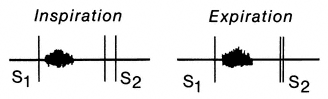
An 18-year-old man is brought to the physician 1 hour after he felt light-headed while playing basketball. He has not had chest pain, palpitations, or shortness of breath. He has no history of serious illness and takes no medications. His father died in a motor vehicle collision at the age of 35 years. There is no family history of serious illness. The patient’s pulse is 80/min, and blood pressure is 115/85 mm Hg. There is no jugular venous distention. Pulmonary examination shows no abnormalities. A diagram of cardiac auscultation is shown. The murmur does not change with inspiration, position, or Valsalva maneuver. An ECG shows no abnormalities. Which of the following is the most appropriate next step in management?
 CorrectIncorrect
 -
Question 15 of 20
15. Question
A 37-year-old woman is brought to the emergency department 30 minutes after an episode of syncope at a shopping mall. She says she had shortness of breath and was sweating before she passed out. She has a childhood history of asthma. She currently has panic disorder and gastroesophageal reflux disease. Current medications include sertraline, omeprazole, and an oral contraceptive. On arrival, she is alert and oriented to person, place, and time. Her temperature is 37.4°C (99.3°F), pulse is 110/min, and blood pressure is 90/60 mm Hg. Pulse oximetry on room air shows an oxygen saturation of 90%. Examination, including neurologic examination, shows no abnormalities. Laboratory studies show:
Hemoglobin
12 g/dL
Hematocrit
36%
Leukocyte count
9000/mm3
Arterial blood gas analysis on room air:
pH
7.46
Pco2
30 mm Hg
Po2
62 mm Hg
Which of the following is the most likely explanation for these findings?
CorrectIncorrect -
Question 16 of 20
16. Question
A 62-year-old woman comes to the physician because of a 2-month history of generalized fatigue and mild low back pain. She has not had any other symptoms. She has no history of serious illness and takes no medications. Her last health maintenance examination was 10 months ago, and a complete blood count at that time was within the reference range. Examination today shows no abnormalities. Laboratory studies show:
Hematocrit
30%
Mean corpuscular volume
103 μm3
Leukocyte count
8200/mm3
Segmented neutrophils
67%
Bands
4%
Lymphocytes
29%
Platelet count
165,000/mm3
Serum
Ca2+
10.9 mg/dL
Creatinine
1.8 mg/dL
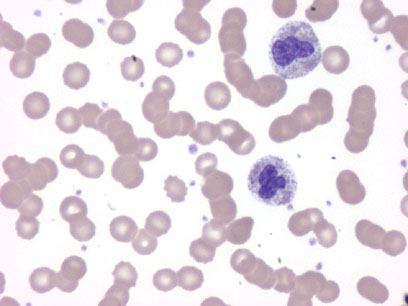
A blood smear is shown. Which of the following is the most appropriate next step to confirm the diagnosis?
 CorrectIncorrect
 -
Question 17 of 20
17. Question
A 37-year-old man comes to the physician for a routine health maintenance examination. He feels well. He has no history of serious illness and takes no medications. He received the hepatitis B vaccine at the age of 28 years. He does not smoke or drink alcohol. During the past 6 months, he has been sexually active with one male partner, and they do not use condoms. The patient works as an accountant and has not traveled outside the USA. Examination shows no abnormalities. A blood sample is obtained for serum lipid studies and an HIV antibody test. In addition to counseling this patient about risk factors for sexually transmitted diseases, which of the following is the most appropriate next step in management?
CorrectIncorrect -
Question 18 of 20
18. Question
A 27-year-old man comes to the physician because of a 1-month history of sudden episodes of a “scary choking feeling.” He has had three episodes during this period; the episodes are accompanied by nausea, sweating, and “heart pounding” sensations. The symptoms peak within 5 to 10 minutes and disappear about 15 minutes later. The first two episodes “came out of the blue” while he was at work; the last episode occurred when he was stuck in traffic. He is fearful that he will have another episode and that “someone will notice and think I’m going crazy.” He has no history of serious medical illness and takes no medications. He is a veteran of the U.S. Marine Corps and experienced some intense fighting 5 years ago. He has occasional nightmares involving combat and intermittent sadness when he thinks about military comrades who were killed. He has occasional difficulty falling asleep. He has had no changes in energy level or appetite. He is 175 cm (5 ft 9 in) tall and weighs 82 kg (180 lb); BMI is 27 kg/m2. Vital signs are within normal limits. Physical examination shows no abnormalities. On mental status examination, he is anxious but relates well with the physician. His serum thyroid-stimulating hormone concentration is within the reference range. A 12-lead ECG shows a normal sinus rhythm. Which of the following is the most appropriate pharmacotherapy?
CorrectIncorrect -
Question 19 of 20
19. Question
A 57-year-old man comes to the physician because of a 1-year history of low back pain that radiates to the buttocks when he walks. He has not had leg pain or pain at rest. The pain is relieved within 1 minute when he stops walking. He has a 1-year history of erectile dysfunction. He has smoked one pack of cigarettes daily for 30 years. His pulse is 85/min, and blood pressure is 160/100 mm Hg. Flexion of either hip with the knee extended does not cause pain. Pedal pulses are decreased. Sensation is intact. His hematocrit is 40%, erythrocyte sedimentation rate is 20 mm/h, and serum glucose concentration is 180 mg/dL. Which of the following is the most likely diagnosis?
CorrectIncorrect -
Question 20 of 20
20. Question
A 60-year-old female store clerk comes to the office for an annual health maintenance examination. Her medical history is unremarkable except for gastroesophageal reflux disease, for which she takes ranitidine at bedtime with good relief. Her last menstrual period was 6 years ago. Mammogram 5 years ago and Pap smear 2 years ago were normal. She does not exercise regularly. She eats a regular diet. She has smoked one pack of cigarettes daily for 40 years and drinks one to two glasses of wine weekly. Her family history is significant only for diet-controlled diabetes mellitus in her mother. The patient is 157 cm (5 ft 2 in) tall and weighs 68 kg (150 lb); BMI is 27 kg/m2. Her waist-to-hip ratio is 1.05. Cardiopulmonary, abdominal, and genitourinary examinations are normal for her age and sex assigned at birth. This patient’s greatest risk of mortality at this time is from which of the following?
CorrectIncorrect