
CK- NBME 12 – Block 1 (Duplicate 2)
Time limit: 0
Quiz Summary
0 of 20 Questions completed
Questions:
Information
You have already completed the quiz before. Hence you can not start it again.
Quiz is loading…
You must sign in or sign up to start the quiz.
You must first complete the following:
Results
Quiz complete. Results are being recorded.
Results
0 of 20 Questions answered correctly
Your time:
Time has elapsed
You have reached 0 of 0 point(s), (0)
Earned Point(s): 0 of 0, (0)
0 Essay(s) Pending (Possible Point(s): 0)
Categories
- Not categorized 0%
- 1
- 2
- 3
- 4
- 5
- 6
- 7
- 8
- 9
- 10
- 11
- 12
- 13
- 14
- 15
- 16
- 17
- 18
- 19
- 20
- Current
- Review
- Answered
- Correct
- Incorrect
-
Question 1 of 20
1. Question
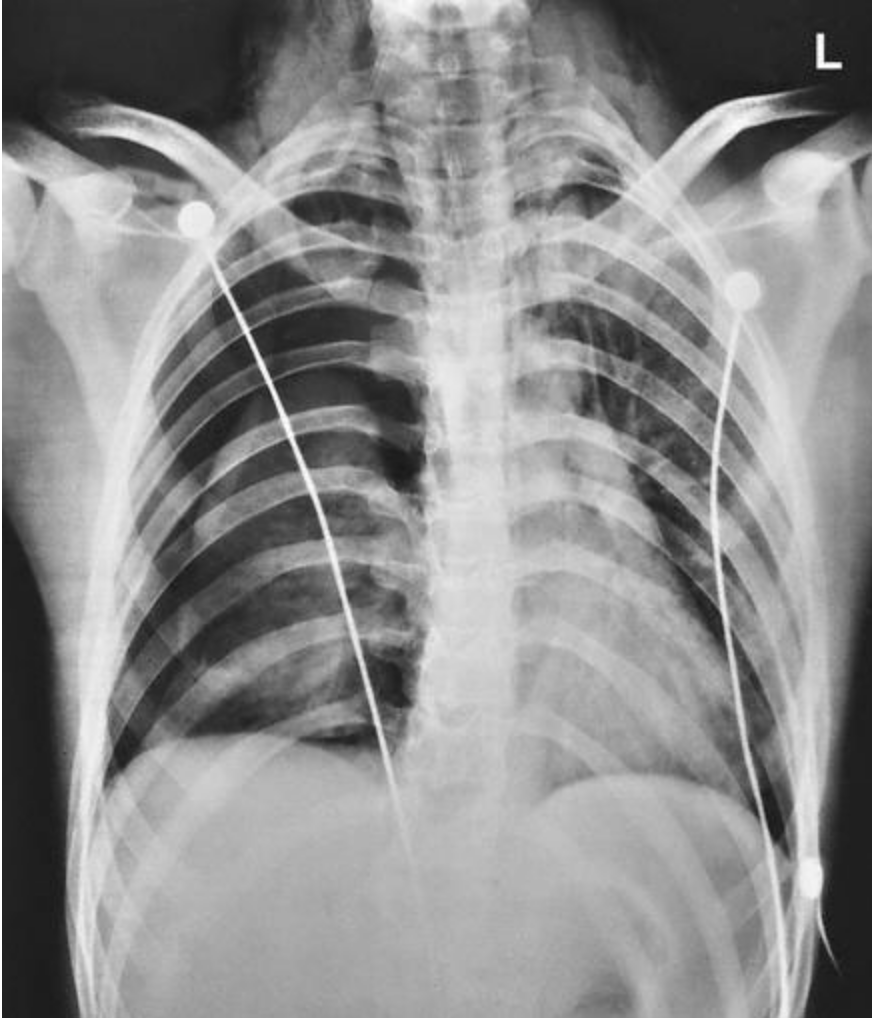
A 36-year-old man is brought to the emergency department after he developed chest pain and dyspnea while attempting a 10K run. He has had mild asthma for several years but he takes no medications for it. He says that he has developed a nonproductive cough recently. He has not had fever, but he has noticed a decrease in his appetite and a 2.5-kg (5-lb) weight loss during the past 6 weeks. Vital signs are pulse 100/min, respirations 26/min, and blood pressure 100/72 mm Hg. Pulse oximetry on room air shows an oxygen saturation of 92%. Breath sounds are diminished on the right and there is increased resonance on percussion. Chest x-ray is shown. Which of the following is the most appropriate treatment at this time?
CorrectIncorrect -
Question 2 of 20
2. Question
A 15-year-old girl is brought to the emergency department by her mother because of a 2-week history of heavy vaginal bleeding. Menarche was at the age of 14 years. Menses occur at irregular 21- to 35-day intervals and last 10 days with moderate flow. She has never been sexually active. She is not in distress. She is at the 55th percentile for height, 70th percentile for weight, and 60th percentile for BMI. Her temperature is 38°C (100.4°F), and blood pressure is 90/55 mm Hg. Examination shows pallor. Laboratory studies show a hemoglobin concentration of 9 g/dL, leukocyte count of 5500/mm3, and platelet count of 15,000/mm3. Which of the following is the most likely diagnosis?
CorrectIncorrect -
Question 3 of 20
3. Question
A 49-year-old man comes to the office because of a 2-week history of dark urine. He has had a 5-kg (11-lb) weight loss during the past month despite no change in appetite. He has no history of serious illness and takes no medications. His temperature is 37.5°C (99.5°F), pulse is 80/min, respirations are 12/min, and blood pressure is 132/86 mm Hg. Examination shows conjunctival icterus. A 5-cm, nontender mass is palpated in the right upper quadrant of the abdomen. Serum studies show a total bilirubin concentration of 6 mg/dL, with a direct component of 5.2 mg/dL, and a lactate dehydrogenase activity of 480 U/L. Abdominal ultrasonography shows an enlarged gallbladder with no calculi, a 2-cm-wide common bile duct with no calculi that tapers at the distal end, and a 5-cm mass in the head of the pancreas. A CT scan of the abdomen shows a 5-cm mass in the head of the pancreas compressing the superior mesenteric vein and partially encasing the superior mesenteric artery. Results of a fine-needle biopsy show hyperchromatic, pleomorphic cells with a high nucleus-to-cytoplasm ratio. Further diagnostic studies show no evidence of metastatic disease. Which of the following factors is most predictive of a poor prognosis in this patient?
CorrectIncorrect -
Question 4 of 20
4. Question
A 60-year-old man comes to the emergency department 6 hours after the onset of shortness of breath associated with a nonproductive cough. One year ago, he was diagnosed with mild hypertension. His pulse is 100/min, respirations are 26/min, and blood pressure is 140/105 mm Hg. Ophthalmoscopic examination shows arteriolar narrowing but no papilledema. There is no peripheral edema. An S3, S4, and crackles at the bases of both lungs are heard, and jugular veins are distended. Which of the following is the most likely diagnosis?
CorrectIncorrect -
Question 5 of 20
5. Question
Immediately after delivery to a 17-year-old primigravid patient, a 500-g (1-lb 2-oz) male newborn fails to breathe spontaneously and has a pulse of 30/min. The mother had no prenatal care and says that her last menstrual period was 2 or 3 months ago. Examination of the newborn shows edematous hands and feet and dark red skin without lanugo. The eyelids are fused. He is hypotonic. All four extremities are in extension. The nipples are barely visible, and the testes are undescended. After several minutes of bag-valve-mask ventilation with 100% oxygen and chest compressions, the pulse falls below 30/min, and there are still no spontaneous respirations. Which of the following is the most appropriate next step in management?
CorrectIncorrect -
Question 6 of 20
6. Question
Fifteen days after sustaining third-degree burns of the abdomen and lower extremities, a hospitalized 67-year-old man has fever. He is intubated and mechanically ventilated. He is receiving cefazolin, lorazepam, and atenolol. His temperature is 38.9°C (102°F), pulse is 90/min, and blood pressure is 110/70 mm Hg. A small amount of cloudy fluid is draining around the nasogastric tube. The burn wounds are clean. The lungs are clear to auscultation. The abdomen is soft. Rectal examination shows no abnormalities. Femoral pulses are intact. Laboratory studies show a hematocrit of 35% and leukocyte count of 15,000/mm3. A chest x-ray shows no abnormalities; endotracheal and nasogastric tubes are in proper position. Which of the following is the most appropriate next step in diagnosis?
CorrectIncorrect -
Question 7 of 20
7. Question
A 13-month-old boy is brought to the physician for a follow-up examination. He completed a 10-day course of amoxicillin for an episode of pneumonia 10 days ago. He has had four episodes of pneumonia since birth and had severe chickenpox at the age of 8 months. He is below the 5th percentile for length and weight. His temperature is 37.4°C (99.3°F), pulse is 120/min, respirations are 30/min, and blood pressure is 94/50 mm Hg. Examination shows no abnormalities except for oral thrush. Laboratory studies show a leukocyte count of 1500/mm3 (50% segmented neutrophils, 8% eosinophils, 1% basophils, 35% lymphocytes, and 6% monocytes), a CD4+ T-lymphocyte count of 225/mm3 (Normal≥500), and a low lymphocyte proliferative response. Which of the following is the most likely diagnosis?
CorrectIncorrect -
Question 8 of 20
8. Question
Twenty-eight hours after undergoing uncomplicated elective right total knee replacement, a 76-year-old woman is alert and fully oriented but has nausea and pain in her right hip. Eight hours later, she is found unresponsive. She has hypertension. Her preadmission medication is lisinopril. Promethazine, hydromorphone, and enoxaparin were added to the regimen postoperatively. Her temperature is 37°C (98.6°F), pulse is 90/min, respirations are 6/min, and blood pressure is 90/50 mm Hg. Physical examination shows a clean surgical site with no drainage or bleeding. On neurologic examination, she does not respond to auditory stimuli. She responds to painful stimuli with a faint grimace. The eyes are closed; when the physician manually opens the patient’s eyes, the pupils are 3 mm. There are no spontaneous movements of the extremities. The extremities do not move with painful stimuli. Which of the following is most likely to show the cause of this patient’s change in level of consciousness?
CorrectIncorrect -
Question 9 of 20
9. Question
A 78-year-old woman comes to the physician because of a 2-week history of mild right knee pain, especially when she walks up stairs. During this time, she also has had stiffness in her knee in the morning. She enjoys walking around her neighborhood but has been unable to walk because of the pain. She has gastroesophageal reflux disease and takes omeprazole occasionally. Vital signs are within normal limits. On examination, active and passive range of motion of the right knee is full; there is moderate crepitus and no effusion. Which of the following is the most appropriate pharmacotherapy?
CorrectIncorrect -
Question 10 of 20
10. Question
A previously healthy 25-year-old man is brought to the emergency department 2 hours after being involved in a motor vehicle collision. He was the restrained driver. On arrival, he is alert and oriented to person, place, and time. He says he has severe lower abdominal pain. His temperature is 37.5°C (99.5°F), pulse is 105/min, respirations are 18/min, and blood pressure is 120/70 mm Hg. Abdominal examination shows ecchymoses over the lower quadrants and an abrasion where the seat belt was fastened. There is suprapubic tenderness. Palpation of the iliac crests produces pain. There is blood at the urethral meatus. His hematocrit is 30%. X-rays of the pelvis show a fracture of the superior and inferior right pubic rami and the right sacroiliac joint. Which of the following is the most appropriate next step in management?
CorrectIncorrect -
Question 11 of 20
11. Question
Eight weeks after an uncomplicated vaginal delivery of a healthy full-term newborn, a 27-year-old woman, gravida 1, para 1, is brought to the physician by her husband because of a change in personality and depressed mood over the past 10 days. She has not had headaches. Her menses have not resumed despite the discontinuation of breast-feeding 5 weeks ago. Her husband says that she has no interest in sexual intercourse. She does not use illicit drugs. She has had a 2.7-kg (6-lb) weight gain since delivery. She is now 175 cm (5 ft 9 in) tall and weighs 74 kg (164 lb); BMI is 24 kg/m2. Physical and neurologic examinations show no abnormalities. On mental status examination, she has a flat affect and is slow to respond to questioning. She spontaneously cries during the interview and examination. She has no suicidal ideation. Which of the following is the most appropriate next step in management?
CorrectIncorrect -
Question 12 of 20
12. Question
A 32-year-old woman, gravida 3, para 2, at 37 weeks’ gestation is admitted to the hospital in labor. Contractions occur every 3 minutes. She has gained 2.3 kg (5 lb) during the past week and has had occasional blurred vision. She has been otherwise healthy. Her temperature is 37°C (98.6°F), pulse is 80/min, respirations are 20/min, and blood pressure is 150/110 mm Hg. Physical examination shows retinal arteriolar spasm and pedal edema. The fundus is midway between the umbilicus and xiphoid. The cervix is 3 cm dilated and 100% effaced; the vertex is at 0 station. Laboratory studies show:
Hemoglobin
12.5 g/dL
Leukocyte count
8000/mm3
Platelet count
200,000/mm3
Serum creatinine
1.2 mg/dL
Urine protein
2+
Which of the following is the most likely complication during labor?
CorrectIncorrect -
Question 13 of 20
13. Question
A 32-year-old man is brought to the physician by his wife because of a gradual change in personality during the past 2 years. She describes him as less motivated and more self-centered. During the past year, he has had several angry outbursts that were triggered by minor events. The patient says that he does not believe his personality has changed and that he does not recall these events. He is alert and attentive. On examination, eye movements are full, but saccadic eye movements are noticeably slow. Smooth pursuit and vestibular ocular movements are normal. He has occasional involuntary rapid, jerk-like movements of the trunk and extremities, but he is unaware of these movements. The remainder of the examination shows no abnormalities. Which of the following is the most appropriate next step in diagnosis?
CorrectIncorrect -
Question 14 of 20
14. Question
A 12-year-old girl is brought to the physician by her mother because of a 2-month history of increasing, constant, throbbing pain and pressure in the pelvic area. She has no history of serious illness and takes no medications. She has never had a menstrual period. She follows a normal diet and takes gymnastics lessons weekly. She is at the 50th percentile for height, weight, and BMI. Vital signs are within normal limits. Breast and pubic hair development are sexual maturity rating (SMR) stage 3. Examination of the external genitalia shows a bluish bulge of tissue between a normal-appearing urethra and anus. Serum studies show:
Follicle-stimulating hormone
12 mIU/mL
Luteinizing hormone
15 mIU/mL
Estradiol
50 pg/mL (N=30–400)
Prolactin
10 ng/mL
Which of the following is the most likely diagnosis?
CorrectIncorrect -
Question 15 of 20
15. Question
A 9-year-old girl is brought to the physician by her father for a well-child examination. He is concerned that she is beginning to develop breasts at an early age. Menarche has not occurred. Her mother’s menarche began at the age of 12 years. The patient is at the 75th percentile for height and 50th percentile for weight. Breast development is sexual maturity rating (SMR) stage 2, and pubic hair development is SMR stage 1. The remainder of the examination shows no abnormalities. Which of the following is the most appropriate next step in management?
CorrectIncorrect -
Question 16 of 20
16. Question
A 57-year-old man comes to the physician because of a 1-week history of shortness of breath and swelling of his legs. He says his shortness of breath occurs most frequently when he lies down. During the past month, he has had the sensation of abdominal fullness and pulling and has noticed a progressive increase in his belt size. Five years ago, he received the diagnosis of bleeding esophageal varices and alcoholic cirrhosis. He underwent sclerosis of the varices and has abstained from alcohol since then. His temperature is 36.9°C (98.4°F). The abdomen is moderately tense and nontender with shifting dullness. There is 3+ pitting edema of the lower extremities. Paracentesis is performed. Laboratory studies show:
Serum
Protein, total
2.8 g/dL
Albumin
1.8 g/dL
Peritoneal fluid
Leukocyte count
900/mm3
Segmented neutrophils
67%
Lymphocytes
28%
Protein, total
1.8 g/dL
Albumin
1 g/dL
Which of the following is the most appropriate next step in management?
CorrectIncorrect -
Question 17 of 20
17. Question
An asymptomatic 62-year-old man comes for a routine health maintenance examination. Physical examination shows splenomegaly. Laboratory studies show:
Hematocrit
42%
Leukocyte count
46,000/mm3
Segmented neutrophils
35%
Bands
15%
Basophils
1%
Lymphocytes
16%
Monocytes
5%
Myeloblasts
1%
Promyelocytes
2%
Metamyelocytes
13%
Myelocytes
12%
Platelet count
650,000/mm3
Leukocyte alkaline phosphatase activity is decreased. Examination of bone marrow shows many immature white blood cell precursors. Which of the following is the most likely diagnosis?
CorrectIncorrect -
Question 18 of 20
18. Question
A 5-year-old boy is brought to the office for a follow-up examination 2 days after he was discharged from the hospital following an episode of pyelonephritis. Medications are cefixime and acetaminophen. He is at the 50th percentile for height and 25th percentile for weight; BMI is at the 10th percentile. Temperature is 37.6°C (99.6°F), pulse is 120/min, respirations are 22/min, and blood pressure is 90/60 mm Hg. Physical examination shows no other abnormalities. Results of laboratory studies from his hospital admission showed a leukocyte count within the reference range and urine positive for leukocyte esterase; urine culture grew Klebsiella pneumoniae susceptible to cephalosporins. Kidney ultrasonography showed mild hydronephrosis. Which of the following is the most appropriate next step in management?
CorrectIncorrect -
Question 19 of 20
19. Question
A 16-year-old girl is brought to the emergency department immediately after she collapsed on her way to the bathroom at home. She has anorexia nervosa and has had an 18-kg (40-lb) weight loss during the past 16 months. Menarche was at the age of 11 years, but her last menstrual period was 14 months ago. She does not drink alcohol or use illicit drugs. On arrival, she appears cachectic. She is 165 cm (5 ft 5 in) tall and weighs 36 kg (80 lb); BMI is 13 kg/m2. Her temperature is 36.4°C (97.6°F), pulse is 40/min, respirations are 18/min, and blood pressure is 85/55 mm Hg. Physical examination shows fine hair over the skin. An ECG shows ST-segment depression and an increased U wave. This patient is most likely to have which of the following sets of serum electrolyte findings?
Option
Na⁺ (mEq/L)
K⁺ (mEq/L)
Cl⁻ (mEq/L)
HCO₃⁻ (mEq/L)
A
125
3.2
102
25
B
125
6.8
102
27
C
140
2.3
94
28
D
140
6.8
94
28
E
155
3.2
102
26
CorrectIncorrect -
Question 20 of 20
20. Question
A 20-hour-old female newborn was noted to have jaundice 1 hour ago. She was born at term to a 29-year-old woman, gravida 2, para 2, following an uncomplicated pregnancy and spontaneous vaginal delivery. The mother emigrated from Ethiopia 2 years ago. She received routine prenatal care. Examination of the patient shows jaundice to the level of the umbilicus. There is conjunctival icterus. No other abnormalities are noted. The maternal blood group is O, Rh-positive. Results of laboratory studies, including the patient’s blood group, are pending. Which of the following laboratory findings is most likely to be decreased in this patient?
CorrectIncorrect