
CK- NBME 10 – Block 4 (Duplicate 1)
Time limit: 0
Quiz Summary
0 of 20 Questions completed
Questions:
Information
You have already completed the quiz before. Hence you can not start it again.
Quiz is loading…
You must sign in or sign up to start the quiz.
You must first complete the following:
Results
Quiz complete. Results are being recorded.
Results
0 of 20 Questions answered correctly
Your time:
Time has elapsed
You have reached 0 of 0 point(s), (0)
Earned Point(s): 0 of 0, (0)
0 Essay(s) Pending (Possible Point(s): 0)
| Average score |
|
| Your score |
|
Categories
- Not categorized 0%
Would you like to submit your quiz result to the leaderboard?
![captcha]()
Loading
- 1
- 2
- 3
- 4
- 5
- 6
- 7
- 8
- 9
- 10
- 11
- 12
- 13
- 14
- 15
- 16
- 17
- 18
- 19
- 20
- Current
- Review
- Answered
- Correct
- Incorrect
-
Question 1 of 20
1. Question
A 2-year-old girl is brought to the physician by her father because of a 4-day history of vomiting and diarrhea. The patient has not voided urine during the past 24 hours. She has no history of serious illness and receives no medications. Immunizations are up-to-date. She appears tired but not in distress. Her pulse is 120/min, respirations are 24/min, and blood pressure is 110/60 mm Hg. Examination shows dry mucous membranes. No other abnormalities are noted. Laboratory studies are most likely to show which of the following findings?
CorrectIncorrect -
Question 2 of 20
2. Question
A 56-year-old man with claudication is scheduled for angiography of the right femoral artery. He has hypertension and type 2 diabetes mellitus treated with insulin. He smoked two packs of cigarettes daily for 30 years until he stopped 5 years ago. He has no history of allergy to radiopaque contrast agents. He has proteinuria secondary to diabetes. Before angiography, which of the following should be administered to prevent further renal injury?
CorrectIncorrect -
Question 3 of 20
3. Question
A previously healthy 6-year-old boy is brought to the emergency department because of cramping abdominal pain and right-sided scrotal pain for 4 hours. He vomited once on the way to the hospital. Examination shows a distended abdomen. Bowel sounds are decreased, and there is diffuse tenderness to palpation with involuntary guarding. The right hemiscrotum is slightly discolored with swelling and tenderness superiorly. The left hemiscrotum is normal; the testicle is normal. Which of the following is the most appropriate next step in management?
CorrectIncorrect -
Question 4 of 20
4. Question
A 53-year-old man with alcoholism comes to the physician because of a 5-month history of loose stools and persistent swelling of his ankles. He is otherwise asymptomatic. He drinks “at least a pint” of bourbon daily. Vital signs are within normal limits. Cardiopulmonary examination shows no abnormalities. Abdominal examination shows distention and a positive fluid wave. Laboratory studies show:
Mean corpuscular volume (MCV): 108 µm³
Serum:
Urea nitrogen: 7 mg/dL
Creatinine: 0.9 mg/dL
Albumin: 2.9 g/dL
Total bilirubin: 1.6 mg/dL
AST: 64 U/L
ALT: 74 U/L
Additional laboratory studies are most likely to show which of the following serum electrolyte concentrations?
Option
Na⁺ (mEq/L)
K⁺ (mEq/L)
A
132
3.1
B
132
4.9
C
140
4.0
D
148
3.1
E
148
4.9
CorrectIncorrect -
Question 5 of 20
5. Question
A 47-year-old woman comes to the physician for a follow-up examination. Two weeks ago, she underwent laparoscopic Nissen fundoplication for Barrett esophagus secondary to gastroesophageal reflux disease. Since the operation, she has had upper abdominal bloating after eating. She also has had a sensation of meat sticking in her esophagus that resolves spontaneously after 1 hour. She has been unable to burp or vomit to relieve her discomfort. She has been following an unrestricted diet. She has not had any changes in bowel habits. Current medications include oxycodone-acetaminophen. She appears well. Her temperature is 36.8°C (98.2°F), pulse is 76/min, respirations are 14/min, and blood pressure is 116/78 mm Hg. Examination shows well-healing surgical incisions with mild tenderness to palpation. The abdomen is scaphoid with no masses. Which of the following is the most appropriate next step in management?
CorrectIncorrect -
Question 6 of 20
6. Question
A 37-year-old man comes to the physician for a follow-up examination 3 weeks after being diagnosed with hepatitis C. He has a long-standing history of intravenous heroin use. He is currently receiving methadone therapy for heroin addiction. He has smoked one and a half packs of cigarettes daily for 20 years and drinks seven glasses of wine weekly. Examination shows no abnormalities. Serum assays are positive for hepatitis B antibody and negative for hepatitis B antigen. Which of the following is the most appropriate recommendation to minimize the progression of liver disease in this patient?
CorrectIncorrect -
Question 7 of 20
7. Question
A 62-year-old woman comes to the emergency department because of a 3-hour history of right-sided chest pain. The pain is worse with coughing and deep breathing. She was discharged from rehabilitation 1 month ago after an uncomplicated left knee replacement. Her only medication is acetaminophen for pain. She is 165 cm (5 ft 5 in) tall and weighs 114 kg (252 lb); BMI is 42 kg/m2. Her temperature is 37.5°C (99.5°F), pulse is 110/min, respirations are 20/min, and blood pressure is 126/70 mm Hg. Pulse oximetry on room air shows an oxygen saturation of 92%. Cardiac examination shows an accentuated S2. The remainder of the examination shows no abnormalities except for limited range of motion of the left knee. A chest x-ray shows plate-like atelectasis in the right lower lung base. Which of the following is the most appropriate next step in diagnosis?
CorrectIncorrect -
Question 8 of 20
8. Question
A 72-year-old man comes to the office because of a 2-year history of progressive shortness of breath that worsens with exertion. He also has a 1-year history of intermittent cough productive of whitish sputum, primarily in the morning; there is no blood. He has not had chest pain. He has hypertension and hyperlipidemia. His medications are chlorthalidone, felodipine, potassium chloride, and simvastatin. He has smoked one pack of cigarettes daily for 55 years. He is 183 cm (6 ft) tall and weighs 73 kg (160 lb); BMI is 22 kg/m2. His temperature is 37°C (98.6°F), pulse is 76/min, respirations are 18/min, and blood pressure is 128/72 mm Hg. Pulse oximetry on room air shows an oxygen saturation of 91%. Breath sounds are decreased bilaterally; the lungs otherwise are clear to auscultation. On cardiac examination, S1 and S2are normal. A grade 2/6, systolic ejection murmur is heard at the upper right sternal border. There is trace pedal edema bilaterally; there is no cyanosis or clubbing. His hemoglobin concentration is 16 g/dL, and hematocrit is 49%. A chest x-ray shows no infiltrates or effusions. An ECG shows no abnormalities. Which of the following is the most appropriate next step in diagnosis?
CorrectIncorrect -
Question 9 of 20
9. Question
A 25-year-old woman at 32 weeks’ gestation comes to the office because of a 1 -month history of “pressure” under her eyes, persistent stuffy nose, and yellow-green nasal discharge. Her pregnancy has been uncomplicated. Temperature is 37.2°C (99.0°F), pulse is 82/min, and respirations are 16/min. Pulse oximetry on room air shows an oxygen saturation of 99%. Physical examination discloses tenderness to palpation over the cheeks. Which of the following is the most appropriate initial step in management for this patient
CorrectIncorrect -
Question 10 of 20
10. Question
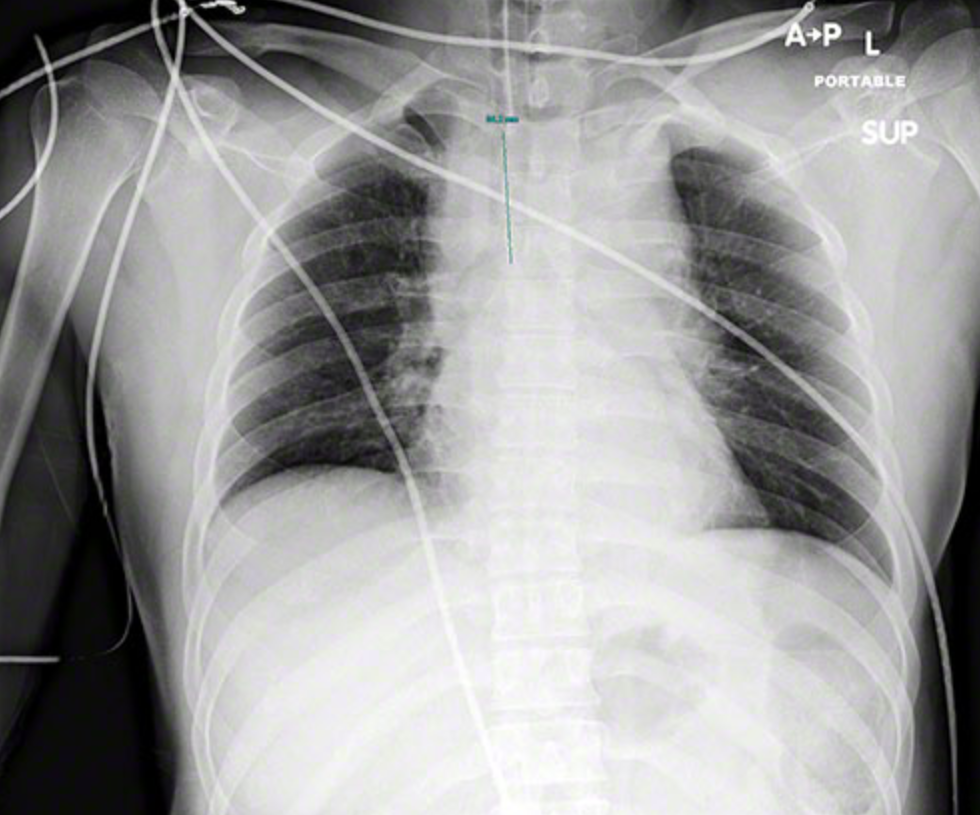
An 18-year-old man is brought to the emergency department (ED) 15 minutes after he was involved in a high-speed motor vehicle collision in which he was the unrestrained driver. The airbags did not deploy on impact. The patient was found unresponsive at the scene by emergency medical technicians, who intubated him prior to transport. On arrival at the ED, he remains unresponsive. Medical history and medications are unknown. Pulse is 100/min, respirations are 16/min, and blood pressure is 105/60 mm Hg. Pulse oximetry on an Fio2of 1.0 shows an oxygen saturation of 100%. Glasgow Coma Scale score is 3. Physical examination shows contusions over the forehead and anterior chest and crepitus of the anterior left chest. Femoral pulses are 1+ bilaterally. Two large-bore intravenous catheters are inserted and 1 L of lactated Ringer solution is administered with no change in hemodynamics. Chest x-ray is shown. Which of the following is the most appropriate diagnostic study at this time?
CorrectIncorrect -
Question 11 of 20
11. Question
A 66-year-old woman comes to the office because of a 6-month history of severe dizziness and a spinning sensation that occurs when she looks up or turns her head quickly. She says she fell 1 week ago during an episode. At that time, she had a brief episode of double vision. She also has a 2-year history of moderate neck pain, which she attributes to “muscle spasms”; since her fall, her pain has become more severe. She has hypertension and type 2 diabetes mellitus. Her medications are lisinopril and metformin. Her mother had a cerebral infarction at the age of 70 years. The patient has smoked one-half pack of cigarettes daily for 40 years. Her pulse is 84/min, and blood pressure is 150/85 mm Hg. Examination shows no nystagmus. Visual field testing shows no abnormalities. There are no cervical bruits. On palpation of the posterior muscles of the neck, there is mild tenderness that increases when the neck is rotated gently. Cardiopulmonary examination shows no abnormalities. Muscle strength is 5/5 in all extremities. Which of the following is the most likely explanation for this patient’s symptoms?
CorrectIncorrect -
Question 12 of 20
12. Question
An 18-year-old man has the sudden onset of rapid, pounding heartbeats. A previous episode occurred while he was drinking coffee and resolved abruptly after 30 minutes. His pulse is 180/min, respirations are 15/min, and blood pressure is 105/85 mm Hg. Examination shows no other abnormalities. Which of the following is the most likely diagnosis?
CorrectIncorrect -
Question 13 of 20
13. Question
A 37-year-old woman comes to the physician for endocarditis prophylaxis prior to undergoing tooth extraction. The patient reports mouth pain but otherwise feels well. Two years ago, echocardiography showed mitral valve prolapse and trace mitral regurgitation. She has no other history of serious illness and takes no medications. Vital signs are within normal limits. Cardiac examination shows a normal S1 and S2; there is no S3or S4, and no murmurs are heard. Which of the following is the most appropriate oral antibiotic prophylaxis prior to this patient’s dental procedure?
CorrectIncorrect -
Question 14 of 20
14. Question
A 5-year-old girl with spastic diplegic cerebral palsy and gastroesophageal reflux disease is brought to the office by her parents for a routine examination. She wears leg braces and occasionally uses a wheelchair for ambulation. Since her last visit 6 months ago, she has had intermittent shortness of breath when walking long distances and has tended to lean toward the right. Her parents say she has had decreased tolerance for sitting in her wheelchair. She was born at 31 weeks’ gestation by cesarean delivery to a 21-year-old woman, gravida 4, para 4; pregnancy was complicated by chorioamnionitis. The patient has undergone soft-tissue release for contractures in her hips and lower extremities. Her medications are baclofen and lansoprazole. She is alert and fully oriented, and she answers questions appropriately. She is at the 40th percentile for height and weight. Vital signs are within normal limits. Mild impingement of the rib cage on the right iliac crest is noted. Cardiopulmonary examination shows no abnormalities. Pelvic obliquity is present. Examination of the upper extremities shows less spasticity and moderate fine motor control when compared with the lower extremities. There is mild tenderness to palpation of the right lower rib cage where it abuts the right iliac crest. Patellar and Achilles deep tendon reflexes are 3+ bilaterally. Which of the following is the most appropriate next step in diagnosis?
CorrectIncorrect -
Question 15 of 20
15. Question
A 54-year-old man comes to the office because of a 4-month history of progressive weakness and numbness of his left leg. He has a 5-year history of type 2 diabetes mellitus treated with metformin. He has worked as a plumber for 34 years; he often crawls into and works in tight spaces, and he frequently moves and lifts heavy objects. On neurologic examination, muscle strength is 5/5 in the thigh adductor, quadriceps, and tibialis anterior muscles on the left and intact on the right. Muscle strength is intact in the iliopsoas, gluteus maximus, thigh abductor, hamstrings, and gastrocnemius muscles bilaterally. Deep tendon reflexes are 1+ in the left knee, 2+ in the right knee, and 2+ in the ankles. Sensation to light touch is mildly decreased over the medial-distal aspect of the left lower extremity and medial aspect of the left foot. Sensation otherwise is intact. Which of the following is the most likely diagnosis?
CorrectIncorrect -
Question 16 of 20
16. Question
A 42-year-old woman with rheumatoid arthritis is admitted to the hospital because of a 3-day history of fever, intermittent severe chest pain, mild abdominal pain, and malaise. She also has a 1-week history of increasing fatigue. The chest pain worsens with inspiration, and she says she now sleeps most comfortably while leaning over her kitchen table. During the past week, she has had increased joint pain and decreased appetite. She has not had vomiting or changes in bowel function. Her medications are methotrexate, prednisone, and acetaminophen with codeine. She does not smoke cigarettes, drink alcohol, or use illicit drugs. She is in moderate distress. She is 165 cm (5 ft 5 in) tall and weighs 59 kg (130 lb); BMI is 22 kg/m2. Her temperature is 38.6°C (101.4°F), pulse is 90/min, respirations are 22/min and shallow, and blood pressure is 140/88 mm Hg. On examination, a pleural friction rub is heard over the lower lobe of the right lung, and a pericardial friction rub is heard over the anterior aspect of the left hemithorax. The spleen tip is palpated 2 cm below the left costal margin. There is no peripheral edema. There is thickening of the synovial membranes and tenderness to palpation of the hands and feet. Laboratory studies show:
Hemoglobin: 11.1 g/dL
Hematocrit: 33%
Mean corpuscular volume (MCV): 88 µm³
Leukocyte count: 1800/mm³
Segmented neutrophils: 65%
Eosinophils: 2%
Basophils: 1%
Lymphocytes: 30%
Monocytes: 2%
Platelet count: 155,000/mm³
Serum:
Urea nitrogen: 24 mg/dL
Creatinine: 1.2 mg/dL
AST: 12 U/L
ALT: 24 U/L
Which of the following is the most likely diagnosis?
CorrectIncorrect -
Question 17 of 20
17. Question
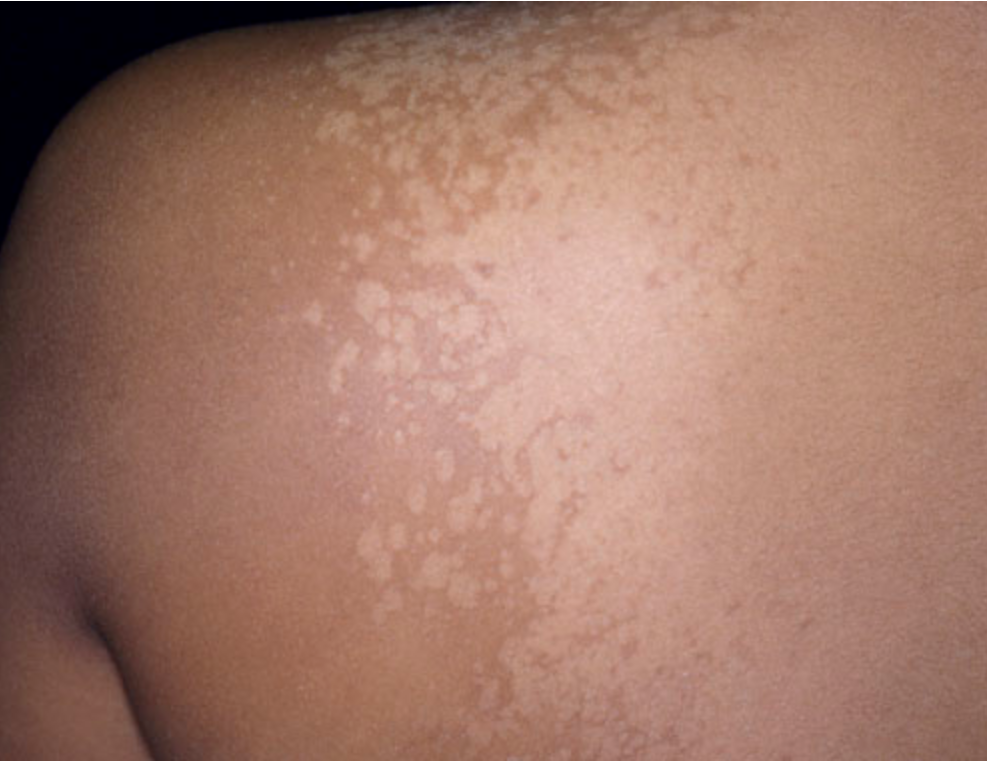
A 15-year-old girl is brought to the physician 2 weeks after noticing multiple areas on her chest and upper back that are lighter than the rest of the skin. She has mild itching over these areas when she plays volleyball. A photograph of the lesions is shown. Which of the following is the most likely diagnosis?
CorrectIncorrect -
Question 18 of 20
18. Question
An 11 -year-old boy is brought to the emergency department because of a 1 -hour history of severe pain and blurred vision in his right eye that began when he was hit in the eye with a tennis ball. He says his eye was closed when he was hit. He has no history of serious illness and takes no medications. He cries and appears anxious but gradually calms down. Vital signs are within normal limits. Ophthalmologic examination of the right eye shows mild periorbital edema; pooling blood in the anterior chamber obscures the lower third of the iris and pupil. Blinking does not increase pain. Gaze is conjugate and symmetric. The right pupil is slightly larger and less reactive to light compared to the left pupil. There are no foreign bodies or visual field defects. The remainder of the neurologic examination shows no focal findings. Which of the following is the most likely diagnosis?
CorrectIncorrect -
Question 19 of 20
19. Question
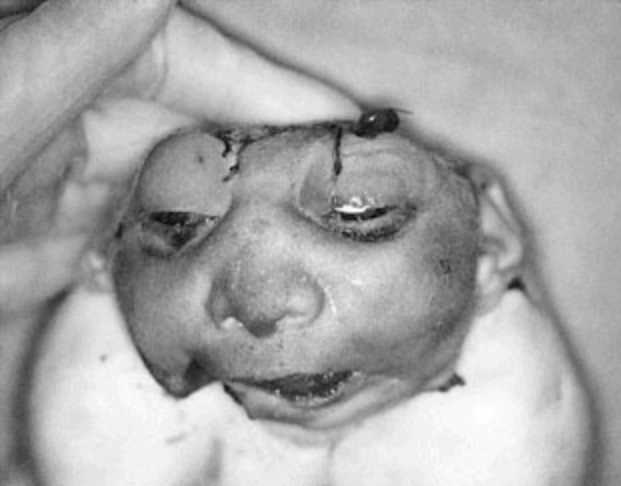
A 25-year-old woman, gravida 1, para 1, delivers a 2268-g (5-lb) male newborn at 38 weeks’ gestation. The mother received no prenatal care. She has no history of serious illness and takes no medications. During pregnancy, she drank four to six glasses of wine daily and used cocaine weekly. A photograph of the newborn is shown. Which of the following during the mother’s pregnancy would have significantly decreased the risk of this fetal outcome?
CorrectIncorrect -
Question 20 of 20
20. Question
A 27-year-old woman comes to the physician because of a 1-year history of daily headaches involving her entire head. The headaches are worse in the afternoon, sometimes throbbing, and are associated with nausea and sensitivity to light. The headaches are worse during menses. She takes four to six tablets of acetaminophen with caffeine daily, which provides partial relief. She takes no other medications. She has smoked one-half pack of cigarettes daily for 10 years and drinks four beers weekly. She works the night shift at an industrial plant. Vital signs are within normal limits. Neurologic examination shows no focal findings. Which of the following is the most appropriate treatment for this patient’s headaches?
CorrectIncorrect