
CK- NBME 10 – Block 1 (Duplicate 2)
Time limit: 0
Quiz Summary
0 of 20 Questions completed
Questions:
Information
You have already completed the quiz before. Hence you can not start it again.
Quiz is loading…
You must sign in or sign up to start the quiz.
You must first complete the following:
Results
Quiz complete. Results are being recorded.
Results
0 of 20 Questions answered correctly
Your time:
Time has elapsed
You have reached 0 of 0 point(s), (0)
Earned Point(s): 0 of 0, (0)
0 Essay(s) Pending (Possible Point(s): 0)
| Average score |
|
| Your score |
|
Categories
- Not categorized 0%
Would you like to submit your quiz result to the leaderboard?
![captcha]()
Loading
- 1
- 2
- 3
- 4
- 5
- 6
- 7
- 8
- 9
- 10
- 11
- 12
- 13
- 14
- 15
- 16
- 17
- 18
- 19
- 20
- Current
- Review
- Answered
- Correct
- Incorrect
-
Question 1 of 20
1. Question
A study is conducted to determine if there is an association between tampon use and toxic shock syndrome (TSS). A total of 50 patients with TSS and 450 patients without TSS are enrolled in the study. The patients are matched for age and race. All patients are interviewed to determine if they use tampons. When analyzing the data, which of the following is the most appropriate statistical method to use for this study?
CorrectIncorrect -
Question 2 of 20
2. Question
A 22-year-old man is admitted to the intensive care unit after he sustained a severe head injury in a motorcycle collision. Three days later, he remains intubated and has had no spontaneous respirations. His temperature is 37°C (98.6°F). His pupils are fixed and dilated, and he is unresponsive to all physical and verbal stimuli. He has no cranial nerve reflexes, and repeated EEG shows no electrical activity. He is receiving no medications. Toxicology screening is negative. Which of the following is the most accurate statement regarding continuation of mechanical ventilation for this patient?
CorrectIncorrect -
Question 3 of 20
3. Question
A 77-year-old woman is brought to the physician by her son because of palpitations for the past month. She had a cerebral infarction 5 years ago and has residual partial paralysis of her right leg. She uses an orthotic brace on her right ankle and a walker. She has fallen three times during the past year but has not sustained any injuries. She has a 5-year history of type 2 diabetes mellitus treated with metformin. Her vision is 20/60 in her left eye, but she is able to read large print. Her pulse is 120/min and irregularly irregular, and blood pressure is 135/78 mm Hg. Crackles are heard at the lung bases. A grade 2/6 systolic murmur is heard best at the lower left sternal border. Abdominal examination shows no abnormalities. There is 2+ edema below the knees. Neurologic examination shows unchanged hemiparesis. Laboratory studies show:
Hematocrit: 37%
Leukocyte count: 4700/mm³ with a normal differential
Serum:
Urea nitrogen: 27 mg/dL
Creatinine: 1.4 mg/dL
An ECG shows atrial fibrillation with a ventricular rate between 90/min and 140/min. Echocardiography shows an ejection fraction of 40%. Which of the following is the most appropriate next step in management?
CorrectIncorrect -
Question 4 of 20
4. Question
A 37-year-old man comes to the physician 12 hours after the onset of vomiting and abdominal cramps and swelling. He has had constipation for the past 4 days. He was diagnosed with Crohn disease 7 years ago. His symptoms of diarrhea and right lower quadrant abdominal pain have been well controlled with mesalamine for the past 3 years. His temperature is 36°C (96.8°F), pulse is 98/min and regular, and blood pressure is 110/70 mm Hg. Examination shows a diffusely distended, tympanitic abdomen and visible peristalsis; high-pitched bowel sounds are heard. Rectal examination shows no stool in the rectal vault. An x-ray of the abdomen shows a small-bowel obstruction. Which of the following is the most likely cause of these findings?
CorrectIncorrect -
Question 5 of 20
5. Question
A 62-year-old man comes to the physician to discuss the results of an abdominal CT scan that was performed 4 days ago. He is undergoing evaluation for a 2-month history of increasing back pain and a 6.8-kg (15-lb) weight loss. An initial physical examination showed no abnormalities. The CT scan showed a 4-cm solid mass in the body of the pancreas, multiple defects in the liver consistent with metastases, and a 7-cm abdominal aortic aneurysm with involvement of the renal arteries and no evidence of leakage. A CT scan-guided biopsy of the mass is performed. Examination of the specimen shows a pancreatic adenocarcinoma. After listening to the physician’s explanation of his prognosis, the patient says, “So you think I have a pancreatic cancer that is too advanced to remove. But what about the aneurysm? Should I have something done about that?” Which of the following is the most appropriate recommendation with respect to repair of this patient’s aneurysm?
CorrectIncorrect -
Question 6 of 20
6. Question
A 52-year-old man comes to the emergency department 3 days after he sustained an injury to his left foot while walking barefoot on the beach. He says he initially thought he only had a minor cut, but he now has severe pain that radiates from his left foot to his groin. Ten years ago, he underwent cadaveric liver transplantation for hepatitis C. Current medications include mycophenolate and prednisone. On arrival, he appears diaphoretic and ill. His temperature is 39.2°C (102.6°F), pulse is 120/min, respirations are 24/min, and blood pressure is 110/60 mm Hg. Examination shows erythema and hemorrhagic bullae over the left calf and foot. The skin is warm and tender to touch from over the left mid calf to the foot. Pulses in the distal lower extremities are equal bilaterally. His leukocyte count is 16,000/mm3 with 82% segmented neutrophils, 15% bands, and 3% eosinophils. Results of blood cultures are pending. In addition to intravenous administration of antibiotics, which of the following is the most appropriate next step in management?
CorrectIncorrect -
Question 7 of 20
7. Question
A 72-year-old man has decreased urine output 2 days after admission to the hospital for treatment of cholecystitis. His urine output has been 15 mL/h over the past 3 hours. On admission, results of laboratory studies were consistent with gram-negative bacteremia and disseminated intravascular coagulation. He is currently receiving intravenous fluids, cefoxitin, and gentamicin. His temperature is 38.5°C (101.3°F), pulse is 110/min, respirations are 24/min, and blood pressure is 90/64 mm Hg. Abdominal examination shows mild right upper quadrant tenderness. His serum creatinine concentration has increased from 1.5 mg/dL 2 days ago to 3 mg/dl_. This patient is most likely to have which of the following sets of urinalysis findings?
Option
Blood
Protein
RBC (/hpf)
WBC (/hpf)
Casts
Other Microscopic Findings
A
None
none
none
none
hyaline
none
B
None
4+
none
none
none
oval fat bodies
C
Trace
1+
0–5
>50
none
WBC clumps
D
1+
1+
0–5
0–5
pigmented granular
renal tubular epithelial cells
E
1+
1+
5–10
10–20
none
eosinophils
F
3+
1+
>50
none
RBC
none
G
4+
1+
none
none
pigmented granular
squamous epithelial cells
H
4+
1+
10–20 dysmorphic
none
none
none
CorrectIncorrect -
Question 8 of 20
8. Question
A 17-year-old patient, gravida 1, para 0, aborta 1, comes to the physician for a follow-up examination. Four weeks ago, she underwent dilatation and curettage (D&C) following a spontaneous abortion at 13 weeks’ gestation. She has had no vaginal bleeding or pelvic pain. The patient has no history of serious illness. Her only current medication is an oral contraceptive; she adheres to her medication regimen. Today, pelvic examination shows no abnormalities. Prior to the D&C, her serum β-hCG concentration was 50,326 mIU/mL. Since the D&C, serial measurements of serum β-hCG concentrations have shown:
Week
β-hCG (mIU/mL)
1
18,275
2
8,157
3
8,356
4
14,589
Which of the following is the most likely diagnosis?
CorrectIncorrect -
Question 9 of 20
9. Question
A previously healthy 23-year-old man comes to the physician because of a 5-day history of fever, malaise, and headache. He has not had nausea, vomiting, cough, sore throat, diarrhea, pain with urination, or penile discharge. Medications include pseudoephedrine and ibuprofen for sinus headaches. He has no known recent exposure to illness and has not traveled recently outside the USA. He has been sexually active with four female partners over the past year and uses condoms inconsistently. He drinks two six-packs of beer weekly. He lives near tick-infested woods but has not noted a tick bite. He is 183 cm (6 ft) tall and weighs 95 kg (210 lb); BMI is 29 kg/m2. His temperature is 38.3°C (101°F), pulse is 72/min, respirations are 12/min, and blood pressure is 126/68 mm Hg. Examination shows a nonpruritic, painless, pigmented, maculopapular rash over the palms and soles. There is diffuse lymphadenopathy. Which of the following is most likely to have prevented this patient’s symptoms?
CorrectIncorrect -
Question 10 of 20
10. Question
A 30-year-old primigravid woman with systemic lupus erythematosus comes to the physician for a prenatal visit at 34 weeks’ gestation. Examination shows that her disease is in remission. She is concerned about the possible effects of her disease on her fetus. The fetus is at greatest risk for which of the following?
CorrectIncorrect -
Question 11 of 20
11. Question
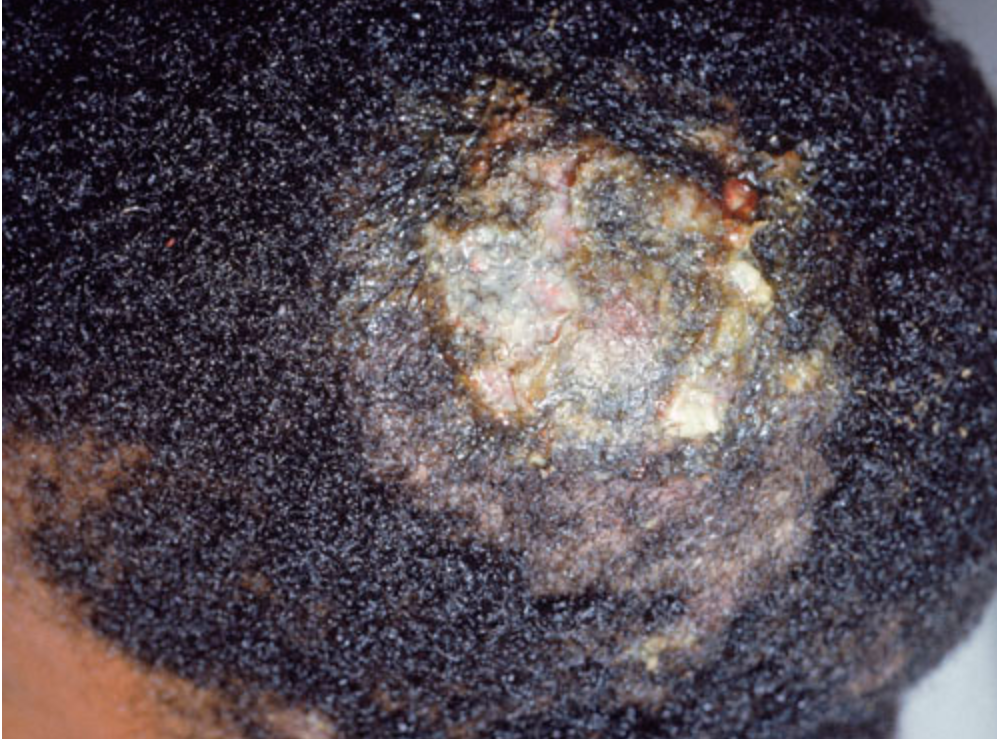
A 4-year-old boy is brought to the physician because of a lesion on his scalp for the past 6 weeks. It has continued to increase in size despite use of over-the-counter antibacterial creams and 7 days of oral cephalexin that his mother had leftover from a previous illness. The lesion began as a round area approximately the size of a quarter. He has no history of serious illness. A photograph of the lesion is shown. Infection with which of the following is the most likely cause of this patient’s lesion?
CorrectIncorrect -
Question 12 of 20
12. Question
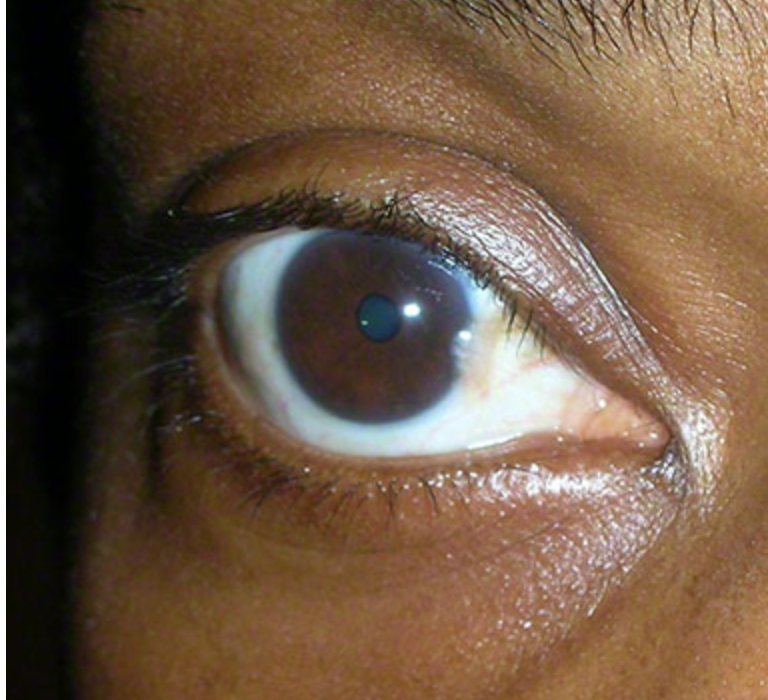
A 32-year-old woman comes to the office for a health maintenance examination. She feels well. She has mild myopia and wears contact lenses. She has no history of serious illness and takes no medications. She appears well. Vital signs are within normal limits. A photograph of the right eye is shown. The remainder of the examination shows no abnormalities. Which of the following is the most appropriate next step in management?
 CorrectIncorrect
 -
Question 13 of 20
13. Question
An 11-year-old boy is brought to the office by his mother as a new patient because of a 3-year history of increasing weakness of his arms and legs. His mother says the weakness is now interfering with her son’s ability to participate in physical education classes at school. He has no history of serious illness and receives no medications. His older sister is healthy. He has several male and female cousins who are uncoordinated and fall frequently. Examination of the patient shows scoliosis of the thoracic and lumbosacral spine. There is atrophy and muscle weakness of both shoulders and pelvic girdles. Deep tendon reflexes are trace throughout. Sensation is intact throughout. His gait is waddling, and he must extend his back to walk smoothly. Results of a complete blood count and serum electrolyte concentrations are within the reference ranges. His serum creatine kinase activity is 387 U/L. Which of the following is the most likely diagnosis?
CorrectIncorrect -
Question 14 of 20
14. Question
A 72-year-old man comes to the physician because of a 2-year history of increasingly severe episodic pain in both legs. The pain is triggered by walking and increases as he walks longer distances. He also has weakness and numbness in both legs when he walks farther than 4 blocks. He says that he now has difficulty walking through the grocery store, but the pain decreases when he leans forward on the cart while walking. He has no history of serious illness and takes no medications. Vital signs are within normal limits. Muscle strength and deep tendon reflexes are normal, and sensation is intact. Femoral, posterior tibial, and pedal pulses are equal bilaterally. The remainder of the examination shows no abnormalities. Which of the following is the most likely cause of this patient’s symptoms?
CorrectIncorrect -
Question 15 of 20
15. Question
A 14-year-old boy is brought to the physician by his parents because he has been increasingly irritable, disrespectful, and uncooperative during the past 4 years. He refuses to do any household chores and does not obey curfew. He may be expelled from school because he is rude and threatening to teachers and has been cutting classes. He is tutored for reading but earns C’s and D’s in his classes. He has been suspended three times during the past year for talking back to his teachers. He repeated first grade due to poor academic readiness. He used to have trouble with homework but now he does not complete any homework. He is at the 65th percentile for height and 50th percentile for weight. Physical examination shows no abnormalities. During the examination, the patient is minimally cooperative and frequently rolls his eyes at questions. Urine toxicology screening is positive for nicotine. Which of the following is the most likely explanation for this patient’s behavior?
CorrectIncorrect -
Question 16 of 20
16. Question
A 44-year-old man comes to the office with his girlfriend because she is concerned about his mood. He recently told her it would be a relief if he were hit by a truck and died. He reports frequent fatigue and says he has been persistently unhappy for 9 years. He has not had problems with sleep or appetite. He has type 1 diabetes mellitus, chronic kidney disease, hypertension, and peripheral neuropathy. His medications are furosemide, gabapentin, insulin, metoprolol, and simvastatin. He lost joint custody of his two children 1 month ago, which he says is “a real downer.” He finds his work as a convenience store clerk tedious and uninteresting, but he enjoys playing poker and watching movies. He has used cocaine once monthly during the past 5 years. His pulse is 84/min, and blood pressure is 146/88 mm Hg. Physical examination shows retinal hemorrhages. On mental status examination, he has a dysphoric mood and sarcastic affect. There is evidence of interpersonal friction with his girlfriend. He reports no current suicidal ideation or intent. Which of the following is the most likely diagnosis?
CorrectIncorrect -
Question 17 of 20
17. Question
A 9-year-old girl is brought to the physician by her parents because of increasingly strange behavior during the past 6 months. They report that she touches and smells household objects and repeatedly turns the lights on and off in her room. She has been worried because of frequent thoughts of her dog being hit by a car and her parents being involved in a motor vehicle collision even though these things have never happened. She has begun to tap her foot three times when she experiences these thoughts to prevent them from happening. Physical examination shows no abnormalities. Mental status examination shows an anxious mood and a constricted affect. Which of the following is the most appropriate pharmacotherapy?
CorrectIncorrect -
Question 18 of 20
18. Question
A previously healthy 27-year-old woman is brought to the emergency department 48 hours after the onset of confusion. She has a 1 -week history of temperatures to 39.3°C (102.8°F) and yellow eyes. Her only medication is an oral contraceptive. She is oriented to person but not to place or time. Her temperature now is 38.6°C (101.5°F), pulse is 110/min, respirations are 18/min, and blood pressure is 110/70 mm Hg. Examination shows scleral icterus and scattered petechiae over the trunk and lower extremities. Laboratory studies show:
Hematocrit: 25%
Leukocyte count: 13,000/mm³
Platelet count: 11,000/mm³
Prothrombin time (PT): 11 sec (INR = 1.0)
Partial thromboplastin time (PTT): 30 sec
Serum:
Creatinine: 4.5 mg/dL
Total bilirubin: 6 mg/dL
Direct bilirubin: 0.9 mg/dL
Which of the following is the most appropriate next step in management?
CorrectIncorrect -
Question 19 of 20
19. Question
A previously healthy 27-year-old woman comes to the emergency department because of a “crawling” sensation over her skin that began 1 hour ago after she ate a candy bar containing peanuts. She has a peanut allergy but did not realize the bar contained peanuts. She says that she used an epinephrine auto-injector as soon as symptoms developed but still does not feel well. She notes that her lips have become swollen and feel especially “itchy and tingly.” She has had three episodes of diarrhea. She appears flushed. Her temperature is 37°C (98.6°F), pulse is 120/min, respirations are 27/min, and blood pressure is 85/42 mm Hg. Pulse oximetry on room air shows an oxygen saturation of 92%. Examination shows slightly swollen lips and cheeks and erythematous areas over the face and extremities. Breath sounds are decreased, and expiratory wheezes are heard throughout the lungs. An ECG shows sinus tachycardia. In addition to epinephrine, which of the following should be administered?
CorrectIncorrect -
Question 20 of 20
20. Question
A 9-month-old boy is brought to the physician by his mother for a well-child examination. She is concerned because over the past 4 weeks, her son has cried, screamed, and rubbed his ears whenever one of her friends holds him. She is the only person who can console him, and it now takes longer to soothe him. He was previously a happy, easygoing baby. When the physician approaches him, he begins to cry. He is at the 50th percentile for height and 75th percentile for weight. Examination shows no abnormalities except for clear rhinorrhea. He sits up independently, pulls himself to standing, and crawls along furniture. Which of the following is the most appropriate next step in management?
CorrectIncorrect