
CK- NBME 11 – Block 4
Time limit: 0
Quiz Summary
0 of 20 Questions completed
Questions:
Information
You have already completed the quiz before. Hence you can not start it again.
Quiz is loading…
You must sign in or sign up to start the quiz.
You must first complete the following:
Results
Quiz complete. Results are being recorded.
Results
0 of 20 Questions answered correctly
Your time:
Time has elapsed
You have reached 0 of 0 point(s), (0)
Earned Point(s): 0 of 0, (0)
0 Essay(s) Pending (Possible Point(s): 0)
| Average score |
|
| Your score |
|
Categories
- Not categorized 0%
Would you like to submit your quiz result to the leaderboard?
![captcha]()
Loading
- 1
- 2
- 3
- 4
- 5
- 6
- 7
- 8
- 9
- 10
- 11
- 12
- 13
- 14
- 15
- 16
- 17
- 18
- 19
- 20
- Current
- Review
- Answered
- Correct
- Incorrect
-
Question 1 of 20
1. Question
A previously healthy 22-year-old man comes to the emergency department because of a 1-day history of burning and tingling around his mouth and in his arms and legs. During this time, cold water has felt “burning hot” when he washes his hands, and cool beverages have felt hot in his mouth. Two days ago, he ate grouper and mussels at a restaurant. One hour after eating, he had nausea, vomiting, and diarrhea, which lasted 24 hours and resolved spontaneously. He takes no medications. Vital signs are within normal limits. Muscle strength is 5/5 throughout. Deep tendon reflexes are absent throughout. Babinski sign is absent. Sensation is intact. Which of the following is the most likely diagnosis?
CorrectIncorrect -
Question 2 of 20
2. Question
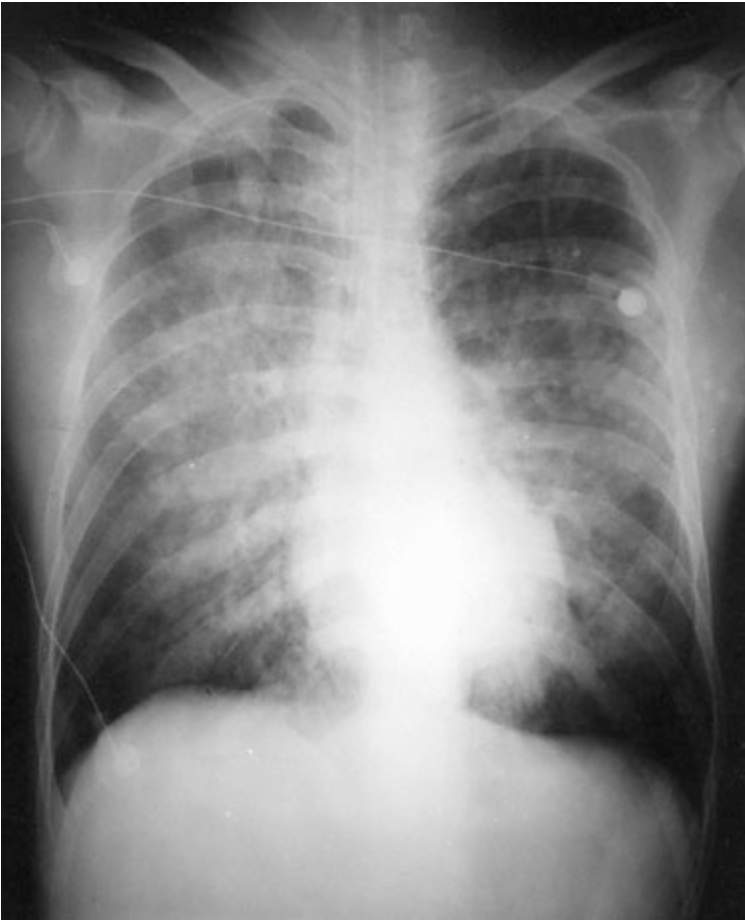
A 37-year-old woman is brought to the emergency department because of a 3-day history of progressive shortness of breath, cough productive of rust-colored sputum, and temperatures to 38.9°C (102°F). Four years ago, she underwent splenectomy for injuries sustained during a motor vehicle collision. Her temperature is 39°C (102.2°F), pulse is 120/min, respirations are 22/min, and blood pressure is 105/60 mm Hg. Examination shows no jugular venous distention. On pulmonary examination, there are diffuse inspiratory wheezes and crackles heard at the right lung base. Cardiac examination shows no abnormalities. The extremities are cyanotic, and there is no edema. Arterial blood gas analysis on 2 L/min of oxygen by nasal cannula shows:
pH: 7.39
Pco₂: 38 mm Hg
Po₂: 41 mm Hg
HCO₃⁻: 22 mEq/L
O₂ saturation: 79%
A chest x-ray is shown. Which of the following is the most likely diagnosis?
CorrectIncorrect -
Question 3 of 20
3. Question
A 24-year-old woman comes to the physician because of a 2-day history of moderate pain and swelling of her left ankle that began when she stepped in a hole while running. She says she continued running for 20 minutes afterward but stopped because she twisted the ankle again. Use of ice, bandages, and crutches has provided moderate relief. She has no history of previous ankle injury or serious illness. She takes ibuprofen as needed for pain. Vital signs are within normal limits. Dorsalis pedis pulses are 2+ bilaterally. The left anterior talofibular and calcaneofibular ligaments are tender to palpation; there is no bony tenderness to palpation of the forefoot, hindfoot, or ankle bilaterally. Anterior drawer test is 0 in the right ankle and 2+ in the left. Talar tilt test is 0 in the right ankle and 1 + in the left. The patient is able to dorsiflex and plantar flex both feet and ankles and flex and extend all toes. Sensation to light touch is intact over the lower extremities. Which of the following is the most appropriate next step in management to prevent morbidity in this patient?
CorrectIncorrect -
Question 4 of 20
4. Question
A 42-year-old woman is admitted to the hospital 2 hours after the onset of pain and numbness in her left arm; she is having difficulty moving her arm. Two weeks ago, she was diagnosed with right popliteal venous thrombosis, and treatment with heparin and warfarin was begun. The left upper extremity is pale and cool; sensation to touch is decreased in a glove distribution distal to the mid forearm. Strength of the intrinsic muscles of the left hand is 2/5. Her prothrombin time is 14 sec (INR=1.3). An uncomplicated brachial embolectomy is performed. Which of the following is most likely to confirm the diagnosis?
CorrectIncorrect -
Question 5 of 20
5. Question
A 71-year-old woman comes to the physician for a follow-up examination. She has chronic obstructive pulmonary disease, hypertension, and osteoporosis. She quit smoking 15 years ago. She is currently able to walk two blocks without shortness of breath, which is her baseline. Current medications include albuterol, alendronate, beclomethasone, chlorthalidone, and lisinopril. Her blood pressure is 135/80 mm Hg. Physical examination shows no abnormalities. The lungs are clear. Screening mammography 18 months ago showed no abnormalities. She has no history of abnormal mammograms and there is no family history of breast cancer. She asks whether she should continue to receive annual mammography to screen for breast cancer. Which of the following is the most appropriate recommendation by the physician?
CorrectIncorrect -
Question 6 of 20
6. Question
A 19-year-old patient, gravida 1, para 1, is examined 1 hour after spontaneous vaginal delivery of a healthy male newborn at term. Pregnancy was uncomplicated. The patient dropped out of high school during the second trimester. The newborn’s father is 19 years of age and is incarcerated for possession of an illicit drug. The patient says the men in her family have histories of aggression, substance abuse, arrests, and incarcerations. She is concerned that her child will follow a similar path. The patient has no history of serious illness. Her only medication is a prenatal vitamin. She does not smoke cigarettes, drink alcohol, or use illicit drugs. Examination shows no abnormalities. Which of the following is the most appropriate next step in management?
CorrectIncorrect -
Question 7 of 20
7. Question
A 55-year-old man comes to the office because of a 3-month history of episodes of mild, intermittent, mid chest pain. He says that the episodes occur 3 days weekly and last 2 to 3 minutes. The pain has not increased since his episodes began, and it is relieved by rest and use of antacids. He has not had shortness of breath, nausea, wheezing, or light-headedness. He has hypertension and asthma. His medications are lisinopril, hydrochlorothiazide, and albuterol. He does not smoke cigarettes. He drinks four glasses of wine on weekends. He works as an automobile mechanic. His pulse is 78/min, respirations are 16/min, and blood pressure is 142/84 mm Hg. Pulse oximetry on room air shows an oxygen saturation of 97%. Cardiopulmonary examination shows no abnormalities. An ECG shows a normal sinus rhythm and no ST-T wave changes. Which of the following is the most appropriate next step in diagnosis?
CorrectIncorrect -
Question 8 of 20
8. Question
Four days after admission to the hospital for management of cellulitis of the right lower extremity, a 70-year-old woman has an increased serum creatinine concentration. She has type 2 diabetes mellitus. Her medications are glipizide and a multivitamin; she also has received intravenous nafcillin since admission. She is retired from the military. Vital signs are within normal limits. Examination of the trunk shows no abnormalities. There is edema, erythema, and warmth of the right lower extremity. Examination of the left lower extremity shows no abnormalities. On admission, her serum creatinine concentration was 0.9 mg/dL. Today, laboratory studies show:
Hemoglobin: 11 g/dL
Hemoglobin A1c: 7.5%
Leukocyte count: 15,000/mm³
Segmented neutrophils: 75%
Bands: 1%
Eosinophils: 8%
Lymphocytes: 14%
Monocytes: 2%
Serum:
K⁺: 5 mEq/L
Urea nitrogen: 60 mg/dL
Creatinine: 2.3 mg/dL
Phosphorus: 4.3 mg/dL
Albumin: 2 g/dL
Cholesterol: 250 mg/dL
Urine:
pH: 6.00
Protein: trace
RBC: 10/hpf
WBC: 20–50/hpf
RBC casts: 0/lpf
WBC casts: 0/lpf
Serum complement concentrations are within the reference ranges. Which of the following is the most likely diagnosis?
CorrectIncorrect -
Question 9 of 20
9. Question
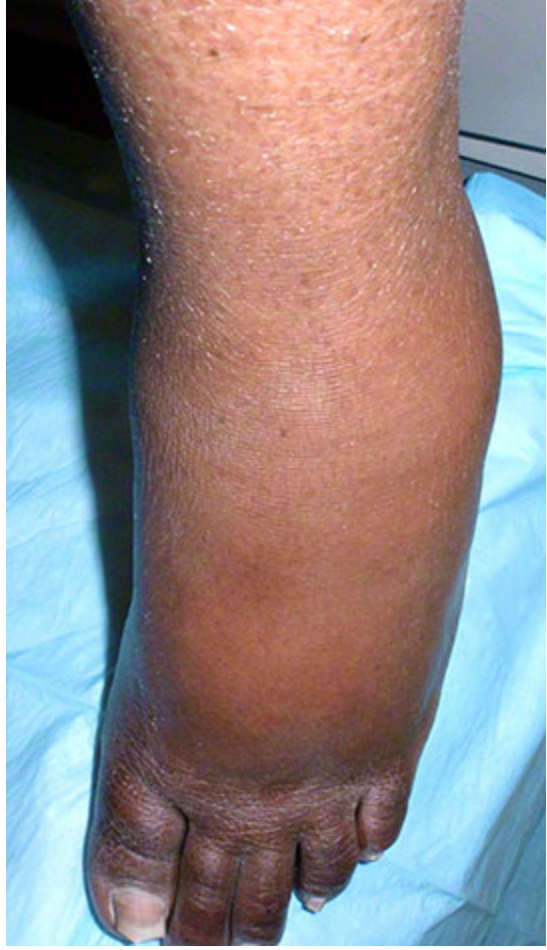
A 29-year-old woman with systemic lupus erythematosus comes to the office because of a 5-day history of moderate pain in the right elbow, left knee, and left foot. There is no recent history of trauma. She has no history of sexually transmitted disease or other serious illness. Menses occur at regular 28-day intervals; her last menstrual period ended 2 days ago. Her only medication is methotrexate. She is sexually active with two male partners and uses condoms inconsistently. She is 173 cm (5 ft 8 in) tall and weighs 84 kg (185 lb); BMI is 28 kg/m2. Her temperature is 38.5°C (101.3°F); other vital signs are within normal limits. A photograph of the left foot is shown. Examination of the skin shows no other abnormalities. Analysis of synovial fluid shows a leukocyte count of 50,000/mm3. Cultures of blood and synovial fluid grow no organisms. Which of the following is the most likely diagnosis?
 CorrectIncorrect
 -
Question 10 of 20
10. Question
A 7-month-old boy is brought to the office by his mother because of a 1 -day history of fussiness. His mother says several children at the patient’s day-care center have been sick during the past week. He has had no change in appetite. His immunizations are up-to-date. He has no history of serious illness and receives no medications. He is at the 10th percentile for length, 15th percentile for weight, and 50th percentile for head circumference. His temperature is 37.2°C (99.0°F), pulse is 110/min, and respirations are 32/min. Pulse oximetry on room air shows an oxygen saturation of 97%. There are mild intercostal retractions. On pulmonary examination, mild wheezes are heard throughout the lung fields. The remainder of the examination shows no abnormalities. There is no change in examination findings after administration of nebulized albuterol. Which of the following is the most appropriate next step in management?
CorrectIncorrect -
Question 11 of 20
11. Question
A 64-year-old woman comes to the office because of an enlarging, painless mass in her left cheek that she first noticed 2 months ago. She says the mass has doubled in size during this time. She has not sustained any trauma to the area. She was diagnosed with chronic obstructive pulmonary disease 2 years ago. She takes no medications. She has smoked one pack of cigarettes daily for 50 years. Her pulse is 96/min, respirations are 16/min, and blood pressure is 136/90 mm Hg. The left cheek at the mandibular angle is larger than the right; a 2 x 2-cm mass fixed to the underlying tissue is palpated. There is no lymphadenopathy. Ultrasonography shows a 2 * 2-cm mass in the superficial left parotid gland. Which of the following is the most appropriate next step in diagnosis?
CorrectIncorrect -
Question 12 of 20
12. Question
A 62-year-old man, who is recovering in the coronary care unit following an acute ST-segment elevation anterior wall myocardial infarction 4 days ago, is being evaluated for the sudden onset of dyspnea and diaphoresis. At the time of admission, tissue plasminogen activator therapy was initiated, and the patient’s recovery had been uncomplicated. Medical history otherwise is unremarkable, and he takes no routine medications. Vital signs are temperature 37°C (98.6°F), pulse 128/min, respirations 36/min, and blood pressure 82/58 mm Hg. Pulse oximetry on 100% oxygen via nonrebreather face mask shows an oxygen saturation of 89%. Jugular venous pressure is 8 cm H20 (N=5-9). Auscultation of the lungs discloses diffuse crackles halfway up the back. Cardiac examination discloses a hyperdynamic precordium and a grade 3/6 holosystolic murmur that was not present on previous examinations. There is no clubbing, cyanosis, or edema of the extremities. Based on these findings, the patient’s condition is most likely attributable to which of the following?
CorrectIncorrect -
Question 13 of 20
13. Question
A 17-year-old girl comes to the office for an examination required for sports participation. Medical history is unremarkable, and she takes no medications. She is 165 cm (5 ft 5 in) tall and weighs 54 kg (120 lb); BMI is 20 kg/m2. At her last visit 1 year ago, BMI was 23 kg/m2. The patient says she lost the weight by “eating healthy and exercising.” She adds, “I would like to lose a little more weight.” She began a vegetarian diet 6 weeks ago. Vital signs are normal with a pulse of 64/min; however, her pulse 1 year ago was 80/min. The remainder of the physical examination discloses no abnormalities. Which of the following is the most appropriate next step in management?
CorrectIncorrect -
Question 14 of 20
14. Question
A 52-year-old man is brought to the emergency department by police 30 minutes after being found wandering in the park. On arrival, he appears confused and agitated. He is tremulous. He is 1 80 cm (5 ft 11 in) tall and weighs 59 kg (130 lb); BMI is 18 kg/m2. His temperature is 37.8°C (100°F), pulse is 100/min, respirations are 16/min, and blood pressure is 150/90 mm Hg. Examination shows telangiectasias over the face and upper and lower extremities. The liver edge is palpated 4 cm below the right costal margin. Muscle bulk is decreased throughout; deep tendon reflexes are 3+ throughout. Babinski sign is absent. His gait is ataxic. On mental status examination, he refuses to answer any questions. Laboratory studies show:
Serum:
Na⁺: 135 mEq/L
K⁺: 3.5 mEq/L
Cl⁻: 93 mEq/L
Glucose: 100 mg/dL
AST: 90 U/L
ALT: 65 U/L
Blood alcohol: 90 mg/dL
Urine:
Positive for Δ⁹-tetrahydrocannabinol
Intravenous administration of which of the following is the most appropriate next step in management to prevent Wernicke encephalopathy in this patient?
CorrectIncorrect -
Question 15 of 20
15. Question
A 35-year-old man with Crohn disease returns to the clinic for follow-up 4 months after undergoing uncomplicated surgical repair of an enterovesical fistula. Medical history otherwise is unremarkable. Trials of 5-aminosalicylic acid, azathioprine, and prednisone prescribed since diagnosis 2 years ago have not controlled his Crohn disease; his only current medication is a daily multivitamin. He has smoked one pack of cigarettes daily for 15 years and occasionally drinks alcoholic beverages. The patient is 180 cm (5 ft 11 in) tall and weighs 68 kg (150 lb); BMI is 21 kg/m2. Temperature is 37.2°C (99.0°F), pulse is 85/min and regular, respirations are 16/min, and blood pressure is 114/68 mm Hg. Lungs are clear to auscultation. Cardiac examination discloses a grade 1/6 systolic ejection murmur heard best at the upper right sternal border. Abdominal examination shows a well-healed surgical scar. Bowel sounds are normal. There is no tenderness to palpation or percussion of the abdomen. Infliximab therapy is initiated. Which of the following studies is most appropriate to obtain at follow-up examination in 1 month?
CorrectIncorrect -
Question 16 of 20
16. Question
A researcher conducts a randomized controlled trial of a new drug to treat chronic hepatitis B infection. A total of 400 patients are needed in order to detect a 10% difference in remission rates between the study drug and standard treatment groups. The researcher sets an α level of 0.05 and a β level of 0.20. A total of 500 patients are enrolled in the study, and 480 complete it. Patients are monitored for adverse events and for remission of the disease. The results are shown:

Which of the following is the most likely cause of the lack of difference in the adverse event rate?
CorrectIncorrect -
Question 17 of 20
17. Question
A 13-year-old boy is brought to the office because of a 2-week history of a painless mass in the right thigh. He noticed the mass after a teammate hit him in the same area during a soccer game. He has not had weight loss, fatigue, or fever. He has no history of serious illness and takes no medications. Vital signs are within normal limits. Cardiopulmonary examination shows no abnormalities. Examination of the anterior aspect of the right thigh shows a 5-cm firm, nontender mass. Range of motion of the right knee is full and does not produce pain. Femoral and distal pulses are palpable. Sensation is intact. MRI of the right thigh shows a soft-tissue mass in the anterior compartment that is not adjacent to major arteries or nerves. An incisional biopsy specimen shows moderate-grade fibrosarcoma. Which of the following studies is the most appropriate next step in management?
CorrectIncorrect -
Question 18 of 20
18. Question
A 17-year-old boy comes to the urgent treatment center because of a 4-day history of abdominal pain, loss of appetite, nausea, chills, and fever, which has responded to acetaminophen. He has not had headache, ear pain, or sore throat. He is able to tolerate fluids, but eating solid food increases his abdominal pain. Medical history is remarkable for seasonal allergies and lactose intolerance. His only routine medication is as-needed loratadine. He does not drink alcoholic beverages or use illicit drugs. He is monogamous with his girlfriend and engages in oral sex only. He returned home from a trip to Mexico with his family 3 weeks ago. Temperature is 37.8°C (100.0°F), pulse is 86/min, respirations are 14/min, and blood pressure is 100/60 mm Hg. The patient appears jaundiced. There is abdominal tenderness in the right upper quadrant without rebound or guarding. Murphy sign is absent. Results of which of the following serologic studies are most likely to confirm the diagnosis?
CorrectIncorrect -
Question 19 of 20
19. Question
Screening for colon cancer is started in patients at the age of 45 years instead of at the age of 50 years. Which of the following is the most likely effect on the predictive values?
Option
Positive Predictive Value
Negative Predictive Value
A
Decrease
Decrease
B
Decrease
Increase
C
Decrease
No change
D
Increase
Decrease
E
Increase
Increase
F
Increase
No change
G
No change
Decrease
H
No change
Increase
I
No change
No change
CorrectIncorrect -
Question 20 of 20
20. Question
A 42-year-old man comes to the physician because of a 1-year history of chronic nosebleeds. He also had an episode of hematuria 3 months ago. His older brother has similar bleeding problems. Examination shows no abnormalities. Laboratory studies show:
Hemoglobin: 13.7 g/dL
Leukocyte count: 8000/mm³
Platelet count: 280,000/mm³
Bleeding time: 15 min
Prothrombin time: 11 sec (INR = 1.0)
Partial thromboplastin time: 45 sec
Test of the stool for occult blood is positive. Urinalysis shows no abnormalities. Which of the following is the most likely diagnosis?
CorrectIncorrect