
CK- NBME 9 – Block 4
Time limit: 0
Quiz Summary
0 of 20 Questions completed
Questions:
Information
You have already completed the quiz before. Hence you can not start it again.
Quiz is loading…
You must sign in or sign up to start the quiz.
You must first complete the following:
Results
Quiz complete. Results are being recorded.
Results
0 of 20 Questions answered correctly
Your time:
Time has elapsed
You have reached 0 of 0 point(s), (0)
Earned Point(s): 0 of 0, (0)
0 Essay(s) Pending (Possible Point(s): 0)
| Average score |
|
| Your score |
|
Categories
- Not categorized 0%
Would you like to submit your quiz result to the leaderboard?
![captcha]()
Loading
- 1
- 2
- 3
- 4
- 5
- 6
- 7
- 8
- 9
- 10
- 11
- 12
- 13
- 14
- 15
- 16
- 17
- 18
- 19
- 20
- Current
- Review
- Answered
- Correct
- Incorrect
-
Question 1 of 20
1. Question
A previously healthy 24-year-old woman is brought to the emergency department because of severe abdominal pain for 4 hours. The pain began after she ate lunch following an aerobics class. She is not sexually active. Her temperature is 38.2°C (100.8°F), and pulse is 120/min. Abdominal examination shows left lower quadrant tenderness and rebound to deep palpation. Pelvic examination shows an exquisitely tender left ovary; the introitus is normal. There is no discharge in the vaginal vault and no cervical motion tenderness. Her leukocyte count is 15,300/mm3 (80% segmented neutrophils, 2% eosinophils, 15% lymphocytes, and 3% monocytes). Urinalysis is within normal limits. In addition to measurement of serum β-hCG concentration, which of the following is the most appropriate next step in diagnosis?
CorrectIncorrect -
Question 2 of 20
2. Question
A 57-year-old man is brought to the emergency department by his wife because of a 3-hour history of progressive lethargy. He has a 5-year history of myasthenia gravis; thymectomy did not improve his symptoms. He has smoked one pack of cigarettes daily for 30 years and drinks one glass of wine daily. Current medications include prednisone and azathioprine. On arrival, he is lethargic and difficult to arouse. Examination shows marked bilateral ptosis. Breath sounds are slightly decreased with no wheezes or crackles. Arterial blood gas analysis on room air shows:
pH: 7.19
PCO₂: 70 mm Hg
PO₂: 70 mm Hg
HCO₃⁻: 25 mEq/L
Which of the following is the most likely acid-base disorder?
CorrectIncorrect -
Question 3 of 20
3. Question
A hospitalized 22-year-old woman with acute myelogenous leukemia undergoes evaluation prior to discharge. She has received induction chemotherapy and transfusions via a subcutaneous central venous catheter for the past 4 weeks. Two days ago, results of a complete blood count and bone marrow biopsy showed no abnormalities. Examination shows well-healed skin over the catheter. The remainder of the examination shows no abnormalities. The physician reviews the patient’s discharge plan with her and her parents. Which of the following is the most appropriate recommendation to avoid complications related to the catheter?
CorrectIncorrect -
Question 4 of 20
4. Question
An asymptomatic 57-year-old woman comes to the physician for a routine health maintenance examination. She has smoked one pack of cigarettes daily for 40 years. She drinks wine occasionally at social events. She takes vitamin D daily. Examination shows no abnormalities. Laboratory studies show:
Hematocrit: 42%
Serum:
Ca²⁺: 11.5 mg/dL
Urea nitrogen: 15 mg/dL
Creatinine: 1 mg/dL
Phosphorus: 2.8 mg/dL
Parathyroid hormone, intact: 12 pg/mL (N = 10–65)
Parathyroid hormone–related protein: 12 pmol/L (N < 1.3)
An x-ray of the chest shows a 2-cm nodule in the right upper lobe of the lung. Which of the following is the most likely diagnosis?
CorrectIncorrect -
Question 5 of 20
5. Question
A 42 -year-old woman comes to the physician because of a nontender lump on the right side of her neck that she discovered 1 month ago. She has no history of serious illness and does not smoke. Her temperature is 37°C (98.6°F), pulse is 72/min, respirations are 14/min, and blood pressure is 122/80 mm Hg. Examination shows a 2-cm mass in the right pretracheal area; the mass moves when the patient swallows. There is no lymphadenopathy. Which of the following studies is most likely to establish a diagnosis?
CorrectIncorrect -
Question 6 of 20
6. Question
A previously healthy 18 years old man is brought to the emergency department because of nausea, vomiting, and abdominal pain for 24 hours. He has had a 4.5 kg (10 Ib) weight loss over the last month despite no change in appetite. He has not had fever, chills, or diarrhea and has not travelled recently. He is lethargic but arousable and oriented. His pulse is 118/min, respiration are 16/min, and blood pressure is 98/58 mm Hg. Examination shows dry mucus membranes. Abdominal examination shows right upper quadrant tenderness with no guarding. Neurologic examination shows no focal findings. Laboratory studies show:
Hemoglobin: 16.3 g/dL
Leukocyte count: 12,000/mm³
Serum:
Na⁺: 135 mEq/L
Cl⁻: 101 mEq/L
K⁺: 4.4 mEq/L
HCO₃⁻: 14 mEq/L
Urea nitrogen: 48 mg/dL
Glucose: 250 mg/dL
Creatinine: 2.3 mg/dL
Arterial blood gas analysis on room air:
pH: 7.32
Pco₂: 30 mm Hg
Po₂: 105 mm Hg
Which of the following is the most likely diagnosis?
CorrectIncorrect -
Question 7 of 20
7. Question
A 27-year-old woman, gravida 1, para 1, comes to the physician for a routine health maintenance examination. She feels well, has no history of serious illness, and takes no medications. Eight months ago, she delivered a healthy newborn at term following spontaneous vaginal delivery. She stopped breast-feeding 2 months ago. She is 173 cm (5 ft 8 in) tall and weighs 66 kg (145 lb); BMI is 22 kg/m2. Her blood pressure is 110/70 mm Hg. Examination shows no axillary lymphadenopathy. The breasts are symmetric, and there are no skin changes. Examination of the right breast shows a 2-cm, well-defined, mobile, nontender mass in the upper inner quadrant; there are no masses in the left breast. The remainder of the examination shows no abnormalities. Which of the following is the most appropriate next step in management?
CorrectIncorrect -
Question 8 of 20
8. Question
A 27-year-old woman, gravida 3, para 2, at 8 weeks’ gestation comes to the physician for her first prenatal visit. She had an unknown sexually transmitted disease 1 year ago that was treated with penicillin. Her sexual partner was recently treated for nongonococcal urethritis. The uterus is consistent in size with an 8-week gestation. Speculum examination shows a heavy mucopurulent discharge and a friable cervix. Which of the following is the most appropriate pharmacotherapy?
CorrectIncorrect -
Question 9 of 20
9. Question
An 87-year-old woman who is a resident of a skilled nursing care facility is brought to the physician by staff because of fever for 1 day. A urinary catheter was placed 2 weeks ago because of urinary incontinence. She has dementia, Alzheimer type, and is unable to communicate verbally. Her temperature is 37.8°C (100°F), pulse is 86/min, respirations are 14/min, and blood pressure is 120/74 mm Hg. Mucous membranes are moist and pink. Urinalysis shows:
Color: cloudy brown
pH: 8.8
Blood: 2+
Glucose: negative
Protein: 2+
RBC: too numerous to count
WBC: 20–25/hpf
Nitrites: 3+
Leukocyte esterase: 3+
Bacteria: many
A Gram stain of urine shows gram-negative bacilli. Which of the following measures is most likely to have prevented this patient’s current condition?
CorrectIncorrect -
Question 10 of 20
10. Question
A 14-year-old boy who has sickle cell trait is brought to the emergency department because of a 1-day history of severe pain in his left thigh and knee. He has been unable to bear weight on his left leg since the pain began. He has not had swelling, locking, or “catching” of his knee. Six days ago, he was evaluated in the emergency department after he twisted the knee during a basketball game. An x-ray of the knee taken at that time is shown. He was instructed to take a nonsteroidal anti-inflammatory drug and apply ice packs to the knee. He also was given crutches and told to bear weight as tolerated. His symptoms improved during the next 3 days, and he discontinued use of the crutches and medication at that time. On arrival, he is walking with the assistance of crutches. He is 173 cm (5 ft 8 in) tall and weighs 95 kg (210 lb); BMI is 32 kg/m2. His temperature is 37°C (98.6°F), and blood pressure is 110/70 mm Hg. Examination of the left lower extremity shows joint line tenderness of the knee; there is no effusion. Range of motion of the left hip is limited by pain. The remainder of the examination shows no abnormalities. His leukocyte count is 8000/mm3, and erythrocyte sedimentation rate is 10 mm/h. Which of the following is the most appropriate next step in management?
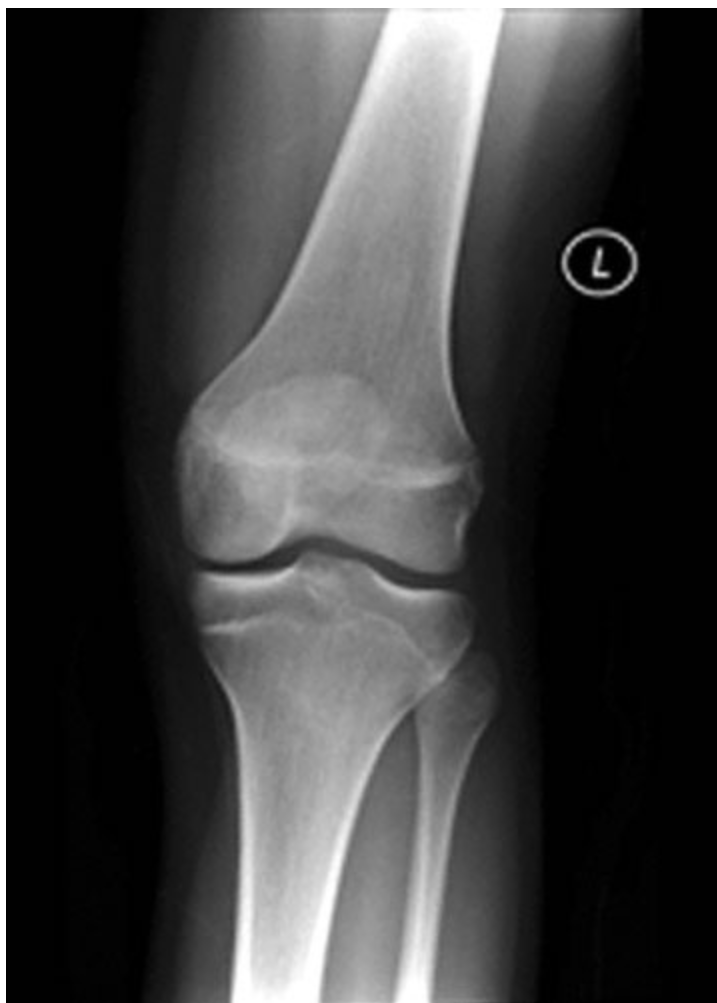 CorrectIncorrect
 -
Question 11 of 20
11. Question
A 42-year-old woman comes to the physician because of a lump in her left thigh since she fell on the ice while playing hockey 4 months ago. At that time, she noticed bruising on her left thigh that has resolved, but the lump has increased in size. She has not had fever, night sweats, or weight loss. She has no history of serious illness and takes no medications. Examination shows a 5 x 6-cm, painless, firm, soft tissue mass on the anterolateral aspect of the left thigh. The overlying skin is intact, and there is no discoloration. There is no inguinal lymphadenopathy. Distal pulses are normal, and sensation is intact. Range of motion of the hips and knees is full, and muscle strength is normal. X-rays of the left femur and knee show no abnormalities. An MRI of the left femur shows a deep soft tissue mass with inhomogeneous signal on T1 – and T2-weighted images. Which of the following is the most appropriate next step in diagnosis?
CorrectIncorrect -
Question 12 of 20
12. Question
A 62-year-old man comes for evaluation prior to undergoing total knee replacement. He has rheumatoid arthritis treated with prednisone. He has no known allergies. Examination shows pain with knee motion. Which of the following is the most appropriate management regarding prophylactic antibiotic therapy?
CorrectIncorrect -
Question 13 of 20
13. Question
A 47-year-old man comes to the physician because of a 6-month history of a lesion on his forehead. The affected area is not painful or itchy. Three years ago, he underwent a renal transplant for chronic renal failure secondary to IgA nephropathy. Examination of the left forehead shows a 2 x 0.5-cm, hyperkeratotic, erythematous, crusted plaque with areas of ulceration. The remainder of the examination shows no abnormalities. Which of the following is the most likely diagnosis?
CorrectIncorrect -
Question 14 of 20
14. Question
A 22-month-old boy is brought to the physician because of a 2-week history of difficulty sleeping. His parents note that each night he awakens screaming 1 to 2 hours after falling asleep and cannot be consoled. During these episodes, he sits or stands in the crib with his eyes open but does not focus his eyes on them. After 10 minutes, the episode resolves, and he falls asleep. He has asthma treated with nebulized albuterol. His maternal cousin has benign rolandic epilepsy of childhood. The patient is above the 95th percentile for head circumference. Examination shows a prominent forehead. The anterior fontanelle cannot be palpated. EEG shows no abnormalities. Which of the following is the most appropriate next step in management?
CorrectIncorrect -
Question 15 of 20
15. Question
A 27-year-old woman who received the diagnosis of multiple sclerosis 8 months ago comes to the physician because of severe fatigue during the past 2 months. She currently experiences double vision and vertigo once or twice weekly, but her most problematic symptom is persistent fatigue. She says that there has been no change in her sleep pattern. She eats five servings of vegetables daily and drinks one glass of wine in the evening. She exercises three times weekly; her regimen consists of 30 minutes of running outdoors. She notes that it has been a particularly hot summer and says that the heat bothers her more than it used to. She has no other history of serious illness. Current medications include interferon beta and a multivitamin. Physical examination shows no abnormalities. Which of the following is the most appropriate recommendation to decrease this patient’s fatigue?
CorrectIncorrect -
Question 16 of 20
16. Question
A 47-year-old woman with a 1-month history of rheumatoid arthritis comes to the physician for a follow-up examination. She has had moderate fatigue and morning joint stiffness. Current medications include ibuprofen and prednisone. There is swelling, tenderness, and decreased range of motion of the wrist and proximal interphalangeal joints bilaterally. Test of the stool for occult blood is negative. Laboratory studies show:
Hematocrit: 31%
Mean corpuscular volume: 85 µm³
Serum
Iron: 55 µg/dL
Total iron-binding capacity: 200 µg/dL (N = 250–400)
X-rays of the hands show bony erosions of the proximal interphalangeal joints bilaterally. Which of the following is the most appropriate next step in management?
CorrectIncorrect -
Question 17 of 20
17. Question
A 25-year-old woman comes to the physician for an initial prenatal examination at 12 weeks’ gestation. She has schizoaffective disorder and had been taking oral haloperidol sporadically until 2 months ago. She says that she was impregnated by evil and that she needs to get rid of the “Devil’s baby.” She states that she hears “angelic voices telling me to get an abortion.” She says that she likes children and has two of her own but “obviously cannot have this one because it is evil!” She demands an abortion. Physical examination shows a uterus consistent in size with a 12-week gestation. On mental status examination, she is agitated. In addition to admitting the patient to the hospital, which of the following is the most appropriate next step in management?
CorrectIncorrect -
Question 18 of 20
18. Question
Studies of a new intravenous fluid that acts as a plasma expander have shown positive results in laboratory animals. An emergency department (ED) physician believes that the new fluid could save human lives and wants to research its effects on critical trauma patients who require urgent care in the ED. Because the most critical patients are often unable to provide informed consent, which of the following best describes how the ED physician should proceed with his research?
CorrectIncorrect -
Question 19 of 20
19. Question
A case-control study is conducted to determine if the relationship between estrogen replacement therapy (ERT) and the risk for breast cancer is affected by estrogen formulation. Cases consist of 705 women with a history of breast cancer; controls consist of 692 randomly selected, age-matched women. All participants range in age from 55 to 74 years. Researchers record the following ERT data from participants and stratify the data accordingly: cumulative dosage, type of formulation, and duration of treatment. Researchers also record patient height and weight, family history of breast cancer, and reproductive history. Results show that the type of estrogen formulation does not affect the risk for breast cancer. Which of the following raises the most concern regarding the validity of this conclusion?
CorrectIncorrect -
Question 20 of 20
20. Question
A study is conducted to compare the prevalence of dental caries is a community that drinks fluorinated water (community A) with that in a community that drinks nonfluorinated water (Community B). Two thousand children ranging in age from 4 to 12 years are observed for 1 year. Subjects in the two community study groups are matched by age, gender, socioeconomic status, and dental insurance coverage. The results show:
Community A
Community B
Total
Number of children with caries
200
500
700
Number of children without caries
800
500
1300
Total
1000
1000
2000
Which of the following is the most accurate interpretation of these results?
CorrectIncorrect