
CK- NBME 11 – Block 3
Time limit: 0
Quiz Summary
0 of 20 Questions completed
Questions:
Information
You have already completed the quiz before. Hence you can not start it again.
Quiz is loading…
You must sign in or sign up to start the quiz.
You must first complete the following:
Results
Quiz complete. Results are being recorded.
Results
0 of 20 Questions answered correctly
Your time:
Time has elapsed
You have reached 0 of 0 point(s), (0)
Earned Point(s): 0 of 0, (0)
0 Essay(s) Pending (Possible Point(s): 0)
| Average score |
|
| Your score |
|
Categories
- Not categorized 0%
Would you like to submit your quiz result to the leaderboard?
![captcha]()
Loading
- 1
- 2
- 3
- 4
- 5
- 6
- 7
- 8
- 9
- 10
- 11
- 12
- 13
- 14
- 15
- 16
- 17
- 18
- 19
- 20
- Current
- Review
- Answered
- Correct
- Incorrect
-
Question 1 of 20
1. Question
A previously healthy 3-month-old boy is brought to the physician because of a 24-hour history of increasingly rapid breathing, difficulty feeding, and progressive fussiness. He has not had fever, but he has received acetaminophen to ease his fussiness. He receives no other medications. He is exclusively breast-fed. He is alert and pale and appears anxious. His pulse is 250/min, respirations are 68/min, and blood pressure is 80/50 mm Hg. He is not using accessory muscles of respiration. Pulse oximetry on room air shows an oxygen saturation of 99%. Capillary refill time is 2 seconds. Examination shows pink lips and moist oral mucosa. The lungs are clear to auscultation. No murmurs or gallops are heard on cardiac examination. The precordium is hyperdynamic. The abdomen is soft. The liver edge is palpated 3 cm below the right costal margin, and the spleen tip is palpated 2 cm below the left costal margin. Distal pulses are palpable. Laboratory studies show:
Hemoglobin: 9 g/dL
Hematocrit: 27%
Leukocyte count: 8000/mm³
Platelet count: 212,000/mm³
An ECG is shown:
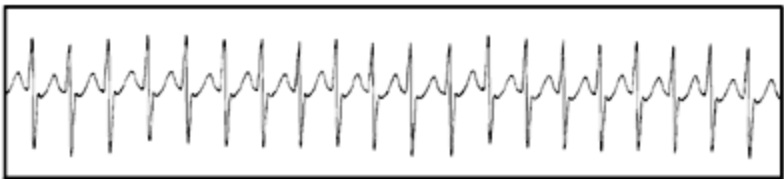
Which of the following is the most likely diagnosis?
CorrectIncorrect -
Question 2 of 20
2. Question
A 17-year-old boy is brought to the emergency department 30 minutes after he was thrown through a window during an altercation. He has no history of serious illness and takes no medications. He is alert and fully oriented. He reports moderate pain in his right arm and hand. His pulse is 110/min, respirations are 22/min, and blood pressure is 110/70 mm Hg. Pulse oximetry on 2 L/min of oxygen by nasal cannula shows an oxygen saturation of 98%. Examination shows superficial abrasions over the right side of the face. A 4 x 4-cm glass shard protrudes from the right upper extremity 2 cm proximal to the medial epicondyle; the extremity is cool and pale, and radial and ulnar pulses are not palpable. Which of the following is the most appropriate next step in management?
CorrectIncorrect -
Question 3 of 20
3. Question
A 58-year-old woman with osteoarthritis comes to the office because of a 1 -week history of fatigue. She also has had difficulty at work climbing stairs and putting away office supplies in cabinets above shoulder level. She says that during this time her arthritis pain has worsened and has spread to her shoulders, hips, and upper legs. She attributes her fatigue to poor sleep because of aching of her arms and legs. During a routine examination 6 months ago, hypertension and hypercholesterolemia were diagnosed and she was started on chlorthalidone, simvastatin, aspirin, vitamin D, calcium, and a multivitamin. Her only additional medication is ibuprofen. The patient smoked two packs of cigarettes daily for 30 years but quit 6 months ago in an attempt to improve her health after her sister had “a major heart attack.” At that time, the patient also stopped drinking alcoholic beverages and decreased her coffee consumption from 4 cups to 2 cups daily. She is 168 cm (5 ft 6 in) tall and weighs 73 kg (160 lb); BMI is 26 kg/m2. Vital signs are temperature 36.4°C (97.6°F), pulse 84/min, respirations 16/min, and blood pressure 122/78 mm Hg. The patient appears anxious but is not in acute distress. Musculoskeletal examination shows no edema, erythema, or deformity with minimal tenderness of all major joints. Active and passive range of motion is full. During passive range of motion testing, the patient reports pain where her upper arms and upper legs are grasped. The remainder of the physical examination discloses no abnormalities. Which of the following studies is most likely to establish the diagnosis?
CorrectIncorrect -
Question 4 of 20
4. Question
A 37-year-old man is brought to the emergency department after his motorcycle ran into the back of a truck at high speed. He was wearing a helmet. On arrival, his neck is immobilized in a cervical collar, and intravenous fluids are being administered. Paramedics report that at the scene he appeared to be intoxicated. He is alert and talking. His breath smells of alcohol. His pulse is 130/min, respirations are 30/min, and blood pressure is 100/60 mm Hg. The lungs are clear to auscultation. Heart sounds are normal. The abdomen is distended and tender. There is blood at the urethral meatus. Ultrasonography shows blood in the abdomen. An x-ray of the pelvis shows fractures of the pubic rami and ischial and ilial fractures on the right. Which of the following is the most appropriate next step in management?
CorrectIncorrect -
Question 5 of 20
5. Question
A 25-year-old woman comes to the emergency department because of nausea, diarrhea, and anxiety for 2 days. She also has noticed dizziness and tingling sensations shooting down her forearms. Her sleep and appetite have been normal. She has a 3-year history of social phobia well controlled for the past year with paroxetine. She is attending an out-of-town conference and forgot to pack her medication; her last dose was 3 days ago. She does not drink alcohol or use illicit drugs. She is 163 cm (5 ft 4 in) tall and weighs 80 kg (176 lb); BMI is 30 kg/m2. Her temperature is 37°C (98.6°F), pulse is 80/min, and blood pressure is 110/75 mm Hg. Physical examination shows no other abnormalities. Mental status examination shows an irritable mood with a full range of affect. Her speech is of normal rate and rhythm. There is no evidence of suicidal ideation or hallucinations. She can recall three of three objects after 5 minutes. Long-term memory is intact. Serum studies show no traces of paroxetine. Which of the following is the most appropriate next step in management?
CorrectIncorrect -
Question 6 of 20
6. Question
A 72-year-old man with lung cancer comes to the physician because of a 2-month history of weakness in his legs. He also has had dry mouth, constipation, and tingling of his hands and feet during this period. He received radiation therapy 3 weeks ago and is currently undergoing chemotherapy. He has smoked two packs of cigarettes daily for 50 years. His temperature is 37°C (98.6°F), pulse is 86/min, respirations are 20/min, and blood pressure is 126/84 mm Hg. There is mild bilateral ptosis, which does not worsen after upward gaze for 1 minute. Ocular movements are full. Oral mucosa is dry. There is mild weakness of hip flexion bilaterally. After several attempts, he can rise from a chair with his arms folded across his chest. Deep tendon reflexes are absent. Sensation is intact. Which of the following is most likely to confirm the diagnosis?
CorrectIncorrect -
Question 7 of 20
7. Question
A 72-year-old woman with a 30-year history of type 2 diabetes mellitus comes to the physician because of pain and swelling of her left foot since a blister on the bottom of her left foot broke 2 weeks ago. Her temperature is 37.2°C (99°F). Examination shows swelling and erythema of the left distal leg, ankle, and foot; there is a 2-cm ulcer at the base of the heel with an overlying black eschar. Peripheral pulses are decreased bilaterally. Capillary refill time is greater than 3 seconds. The ulcer is debrided, and a sterile probe is inserted until the base touches bone. Which of the following is the most likely cause of these findings?
CorrectIncorrect -
Question 8 of 20
8. Question
A 37-year-old man with end-stage Duchenne muscular dystrophy is scheduled for discharge from the hospital after treatment for pneumonia. He has been admitted to the hospital four times over the past 6 months for recurrent pneumonia. Over the past 3 years, he has received mechanical ventilation and has used a wheelchair. His life expectancy is less than 6 months. The patient tells the physician that he is “tired of living like this” and requests a do-not-resuscitate order with no further antibiotics. He has been considering this decision for 3 weeks but has not discussed it with his family. On mental status examination, he shows sadness about his health but has a normal thought process. He expresses no ambivalence about his decision. Which of the following is the most appropriate next step in management?
CorrectIncorrect -
Question 9 of 20
9. Question
A 12-year-old boy is brought to the physician for a routine follow-up examination. He received the diagnosis of chronic renal failure secondary to glomerulonephritis 2 years ago. He has hypertension controlled with an ACE inhibitor. He is at the 10th percentile for height and weight. Examination shows mild edema of the lower extremities. His mother asks about ways to minimize complications of his renal failure. Which of the following is the most appropriate recommendation?
CorrectIncorrect -
Question 10 of 20
10. Question
A 13-year-old girl is brought to the physician because her mother is concerned that her daughter has never had a menstrual period. She is at the 80th percentile for height and 75th percentile for weight. Breast and pubic hair development is Tanner stage 2. Examination shows no other abnormalities. Which of the following is the most appropriate next step in management?
CorrectIncorrect -
Question 11 of 20
11. Question
A 27-year-old woman comes to the physician because of a 2-week history of intermittent substernal chest pain. She states that the pain is worsened by swallowing solids or liquids. She has a 10-year history of intravenous drug use. Her temperature is 37°C (98.6°F), pulse is 80/min, respirations are 20/min, and blood pressure is 120/80 mm Hg. Examination shows poor dentition and multiple 1- to 2-cm lymph nodes in the cervical and inguinal regions. Cardiac examination shows no abnormalities. Which of the following is the most appropriate next step in diagnosis?
CorrectIncorrect -
Question 12 of 20
12. Question
A previously healthy 42-year-old woman has had generalized weakness, lethargy, and double vision for 2 weeks. Examination shows no other abnormalities. X-rays of the chest show an upper anterior mediastinal mass. Which of the following is the most likely diagnosis?
CorrectIncorrect -
Question 13 of 20
13. Question
A 67-year-old woman comes to the emergency department 6 hours after she noticed a red rash over her arms and abdomen. She has had nosebleeds during the past week. She has a 1-month history of nightly temperatures to 38.3°C (101°F) with night sweats. Eight years ago, she had ovarian cancer and underwent total abdominal hysterectomy, bilateral salpingo-oophorectomy, and omentectomy followed by chemotherapy and filgrastim (GCSF) therapy. She has received conjugated estrogen therapy since the operation. There has been no recurrence of ovarian cancer. She is 168 cm (5 ft 6 in) tall and weighs 59 kg (130 lb); BMI is 21 kg/m2. Her temperature is 38.3°C (101 °F), pulse is 120/min, respirations are 20/min, and blood pressure is 100/70 mm Hg. Examination shows a diffuse petechial rash over the upper extremities and abdomen. The cervical lymph nodes are shoddy and slightly enlarged. Pelvic examination shows no abnormalities. Her hematocrit is 22%, leukocyte count is 30,000/mm3, and platelet count is 30,000/mm3. A blood smear shows immature myeloblasts. Which of the following is the most likely cause of this patient’s current condition?
CorrectIncorrect -
Question 14 of 20
14. Question
A healthy 16-year-old girl is brought to the physician for an examination prior to participation in school sports. She has no history of serious illness, and she is doing well in school. Menarche occurred at the age of 12 years; menses occur at regular 28-day intervals. Her mother and maternal grandmother have hypothyroidism treated with levothyroxine. The patient appears well. She is 168 cm (5 ft 6 in) tall and weighs 75 kg (165 lb); BMI is 27 kg/m2. Her temperature is 37°C (98.6°F), pulse is 72/min, respirations are 18/min, and blood pressure is 96/70 mm Hg. Examination shows no exophthalmos or lid lag. The thyroid gland is moderately enlarged and firm, but no nodules are palpable. Cardiopulmonary examination shows no abnormalities. The extremities are warm and well perfused. Deep tendon reflexes are 2+, but the Achilles relaxation phase is delayed. Serum studies show:
Thyroid-stimulating hormone: 56 µU/mL
Thyroxine (T₄): 6 µg/dL
Antithyroid peroxidase antibodies: >1:1000 (N < 1:20)
Thyroglobulin antibodies: 1:500 (N < 1:20)
Which of the following is the most likely explanation for these findings?
CorrectIncorrect -
Question 15 of 20
15. Question
A previously healthy 52-year-old man comes to the physician because of a 6-month history of difficulty swallowing solids and liquids. He has had a 2.3-kg (5-lb) weight loss during this period. Examination shows no abnormalities. An upper gastrointestinal series with barium contrast is shown. Which of the following is the most likely diagnosis?
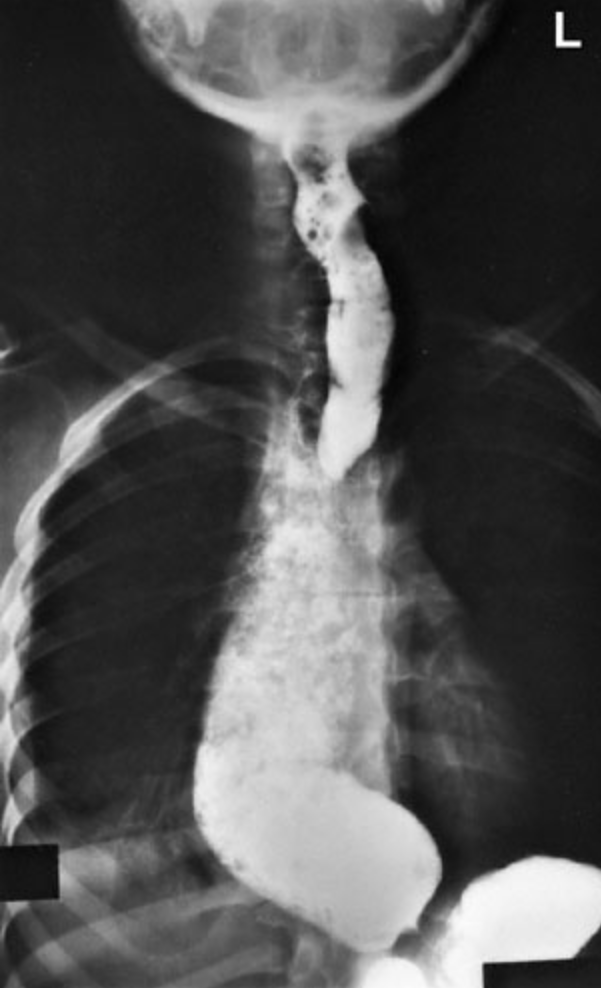 CorrectIncorrect
 -
Question 16 of 20
16. Question
A previously healthy 4-year-old boy is brought to the physician because of increasing left ear pain for 2 weeks. His temperature is 38.5°C (101.3°F). Examination of the left ear shows an erythematous, bulging tympanic membrane and an edematous auditory canal with a small amount of mucopurulent discharge. The ear appears to be displaced laterally, and there is moderate tenderness in the area behind the ear. Examination of the right ear shows no abnormalities. A 1-cm, freely mobile, nontender mass is palpated over the left anterior neck. Examination of the pharynx shows no abnormalities. Which of the following is the most appropriate next step in management?
CorrectIncorrect -
Question 17 of 20
17. Question
A 21-year-old woman comes to the physician because she has not had a menstrual period since she stopped using an oral contraceptive 10 months ago. Menarche was at the age of 14 years, and menses had occurred at regular 28-day intervals before starting an oral contraceptive 3 years ago. She is not sexually active. She is 165 cm (5 ft 5 in) tall and weighs 63 kg (140 lb); BMI is 23 kg/m2. Her blood pressure is 120/58 mm Hg. Examination shows no hirsutism or other abnormalities. Serum studies show a thyroid- stimulating hormone concentration of 3 μU/mL, prolactin concentration of 20 ng/mL, and free thyroxine concentration of 2 ng/dL (N=0.8-2.4). A progestin challenge test shows withdrawal bleeding. Which of the following is the most likely diagnosis?
CorrectIncorrect -
Question 18 of 20
18. Question
A 72-year-old man is brought to the emergency department by his wife because of fever and chills for 2 hours. He visited the physician 2 days ago because of burning with urination, and urine cultures were ordered. He was an artillery officer 40 years ago, and his wife says that his hearing is deteriorating. He has a sulfa allergy. He appears moderately ill. His temperature is 38.3°C (101°F). Examination shows left costovertebral angle tenderness. His leukocyte count is 15,000/mm3 with a shift to the left. Urinalysis shows many bacilli. Urine culture and sensitivity show an organism that is sensitive only to nitrofurantoin, gentamicin, amikacin, tobramycin, trimethoprim-sulfamethoxazole, and ciprofloxacin. Which of the following is the most appropriate pharmacotherapy?
CorrectIncorrect -
Question 19 of 20
19. Question
A 19-year-old man comes to the physician because of frequent nosebleeds over the past 3 weeks. He has bipolar disorder currently well controlled with lithium carbonate, bupropion, and valproic acid. Physical examination shows no abnormalities except for dried blood in the nares. Mental status examination shows an anxious mood and slight motor restlessness. Serum studies show a lithium carbonate concentration of 1.3 mEq/L (therapeutic range=0.6-1.2), and valproic acid concentration of 77 pg/mL (therapeutic range=40-100). Which of the following is the most appropriate next step in management?
CorrectIncorrect -
Question 20 of 20
20. Question
A 52-year-old woman comes to the physician because of tremors in her hands for 4 months. She only fills teacups halfway to avoid spilling, and she has difficulty lifting a spoonful of soup to her mouth without spilling it. Her children noticed tremors of her head 5 years ago. She has no history of serious illness and takes no medications. She is 168 cm (5 ft 6 in) tall and weighs 56 kg (123 lb); BMI is 20 kg/m2. Her temperature is 37°C (98.6°F), pulse is 80/min, respirations are 12/min, and blood pressure is 110/70 mm Hg. Examination shows a tremor of the outstretched hands bilaterally; the amplitude of the tremor increases with finger-nose testing. The tremor resolves at rest. Muscle strength and tone are intact, and her gait is normal. Which of the following is the most appropriate pharmacotherapy?
CorrectIncorrect