
CK- NBME 9 – Block 2
Time limit: 0
Quiz Summary
0 of 20 Questions completed
Questions:
Information
You have already completed the quiz before. Hence you can not start it again.
Quiz is loading…
You must sign in or sign up to start the quiz.
You must first complete the following:
Results
Quiz complete. Results are being recorded.
Results
0 of 20 Questions answered correctly
Your time:
Time has elapsed
You have reached 0 of 0 point(s), (0)
Earned Point(s): 0 of 0, (0)
0 Essay(s) Pending (Possible Point(s): 0)
| Average score |
|
| Your score |
|
Categories
- Not categorized 0%
Would you like to submit your quiz result to the leaderboard?
![captcha]()
Loading
- 1
- 2
- 3
- 4
- 5
- 6
- 7
- 8
- 9
- 10
- 11
- 12
- 13
- 14
- 15
- 16
- 17
- 18
- 19
- 20
- Current
- Review
- Answered
- Correct
- Incorrect
-
Question 1 of 20
1. Question
A 25-year-old primigravid woman at 27 weeks’ gestation is brought to the emergency department because of severe contractions for 6 hours. She says the contractions have not resolved despite changing positions and increasing her fluid intake. She also noted a small amount of vaginal spotting the last time she voided. External fetal monitoring shows contractions every 2 to 3 minutes and a fetal heart rate of 130/min with no decelerations. The cervix is 1 cm dilated and 10% effaced. The fetal presenting part is high. During the next hour, she receives oral hydration. Her temperature is 37.2°C (99°F), pulse is 110/min, respirations are 16/min, and blood pressure is 110/70 mm Hg. The lungs are clear to auscultation. The fundal height is 27 cm. The cervix is now 1 to 2 cm dilated and 70% effaced; the vertex is at -2 station. Vaginal culture for group B streptococcus is positive. Which of the following is the most appropriate next step in management?
CorrectIncorrect -
Question 2 of 20
2. Question
An 18-year-old woman comes to the physician because of intermittent vaginal bleeding and abdominal pain over the past 4 days. Menses occur at irregular 28- to 40-day intervals. She cannot remember the date of her last menstrual period. She is sexually active with one partner, and they use condoms for contraception. Pelvic examination shows normal external genitalia and a normal-appearing cervix. There is blood coming from the cervical os. The uterus is slightly enlarged. Serum (3-hCG concentration is 7000 mlll/mL. Pelvic ultrasonography shows a small amount of fluid in the uterus only but no evidence of a gestational sac. Which of the following is the most likely diagnosis?
CorrectIncorrect -
Question 3 of 20
3. Question
A 47-year-old man is brought to the emergency department 20 minutes after being involved in a head-on motor vehicle collision. He was an unrestrained passenger of a car traveling at 30 mph. At the scene, he was conscious and followed commands. His pulse was 110/min, and blood pressure was 90/55 mm Hg. En route to the hospital, he was resuscitated with 1 L of crystalloid solution. On arrival, he is alert and oriented to person, place, and time. He has shortness of breath and chest pain. A nasogastric tube is inserted. His blood pressure is 130/70 mm Hg. Examination shows abrasions over the left anterior hemithorax. The lungs are clear to auscultation. Heart sounds are normal. Abdominal examination shows no abnormalities. A portable x-ray of the chest shows fluid at the base of the left lung field and a fluid density at the left pleural apex. The nasogastric tube is deviated to the right in the upper mediastinal region. His blood pressure suddenly decreases to 80/40 mm Hg. Which of the following is the most likely cause of this patient’s hypotension?
CorrectIncorrect -
Question 4 of 20
4. Question
A 42-year-old man comes for a routine health maintenance examination. There is no family history of coronary artery disease, and he does not smoke. His weight is appropriate for his height. His blood pressure is 120/80 mm Hg. Serum lipid studies show a total cholesterol concentration of 190 mg/dL, HDL-cholesterol concentration of 40 mg/dl_, and triglyceride concentration of 150 mg/dL. Which of the following is the most appropriate next step in management?
CorrectIncorrect -
Question 5 of 20
5. Question
An 18-month-old girl is brought to the physician because she has not used her right arm since falling while running hand-in-hand with her right arm at her side with the forearm pronated; she is unable to fully supinate or flex her forearm. There is no obvious swelling or the most appropriate initial management?
CorrectIncorrect -
Question 6 of 20
6. Question
A 57-year-old man comes to the emergency department because of a 3-week history of constant, severe, nonradiating, midthoracic back pain. He has not had recent trauma to the area. Six weeks ago, he had an episode of Staphylococcus aureus sepsis that resolved with antibiotic therapy. He has end-stage renal disease secondary to hypertension treated with minoxidil and metoprolol; he also receives dialysis by way of tunnel dialysis catheter. His temperature is 37.8°C (100°F), and blood pressure is 140/88 mm Hg. Examination shows tenderness to palpation overT7 and T8. Laboratory studies show an erythrocyte sedimentation rate of 50 mm/h. A T1 -weighted MRI of the spine shows decreased signal intensity in the vertebral bodies of T7 and T8 and no abnormalities in the epidural space. In addition to changing the patient’s hemodialysis catheter, which of the following is the most appropriate next step in management?
CorrectIncorrect -
Question 7 of 20
7. Question
A 19-year-old man is brought to the emergency department by friends because of increasing agitation and confusion during the past 2 hours. On arrival, he is mute and unresponsive to questions. His friends say that he drinks alcohol heavily and uses various illicit drugs on the weekends. His temperature is 39.6°C (103.2°F), pulse is 130/min, and blood pressure is 144/92 mm Hg. He is diaphoretic and grinding his teeth. The pupils are 4 mm. Neurologic examination shows tremulousness and poor coordination of the upper and lower extremities. On mental status examination, he exhibits psychomotor agitation and glances about the room in a confused and anxious manner. The most likely diagnosis is intoxication with which of the following substances?
CorrectIncorrect -
Question 8 of 20
8. Question
An 80-year-old woman is admitted to the hospital because of increasing somnolence over the past 2 days. Her pulse is 90/min while supine and 110/min while standing, respirations are 20/min, and blood pressure is 120/80 mm Hg while supine and 100/80 mm Hg while standing. Examination shows no abnormalities except for dry skin and mucous membranes. Laboratory studies show:
Serum
Na⁺: 137 mEq/L
Cl⁻: 100 mEq/L
K⁺: 4.3 mEq/L
HCO₃⁻: 19 mEq/L
Urea nitrogen: 30 mg/dL
Glucose: 900 mg/dL
Creatinine: 1.6 mg/dL
Arterial pH: 7.38
Which of the following is the most appropriate initial therapy?
CorrectIncorrect -
Question 9 of 20
9. Question
A 47-year-old woman comes to the physician because of a 6-day history of frequent diarrhea associated with painful straining, abdominal cramps, and intermittent passage of bright red blood. Her symptoms began during a trip to Mexico. She is otherwise in good health and takes no medications. Her temperature is 38.2°C (100.7°F), pulse is 92/min, respirations are 18/min, and blood pressure is 130/75 mm Hg. There is mild lower abdominal tenderness without peritoneal signs. A scant amount of loose brown stool present in the rectal vault tests positive for occult blood. Which of the following is the most likely causal organism?
CorrectIncorrect -
Question 10 of 20
10. Question
A full-term 8-hour-old male newborn regurgitates his first feeding. He drools constantly and has not urinated or had a bowel movement. His pulse is 136/min, and respirations are 68/min. There are no intercostal retractions. The remainder of the examination shows no abnormalities. Which of the following is the most appropriate initial diagnostic procedure?
CorrectIncorrect -
Question 11 of 20
11. Question

A 72-year-old man is brought to the emergency department 20 minutes after collapsing at a local restaurant. He was waiting to get his coat when he passed out. He did not lose bowel or bladder control and was awake and oriented when the paramedics arrived. He has coronary artery disease and sustained a myocardial infarction 3 years ago. His current medications include enalapril, metoprolol, aspirin, and pravastatin. Examination shows no abnormalities. Laboratory studies, including measurement of cardiac enzyme activities, are within normal limits. A CT scan of the head shows no abnormalities. An ECG is shown. Which of the following is the most likely cause of this patient’s symptoms?
CorrectIncorrect -
Question 12 of 20
12. Question
A 2-month-old girl is brought to the physician for a well-child examination. She was born at 39 weeks’ gestation following an uncomplicated pregnancy and a cesarean delivery for breech presentation. Apgar scores were 9 and 9 at 1 and 5 minutes, respectively. Her temperature is 37°C (98.6°F), pulse is 120/min, respirations are 20/min, and blood pressure is 75/50 mm Hg. Abduction of the left hip is limited. Manipulation of the hip with and without pressure elicits a palpable clunk. Which of the following is the most appropriate initial step in management?
CorrectIncorrect -
Question 13 of 20
13. Question
A 62-year-old man comes to the physician for a routine examination. His paternal grandfather received the diagnosis of dementia, Alzheimer type, at the age of 65 years. The patient says he is “not forgetting things” but wonders whether he might have inherited the disorder. He has major depressive disorder treated with citalopram, hypertension treated with hydrochlorothiazide, and hyperlipidemia treated with atorvastatin. He sustained minor injuries in a motor vehicle collision at the age of 11 years but has no other history of trauma. Today, he appears well. His temperature is 37°C (98.6°F), pulse is 74/min and regular, respirations are 12/min, and blood pressure is 140/80 mm Hg. The remainder of the examination shows no abnormalities. Which of the following factors presents the greatest risk for development of dementia in this patient?
CorrectIncorrect -
Question 14 of 20
14. Question
A 67-year-old man comes to the emergency department 1 hour after the onset of vertigo, nausea, and imbalance. He has a 20-year history of poorly controlled hypertension. His pulse is 70/min, respirations are 20/min, and blood pressure is 210/115 mm Hg. Examination shows a small right pupil, mild right ptosis, and nystagmus. Neurologic examination shows weakness of the right palate. Sensation to pinprick is decreased over the right side of the face and left extremities. There is incoordination on finger-nose testing and heel-knee-shin testing on the right. Which of the following arteries is most likely to be occluded?
CorrectIncorrect -
Question 15 of 20
15. Question
A previously healthy 52-year-old man is brought to the emergency department by his wife 30 minutes after he had a generalized tonic-clonic seizure, which lasted 90 seconds. He had no prodromal symptoms. His wife reports that he has been “more distant and less engaged” during the past 3 weeks. He has no history of seizures. There is no personal or family history of serious illness. He takes no medications. He smoked two packs of cigarettes daily for 25 years but quit 3 years ago. He drinks one glass of wine weekly. He appears drowsy but is easily aroused. His pulse is 80/min, and blood pressure is 110/78 mm Hg. Funduscopic examination shows sharp disc margins; there is no papilledema. Range of motion of all extremities is full. Deep tendon reflexes are 2+ bilaterally. A CT scan of the chest shows no abnormalities. A CT scan of the head is shown. Which of the following is the most appropriate next step in management?
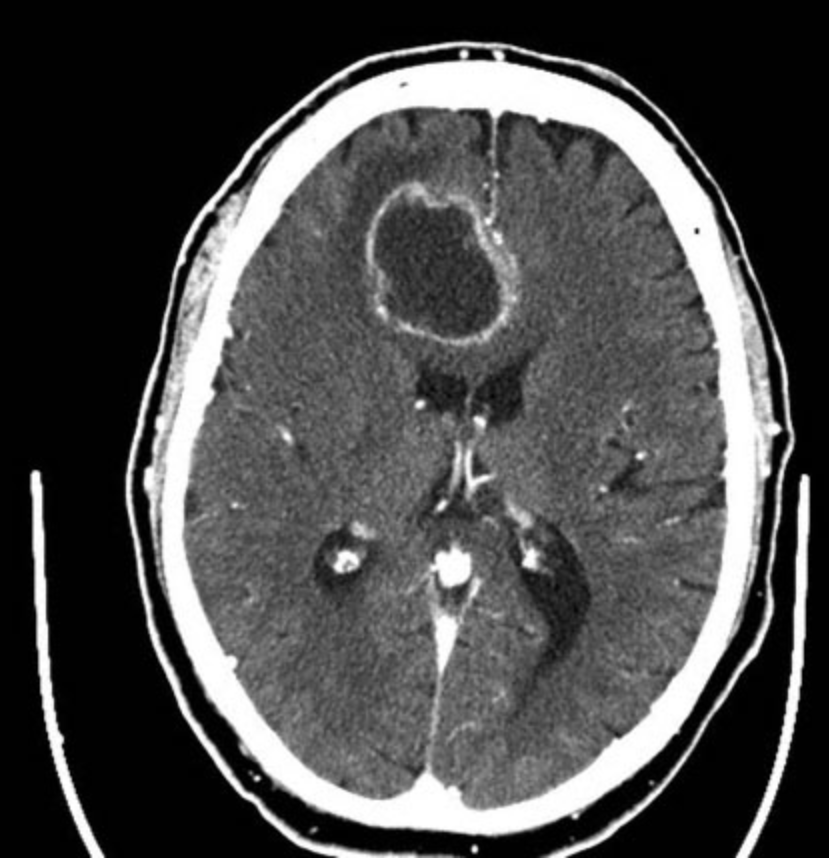 CorrectIncorrect
 -
Question 16 of 20
16. Question
A randomized controlled trial is conducted to asses the safety of uterine artery embolization (UAE) compared with hysterectomy for treatment of leiomyomata uteri with menorrhagia. A total of 350 patients are equally divided to undergo either UAE or hysterectomy. The mean patient age is similar in both groups. Major and minor complication length of hospital stay, and readmission up to 6 weeks after the procedure are evaluated. Results show:
Group
Major Complication Rate (p = 0.68)
Minor Complication Rate (p = 0.024)
Average Length of Hospital Stay (p < 0.001)
Readmission Rate (p = 0.003)
UAE
5%
60%
2.5 days
10%
Hysterectomy
3%
40%
5 days
0%
Based on these results, which of the following is the most accurate conclusion regarding the safety of UAE compared with hysterectomy?
CorrectIncorrect -
Question 17 of 20
17. Question
A new screening test for HIV is implemented in a prison in a Midwestern state. The medical director of the prison wants to know how the new test compares to the one used previously. Which of the following is the most important determinant of the specificity of the test to identify HIV infected prisoners?
CorrectIncorrect -
Question 18 of 20
18. Question
A study is conducted to compare the effects of remote patient monitoring (RPM) with the effects of monthly clinic visits for patients with congestive heart failure (CHF). One thousand patients are enrolled in the study; 500 receive RPM and 500 receive monthly clinic visits. Patients are observed for 6 months. Data show:
Outcome
RPM (%)
Standard Care (%)
Relative Risk Reduction (95% CI)
All-cause mortality
13
15
17 (5–27)
Hospitalization for any cause
43
45
3 (−3–8)
Hospitalization for heart failure
20
27
29 (20–36)
Which of the following best represents the number of patients who need to be treated with RPM instead of standard care during a 6-month period to prevent mortality in one patient with CHF?
CorrectIncorrect -
Question 19 of 20
19. Question
A 32-year-old man comes to the physician as a new patient. Twice during the past 15 years, he has received treatment in the emergency department for severe wheezing, shortness of breath, and swelling of the face and hands; one episode was triggered by a bee sting and the other by a wasp sting. He has no other history of serious illness. His only medication is self-injectable epinephrine, which he used successfully to prevent a reaction when he was stung by a bee during a camping trip 1 year ago. Examination shows no abnormalities. In addition to self-injectable epinephrine therapy if stung, which of the following is the most appropriate management to decrease this patient’s risk for future anaphylactic reactions?
CorrectIncorrect -
Question 20 of 20
20. Question
A 48-year-old woman comes to the office for consultation before undergoing Roux-en-Y gastric bypass. She says her cousin underwent gastric bypass 1 year ago and developed postoperative nausea, vomiting, confusion, and falling. The patient asks what she can do to prevent this outcome if she undergoes the operation. The patient has type 2 diabetes mellitus, obstructive sleep apnea hypopnea, and hypertension. Medications are metformin, glipizide, atorvastatin, and lisinopril. She is 162 cm (5 ft 4 in) tall and weighs 118 kg (260 lb); BMI is 45 kg/m2. Temperature is 37.0°C (98.6°F), pulse is 60/min, respirations are 16/min, and blood pressure is 142/90 mm Hg. Pulse oximetry on room air shows an oxygen saturation of 98%. Cardiopulmonary examination discloses no abnormalities. Abdomen is obese with no tenderness. The remainder of the examination discloses no abnormalities. Regarding this patient’s concerns, it is most appropriate to counsel her that routine supplementation with which of the following will prevent a postoperative outcome similar to that of her cousin?
CorrectIncorrect