
NBME 33 – Block 1
Time limit: 0
Quiz Summary
0 of 20 Questions completed
Questions:
Information
You have already completed the quiz before. Hence you can not start it again.
Quiz is loading…
You must sign in or sign up to start the quiz.
You must first complete the following:
Results
Quiz complete. Results are being recorded.
Results
0 of 20 Questions answered correctly
Your time:
Time has elapsed
You have reached 0 of 0 point(s), (0)
Earned Point(s): 0 of 0, (0)
0 Essay(s) Pending (Possible Point(s): 0)
Categories
- Not categorized 0%
- 1
- 2
- 3
- 4
- 5
- 6
- 7
- 8
- 9
- 10
- 11
- 12
- 13
- 14
- 15
- 16
- 17
- 18
- 19
- 20
- Current
- Review
- Answered
- Correct
- Incorrect
-
Question 1 of 20
1. Question
A 25-year-old woman of Mediterranean descent comes to the physician because of a 2-day history of shortness of breath and dizziness with exertion. Five days ago, she began treatment with clotrimazole and trimethoprim-sulfamethoxazole for dysuria, bacteriuria, and pyuria. Her identical twin sister, who had similar symptoms and findings, also began treatment with the same dosage of the same medications at that time; the sister’s symptoms have resolved without complication. The patient’s respirations are 15/min. Physical examination shows pallor. Her hemoglobin concentration is 7 g/dL, and hematocrit is 21%. A peripheral blood smear shows marked anisocytosis, poikilocytosis, and polychromasia with increased numbers of nucleated erythrocytes. The difference in drug response between the patient and her sister is best explained by a difference in which of the following?
CorrectIncorrect -
Question 2 of 20
2. Question
A previously healthy 33-year-old man comes to the physician because of a 3-week history of cough and the frequent need to clear his throat. He takes no medications. He does not smoke cigarettes. Examination of the nasopharynx shows secretions and cobblestoning. The patient says, “I am concerned that I may have lung cancer like my dad. His lung cancer started with a cough just like this.” Which of the following is the most appropriate response by the physician?
CorrectIncorrect -
Question 3 of 20
3. Question
A 29-year-old man is brought to the emergency department 30 minutes after he developed shortness of breath following a wasp sting. He appears acutely ill. His pulse is 130/min, respirations are 24/min, and systolic blood pressure is 70 mm Hg. Physical examination shows a diffuse urticarial rash. Wheezes are heard over all lung fields. It is most appropriate to first administer a drug with which of the following mechanisms of action?
CorrectIncorrect -
Question 4 of 20
4. Question
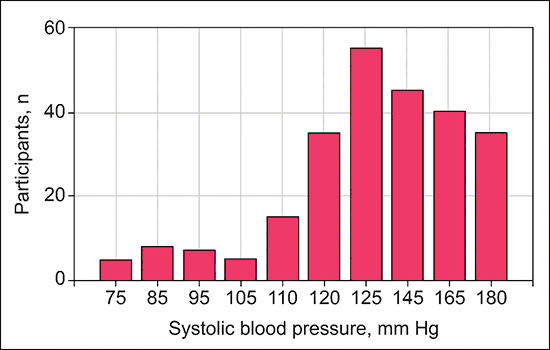
A 1-day hypertension awareness program is held at a local community center. As part of the program, participants undergo blood pressure measurement to screen for systolic hypertension. A total of 250 adults are screened for systolic hypertension. The systolic blood pressure values for the participants are shown. Which of the following is the most appropriate measure to use to identify the central tendency of these data?
CorrectIncorrect -
Question 5 of 20
5. Question
A 15-year-old boy is brought to the emergency department because of a 36-hour history of severe thirst and voluminous, painless, watery diarrhea; he also has had a 4-kg (8.8-lb) weight loss during this period. He has not had vomiting. His pulse is 110/min, and blood pressure is 110/60 mm Hg while supine; his pulse increases to 170/min, and blood pressure decreases to 70/40 mm Hg while standing. An increase of which of the following most likely occurs in this patient when he stands?
CorrectIncorrect -
Question 6 of 20
6. Question
A 61-year-old man comes to the emergency department because of a 2-month history of progressive shortness of breath and right-sided chest pain. The symptoms now occur at rest. He describes the chest pain as sharp, but he cannot localize it. He has worked as a carpenter on construction sites for 40 years. His temperature is 37°C (98.6°F), pulse is 80/min, respirations are 14/min, and blood pressure is 136/88 mm Hg. There are decreased breath sounds and dullness to percussion over the right lung field. Laboratory studies show no abnormalities. A chest x-ray shows thickening of the majority of the right pleura and decreased size of the right lung. A right pleural biopsy specimen shows atypical epithelioid cells that stain positive for cytokeratin and calretinin but are negative for carcinoembryonic antigen and thyroid transcription factor-1. Occupational exposure to which of the following is the most likely cause of these findings?
CorrectIncorrect -
Question 7 of 20
7. Question
A 29-year-old man is brought to the emergency department because of a 12-hour history of light-headedness and dizziness that coincides with acute nausea, vomiting, and diarrhea. After sitting in the waiting room for 2 hours, he is called for examination. On standing, he feels faint and immediately returns to a seated position. His blood pressure is 98/69 mm Hg and increases to 118/82 mm Hg within 5 minutes. Activation of vascular receptors by which of the following best explains the return of this patient’s blood pressure to normal when he sits down?
CorrectIncorrect -
Question 8 of 20
8. Question
A 17-year-old boy is brought to the office by his mother because of delayed puberty. The patient is 147 cm (4 ft 10 in) tall and weighs 50 kg (110 lb); BMI is 23 kg/m2. Physical examination shows a lack of facial and body hair, small testes, and poorly developed muscles. The patient speaks with a high voice. Neurologic examination shows anosmia. The results of serum studies are shown:
Thyroid-stimulating hormone
2.1 μU/mL (N=0.5–5)
Thyroxine (T4)
10 μg/dL (N=5–12)
Growth hormone
8 ng/mL (N=1–9)
Insulin-like growth factor-1
200 ng/mL (N=113–566)
Total testosterone
3.5 nmol/L (N=10–35)
Luteinizing hormone
undetectable
Genetic testing shows a mutation in the KAL1 gene. The most likely cause of these findings is which of the following defects in the gonadotropin-releasing hormone (GnRH) system?
CorrectIncorrect -
Question 9 of 20
9. Question
During a study of vitamin A, one experimental animal is given a normal, balanced diet (Animal X). A different experimental animal (Animal Y) is given a diet that is similar except for a total lack of vitamin A. Which of the following tissue types taken from Animal Y is most likely to show severe and extensive effects compared with tissue taken from Animal X?
CorrectIncorrect -
Question 10 of 20
10. Question
An investigator is conducting a study of hypertension in a group of healthy volunteers. Fifty men and 50 women are enrolled in the study. Each participant is between the ages of 40 and 50 years, has a family history of hypertension, exercises regularly, and has a normal BMI. Results show that the average blood pressure of the women is 120/75 mm Hg compared with 135/80 mm Hg for the men. Which of the following effects of estrogen in the women best accounts for this difference?
CorrectIncorrect -
Question 11 of 20
11. Question
A new antiplatelet agent is developed for the prevention of recurrence of stroke. In a large randomized clinical trial with equal numbers of men and women, the rates of stroke are lower in patients receiving the new agent than in patients receiving the standard treatment. Results are shown:
Recurrent Stroke Rates per 1000 Person-Years
Standard Treatment
New Antiplatelet Drug
Women
.12
.04
Men
.24
.08
Overall
.18
.06
Based on the overall results, which of the following is the overall relative risk reduction?
CorrectIncorrect -
Question 12 of 20
12. Question
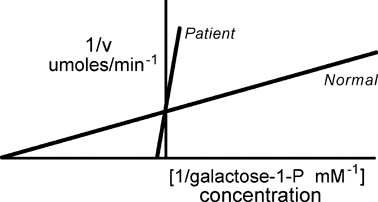
A 4-day-old breast-fed male newborn is admitted to the hospital because of jaundice, vomiting, and diarrhea. He appears listless. Physical examination shows scleral icterus and hepatomegaly. Galactose 1-phosphate uridyltransferase activity is analyzed in an extract of erythrocytes at varying concentrations of galactose 1-phosphate. A double reciprocal plot of data obtained from the patient compared with a healthy newborn is shown. Which of the following is most likely in this patient?
CorrectIncorrect -
Question 13 of 20
13. Question
A 70-year-old woman comes to the physician because of occasional difficulty swallowing and a feeling of having food “stuck in her throat” since undergoing surgical removal of a pharyngeal tumor 2 weeks ago. On direct laryngoscopy, sensation to light touch is absent unilaterally above but not below the left vocal fold. Which of the following nerves on the left was most likely injured in this patient during the procedure?
CorrectIncorrect -
Question 14 of 20
14. Question
A 79-year-old man with progressive, nonresectable lung cancer is admitted to the hospital because of a 3-day history of progressive dizziness and shortness of breath. He currently receives chemotherapy with docetaxel. He appears acutely ill. Temperature is 36.7°C (98.1°F), pulse is 122/min, and respirations are 24/min. Blood pressure is 70/30 mm Hg on inspiration and 90/40 mm Hg on expiration. Pulse oximetry on room air shows an oxygen saturation of 90%. Physical examination shows venous distention over the forehead and neck. Cardiac examination is most likely to disclose which of the following findings?
CorrectIncorrect -
Question 15 of 20
15. Question
A 4-month-old girl is brought to the physician by her mother because of a 2-day history of vomiting and diarrhea. She weighs 6.8 kg (15 lb); she weighed 7.5 kg (16.5 lb) at her last examination 2 weeks ago. Her pulse is 150/min, and blood pressure is 86/56 mm Hg. Physical examination shows decreased saliva production and cool extremities. Which of the following most accurately estimates this patient’s volume deficit (in mL)?
CorrectIncorrect -
Question 16 of 20
16. Question
A 75-year-old man who is a widower comes to the physician for advice before becoming sexually active with his new partner. He has a 5-year history of hypertension and type 2 diabetes mellitus with no end-organ damage. Current medications include metformin and metoprolol. His blood pressure is 126/80 mm Hg. Physical examination shows no abnormalities. The patient says, “I just want to be sure that this type of thing is okay for me.” Which of the following is the most appropriate initial response by the physician?
CorrectIncorrect -
Question 17 of 20
17. Question
A previously healthy 45-year-old man is brought to the emergency department 1 hour after the sudden onset of right-sided paralysis and difficulty speaking. He returned from a trip to India 3 days ago. His temperature is 37°C (98.6°F), pulse is 80/min and regular, respirations are 16/min, and blood pressure is 120/75 mm Hg. Physical examination shows edema and tenderness of the right calf. Cardiac studies are most likely to show which of the following additional findings?
CorrectIncorrect -
Question 18 of 20
18. Question
A 35-year-old man is brought to the emergency department because of a 3-hour history of sharp cramping pain that began in his back and then localized to the right lower abdomen and groin. Physical examination shows no abnormalities. Laboratory studies show hematuria. It is determined that the pain is most likely due to a renal calculus passing through the ureter. The calculus is most likely to lodge at which of the following junctions because of narrowing of the lumen?
CorrectIncorrect -
Question 19 of 20
19. Question
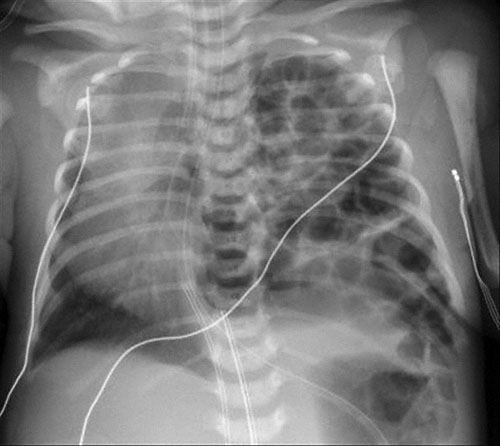
A 3200-g (7-lb 1-oz) male newborn is delivered at 38 weeks’ gestation to a 21-year-old primigravid woman. The newborn develops respiratory distress and cyanosis within 5 minutes of delivery. Physical examination shows a barrel-shaped chest and scaphoid abdomen. Cardiopulmonary examination shows absent air entry on the left side, with a shift of heart sounds to the right side of the chest. Arterial blood gas analysis on room air shows hypoxia and acidosis. A chest x-ray is shown. Which of the following is the most likely diagnosis?
CorrectIncorrect -
Question 20 of 20
20. Question
A 12-year-old boy with osteosarcoma of the right lower extremity is scheduled to receive high-dose methotrexate chemotherapy. He is given a drug after receiving the course of methotrexate therapy to decrease toxicity. This drug is most likely to have which of the following actions?
CorrectIncorrect