
CK- NBME 10 – Block 1
Time limit: 0
Quiz Summary
0 of 20 Questions completed
Questions:
Information
You have already completed the quiz before. Hence you can not start it again.
Quiz is loading…
You must sign in or sign up to start the quiz.
You must first complete the following:
Results
Quiz complete. Results are being recorded.
Results
0 of 20 Questions answered correctly
Your time:
Time has elapsed
You have reached 0 of 0 point(s), (0)
Earned Point(s): 0 of 0, (0)
0 Essay(s) Pending (Possible Point(s): 0)
| Average score |
|
| Your score |
|
Categories
- Not categorized 0%
Would you like to submit your quiz result to the leaderboard?
![captcha]()
Loading
- 1
- 2
- 3
- 4
- 5
- 6
- 7
- 8
- 9
- 10
- 11
- 12
- 13
- 14
- 15
- 16
- 17
- 18
- 19
- 20
- Current
- Review
- Answered
- Correct
- Incorrect
-
Question 1 of 20
1. Question
An otherwise healthy 11 -year-old girl is brought to the physician by her mother because of a 3-month history of right breast tenderness. She is at the 50th percentile for height and weight. Breast development is Tanner stage 1 on the left and Tanner stage 2 on the right. The left breast is flat and nontender, and the right breast is slightly raised, enlarged, and tender; there is no nipple discharge. There is no axillary or pubic hair. Pelvic examination shows normal-appearing external genitalia. Which of the following is the most appropriate next step in management?
CorrectIncorrect -
Question 2 of 20
2. Question
A 13-year-old girl is brought to the physician by her mother because of a 10-day history of vaginal spotting. This is her first episode of vaginal bleeding. She has never been sexually active. She has mild asthma treated with an inhaled β-adrenergic agonist as needed. She is at the 75th percentile for height and 80th percentile for weight and BMI. Breast and pubic hair development are Tanner stage 4. The external genitalia are normal. The remainder of the examination shows no abnormalities. Which of the following is the most appropriate next step in management?
CorrectIncorrect -
Question 3 of 20
3. Question
A 7-month-old boy is brought to the physician because of a 4-day history of persistent fever. He was born at term following an uncomplicated pregnancy and delivery; there was prolonged bleeding following circumcision. At the age of 3 months, he developed eczema over the face and elbows that now involves the entire body. He has also had frequent episodes of thrush and otitis media and was recently discharged following treatment of pneumococcal bacteremia. His current temperature is 38.5°C (101.3°F), pulse is 120/min, and respirations are 32/min. Examination shows a diffuse eczematoid rash with areas of purulent drainage. Cervical lymph nodes are movable and range in size from 1.5 to 2 cm. There are white plaques over the oral cavity. The liver edge and spleen tip are palpated 2 cm below the costal margin. Laboratory studies show:
Hemoglobin: 10 g/dL
Leukocyte count: 5000/mm³
Segmented neutrophils: 60%
Lymphocytes: 30%
Monocytes: 10%
Platelet count: 35,000/mm³
Serum:
IgA: 100 mg/dL
IgG: 400 mg/dL
IgM: 15 mg/dL
IgE: 60 IU/mL
Which of the following is the most likely diagnosis?
CorrectIncorrect -
Question 4 of 20
4. Question
A 59-year-old woman with a 5-year history of ulcerative colitis comes to the office to discuss pharmacotherapy options. Her condition has been progressively less responsive to oral prednisone therapy. She also has Ehlers-Danlos syndrome and asthma. Other medications are mesalamine, albuterol, and tiotropium. The patient is allergic to sulfonamide drugs. She appears pale and has cushingoid facies; she is not in acute distress. Temperature is 36.9°C (98.4°F), pulse is 90/min, respirations are 16/min, and blood pressure is 110/60 mm Hg. Lungs are clear to auscultation. Cardiac examination discloses a grade 2/6 systolic ejection murmur heard best at the upper left sternal border; the murmur does not radiate. Abdomen is mildly distended and tender to palpation. There is 1+ edema of the lower extremities. Results of laboratory studies are shown:
Blood:
Hematocrit: 36%
Hemoglobin: 11.0 g/dL
WBC: 13,000/mm³
Neutrophils (segmented): 60%
Eosinophils: 1%
Lymphocytes: 36%
Monocytes: 2%
Basophils: 1%
Platelet count: 197,000/mm³
The most appropriate pharmacotherapy for the patient is being considered. Which of the following is most appropriate for this patient to undergo before beginning this medication?
CorrectIncorrect -
Question 5 of 20
5. Question
A 27-year-old man with sickle cell disease is admitted to the hospital because of a 2-day history of increasingly severe pain in his shoulders, back, and shins. During the past 6 months, he has been hospitalized three times for treatment of painful crises unresponsive to outpatient therapy with hydrocodone. His temperature is 37.2°C (99°F), pulse is 90/min, respirations are 18/min, and blood pressure is 108/52 mm Hg. The lungs are clear to auscultation. Examination shows tenderness over the shoulders, back, and shins. His hematocrit is 30%, and reticulocyte count is 11%. In addition to pain control, which of the following is the most appropriate next step in management?
CorrectIncorrect -
Question 6 of 20
6. Question
A 72-year-old man comes to the emergency department because he has vomited blood three times during the past 12 hours. He has had dizziness during this period. He has a 5-year history of arthritis treated with daily ibuprofen. Over the past 4 weeks, he has increased his daily dose of ibuprofen because of worsening joint pain but is not sure how many pills he has been taking. He has been unable to take his daily walks because of the joint pain. He has not had chest pain. He had an uncomplicated myocardial infarction 10 years ago. He appears pale. His temperature is 37.5°C (99.5°F), pulse is 110/min, respirations are 24/min, and blood pressure is 90/60 mm Hg. Examination shows dried blood near the mouth. The lungs are clear to auscultation. Heart sounds are normal. The stool is black, and test for occult blood is positive. His hematocrit is 22%, and platelet count is 215,000/mm3. Upper endoscopy shows hemorrhagic gastritis with no active site of bleeding. Thirty minutes after fluid resuscitation with crystalloid solution and transfusion of 4 units of crossmatched packed red blood cells, the patient has shortness of breath. Diffuse rhonchi and crackles are heard bilaterally. Which of the following is the most likely cause of the dyspnea?
CorrectIncorrect -
Question 7 of 20
7. Question
Six hours after admission to the hospital for management of a seizure secondary to hyponatremia, a 53-year-old man with schizophrenia is found to have iron deficiency anemia. He says he has been drinking 1 gallon of water daily during the past 2 months. He is receiving haloperidol in the hospital. Physical examination shows no abnormalities. His fluid balance has normalized. His psychosis has improved, and he consents to colonoscopy, which shows a large tumor in the ascending colon. When the physician mentions cancer, the patient immediately says, “I don’t have cancer; I stopped drinking a lot of water after I was admitted to the hospital.” Which of the following is the most likely explanation for this patient’s response?
CorrectIncorrect -
Question 8 of 20
8. Question
A 25-year-old woman comes to the physician because of a 6-month history of itching over her arms that has become worse during the past 2 months. She attributes the itching to small worms, which she reports having seen appear from under her skin intermittently. On several occasions, she has “dug them out” with a clean needle. She has brought a small box containing samples of her dry skin and debris. She reports no history of depressed mood or auditory hallucinations. There is no personal or family history of serious illness. The patient takes no medications and does not use illicit drugs. Vital signs are within normal limits. Physical examination shows mildly inflamed lesions over the upper extremities with scabbing and excoriations. Examination of the samples she provides shows skin, scabs, and cotton fibers. On mental status examination, she has an anxious mood and constricted affect. Her speech is normal in rate and tone, and her thought processes are organized and coherent. She insists that she has parasites in her skin. Which of the following is the most likely diagnosis?
CorrectIncorrect -
Question 9 of 20
9. Question
A 15-year-old boy is brought to the physician by his parents for an examination prior to participating on the school basketball team. Five weeks ago, he had a 1-week history of fever, sore throat, and diffuse muscle aches. Since then, he has had decreased energy and needs at least 10 hours of sleep every night. While the patient’s parents are out of the room, the patient states that he does not want to play basketball, but his parents are forcing him to join the team. He is an honor student but failed an examination last week. He does not drink alcohol, but he smokes marijuana occasionally; he does not use any other illicit drugs. He has been sad and angry since his girlfriend broke up with him 3 weeks ago after she told him that he was “too moody and not fun to be around anymore.” His pulse is 88/min, and blood pressure is 120/72 mm Hg. Physical examination shows no abnormalities. On mental status examination, he has a sad mood and a full range of affect. Which of the following is the most appropriate next step in management?
CorrectIncorrect -
Question 10 of 20
10. Question
A 16-year-old boy is brought to the emergency department by his mother 30 minutes after a 4-minute episode of generalized shaking of his body. One hour ago, the patient’s friend brought him home after a party, at which time, the patient exhibited unusual behavior and said he was a superhero with the ability to fly. The patient subsequently became unresponsive and the episode began. The friend reports that he saw the patient “smoke weed” at the party 2 hours before the episode. On arrival, the patient is diaphoretic and difficult to arouse. His temperature is 37.0°C (98.6°F), pulse is 120/min, respirations are 24/min, and blood pressure is 135/95 mm Hg. Pulse oximetry on room air shows an oxygen saturation of 99%. The pupils are 6 mm and sluggishly reactive to light. There is horizontal nystagmus. Use of which of the following substances is the most likely cause of this patient’s symptoms?
CorrectIncorrect -
Question 11 of 20
11. Question
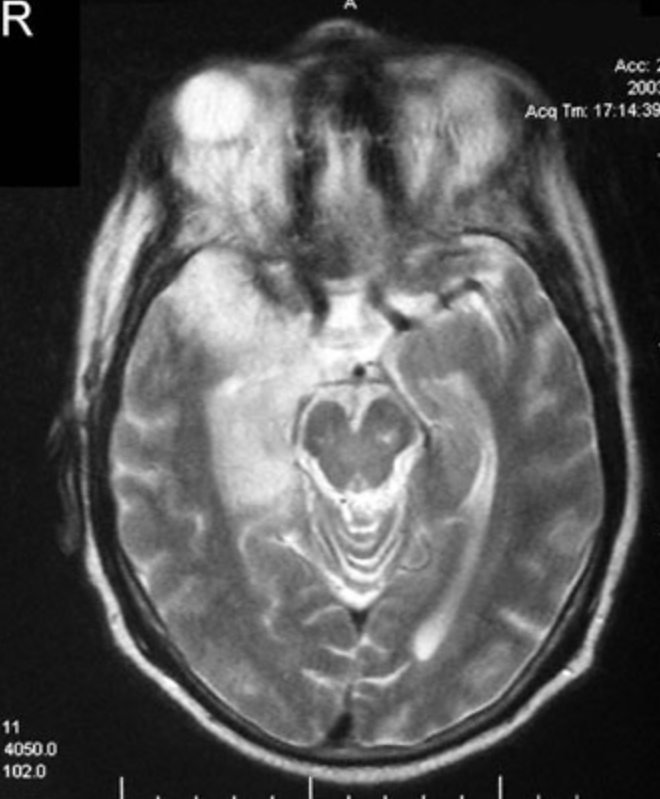
A 38-year-old woman is brought to the emergency department by her husband 30 minutes after she sustained a generalized tonic-clonic seizure. Her husband reports that she has had worsening headache during the past 2 days and had the gradual onset of confusion 1 hour prior to the seizure. The patient has no history of serious illness. Her only medication is an oral contraceptive. She has smoked one pack of cigarettes daily for 20 years. On arrival, she is sleepy but arousable. Her temperature is 37.8°C (100°F). Physical examination shows no abnormalities. On mental status examination, she is oriented to person but not to place or time. She is distractible and recalls zero of three objects after 5 minutes. A T2-weighted MRI of the brain is shown. Which of the following is the most appropriate next step in diagnosis?
 CorrectIncorrect
 -
Question 12 of 20
12. Question
A 54-year-old woman is brought to the emergency department because she was unable to move her right side or speak when she awoke this morning. Her husband reports that he found her in bed with these symptoms 25 minutes ago, when he returned home from working an overnight shift. He says she understood what he was saying to her but was unable to respond. He says she felt well the night before. He adds that she fainted three times during the past 2 years. She has no history of serious illness and takes no medications. She appears to be in distress. She seems to understand what is said to her but is unable to respond. She is 165 cm (5 ft 5 in) tall and weighs 82 kg (180 lb); BMI is 30 kg/m2. Her temperature is 36.4°C (97.5°F), pulse is 80/min and regular, respirations are 12/min, and blood pressure is 142/89 mm Hg. Examination shows weakness of the right lower aspect of the face. Muscle strength is 3/5 in the right extremities. Babinski sign is present on the right. The remainder of the examination shows no abnormalities. MRI of the brain shows an infarct in the anterior branches of the left middle cerebral artery. Which of the following is the most appropriate pharmacotherapy?
CorrectIncorrect -
Question 13 of 20
13. Question
A previously healthy 47-year-old man comes to the emergency department because he has been unable to close his right eye during the past 4 hours. He noticed the problem while shaving this morning. During breakfast, he had difficulty closing his mouth to chew and could not taste his food. His temperature is 37.2°C (99°F), pulse is 84/min, respirations are 16/min, and blood pressure is 132/80 mm Hg. Examination of the face shows a loss of the right labial fold. There is no movement of the right side of the mouth when the patient is asked to smile, and he is unable to wrinkle the forehead on the right. The remainder of the examination shows no abnormalities. Which of the following is the most appropriate next step in diagnosis?
CorrectIncorrect -
Question 14 of 20
14. Question
A 32-year-old woman is brought to the emergency department because of a 1-day history of worsening confusion. Two months ago, she underwent successful gastric bypass for morbid obesity, but she has not adhered to her physician’s instructions for health maintenance since she was discharged from the hospital. She has been taking no regular medications or supplements and has not followed the recommended diet. She has smoked one pack of cigarettes daily for 15 years, and she drinks two glasses of wine daily. On arrival, she is oriented to person but not to place or time. Vital signs are within normal limits. Examination shows disconjugate gaze and marked nystagmus. Muscle strength is normal bilaterally. She cannot stand with her feet together; she stands unsteadily with her feet 12 inches apart. Mental status examination shows moderately impaired attention. She is admitted to the hospital, and medical and physical therapy are begun. Her condition improves, and she is reexamined 1 week later in preparation for discharge home. The patient agrees to take all necessary medications and follow the recommended diet. Which of the following is the most appropriate next step to prevent future similar episodes in this patient?
CorrectIncorrect -
Question 15 of 20
15. Question
An 8-year-old girl is brought to the emergency department by her father because of swelling of the right side of her neck. The father first noticed a small lump on her neck last week and says it seems larger today; it also has become discolored and now resembles a bruise. The patient has not had fever or changes in energy or appetite. She has had no recent infections or contact with anyone known to be ill. The family has not traveled outside of the United States, but they spend weekends on the patient’s grandparents’ ranch. The patient is at the 50th percentile for height, weight, and BMI. Vital signs are within normal limits. She appears well. Physical examination shows a 3 x 5-cm firm, mobile mass in the right anterior cervical chain region; there is no erythema and the mass is minimally tender. A purplish hue is noted over the mass. There is no other lymphadenopathy, and no hepatomegaly or splenomegaly is noted. Excisional biopsy specimen of the mass shows the presence of multiple granulomas. Which of the following infectious agents is the most likely cause of this patient’s condition?
CorrectIncorrect -
Question 16 of 20
16. Question
A 55-year-old woman with a 10-year history of type 2 diabetes mellitus returns to the clinic for a follow-up examination of a right foot ulcer diagnosed 8 weeks ago. At that time, she was treated with hydrocolloid dressings. Today, the patient reports a 1-week history of chills and moderate mid back pain. She has not had cough, pain with urination, or diarrhea. She also has hypertension. Medications are metformin and lisinopril. The patient is 160 cm (5 ft 2 in) tall and weighs 88 kg (195 lb); BMI is 35 kg/m2. Her temperature is 38.2°C (100.8°F), pulse is 90/min, respirations are 18/min, and blood pressure is 132/80 mm Hg. Examination shows a stage 2 foot ulcer that measures 2 cm in diameter and point tenderness over the T12 spinous process. The remainder of the examination shows no abnormalities. Which of the following studies is most likely to confirm the cause of this patient’s fever and back pain?
CorrectIncorrect -
Question 17 of 20
17. Question
A 67-year-old woman comes to the physician because of a 1-week history of moderate pain and swelling, redness, and warmth of her right knee. She has a 10-year history of moderate pain and progressive stiffness of her hands and a 1-year history of swelling and warmth of her digits and wrists. She says she has generalized stiffness for 1 hour after awakening in the morning. She has no history of trauma to the hands or knees. She has no history of serious illness and takes ibuprofen for the pain as needed. Vital signs are within normal limits. On examination, the metacarpophalangeal joints are boggy bilaterally and tender on squeezing. There is erythema and swelling of the right knee; the patella is ballotable. Which of the following is the most appropriate next step in management?
CorrectIncorrect -
Question 18 of 20
18. Question
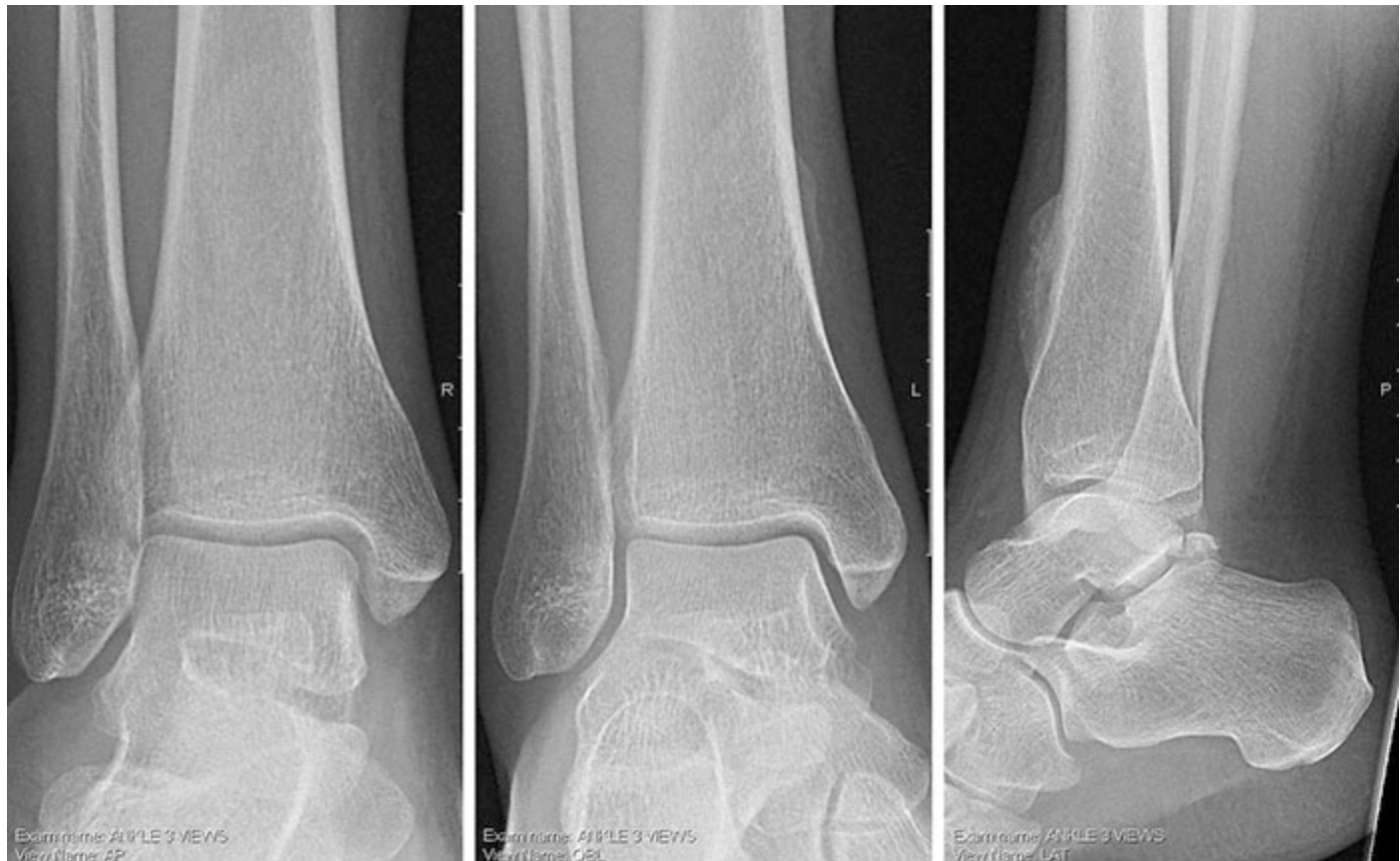
A 22-year-old woman comes to the office because of a 6-week history of mild pain and swelling in the front of her right ankle. She says her symptoms began after she awkwardly stepped off a curb. There is no personal or family history of serious illness. Her only medication is ibuprofen as needed for pain. She does not smoke cigarettes or drink alcohol. Vital signs are within normal limits. Examination shows a 1 -cm abrasion and mild ecchymosis over the anterolateral aspect of the right ankle. There is warmth and swelling at the right anterior ankle joint; passive dorsiflexion produces pain. Anterior drawer test is negative bilaterally. Muscle strength is 5/5 on inversion, eversion, dorsiflexion, and plantar flexion of the right ankle. Dorsalis pedis pulses are 2+ bilaterally. Sensation to light touch is intact over the lower extremities. X-rays of the right ankle are shown. Which of the following is the most appropriate next step in diagnosis?
CorrectIncorrect -
Question 19 of 20
19. Question
A 16-year-old girl is brought to the physician because of generalized weakness for the past 3 days. She states that during the past month, she has been following a strict diet and taking laxatives and diuretics to lose weight. She has no history of serious illness. Vital signs are within normal limits. Examination shows diffuse, generalized weakness; there is no pain on muscle palpation. Deep tendon reflexes are 1+ in the upper and lower extremities. A decreased concentration of which of the following serum electrolytes is the most likely cause of this patient’s muscle weakness?
CorrectIncorrect -
Question 20 of 20
20. Question
A 61 -year-old man with ischemic cardiomyopathy is admitted to the hospital for management of community-acquired pneumonia. His medications are furosemide, spironolactone, and lisinopril. He has a dietary sodium restriction of less than 1500 mg daily. His temperature is 38.8°C (101.8°F), pulse is 100/min, respirations are 22/min, and blood pressure is 128/74 mm Hg. Pulse oximetry on room air shows an oxygen saturation of 88%. Crackles are heard in the middle lobe of the right lung. There is no edema of the lower extremities. A chest x-ray shows a right middle lobe infiltrate. His ejection fraction is 30%. Which of the following is the most appropriate intravenous fluid maintenance therapy?
CorrectIncorrect