
CK- NBME 10 – Block 3 (Duplicate 1)
Time limit: 0
Quiz Summary
0 of 20 Questions completed
Questions:
Information
You have already completed the quiz before. Hence you can not start it again.
Quiz is loading…
You must sign in or sign up to start the quiz.
You must first complete the following:
Results
Quiz complete. Results are being recorded.
Results
0 of 20 Questions answered correctly
Your time:
Time has elapsed
You have reached 0 of 0 point(s), (0)
Earned Point(s): 0 of 0, (0)
0 Essay(s) Pending (Possible Point(s): 0)
| Average score |
|
| Your score |
|
Categories
- Not categorized 0%
Would you like to submit your quiz result to the leaderboard?
![captcha]()
Loading
- 1
- 2
- 3
- 4
- 5
- 6
- 7
- 8
- 9
- 10
- 11
- 12
- 13
- 14
- 15
- 16
- 17
- 18
- 19
- 20
- Current
- Review
- Answered
- Correct
- Incorrect
-
Question 1 of 20
1. Question
A 54-year-old woman comes to the office because of a 1 -day history of intermittent episodes of severe, sharp pain in the right side of her back that occur every 30 minutes. The episodes are associated with nausea; the patient has had two episodes of nonbloody vomiting since her symptoms began. During the past month she has had fatigue, generalized aches, and difficulty concentrating on simple tasks. She has had painful urination during the past 2 days. She has osteoarthritis treated with ibuprofen as needed. Her temperature is 37°C (98.6°F), pulse is 100/min, respirations are 20/min, and blood pressure is 146/90 mm Hg. The patient is in moderate distress and shifts around on the examination table. No murmurs are heard. Bowel sounds are normal. Abdominal examination shows tenderness to percussion at the right flank. There is no X-ray of the abdomen shows a 4-mm calcified calculus in the right ureteropelvic junction. There is no hydronephrosis. Which of the following is the most appropriate additional study at this time?
Blood / CBC:
Hemoglobin: 12 g/dL
Hematocrit: 38%
Leukocyte count: 5100/mm³
Platelet count: 204,000/mm³
Serum:
Na⁺: 142 mEq/L
K⁺: 5 mEq/L
Cl⁻: 100 mEq/L
HCO₃⁻: 25 mEq/L
Ca²⁺: 12 mg/dL
Urea nitrogen: 14 mg/dL
Glucose: 92 mg/dL
Creatinine: 0.9 mg/dL
Urine analysis:
Color: clear yellow
pH: 7.0 (N = 4.5–7.8)
Specific gravity: 1.018 (N = 1.003–1.029)
Blood: grossly positive
Glucose: negative
Bilirubin: negative
Protein: trace
Ketones: negative
Nitrites: negative
Leukocyte esterase: negative
Urobilinogen: 0.2 mg/2 hr (N = 0.1–1.1)
CorrectIncorrect -
Question 2 of 20
2. Question
A 47-year-old woman comes to the physician for a routine examination. Two years ago, she underwent total thyroidectomy for medullary cancer; her postoperative course was uncomplicated, but she did not keep her appointments for follow-up examinations. She says she feels well. She has never had radiation therapy. There is no family history of thyroid disease. Her only current medication is levothyroxine. Vital signs are within normal limits. Examination of the neck shows a well-healed surgical scar; there are no masses or cervical lymphadenopathy. The remainder of the examination shows no abnormalities. Which of the following serum measurements is most appropriate to order to determine if this patient’s cancer is in remission?
CorrectIncorrect -
Question 3 of 20
3. Question
A 32-year-old woman, gravida 2, para 2, comes to the physician for a routine health maintenance examination. At her last examination 1 year ago, a Pap smear and screening test results for sexually transmitted diseases were negative. Her two children, ages 6 and 4 years, were delivered by cesarean section. Her first child weighed 4394 g (9 lb 11 oz) at birth, and her second child weighed 4593 g (10 lb 2 oz) at birth. The patient is sexually active with her husband and uses an oral contraceptive. She is 157 cm (5 ft 2 in) tall and weighs 72 kg (158 lb); BMI is 29 kg/m2. Her temperature is 37°C (98.6°F), pulse is 84/min, respirations are 18/min, and blood pressure is 130/75 mm Hg. Physical examination shows no other abnormalities. Which of the following is the most appropriate screening test at this visit?
CorrectIncorrect -
Question 4 of 20
4. Question
A 37-year-old nulligravid woman comes to the physician because she has been unable to conceive for 6 months. She has been married for 18 years and discontinued her oral contraceptive 6 months ago. She is an attorney, and she and her husband have sexual intercourse twice monthly. Menses occur at regular 28-day intervals. She feels well and has no history of serious illness. Physical examination shows no abnormalities. Which of the following is the most appropriate next step in management?
CorrectIncorrect -
Question 5 of 20
5. Question
A 47-year-old woman comes to the physician because of heavy menstrual flow for 7 days. Menses usually occur at regular 28-day intervals and last 4 to 5 days. She has not had intermenstrual or postcoital bleeding. She has no history of serious illness and takes no medications. Bimanual examination shows a uterus consistent in size with a 20-week gestation. A Pap smear shows no abnormalities. Ultrasonography of the pelvis shows an enlarged uterus with three solid, well-circumscribed masses within the myometrium that are homogeneous in appearance. The largest mass is 7 cm in diameter. Results of an endometrial biopsy specimen show proliferative endometrium. Which of the following is the most likely diagnosis?
CorrectIncorrect -
Question 6 of 20
6. Question
A 42-year-old woman comes to the office 2 months after noticing a mass in her left breast. There is no personal or family history of serious illness. Her last Pap smear 2 years ago and mammography 1 year ago showed no abnormalities. Menses occur at regular 28-day intervals and last 3 days. Her last menstrual period was 2 weeks ago. She is sexually active with one male partner and uses an oral contraceptive. She drinks four cups of coffee daily. Examination shows a 3-cm, firm, irregular mass in the upper outer quadrant of the left breast. Examination of the right breast shows no abnormalities. In addition to mammography, which of the following is the most appropriate next step in management?
CorrectIncorrect -
Question 7 of 20
7. Question
A previously healthy 27-year-old woman, gravida 1, para 1, comes to the physician because of a 2-week history of anxiety, irritability, and difficulty sleeping. During this time, she has noticed a mild tremor of her hands. Two months ago, she gave birth to a healthy male newborn at term. Delivery was uncomplicated. She is not breast-feeding. She initially attributed her symptoms to giving birth. Her only medication is a prenatal vitamin. She appears slightly anxious. Her temperature is 37.1°C (98.8°F), pulse is 108/min, respirations are 16/min, and blood pressure is 122/74 mm Hg. Examination shows a normal-sized thyroid that is slightly tender to palpation. There is a fine tremor of the outstretched hands. Laboratory studies show:
Hemoglobin: 11.5 g/dL
Hematocrit: 35%
Mean corpuscular volume (MCV): 82 µm³
Leukocyte count: 9800/mm³
Platelet count: 410,000/mm³
Serum:
Thyroid-stimulating hormone (TSH): 0.3 µU/mL
Thyroxine (T₄): 12 µg/dL
Antithyroid peroxidase antibody: negative
Thyroid 123l scintigraphy shows decreased uptake of radioactive iodine. Which of the following is the most appropriate next step in management?
CorrectIncorrect -
Question 8 of 20
8. Question
A 37-year-old woman, gravida 4, para 4, has continued to have vaginal bleeding 2 hours after forceps delivery of a 4300-g (9-lb 8-oz) newborn at term. Pregnancy was complicated by gestational diabetes. During delivery, shoulder dystocia required hyperflexion of the maternal hips, suprapubic pressure, and manual rotation of the fetal shoulders. The patient’s pulse is 115/min, and blood pressure is 90/55 mm Hg. The uterine fundus is firm and palpable at the umbilicus, and the placenta appears to have been delivered intact. Which of the following is the most likely cause of the vaginal bleeding?
CorrectIncorrect -
Question 9 of 20
9. Question
An 18-year-old man who is a college student comes to the office for a follow-up examination 3 days after routine dipstick urinalysis during a sports physical examination showed proteinuria. Repeat dipstick urinalysis 2 days later was negative for protein. He has no history of serious illness and takes no medications. Today, vital signs are within normal limits. Examination shows no abnormalities. Microscopic examination of urine sediment shows no abnormalities. Which of the following is the most appropriate next step in management regarding the change in urine findings?
CorrectIncorrect -
Question 10 of 20
10. Question
A previously healthy 27-year-old woman comes to the physician because of frequent urination and dysuria for 2 days. She has had no fever, chills, or back pain. She has had two similar episodes over the past 12 months treated with trimethoprim-sulfamethoxazole. Examination shows suprapubic tenderness to palpation. There is no costovertebral angle tenderness. Urinalysis shows 20-30 WBC/hpf and is positive for nitrites. Which of the following is the most appropriate measure to prevent recurrent symptoms?
CorrectIncorrect -
Question 11 of 20
11. Question
A 16-day-old girl is brought to the physician for a well-child examination. She has a 1-week history of increasingly yellow skin. She was born at term following an uncomplicated pregnancy and delivery. Her birth weight was 3005 g (6 lb 10 oz). Newborn screening showed no abnormalities. She receives no medications. She is breast-feeding well. Today, she weighs 3062 g (6 lb 12 oz). Vital signs are within normal limits. Examination shows generalized jaundice and scleral icterus. Laboratory studies show a serum bilirubin concentration of 15 mg/dL, with a direct component of 10 mg/dL and an indirect component of 5 mg/dL. Urinalysis shows no reducing substances or pus. Which of the following is the most appropriate next step in management?
CorrectIncorrect -
Question 12 of 20
12. Question
A 72-year-old woman is hospitalized because of a 3-day history of increasingly severe central abdominal pain and bilious vomiting. Her only medications are
hydrochlorothiazide and atorvastatin for hypertension and hyperlipidemia, respectively. She does not smoke cigarettes and drinks one glass of wine daily. Temperature is 38.2°C (100.8°F), pulse is 95/min, respirations are 18/min, and blood pressure is 120/75 mm Hg. Abdominal examination shows moderate epigastric and periumbilical tenderness without rebound. Results of laboratory studies are shown:Total bilirubin: 1.1 mg/dL
Alkaline phosphatase: 180 U/L
AST: 40 U/L
ALT: 30 U/L
Amylase: 350 U/L
Lipase: 500 U/L (N = 14–280)
Which of the following is the most likely cause of these findings?
CorrectIncorrect -
Question 13 of 20
13. Question
A 35-year-old woman comes to the office because of a 4-month history of progressive fatigue, generalized itching, and dry eyes and mouth. She has no history of serious illness and takes no medications. Her pulse is 80/min, and blood pressure is 123/77 mm Hg. Examination shows excoriations over the extremities. The liver span is 20 cm. The remainder of the examination shows no abnormalities. Laboratory studies show:
Serum
Glucose: 88 mg/dL
Creatinine: 0.8 mg/dL
Total bilirubin: 1.5 mg/dL
Alkaline phosphatase: 300 U/L
AST: 30 U/L
ALT: 35 U/L
Antimitochondrial antibodies: positive
Liver biopsy shows lymphocytic infiltrates in portal tracts with loss of medium-sized interlobar bile ducts. Which of the following is the most appropriate pharmacotherapy?
CorrectIncorrect -
Question 14 of 20
14. Question
A 47-year-old woman comes to the physician because of a 1-year history of difficulty swallowing liquids and solids. She says she often feels food and drink stick in the middle of her chest. For 8 weeks, she has been awakening at night after regurgitating partially digested food. After meals, she has mild heartburn that is occasionally associated with a mild sensation of fullness and discomfort in her chest. The heartburn is not relieved by over-the-counter antacids. She has had a 3.2-kg (7-lb) weight loss during the past 6 months. She has no history of serious illness. She does not smoke cigarettes or drink alcohol. She takes a daily multivitamin. Examination shows no abnormalities. Which of the following is the most likely diagnosis?
CorrectIncorrect -
Question 15 of 20
15. Question
A 49-year-old man is admitted to the hospital because of a 2-year history of progressive, oily, foul-smelling diarrhea and an unintentional 18-kg (40-lb) weight loss. He has not had nausea, vomiting, melena, or rectal bleeding. He also has a 5-year history of intermittent joint pain and swelling of the wrists, hips, and knees. His wife reports that his memory has declined during the past month. He has no other history of serious illness and takes no medications. He is a farmer. He is 178 cm (5 ft 10 in) tall and weighs 57 kg (125 lb); BMI is 18 kg/m2. His temperature is 36.3°C (97.3°F), pulse is 88/min, respirations are 16/min, and blood pressure is 124/82 mm Hg. Examination shows cervical, axillary, and inguinal lymphadenopathy. The abdomen is nontender to palpation; no masses are palpated. There is no hepatosplenomegaly. Bowel sounds are normal. Test of the stool for occult blood is positive. Endoscopic biopsy specimen of the small intestine shows numerous periodic acid-Schiff-positive macrophages in the lamina propria. Which of the following is the most appropriate next step in management?
CorrectIncorrect -
Question 16 of 20
16. Question
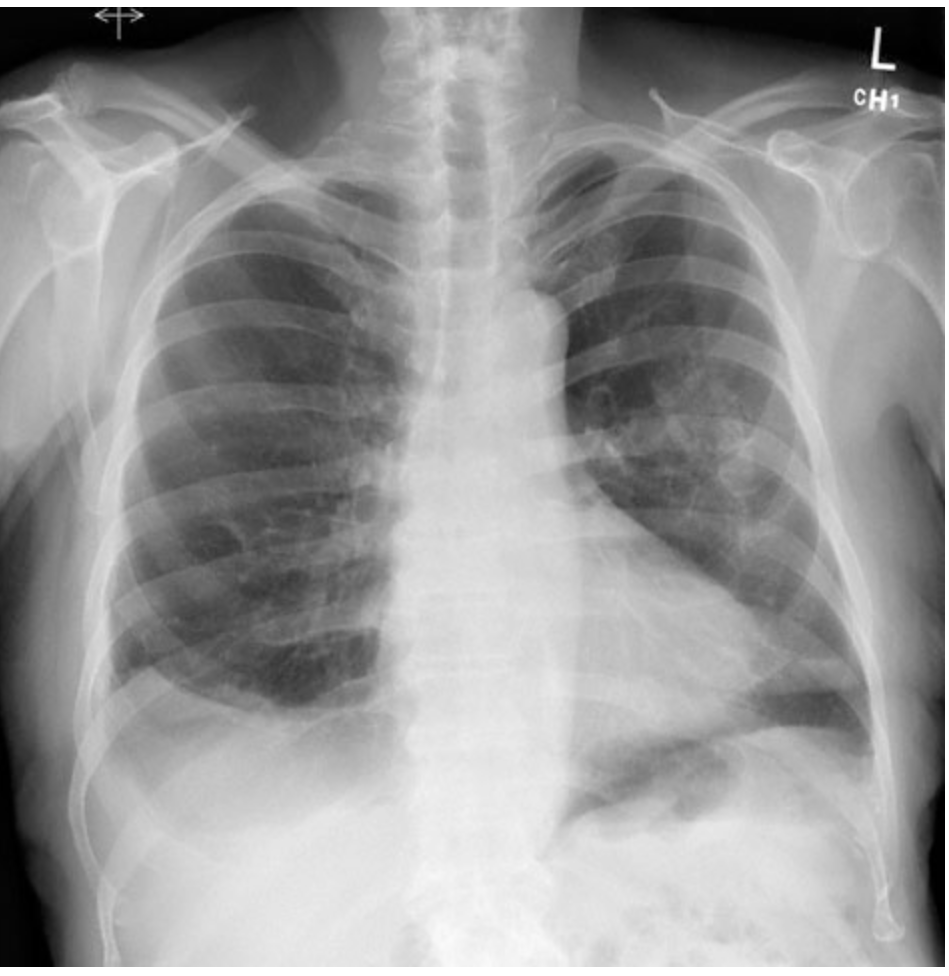
An 82-year-old man comes to the physician for a follow-up examination 1 week after discharge from the hospital, where he received treatment for streptococcal pneumonia. He received a 7-day course of intravenous ceftriaxone in the hospital, then completed a 4-day course of oral doxycycline at home. His fever, shortness of breath, cough, and chills resolved by the time of hospital discharge. He has hypertension and hyperlipidemia. His current medications are metoprolol, lisinopril, and atorvastatin. He smoked one pack of cigarettes daily for 50 years but quit 10 years ago. His blood pressure is 128/84 mm Hg. Breath sounds are decreased at the right lung base; no crackles, rhonchi, or rubs are heard. The remainder of the examination shows no abnormalities. Laboratory studies show:
Hemoglobin: 13.8 g/dL
Hematocrit: 41%
Leukocyte count: 5,200/mm³
A sputum culture shows no leukocytes or organisms. A chest x-ray is shown. Which of the following is the most appropriate next step in diagnosis?
CorrectIncorrect -
Question 17 of 20
17. Question
A 32-year-old woman with Crohn disease is being placed on total parenteral nutritional support. During insertion of a central venous catheter into the left subclavian vein, she has the sudden onset of severe chest pain, dyspnea, and agitation. She is supine, and a sterile drape is placed over her. Her medications are infliximab and prednisone. She appears malnourished and anxious. She is 157 cm (5 ft 2 in) tall and weighs 45 kg (100 lb); BMI is 18 kg/m2. Examination shows diaphoresis. Which of the following is the most appropriate next step in management?
CorrectIncorrect -
Question 18 of 20
18. Question
Five days after discharge from the hospital following treatment of ischemic left hemispheric cerebral infarction, an 82-year-old man is brought to the physician because of repeated coughing after drinking liquids. Recovery in the hospital was complicated by right lower lobe pneumonia that resolved after treatment with antibiotics. The patient has lived in a skilled nursing care facility since discharge. He has no known allergies. His medications are lisinopril and aspirin. He is currently not in respiratory distress. Vital signs are within normal limits. Muscle strength is 3/5 in the right extremities and 5/5 in the left extremities. On mental status examination, he is alert and fully oriented. His speech is dysarthric, and he has occasional difficulty finding words. Which of the following is most likely to decrease this patient’s risk for pulmonary complications?
CorrectIncorrect -
Question 19 of 20
19. Question
A 25-year-old man comes to the physician because of a 2-day history of right calf pain that began after he played in a soccer match. The pain is worse with walking and resolves with rest or acetaminophen therapy. He is otherwise healthy and takes no other medications. There is no family history of serious illness. The patient traveled outside the USA by plane 4 months ago. He drinks 48 oz of beer weekly. He does not smoke cigarettes or use illicit drugs. His pulse is 85/min, respirations are 14/min, and blood pressure is 120/80 mm Hg. Pulse oximetry on room air shows an oxygen saturation of 98%. Skin examination shows ecchymoses over the anterior and lateral aspects of the right calf. There are no cords. The calves are symmetric in size, and there is no warmth. The right lower extremity is diffusely tender to deep palpation below the knee. Cardiopulmonary and neurologic examinations show no abnormalities. Gait is normal. Serum D-dimer concentration is less than 0.2 pg/mL (N<0.5) by ELISA. Which of the following is the most appropriate next step in diagnosis?
CorrectIncorrect -
Question 20 of 20
20. Question
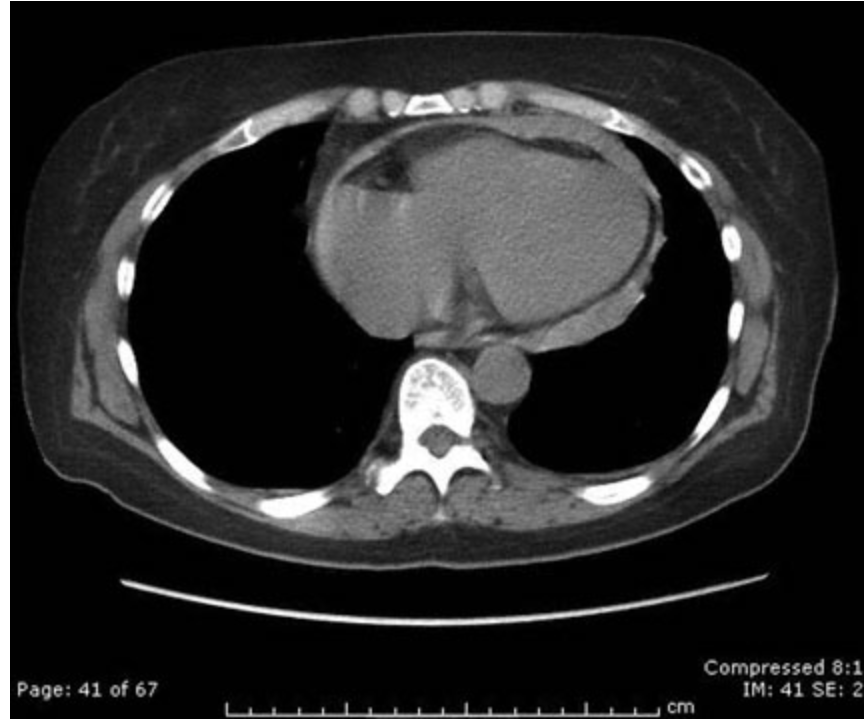
A 57-year-old woman comes to the emergency department because of a 1 -day history of constant sharp chest pain and shortness of breath. The pain is located to the left of her sternum, increases when she lies on her back, and decreases when she sits and leans forward. She has had no cough, sputum production, recent trauma, or recent respiratory tract infection. She has hypertension and reactive airway disease. Medications are inhaled tiotropium, inhaled salmeterol-fluticasone, montelukast, amlodipine, and 81-mg aspirin. Her temperature is 37.6°C (99.6°F), pulse is 62/min, respirations are 24/min, and blood pressure is 87/55 mm Hg. Pulse oximetry on room air shows an oxygen saturation of 88%. Jugular venous pressure is 9 cm H20. The remainder of the examination shows no abnormalities. Her hematocrit is 39%, leukocyte count is 15,800/mm3, and platelet count is 252,000/mm3. Serum electrolyte concentrations are within the reference ranges. An ECG shows diffuse ST- segment elevation. ACT scan of the chest with contrast is shown. Which of the following is the most appropriate next step in diagnosis?
 CorrectIncorrect