
CK- NBME 10 – Block 2 (Duplicate 1)
Time limit: 0
Quiz Summary
0 of 20 Questions completed
Questions:
Information
You have already completed the quiz before. Hence you can not start it again.
Quiz is loading…
You must sign in or sign up to start the quiz.
You must first complete the following:
Results
Quiz complete. Results are being recorded.
Results
0 of 20 Questions answered correctly
Your time:
Time has elapsed
You have reached 0 of 0 point(s), (0)
Earned Point(s): 0 of 0, (0)
0 Essay(s) Pending (Possible Point(s): 0)
| Average score |
|
| Your score |
|
Categories
- Not categorized 0%
Would you like to submit your quiz result to the leaderboard?
![captcha]()
Loading
- 1
- 2
- 3
- 4
- 5
- 6
- 7
- 8
- 9
- 10
- 11
- 12
- 13
- 14
- 15
- 16
- 17
- 18
- 19
- 20
- Current
- Review
- Answered
- Correct
- Incorrect
-
Question 1 of 20
1. Question
A 51 -year-old woman, gravida 1, para 1, comes to the office for an annual health maintenance examination. She says she has been generally healthy and feels well but is concerned about her risk for ovarian cancer because her friend of the same age recently was diagnosed with such cancer. Medical history is significant for an uncomplicated pregnancy and vaginal delivery. She breast-fed her child until he was age 6 months. Her only medications are a calcium supplement and daily multivitamin. She took an oral contraceptive for 15 years and discontinued the therapy 1 year ago; her menses did not resume after discontinuing the therapy. She has not taken hormone replacement therapy. She exercises regularly and does not smoke cigarettes. She has no known family history of cancer. All Pap smears in the past have shown no abnormalities. She is 173 cm (5 ft 8 in) tall and weighs 63 kg (139 lb); BMI is 21 kg/m2. Vital signs are normal. Physical examination, including pelvic examination, discloses no abnormalities. Which of the following factors in the patient’s history is most strongly associated with a decreased risk for ovarian cancer?
CorrectIncorrect -
Question 2 of 20
2. Question
A 27-year-old woman is evaluated in the hospital 36 hours after undergoing cesarean delivery at term because of a prolonged first stage of labor and rupture of membranes. She currently reports abdominal pain and breast tenderness. Current medications are oxycodone and acetaminophen. Her temperature is 38.9°C (102°F), pulse is 100/min, respirations are 18/min, and blood pressure is 110/60 mm Hg. Examination shows mild breast tenderness and induration. The incision site is clean and not erythematous. The uterus is diffusely tender to mild palpation. A urine sample shows multiple RBCs. Which of the following is the most appropriate next step in management?
CorrectIncorrect -
Question 3 of 20
3. Question
A 36-year-old woman comes to the clinic for a routine examination. She has hypertension treated with lisinopril. She has no other history of serious illness or operative procedures. She uses a copper IUD for contraception. She does not smoke cigarettes, drink alcohol, or use illicit drugs. Her maternal aunt was diagnosed with ovarian cancer at age 42 years. Her mother died in a motor vehicle collision at age 45 years. The patient’s vital signs are within normal limits. On examination, a 2-cm, fixed nontender mass is palpated in the upper outer quadrant of the right breast. Examination of the left breast shows no abnormalities. Findings on fine-needle biopsy of the mass are consistent with ductal carcinoma. Which of the following is the most appropriate next step in management?
CorrectIncorrect -
Question 4 of 20
4. Question
A 22-year-old primigravid woman at 38 weeks’ gestation comes to the physician as a new patient because she recently moved to this area. Pregnancy has been uncomplicated. Her only medication is a prenatal vitamin. Her father has factor VIII deficiency. The patient is concerned that her child may have hemophilia and bleeding complications at the time of delivery. Which of the following is the most appropriate physician recommendation?
CorrectIncorrect -
Question 5 of 20
5. Question
A 32-year-old woman, gravida 2, para 1, at 38 weeks’ gestation is admitted to the hospital in labor. Her pregnancy has been complicated by the diagnosis of HIV infection. Antiretroviral therapy with zidovudine (AZT), lamivudine (3TC), and nelfinavir was begun at 12 weeks’ gestation. She has tolerated therapy well. Her most recent CD4+ T-lymphocyte count was 600/mm3 (Normal>500), and plasma HIV viral load was 480 copies/mL. She wishes to attempt vaginal delivery. Which of the following is contraindicated with this patient’s pregnancy?
CorrectIncorrect -
Question 6 of 20
6. Question
A 57-year-old woman with diabetic nephropathy comes to the physician for a routine examination. She has chronic kidney disease, type 2 diabetes mellitus, and hypertension. Her medications are glyburide, enalapril, and metoprolol. Her blood pressure is 128/90 mm Hg. Cardiopulmonary examination shows no abnormalities. There is trace pedal edema. A 24-hour urine collection shows a total protein concentration of 5000 mg and creatinine clearance of 40 mL/min. Measurement of which of the following is the most appropriate next step to prevent complications of this patient’s kidney disease?
CorrectIncorrect -
Question 7 of 20
7. Question
An 82-year-old woman, who resides in a skilled nursing care facility, is brought to the emergency department because of a 2-day history of diffuse, severe abdominal pain, which has worsened during the past day. She rates her pain as an 8 on a 10-point scale. Her last bowel movement was 3 days ago. She has severe diffuse arthritis, osteoporosis, hypertension, and scoliosis. Her medications are oxycodone, alendronate, hydrochlorothiazide, and calcium and vitamin D supplementation. Her blood pressure is 148/62 mm Hg. The abdomen is tympanitic to percussion with marked distention and diffuse tenderness; there is no guarding or rigidity. High-pitched bowel sounds are heard. X-rays of the abdomen are most likely to show which of the following findings?
CorrectIncorrect -
Question 8 of 20
8. Question
An 84-year-old woman comes to the office because of a 1-week history of increasingly severe pain and swelling of the left side of her face. The pain worsens with eating. She has mild dementia, Alzheimer type, and hypertension. Her medications are donepezil and hydrochlorothiazide. Her temperature is 38.1°C (100.5°F), pulse is 86/min, and blood pressure is 144/90 mm Hg. Examination of the face shows left-sided edema that is tender to palpation. On palpation of the left parotid gland, purulent discharge is expressed from the orifice of the Stensen duct. Several tender nodes are palpated in the left anterior cervical chain. Cardiopulmonary examination shows no abnormalities. Which of the following is the most likely infectious agent?
CorrectIncorrect -
Question 9 of 20
9. Question
A 57-year-old man comes to the physician 3 days after undergoing colonoscopy screening that showed an ulcerated mass of invasive, poorly differentiated adenocarcinoma in the mid ascending colon. He feels well and has not had abdominal discomfort; black, tarry, or bloody stools; or weight loss. He has sciatica treated with ibuprofen as needed. Vital signs are within normal limits. Examination shows no abnormalities. Results of laboratory studies are within the reference ranges. Which of the following is the most appropriate next step in diagnosis?
CorrectIncorrect -
Question 10 of 20
10. Question
A 12-month-old boy is brought to the physician 24 hours after the sudden onset of diarrhea. His parents report that he has had approximately 10 episodes of watery stools with no blood or mucus. He has vomited once. He has been drinking fluids and eating crackers but has not been as active as usual. He appears alert and is not in distress. His temperature is 38.3°C (101°F), pulse is 120/min, respirations are 26/min, and blood pressure is 90/60 mm Hg. Physical examination shows moist mucous membranes. The oropharynx appears normal. The lungs are clear to auscultation. The abdomen is soft and nontender with no distention. Bowel sounds are normal. All extremities are warm and well perfused. Laboratory studies show:
Serum
Na⁺: 139 mEq/L
K⁺: 4.0 mEq/L
Cl⁻: 110 mEq/L
HCO₃⁻: 15 mEq/L
Urea nitrogen: 10 mg/dL
Creatinine: 0.5 mg/dL
Fecal leukocytes: none
Which of the following is the most appropriate next step in management?
CorrectIncorrect -
Question 11 of 20
11. Question
A 62-year-old man comes to the physician because of a 1-year history of increasing shortness of breath on exertion. He now has difficulty finishing yard work and climbing stairs in his home. He has not had cough, fever, or night sweats. He has hypertension treated with atenolol. He smoked two packs of cigarettes daily for 30 years but quit 12 years ago. He worked in the auto parts department of a local car dealership until he had to retire last month because of his respiratory symptoms. His temperature is 36.2°C (97.2°F), pulse is 88/min, respirations are 20/min, and blood pressure is 140/82 mm Hg. Pulse oximetry on room air shows an oxygen saturation of 90% at rest and 82% after walking 20 feet. Fine inspiratory crackles are heard at both lung bases. The remainder of the examination shows no abnormalities. A high-resolution CT scan of the chest shows a honeycomb appearance of the lungs. Which of the following is the most likely diagnosis?
CorrectIncorrect -
Question 12 of 20
12. Question
A 47-year-old woman comes to the physician because of a 3-month history of a nonproductive cough that is worse on weekdays when she is at work and improves during the weekend. She reports that the cough resolves completely by the end of the weekend. She has not had fever or weight loss. She does not smoke or use illicit drugs. Four months ago, she began working at a dry cleaning business. She is in no distress. Vital signs are within normal limits. An occasional end-expiratory wheeze is heard at both lung bases with mild hyperresonance to percussion. The remainder of the examination shows no abnormalities. Pulmonary function tests are most likely to show which of the following findings?
Option
FEV₁:FVC Ratio
Peak Expiratory Flow Rate
A
Decreased
Decreased
B
Decreased
Increased
C
Decreased
Normal
D
Increased
Decreased
E
Increased
Increased
F
Increased
Normal
G
Normal
Decreased
H
Normal
Increased
I
Normal
Normal
CorrectIncorrect -
Question 13 of 20
13. Question
A 13-year-old boy is brought to the emergency department by his father because of a 1-day history of severe, left-sided throat pain. The pain is constant and increases when he swallows or opens his mouth. He also has had mild shortness of breath during this time. He had an episode of tonsillitis 5 years ago that resolved with amoxicillin therapy. He has no other history of serious illness and takes no medications. His temperature is 38.4°C (101.1 °F), pulse is 100/min, respirations are 18/min, and blood pressure is 110/65 mm Hg. Pulse oximetry on room air shows an oxygen saturation of 96%. Examination shows edema of the left tonsil and deviation of the uvula with almost complete occlusion of the pharyngeal space. The tonsil is erythematous and fluctuant; there is a diffuse yellow exudate. Which of the following is the most appropriate next step in management?
CorrectIncorrect -
Question 14 of 20
14. Question
Five days after admission to the hospital because of inoperable descending thoracic aortic aneurysm with dissection, a 73-year-old man has moderate back pain. He has been treated with acetaminophen-oxycodone and rest. He has hypertension, type 2 diabetes mellitus, and hypercholesterolemia. On admission, his medications were clopidogrel, levalbuterol, pravastatin, glipizide, metoprolol, lisinopril, and aspirin. The clopidogrel and aspirin were discontinued on hospital day 1. Five years ago, drug-eluting stents were placed in the left main coronary artery and circumflex artery for an anterior myocardial infarction. His current medications are nitroprusside, metoprolol, furosemide, acetaminophen-oxycodone, and levalbuterol. He has smoked one pack of cigarettes daily for 50 years. His temperature is 38.3°C (101 °F), pulse is 110/min, and blood pressure is 180/106 mm Hg. Examination shows livedo reticularis over the dorsum of the left lower leg. There are petechiae over the dorsa of the feet and several small, purplish black lesions over the left first, second, and third toes and the right second and third toes. The toes are tender to palpation. There is lower abdominal tenderness; bowel sounds are increased. Laboratory studies show:
Leukocyte count: 14,000/mm³
Segmented neutrophils: 80%
Eosinophils: 13%
Lymphocytes: 5%
Monocytes: 2%
Erythrocyte sedimentation rate (ESR): 130 mm/h
Serum creatinine: 2.4 mg/dL
Urine:
Protein: 2+
RBC: 20–30/hpf
Casts: multiple RBC and granular cast
Maltese crosses are noted. Which of the following is the most likely diagnosis?
CorrectIncorrect -
Question 15 of 20
15. Question
A 23-year-old man comes to the physician for an examination prior to employment. He feels well. He has no history of serious illness and takes no medications. He is in his first year of law school and sleeps 4 to 5 hours nightly; he reports feeling stressed frequently because of the demanding course load. He has smoked one pack of cigarettes daily for 2 years and drinks one beer daily. He exercises by running for 30 minutes three times weekly. He is 178 cm (5 ft 10 in) tall and weighs 91 kg (200 lb); BMI is 29 kg/m2. His pulse is 80/min, and blood pressure is 132/96 mm Hg. Serum electrolyte concentrations are within the reference ranges. Urinalysis shows no abnormalities. In addition to advising smoking cessation, which of the following is the most appropriate recommendation to manage this patient’s increased blood pressure?
CorrectIncorrect -
Question 16 of 20
16. Question
A previously healthy 53-year-old woman is brought to the emergency department 2 hours after the onset of severe pressure and pain in her chest radiating down her left arm. She says she fell off her bicycle last week and bruised the left side of her rib cage. She has been taking naproxen for pain since then. She takes no other medications. On arrival, she is in severe distress. Her pulse is 110/min, respirations are 25/min, and blood pressure is 80/50 mm Hg. Pulse oximetry on 2 L/min of oxygen by nasal cannula shows an oxygen saturation of 85%. Examination shows cool, mottled skin. Jugular venous pulsations are present 8 cm above the sternal angle. Examination of the chest shows healing ecchymoses and mild tenderness over the ribs on the left. Crackles are heard at both lung bases. S1 and S2 are normal; an S3 is heard. An ECG shows ST-segment depression and a left bundle branch block. Which of the following is the most likely diagnosis?
CorrectIncorrect -
Question 17 of 20
17. Question
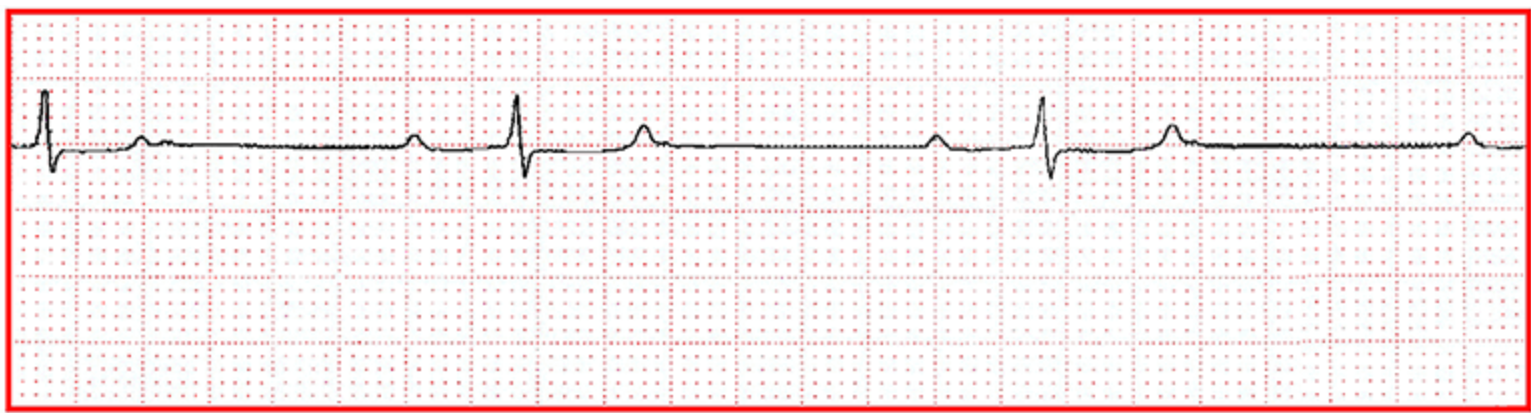
A 28-year-old primigravid woman at 7 weeks’ gestation is admitted to the hospital because of a 2-day history of shortness of breath, palpitations, and light-headedness. Pregnancy had been uncomplicated. She has no history of serious illness, and her only medication is a prenatal vitamin. Two months ago, she visited her parents’ farm in Wisconsin. The patient’s temperature is 37.8°C (100°F), pulse is 38/min, respirations are 20/min, and blood pressure is 110/70 mm Hg. Pulse oximetry on room air shows an oxygen saturation of 96%. Forehead movement is decreased. There is left facial droop, and the patient is unable to close her left eye. An ECG is shown. Which of the following is the most appropriate next step in management?
CorrectIncorrect -
Question 18 of 20
18. Question
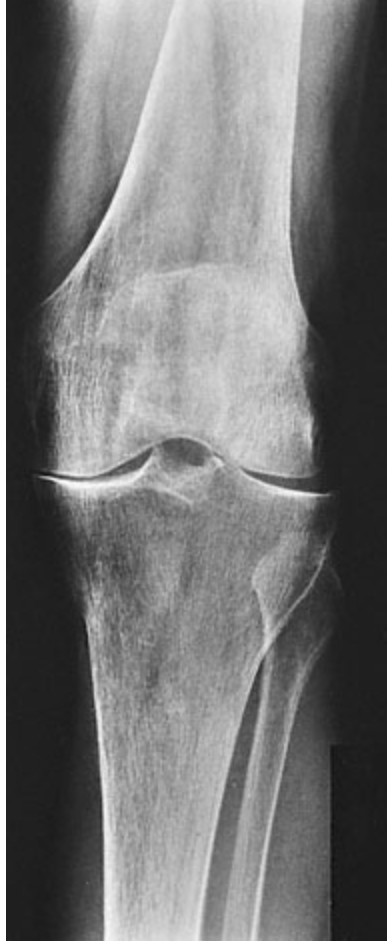
A 72-year-old woman comes to the physician because of a 6-month history of left knee pain. The pain increases when she walks up or down stairs. She rates her pain as a 3 on a 10-point scale. She has not had fever or morning stiffness. She has no history of serious illness and takes no medications. She is 160 cm (5 ft 3 in) tall and weighs 89 kg (196 lb); BMI is 35 kg/m2. Her temperature is 37°C (98.6°F), pulse is 68/min, respirations are 12/min, and blood pressure is 128/70 mm Hg. Examination of the left knee shows crepitus on passive flexion and extension; there is no synovitis. An x-ray of the left knee is shown. Which of the following is the most appropriate initial pharmacotherapy?
 CorrectIncorrect
 -
Question 19 of 20
19. Question
A 62-year-old man comes to the physician because he has noticed bloody urine intermittently during the past 2 months. He occasionally passes large clots through his urethra. During the past 2 weeks, he has had pain and swelling over his distal radial forearm. Examination shows tenderness, erythema, and edema over the radius 10 cm proximal to the wrist joint. An x-ray of the left upper extremity shows a lytic lesion of the radius with a pathologic fracture. Which of the following is the most likely diagnosis?
CorrectIncorrect -
Question 20 of 20
20. Question
A 67-year-old man comes to the emergency department because of a 2-day history of fever and progressive pain in his right knee. He says that he had a cold 5 days ago. He has end-stage renal failure secondary to type 2 diabetes mellitus and has required hemodialysis for the past 2 years. Current medications include insulin, erythropoietin, and a daily multivitamin. His temperature is 37.9°C (100.2°F). The right knee is swollen and warm. Range of motion is severely limited due to pain. The remainder of the examination shows no abnormalities. Which of the following is the most likely cause of this patient’s current symptoms?
CorrectIncorrect