
CK- NBME 9 – Block 2 (Duplicate 1)
Time limit: 0
Quiz Summary
0 of 20 Questions completed
Questions:
Information
You have already completed the quiz before. Hence you can not start it again.
Quiz is loading…
You must sign in or sign up to start the quiz.
You must first complete the following:
Results
Quiz complete. Results are being recorded.
Results
0 of 20 Questions answered correctly
Your time:
Time has elapsed
You have reached 0 of 0 point(s), (0)
Earned Point(s): 0 of 0, (0)
0 Essay(s) Pending (Possible Point(s): 0)
| Average score |
|
| Your score |
|
Categories
- Not categorized 0%
Would you like to submit your quiz result to the leaderboard?
![captcha]()
Loading
- 1
- 2
- 3
- 4
- 5
- 6
- 7
- 8
- 9
- 10
- 11
- 12
- 13
- 14
- 15
- 16
- 17
- 18
- 19
- 20
- Current
- Review
- Answered
- Correct
- Incorrect
-
Question 1 of 20
1. Question
A 32-year-old woman comes to the emergency department 12 hours after the sudden onset of fever, vomiting, diffuse muscle and bone pain, rash, and dizziness. She has no history of serious illness and takes no medications. Temperature is 39.0°C (102.2°F), pulse is 100/min, and blood pressure is 90/50 mm Hg while supine. Palpable systolic blood pressure is 70 mm Hg while sitting. Examination shows a diffuse, erythematous, macular rash over the face, trunk, hands, and feet. The lungs are clear to auscultation. On cardiac examination, no murmurs or gallops are heard. There is 1+ peripheral edema bilaterally. Neurologic examination shows no focal findings. Which of the following is the most likely explanation for these findings?
CorrectIncorrect -
Question 2 of 20
2. Question
A 32-year-old woman is brought to the office by her husband, who reports that she has had increasingly bizarre behavior during the past 2 days. He says she frequently becomes confused during her daily activities at home, and she occasionally refers to objects and people that are not present. She also appears to be depressed. The patient reports severe spasms in her wrists that cause her wrists to remain flexed for several minutes at a time, and muscle cramps in her legs and feet. Three days ago, she underwent a total thyroidectomy for papillary thyroid cancer. She also has asthma. Medications are albuterol as needed and levothyroxine. She is 162 cm(5 ft 4 in) tall and weighs 59 kg(130 lb); BMI is 22 kg/m2. Vital signs are within normal limits. The patient appears well nourished and is not in distress. She is alert and oriented to person, place, and time. Affect is flat. There is a well-healing surgical incision on the anterior lower neck. Tapping the left side of the face, anterior to the left ear, results in twitching of the left side of the mouth. Results of serum laboratory studies are most likely to show which of the following?
Option
Calcium
Phosphate
A
Decreased
Increased
B
Increased
Increased
C
Decreased
Decreased
D
Increased
Decreased
CorrectIncorrect -
Question 3 of 20
3. Question
A 32-year-old woman, gravida 1, para 1, comes to the physician because she has not had a menstrual period for 6 months. During this time, she also has had lethargy, dry skin, and nipple discharge. Menses previously occurred at regular 28-day intervals. She was recently married and would like to have a child with her new husband. She has one child from a previous marriage. A home pregnancy test was negative 1 day ago. On physical examination, clear fluid can be expressed from both nipples. Examination shows no other abnormalities. The most appropriate next step in diagnosis is measurement of which of the following serum concentrations?
CorrectIncorrect -
Question 4 of 20
4. Question
A 55-year-old woman comes to the office because of a 5-year history of decreased interest in sexual activity and difficulty achieving orgasm. During this time, she also has had mild vaginal dryness. She has not had pain with intercourse. She says she has been happily married for 25 years and previously enjoyed sexual activity. Menopause occurred 2 years ago, but she continues to have hot flashes. She has hypertension and major depressive disorder. Her medications are lisinopril and fluoxetine. Vital signs are within normal limits. Pelvic examination shows mild vaginal atrophy. The remainder of the examination shows no abnormalities. Which of the following is the most appropriate next step in management?
CorrectIncorrect -
Question 5 of 20
5. Question
A previously healthy 29-year-old woman comes to the office because of a 6-month history of frequent throbbing right-sided headaches. The headaches are preceded by flashing lights and accompanied by mild nausea. Her symptoms resolve with over-the-counter acetaminophen, aspirin, and caffeine. She has no other history of serious illness and takes no other medications. She is sexually active and has been using a vaginal contraceptive ring (VCR) for the past year. Vital signs are within normal limits. Physical examination, including pelvic examination, shows no abnormalities. The patient is concerned that the VCR is causing her headaches and asks about the use of feverfew herbal supplementation for headache prevention. Which of the following is the most appropriate recommendation for this patient?
CorrectIncorrect -
Question 6 of 20
6. Question
Twenty-eight hours after spontaneous vaginal delivery of a healthy newborn at 39 weeks’ gestation, a 24-year-old woman, gravida 1, para 1, has a temperature of 38.3°C (101 °F). Four hours ago, her temperature was 38.6°C (101.5°F). She has no history of serious illness, and her pregnancy was uncomplicated. Labor lasted 14 hours. During delivery, she sustained a second-degree perineal laceration and had an estimated blood loss of 300 mL. The placenta delivered spontaneously 15 minutes later and appeared intact. Her pulse is 88/min, and blood pressure is 120/60 mm Hg. The uterus is tender to palpation; the uterine fundus is firm and 4 cm below the umbilicus. The perineal repair appears intact. There is moderate lochia. The cervix and vagina appear intact. Bimanual examination shows exquisite diffuse tenderness. Which of the following is the most appropriate next step in management?
CorrectIncorrect -
Question 7 of 20
7. Question
A 29-year-old nulligravid white woman comes to the office for a routine health maintenance examination. She has no history of serious illness or operative procedures. She had chickenpox as a child. Her medications are an oral contraceptive and a daily over-the-counter multivitamin that contains folic acid and vitamin A. Her most recent Pap smear 1 year ago showed no abnormalities. Immunizations are up-to-date. She is sexually active with one male partner. They recently became engaged and are considering pregnancy. The patient works as an accountant. She is 168 cm (5 ft 6 in) tall and weighs 70 kg (155 lb); BMI is 25 kg/m2. Vital signs are within normal limits. Examination shows no abnormalities. Which of the following is the most appropriate next step in evaluation?
CorrectIncorrect -
Question 8 of 20
8. Question
A 32-year-old woman, gravida 2, para 1, at 32 weeks’ gestation comes to the physician for a routine prenatal visit. Her pregnancy has been uncomplicated. Vital signs are within normal limits. Ultrasonography shows a female fetus with moderately severe unilateral hydronephrosis and a normal contralateral kidney; the amniotic fluid volume is normal. Which of the following is the most appropriate next step in management?
CorrectIncorrect -
Question 9 of 20
9. Question
A 57-year-old man with a history of chronic kidney disease is admitted to the hospital because of a 1-day history of blood in his urine and severe pain in his right side. He has type 2 diabetes mellitus. During the past 5 years, he has passed renal calculi twice. Medications are lisinopril, metoprolol, glyburide, and furosemide. His pulse is 100/min; other vital signs are within normal limits. Abdominal examination shows right flank tenderness. There is trace swelling of the ankles. Laboratory studies show:
Serum
Urea nitrogen: 45 mg/dL
Creatinine: 4.3 mg/dL
Urine
Blood: 4+
Protein: 4+
RBC: too numerous to count
Serum urea nitrogen and creatinine concentrations are unchanged from 1 month ago. Which of the following is the most appropriate next step in diagnosis?
CorrectIncorrect -
Question 10 of 20
10. Question
A 26-year-old man comes to the emergency department because of a 1-month history of low back pain that has acutely worsened during the past 24 hours. He rates his current pain as a 6 on a 10-point scale. He is in the military, and the pain originally began when he injured his back during a deployment to the Middle East. He was prescribed diazepam and hydrocodone-acetaminophen at that time. During the past 24 hours, the patient reports taking 20 combination tablets containing hydrocodone and acetaminophen, 10 diazepam tablets, and 40 acetaminophen tablets, but his back pain has persisted. Additional medical history is unremarkable, and he takes no other medications. The patient appears to be in moderate distress. Vital signs are temperature 37°C (98.6°F), pulse 88/min, respirations 16/min, and blood pressure 126/84 mm Hg. Pulse oximetry on room air shows an oxygen saturation of 100%. Examination of the back discloses tenderness and muscle spasm to the left of the lumbar spine. The remainder of the physical examination, including neurologic examination, discloses no abnormalities. Which of the following is the most appropriate pharmacotherapy at this time?
CorrectIncorrect -
Question 11 of 20
11. Question
A 5-year-old boy is brought to the office by his mother for a well-child examination. The family recently moved to the area from another state; the child’s last examination was 6 months ago. The mother says the boy has been generally healthy. Vital signs are temperature 37.0°C (98.6°F), pulse 100/min, respirations 20/min, and blood pressure 100/60 mm Hg. Physical examination shows a protuberant umbilicus that enlarges when the boy coughs. Palpation of the umbilicus discloses a 2-cm umbilical ring with no incarcerated tissue. Without treatment, which of the following is the most likely outcome of the child’s condition?
CorrectIncorrect -
Question 12 of 20
12. Question
A 62-year-old woman comes to the physician because of a 1-year history of increased flatulence. During this time, she also has had mild abdominal cramps often followed by loose stools. She has not had any weight changes. She has a low-fiber diet and does not drink milk. She drinks three to four cans of diet cola daily and chews sugar-free gum. Examination shows no abnormalities. Laboratory studies show no abnormalities. Ingestion of which of the following is the most likely cause of this patient’s flatulence?
CorrectIncorrect -
Question 13 of 20
13. Question
A 52-year-old man comes to the physician because of a 6-month history of progressive shortness of breath with exertion. He reports shortness of breath after climbing one flight of stairs and occasional whistling breath sounds. He has no history of serious illness. He has smoked one and one-half packs of cigarettes daily for 36 years. His pulse is 88/min, respirations are 20/min, and blood pressure is 160/88 mm Hg. Pulse oximetry on room air shows an oxygen saturation of 98% at rest. Jugular venous pressure is within normal limits. Breath sounds are distant. There is no peripheral edema. Pulmonary function tests show an FEV1 of 60% of predicted; the FEV1/FVC ratio is 50% of predicted. In addition to recommending smoking cessation, which of the following is the most appropriate next step in management?
CorrectIncorrect -
Question 14 of 20
14. Question
A 67-year-old man is brought to the emergency department by his wife because of a 3-day history of fever and cough productive of blood-tinged, green sputum. She says he was reluctant to come to the hospital and she had to insist. He has type 2 diabetes mellitus. He does not take any medications. On questioning about his alcohol use, he says he sometimes drinks a little too much, especially when he is traveling for his job. He has smoked two packs of cigarettes daily for 30 years. On arrival, he appears slightly disheveled and smells strongly of cigarette smoke. He coughs frequently during the examination. His temperature is 38.9°C (102°F), pulse is 96/min and regular, and blood pressure is 110/65 mm Hg. Rhonchi are heard throughout the lung fields, most prominently on the right. A grade 2/6 systolic murmur is heard best at the left sternal border. The liver is firm, and the edge is palpated 3 cm below the right costal margin. There is trace pedal edema. The remainder of the examination shows no abnormalities. Laboratory studies show:
Hematocrit: 37%
Leukocyte count: 16,500/mm³
Segmented neutrophils: 85%
Lymphocytes: 15%
Platelet count: 99,000/mm³
Serum
Alkaline phosphatase: 350 U/L
AST: 95 U/L
ALT: 97 U/L
A chest x-ray shows an infiltrate in the middle of the right lung with a dense area of consolidation. Results of a sputum culture are pending. In addition to antibiotic therapy, which of the following is the most appropriate next step in diagnosis?
CorrectIncorrect -
Question 15 of 20
15. Question
A 34-year-old woman comes to the physician because of a 2-year history of episodes of nasal congestion and clear discharge, frequent sneezing, and moderate “sinus pressure.” Her symptoms occur throughout the year. She has no history of asthma, hives, generalized swelling, or known allergies. She takes no medications. Her parents are allergic to cats. The patient has never had a pet. She has never smoked cigarettes. She lives on the fourth floor of a large apartment complex. She appears in no distress. Her temperature is 36.7°C (98°F), pulse is 68/min, respirations are 12/min, and blood pressure is 113/67 mm Hg. Examination shows pale, edematous nasal mucosa; no other abnormalities are noted. Which of the following is the most appropriate recommendation for this patient?
CorrectIncorrect -
Question 16 of 20
16. Question
A 49-year-old man comes to the clinic for an initial health maintenance examination. He has not been evaluated by a physician during the past 20 years. Medical history is unremarkable. His only medication is as-needed acetaminophen. Family history is remarkable for the death of his maternal grandmother at age 82 years and of his father at age 58 years from ruptured aortic aneurysms. The patient’s brother underwent elective repair of an aortic aneurysm at age 57 years. The patient has smoked one-half pack of cigarettes daily for 24 years. He drinks four alcoholic beverages and several cups of coffee daily. He does not exercise regularly. He is 183 cm (6 ft) tall and weighs 107 kg (235 lb); BMI is 32 kg/m2. Temperature is 37.1 °C (98.8°F), pulse is 92/min, respirations are 18/min, and blood pressure is 144/86 mm Hg. Physical examination discloses central obesity. No other abnormalities are noted. Which of the following interventions is most likely to have the greatest benefit for this patient based on his personal risk factors?
CorrectIncorrect -
Question 17 of 20
17. Question
A 76-year-old man comes to the physician because of a 5-week history of shortness of breath. He has no history of serious illness and takes no medications. His pulse is 110/min, respirations are 22/min, and blood pressure is 118/68 mm Hg. Pulse oximetry on room air shows an oxygen saturation of 88%. Examination shows jugular venous distention to above the mandible bilaterally. The distention increases with inspiration. Which of the following is the most likely diagnosis?
CorrectIncorrect -
Question 18 of 20
18. Question
A 48-year-old man, who was admitted to the hospital 3 days ago for treatment of multiple injuries sustained during a motor vehicle collision, suddenly develops left-sided substernal chest pain. On admission, a right chest tube was placed for treatment of a hemopneumothorax and multiple right-sided rib fractures. He also sustained a right femur fracture, which was surgically repaired 2 days ago, and a grade II liver laceration, which was treated nonoperatively. Vital signs now are temperature 37.2°C (99.0°F), pulse 120/min and irregularly irregular, respirations 26/min, and blood pressure 90/50 mm Hg. Pulse oximetry on room air shows an oxygen saturation of 100%. The patient appears anxious, and his breathing is labored. Auscultation of the lungs discloses mildly diminished breath sounds on the right but no wheezes or crackles. Abdominal examination discloses no abnormalities. Which of the following is the most appropriate immediate next step in evaluation of this patient?
CorrectIncorrect -
Question 19 of 20
19. Question
A 15-year-old boy is brought to the physician because of a painful lump in his right thigh for 3 weeks. Two months ago, he was kicked in the right thigh during a soccer game and had a bruise over the right femur. He has had no fever. Examination shows a mass in the distal anterior right thigh; the area is warm and tender to deep palpation. The circumference of the right thigh is larger than the left. Flexion and extension of the right knee are limited. An x-ray of the right femur and knee shows evidence of bone destruction with irregular, ragged, radiolucent defects and new bone formation. Which of the following is the most appropriate next step in diagnosis?
CorrectIncorrect -
Question 20 of 20
20. Question
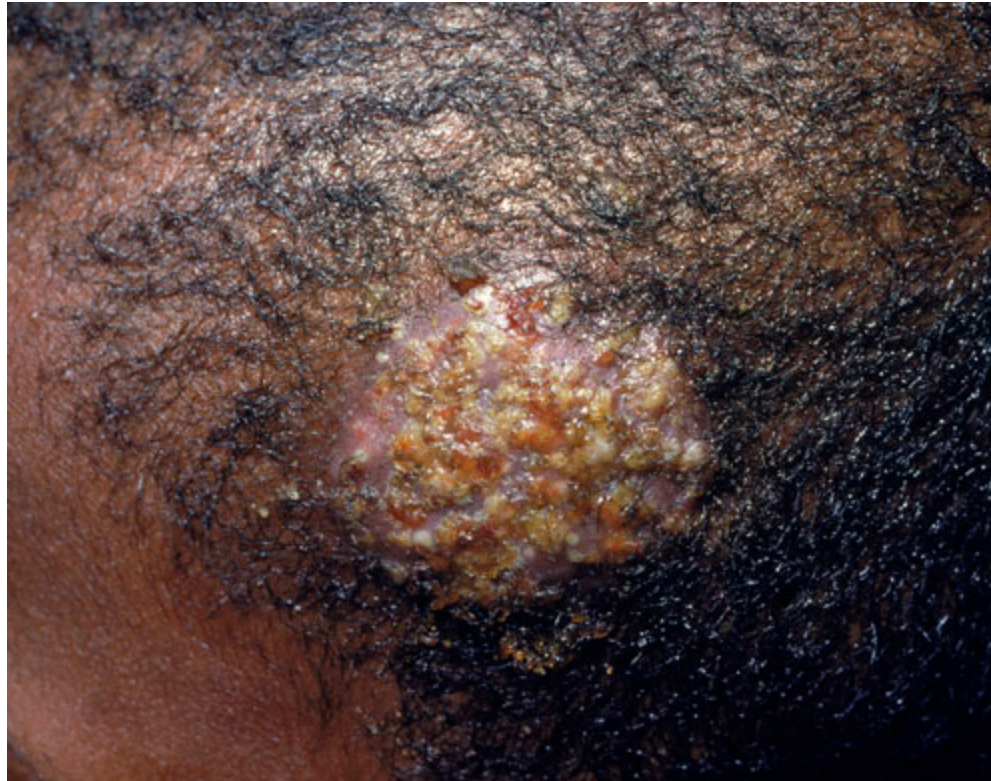
A 6-year-old boy is brought to the physician because of hair loss and a lump on his scalp. His mother says that she first noticed the lump 5 days ago and it appears to be increasing in size. There is no history of serious illness, and he takes no medications. His temperature is 37°C (98.6°F). A photograph of the lesion is shown. A tender 2-cm occipital lymph node is palpated. Which of the following is the most likely causal organism?
CorrectIncorrect