
NBME 33 – Block 3 (Duplicate 2)
Time limit: 0
Quiz Summary
0 of 20 Questions completed
Questions:
Information
You have already completed the quiz before. Hence you can not start it again.
Quiz is loading…
You must sign in or sign up to start the quiz.
You must first complete the following:
Results
Quiz complete. Results are being recorded.
Results
0 of 20 Questions answered correctly
Your time:
Time has elapsed
You have reached 0 of 0 point(s), (0)
Earned Point(s): 0 of 0, (0)
0 Essay(s) Pending (Possible Point(s): 0)
Categories
- Not categorized 0%
- 1
- 2
- 3
- 4
- 5
- 6
- 7
- 8
- 9
- 10
- 11
- 12
- 13
- 14
- 15
- 16
- 17
- 18
- 19
- 20
- Current
- Review
- Answered
- Correct
- Incorrect
-
Question 1 of 20
1. Question
A 30-year-old man is brought to the emergency department 20 minutes after the sudden onset of nausea, dizziness, and malaise. His symptoms began when he was working in a closed room heated by a propane-burning space heater. Arterial blood gas analysis on room air shows a carboxyhemoglobin concentration of 40%. After he loses consciousness, he is transferred to a hyperbaric chamber, and 100% oxygen at 2.5 atmospheric pressure (1900 mm Hg) is administered. Within 30 seconds, the hyperbaric oxygen therapy will increase the amount of oxygen in which of the following locations?
CorrectIncorrect -
Question 2 of 20
2. Question
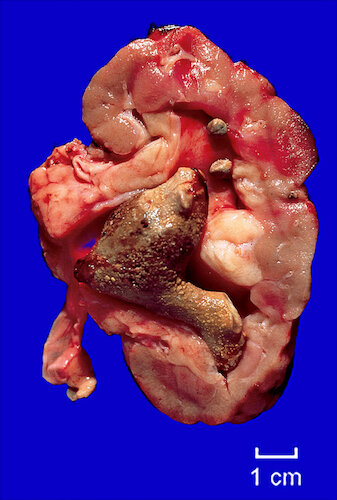
A 68-year-old man comes to the physician because of a 1-month history of left flank pain. Physical examination shows left costovertebral angle tenderness. Urinalysis shows a pH of 8 with many RBCs, WBCs, and bacteria. Intravenous pyelography shows a nonfunctioning left kidney. A photograph of the resected kidney is shown. Which of the following is the most likely composition of the lesion in this patient?
CorrectIncorrect -
Question 3 of 20
3. Question
A 78-year-old man with coronary artery disease develops pain in his right ankle 3 days after starting intravenous treatment with furosemide for congestive heart failure. His temperature is 38.2°C (100.8°F), pulse is 98/min, and blood pressure is 130/88 mm Hg. Physical examination shows an exquisitely tender, erythematous, swollen right ankle. Range of motion is limited because of pain. Examination of synovial fluid aspirated from this patient’s ankle is most likely to show which of the following findings?
CorrectIncorrect -
Question 4 of 20
4. Question
A 27-year-old woman is brought to the emergency department 4 hours after she swallowed 25 acetaminophen tablets in a suicide attempt. She appears pale and diaphoretic. Her temperature is 37°C (98.6°F), pulse is 90/min, and blood pressure is 95/50 mm Hg. Laboratory studies show a plasma acetaminophen concentration in the toxic range. An infusion of N-acetylcysteine is initiated. This compound helps prevent hepatocellular damage by increasing which of the following?
CorrectIncorrect -
Question 5 of 20
5. Question
A 9-year-old boy is brought to the office by his mother because of repeated disruptive classroom behavior, including frequently leaving his seat, interrupting others, and difficulty taking turns. He was diagnosed with attention-deficit/hyperactivity disorder 9 months ago, and his mother says they have tried to implement basic behavioral management techniques and decrease stimulation at home. He has no other history of major medical illness and receives no medications. Vital signs are within normal limits. During the examination, the patient fidgets with his hands and continually attempts to climb onto the examination table rather than sit in his chair. The remainder of the examination shows no abnormalities. The most appropriate initial pharmacotherapy for this patient will target which of the following neurotransmitters?
CorrectIncorrect -
Question 6 of 20
6. Question
A 55-year-old woman comes to the physician because of a 3-month history of feeling run-down and a 3-day history of difficulty sleeping due to shortness of breath. She had a severe upper respiratory tract infection 2 years ago. She feels that she has never completely recovered. Her temperature is 37.2°C (99°F), pulse is 105/min, respirations are 20/min, and blood pressure is 100/80 mm Hg. Physical examination shows jugular venous distention 12 cm above the sternal angle. Crackles are heard over all lung fields except at the apices. The point of maximal impulse shifts to the left. The liver is enlarged and tender, and there is 3+ pretibial edema bilaterally. Measurement of which of the following is the most appropriate to determine the long-term prognosis of this patient?
CorrectIncorrect -
Question 7 of 20
7. Question
A 25-year-old woman with moderate persistent asthma participates in a clinical trial of a new asthma drug. Investigators hypothesize that the drug will decrease the frequency of asthma symptoms compared with the standard treatment. The patient is randomized to receive the new drug, which is to be taken daily for 6 months. After 2 months, the patient has an exacerbation of her asthma symptoms. She stops taking the new drug and goes back to the standard treatment. To perform an intention-to-treat analysis of the study results, it is most appropriate for the investigators to do which of the following?
CorrectIncorrect -
Question 8 of 20
8. Question
A 34-year-old woman with a 6-month history of four urinary tract infections comes to the physician for a follow-up examination. She has a 28-year history of type 1 diabetes mellitus. Renal ultrasonography shows bladder enlargement with mild dilation of the ureters and renal calyces. Residual urine volume after voiding is increased. Which of the following is the most likely cause of her recurrent urinary tract infections?
CorrectIncorrect -
Question 9 of 20
9. Question
A 33-year-old man with long-standing, poorly controlled type 1 diabetes mellitus and retinopathy comes to the physician because of a 2-week history of nausea and occasional vomiting. He also has felt full during this period after eating only a few bites of food. An upper gastrointestinal series with barium swallow shows a 4.5-cm irregular mass in the body of the stomach. Which of the following is the most likely cause of this patient’s condition?
CorrectIncorrect -
Question 10 of 20
10. Question
A 5-year-old boy is brought to the physician by his mother because of a 3-month history of hyperactivity and difficulty walking. His brother died of severe neurologic dysfunction at the age of 12 years. Physical examination shows decreased vision bilaterally. He walks with an ataxic gait. Serum phospholipid analysis shows an increased concentration of C26:0 and increased C26:0/C22:0 and C24:0/C22:0 ratios. An MRI of the brain shows a high-intensity signal in the periventricular white matter of the posterior parietal and occipital lobes. This patient most likely has a defect in a metabolic process located in which of the following organelles?
CorrectIncorrect -
Question 11 of 20
11. Question
A 70-year-old man comes to the physician because of a 2-week history of urinary frequency and pain with urination. As a result, he decreased his fluid intake 1 week ago. Three weeks ago, he underwent a biopsy of the prostate after he was found to have an enlarged prostate and an increased prostate-specific antigen concentration. Results of the biopsy showed hyperplasia. His vital signs are within normal limits. Physical examination shows suprapubic tenderness. Urinalysis shows 15 WBC/hpf and greater than 100,000 gram-negative rods/mL. Which of the following is the most likely causal organism?
CorrectIncorrect -
Question 12 of 20
12. Question
A 24-year-old woman has a well-delineated, lobular, firm, mobile, nontender nodule in her left breast. Which of the following is the most likely diagnosis?
CorrectIncorrect -
Question 13 of 20
13. Question
A 24-year-old man comes to the physician because of a 2-day history of fever, muscle aches, and headache. He also has had a rash that started around his wrists and ankles and spread to his palms during the past 24 hours. He went hiking in the woods last week. Physical examination shows an erythematous rash on the abdomen as well. The most appropriate treatment is an antibiotic with which of the following mechanisms?
CorrectIncorrect -
Question 14 of 20
14. Question
The estimated LD50 for ingested iron is 200 mg/kg in humans. The toxic effects of iron are mediated by oxygen radical damage of mitochondria in the heart and central nervous system by circulating free iron. Patients with which of the following conditions will most likely have a decreased LD50 for ingested iron?
CorrectIncorrect -
Question 15 of 20
15. Question
A 5-year-old boy is brought to the emergency department 6 hours after the sudden onset of a rash over his stomach. He also has a 2-day history of fever, headache, and vomiting. His temperature is 40.5°C (104.9°F). Physical examination shows purpura over the abdomen. Cultures of blood and cerebrospinal fluid grow gram-negative diplococci. He was successfully treated with ceftriaxone for a similar infection at 3 years of age. A defect of which of the following immune system components best explains this patient’s recurrent infection?
CorrectIncorrect -
Question 16 of 20
16. Question
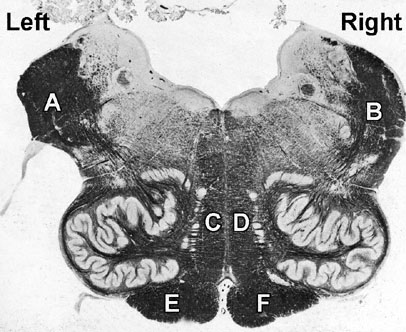
A 57-year-old man is brought to the emergency department 1 hour after he suddenly collapsed at home. He regained consciousness 5 minutes later. He has a 5-year history of hypertension. Neurologic examination shows dysmetria on the right. Sensation to pain and temperature is decreased over the right side of the face. Which of the following labeled regions in the photograph of the myelin-stained cross section of the brain stem shown is most likely damaged in this patient?
 CorrectIncorrect
 -
Question 17 of 20
17. Question
A 27-year-old man comes to the physician because of a dry, scaling, itchy, red rash. A diagnosis of moderately severe active psoriasis with psoriatic arthropathy is made. Use of nonsteroidal drugs and topical therapies is not successful in treating the symptoms. The most appropriate treatment is a drug that inhibits which of the following?
CorrectIncorrect -
Question 18 of 20
18. Question
A 47-year-old man comes to the physician because of a cough productive of white sputum for 3 months. He has not had fever or weight loss. He takes no medications. He has smoked 2 packs of cigarettes daily for 25 years. Physical examination shows a barrel-shaped chest. Occasional wheezes are heard on auscultation of the chest. Which of the following is most likely to be heard on cardiac examination?
CorrectIncorrect -
Question 19 of 20
19. Question
A 55-year-old man is undergoing suprapubic prostatectomy. During the procedure, the nerves in close proximity to the lateral surfaces of the prostate are inadvertently cut. Which of the following is the most likely sequela?
CorrectIncorrect -
Question 20 of 20
20. Question
A survey is conducted to assess the health of a group of medical students before they enter clinical rotations. A total of 100 male and female medical students are asked to complete a 10-item survey regarding their personal and family medical histories. Students are from the same university and are 20 to 40 years of age. The results of the survey indicate that more women than men have a family history of type 2 diabetes mellitus. Which of the following statistical tests is most likely to determine if this finding is due to chance?
CorrectIncorrect