
NBME 33 – Block 2 (Duplicate 1)
Time limit: 0
Quiz Summary
0 of 20 Questions completed
Questions:
Information
You have already completed the quiz before. Hence you can not start it again.
Quiz is loading…
You must sign in or sign up to start the quiz.
You must first complete the following:
Results
Quiz complete. Results are being recorded.
Results
0 of 20 Questions answered correctly
Your time:
Time has elapsed
You have reached 0 of 0 point(s), (0)
Earned Point(s): 0 of 0, (0)
0 Essay(s) Pending (Possible Point(s): 0)
Categories
- Not categorized 0%
- 1
- 2
- 3
- 4
- 5
- 6
- 7
- 8
- 9
- 10
- 11
- 12
- 13
- 14
- 15
- 16
- 17
- 18
- 19
- 20
- Current
- Review
- Answered
- Correct
- Incorrect
-
Question 1 of 20
1. Question
A 28-year-old man comes to the physician because of weakness for 2 months; he has had a 4.5-kg (10-lb) weight loss during this period. There is no family history of cancer. Laboratory studies show a hemoglobin concentration of 8 g/dL. A chest x-ray shows multiple pulmonary nodules of varying sizes throughout both lung fields. A diagnosis of metastatic cancer is made. Which of the following organs is the most likely primary source of the cancer?
CorrectIncorrect -
Question 2 of 20
2. Question
A 1-year-old girl is brought to the physician by her mother because of a 2-day history of poor eating and vomiting after she was diagnosed with an upper respiratory tract infection. She appears lethargic. Physical examination shows mild hepatomegaly. Serum studies show hypoglycemia and absence of ketones. Urine studies show increased concentrations of acylcarnitines and dicarboxylic acids. A defect in which of the following processes best explains the findings in this patient?
CorrectIncorrect -
Question 3 of 20
3. Question
A 48-year-old woman comes to the physician for a follow-up examination. She received a diagnosis of type 2 diabetes mellitus at her last examination 1 week ago. Her mother had complications related to this disease. The patient is a college graduate. She often uses the Internet to do research for her job. Today she is given a pamphlet explaining the importance of diet, exercise, and weight management in controlling her disease. Which of the following initial statements by the physician is most likely to ensure that this patient will read and keep the pamphlet for future referral?
CorrectIncorrect -
Question 4 of 20
4. Question
A 14-year-old girl is brought to the office by her mother for a well-child examination. She has no history of major medical illness and takes no medications. She has never had a menstrual period. She has no history of physical, sexual, or emotional abuse. After the mother leaves the room, the patient says she has not had depressed mood or anxiety. She does not smoke, drink alcoholic beverages, or use illicit drugs. She has never been sexually active. She has a good relationship with her parents and siblings. She is a freshman in high school and receives grades of As and Bs. She plays soccer three days weekly. She is at the 75th percentile for height, weight, and BMI. Vital signs are within normal limits. Sexual maturity rating is 4 for breast development and 3 for pubic hair development. The remainder of the examination shows no abnormalities. Which of the following is the most likely explanation for this patient’s lack of menstrual period?
CorrectIncorrect -
Question 5 of 20
5. Question
A 14-year-old boy is brought to the office by his mother for an examination prior to participating on his school’s long-distance running team. During the interview, the patient says that he has been using increasing amounts of erythropoietin to try to increase his oxygen capacity in preparation for the season. Which of the following physical parameters is most likely to be adversely affected in this patient as a result of the use of this drug?
CorrectIncorrect -
Question 6 of 20
6. Question
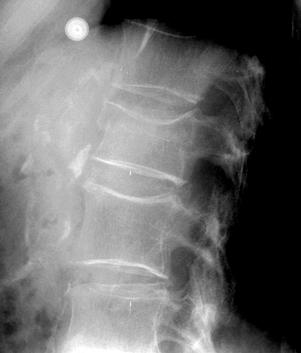
A previously healthy 79-year-old woman has had thoracolumbar back pain since the car she was riding in hit a pothole 4 days ago. A lateral x-ray of her spine is shown. Which of the following is the most likely underlying cause of the abnormality shown?
CorrectIncorrect -
Question 7 of 20
7. Question
A 10-year-old girl with a lifelong history of intermittent dyspnea is brought to the physician for a follow-up examination. During an episode of dyspnea, she turns blue. The episode resolves after she squats. A systolic murmur was heard at birth. Today, a grade 4/6 systolic murmur is heard at the pulmonic area, radiating widely to the back and left side. Cardiac catheterization shows:
Location
Pressure (mm Hg)
O2 Saturation
Aorta
120/80
82%
Vena cava
6/0
70%
Pulmonary artery
20/8
70%
Right atrium
4
70%
Left atrium
6
95%
Right ventricle
120/6
70%
Left ventricle
120/6
82%
This patient’s condition is most likely caused by which of the following embryologic defects?
CorrectIncorrect -
Question 8 of 20
8. Question
A previously healthy 35-year-old woman comes to the physician because of a 2-month history of abdominal cramping and intermittent bloody diarrhea. She takes no medications. Physical examination shows no abnormalities. Colonoscopy confirms the diagnosis of ulcerative colitis. Treatment is initiated with a drug containing an azo (N=N) bond to an inert compound, that prevents absorption in the small intestine for maximal direct effect in the colon. This drug is most likely which of the following?
CorrectIncorrect -
Question 9 of 20
9. Question
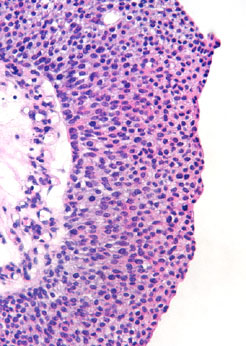
A 51-year-old woman comes to the physician because of a 3-month history of urinary frequency and pain with urination. The patient says, “The pain started a couple of days after I returned from a trip to the Caribbean.” She has smoked 2 packs of cigarettes daily for 30 years. She used an oral contraceptive for 30 years. Menopause occurred 2 years ago. Her mother died of breast cancer at the age of 55 years. Physical examination shows no abnormalities. Urinalysis shows a pH of 6.5, specific gravity of 1.013, and 1+ blood. Cystoscopy shows mucosal irregularity with erythema in the dome of the bladder. A photomicrograph of a biopsy specimen of the lesion is shown. Which of the following is the strongest predisposing risk factor for this condition?
CorrectIncorrect -
Question 10 of 20
10. Question
A 54-year-old man comes to the office for a follow-up examination. He has an 8-year history of HIV infection well controlled with antiretroviral therapy. Vital signs are within normal limits. Physical examination shows facial and peripheral wasting, central obesity, and enlargement of the dorsocervical fat pad and breasts. A drug to treat HIV infection from which of the following classes is the most likely cause of these findings?
CorrectIncorrect -
Question 11 of 20
11. Question
A 44-year-old man comes to the physician for a health maintenance examination. He has drunk twelve 12-oz beers nightly for several years. He tells the physician that he is concerned he may have a drinking problem, but he has not mentioned the concern to anyone else. He says, “Most of my friends drink the same amount and I’m afraid they’ll think I’m overreacting if I talk to them about it.” Which of the following best describes this patient’s stage of behavioral change?
CorrectIncorrect -
Question 12 of 20
12. Question
A 16-year-old girl is brought to the physician by her mother because she has had bowed legs since the age of 12 years. She is a member of the track team at school and feels this deformity is affecting her performance. Examination of the patient’s gait shows bilateral genu varum. Excess stress is most likely being placed on which of the following lateral structures in this patient?
CorrectIncorrect -
Question 13 of 20
13. Question
A 50-year-old woman develops decreased urine output and an increasing serum creatinine concentration 6 weeks after a kidney transplantation. A diagnosis of acute rejection is suspected. Which of the following findings on biopsy of the transplanted kidney is most likely to confirm the diagnosis?
CorrectIncorrect -
Question 14 of 20
14. Question
A 25-year-old man is scheduled to undergo an operation for a thymoma. He says that he had muscle weakness before the operation. He regularly eats at sushi bars. Sevoflurane and pancuronium are used perioperatively. Postoperatively, the patient has profound residual neuromuscular block. If electrophysiologic evaluation of skeletal muscle were done at this time, results would show:
EPP Amplitude
MEPP Amplitude
Response to Acetylcholine
Healthy muscle
12 mV
1 mV
1 mV
Patient muscle
3 mV
0.25 mV
0.25 mV
EPP=end-plate potential; MEPP=miniature epp; 1 μM acetylcholine applied to the muscle surface by iontophoresis
Which of the following is the most likely cause of these findings?
CorrectIncorrect -
Question 15 of 20
15. Question
An investigator conducts a retrospective analysis of medullary carcinomas of the thyroid gland. Microscopic features of tumors arising in patients with a positive family history are compared with features of tumors that occurred sporadically. The familial tumors are more likely to exhibit which of the following?
CorrectIncorrect -
Question 16 of 20
16. Question
A 74-year-old woman comes to the emergency department because of a 3-day history of abdominal pain, vomiting, and constipation. Physical examination shows tenderness to deep palpation of the right upper abdominal quadrant. An abdominal x-ray shows dilation of the small intestine in the left upper quadrant. Abdominal ultrasonography shows multiple dilated small-bowel loops and air in the gallbladder. The most likely cause of these findings is a gallstone lodged in which of the following locations?
CorrectIncorrect -
Question 17 of 20
17. Question
A 29-year-old man with bronchiectasis comes to the physician for a routine follow-up examination. Physical examination shows the tissue of the proximal nail fold to have a spongy resilience, and the nail plate to be at a 180° angle with the long axis of the finger. These findings best describe which of the following?
CorrectIncorrect -
Question 18 of 20
18. Question
A study is conducted to assess the effects of in vitro fertilization (IVF) on preterm delivery. Women who conceive using IVF are compared with a control group of women who conceive naturally. The women are matched by maternal age and parity, and only singleton gestations are included in the study. Gestational age at delivery is recorded for both groups. Results show a statistically significant association between the use of IVF and preterm delivery. Which of the following best describes this study design?
CorrectIncorrect -
Question 19 of 20
19. Question
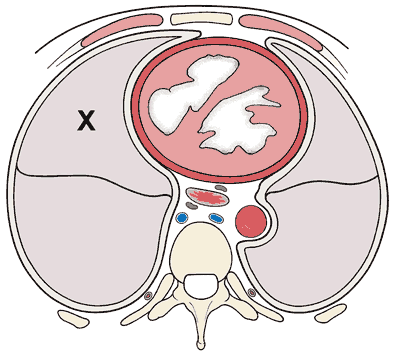
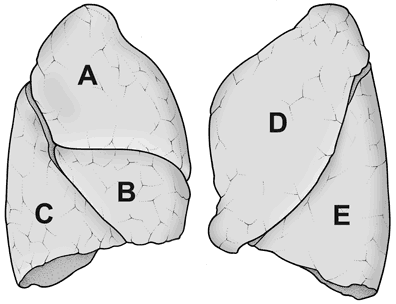
A 35-year-old woman is scheduled to undergo an exploratory operation for suspected lung cancer after a chest x-ray shows a suspicious mass. A CT scan–style drawing of a cross section of the chest is shown; the X indicates the area of the mass. Which of the following labeled areas in the diagram of the lungs is the most likely location of this mass in the patient?
 CorrectIncorrect
 -
Question 20 of 20
20. Question
A 35-year-old man with a 1-year history of fluctuating, crampy abdominal pain in the right lower quadrant comes to the physician because of a 6-month history of decreased appetite and diarrhea tinged with blood and mucus. He has had a 6.8-kg (15-lb) weight loss during the past 6 months. Vital signs are within normal limits. Test of the stool for occult blood is positive. Which of the following is the most likely diagnosis?
CorrectIncorrect