
NBME 33 – Block 1 (Duplicate 1)
Time limit: 0
Quiz Summary
0 of 20 Questions completed
Questions:
Information
You have already completed the quiz before. Hence you can not start it again.
Quiz is loading…
You must sign in or sign up to start the quiz.
You must first complete the following:
Results
Quiz complete. Results are being recorded.
Results
0 of 20 Questions answered correctly
Your time:
Time has elapsed
You have reached 0 of 0 point(s), (0)
Earned Point(s): 0 of 0, (0)
0 Essay(s) Pending (Possible Point(s): 0)
Categories
- Not categorized 0%
- 1
- 2
- 3
- 4
- 5
- 6
- 7
- 8
- 9
- 10
- 11
- 12
- 13
- 14
- 15
- 16
- 17
- 18
- 19
- 20
- Current
- Review
- Answered
- Correct
- Incorrect
-
Question 1 of 20
1. Question
A randomized, double-blind, controlled trial is conducted to assess whether a drug that decreases clotting by interfering with the function of platelets also decreases the incidence of myocardial infarction in 60-year-old men with known risk factors, such as hypertension and hyperlipidemia. After informed consent is obtained, subjects are assigned to Group X or Group Y by coin toss. After collecting baseline data, Group X receives the experimental drug, and Group Y receives placebo. In both groups, risk factors are aggressively treated. At the first data analysis point, it is found that at baseline, Groups X and Y are similar regarding factors associated with increased risk for myocardial infarction. Which of the following best explains this similarity?
CorrectIncorrect -
Question 2 of 20
2. Question
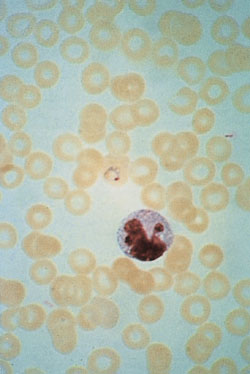
A 62-year-old man is brought to the emergency department by his wife because of a 2-day history of intermittent fever, chills, nausea, and vomiting. One year ago, he traveled extensively through Southeast Asia for 1 month. He appears acutely ill and is shaking continuously. His temperature is 40.5°C (104.9°F), pulse is 128/min, respirations are 32/min, and blood pressure is 160/92 mm Hg. Physical examination shows profound diaphoresis. A photomicrograph of a peripheral blood smear is shown. The most likely explanation for these clinical findings is activation of the causal organism from a dormant state in which of the following cell types?
CorrectIncorrect -
Question 3 of 20
3. Question
A 35-year-old woman comes to the office 2 days after the sudden onset of fever and chills with accompanying muscle and joint pain. Three weeks ago, she returned from a vacation in the Philippines. During this trip, she went swimming in fresh water on several occasions. Her temperature is 38.9°C (102°F), pulse is 120/min, respirations are 24/min, and blood pressure is 110/70 mm Hg. Physical examination shows hepatosplenomegaly. Her leukocyte count is 16,000/mm3, with 35% segmented neutrophils, 40% eosinophils, 20% lymphocytes, and 5% monocytes. Which of the following factors is most likely being released in increased quantities in this patient at this time?
CorrectIncorrect -
Question 4 of 20
4. Question
A 54-year-old man comes to the physician for a follow-up examination. Two months ago, he received an experimental vaccine for treatment of recurrent melanoma. The vaccine consisted of tumor cells from the patient that had been cultured in vitro, transfected with a plasmid for expression of the gene for human interleukin-2 (IL-2), then irradiated before administration. Today, physical examination shows regression of localized melanoma skin lesions. Infiltrating cells are isolated from one of the regressing lesions and are characterized for cell-surface markers and intracellular protein expression using flow cytometry. Results show that the majority of the cells are negative for CD3 and positive for perforin. Which of the following best describes these cells?
CorrectIncorrect -
Question 5 of 20
5. Question
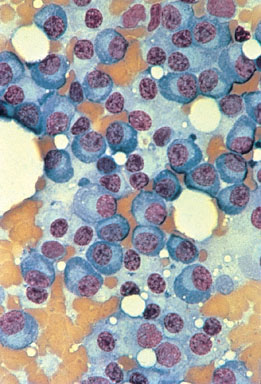
A 68-year-old man has had increasingly severe back pain for 2 months. Hematocrit is 30%. A photomicrograph of bone marrow aspirate is shown. Which of the following organisms is most likely to be associated with complications of this disorder?
CorrectIncorrect -
Question 6 of 20
6. Question
A 17-year-old girl is brought to the emergency department after she took an unknown drug at a party. Her temperature is 38.5°C (101.3°F), pulse is 144/min, respirations are 24/min, and blood pressure is 140/70 mm Hg. Physical examination shows diaphoresis and a clenched jaw. She appears anxious, delusional, and paranoid. She is disoriented to person, place, and time. Which of the following drugs is the most likely cause of this patient’s symptoms?
CorrectIncorrect -
Question 7 of 20
7. Question
A 54-year-old man comes to the physician because of a 2-week history of pain of his right shoulder. He has been remodeling his kitchen for the past month. Examination of the right shoulder shows no bony deformities, soft-tissue swelling, or point tenderness. Internal rotation of the shoulder against resistance produces pain. The most likely source of this patient’s pain is inflammation of which of the following tendons?
CorrectIncorrect -
Question 8 of 20
8. Question
A 35-year-old woman comes to the physician 7 hours after having a generalized tonic-clonic seizure. She also has a 2-week history of fever, arm and leg numbness, fatigue, and an irregular heartbeat. Her temperature is 38.5°C (101.3°F), pulse is 106/min, and blood pressure is 105/65 mm Hg. Physical examination shows no other abnormalities. Laboratory studies show mildly increased prothrombin and partial thromboplastin times, a serum urea nitrogen concentration of 20 mg/dL, and a serum creatinine concentration of 2.5 mg/dL. Results of a direct antiglobulin (Coombs) test are negative. A peripheral blood smear shows increased schistocytes and reticulocytes. Which of the following is the most likely diagnosis?
CorrectIncorrect -
Question 9 of 20
9. Question
A 41-year-old woman with cholecystitis is admitted to the hospital to undergo laparoscopic cholecystectomy. During this procedure, it is most appropriate for the physician to locate and ligate the cystic artery branching from which of the following arteries?
CorrectIncorrect -
Question 10 of 20
10. Question
A 25-year-old woman, gravida 1, para 0, at 40 weeks’ gestation is in labor. Her amniotic membranes have ruptured, releasing a large amount of clear fluid. A sterile vaginal examination shows a pulsating mass. Which of the following is the most likely diagnosis?
CorrectIncorrect -
Question 11 of 20
11. Question
A 24-year-old man with type 1 diabetes mellitus is brought to the emergency department because of a 1-day history of nausea, vomiting, and abdominal pain. He also has a 3-day history of diarrhea and decreased appetite. He has not taken insulin in the past 1½ days. His temperature is 37°C (98.6°F), pulse is 120/min, and blood pressure is 100/70 mm Hg. Abdominal examination shows mild diffuse tenderness. Bowel sounds are decreased. His serum glucose concentration is 650 mg/dL. Urine studies show the presence of ketones. Which of the following respiratory patterns is most likely in this patient?
CorrectIncorrect -
Question 12 of 20
12. Question
A 3-month-old girl is brought to the physician because of rapid breathing, weakness, and poor feeding for 2 weeks. Physical examination shows tachycardia, tachypnea, hypotonia, and hepatomegaly. A chest x-ray shows massive cardiomegaly. An ECG shows a shortened PR interval and depressed ST segment. Examination of a skeletal muscle biopsy specimen shows an increased glycogen concentration within lysosomes. A deficiency of which of the following enzyme activities is the most likely cause of the findings in this patient?
CorrectIncorrect -
Question 13 of 20
13. Question
An 8-year-old boy is brought to the physician by his mother for a well-child examination. The mother mentions that she and her husband are getting divorced and expresses concern about the impact of the divorce on her son. She should be advised that which of the following risk factors is most predictive of a negative emotional outcome for the child?
CorrectIncorrect -
Question 14 of 20
14. Question

A 40-year-old man experiencing homelessness comes to the physician because of a 5-day history of an itchy rash. He has alcohol use disorder and lives in a shelter. He has no history of skin problems. He has not been exposed to new soaps or lotions. His vital signs are within normal limits. Physical examination shows an excoriated linear rash on the hands and feet, with a few areas of the rash on the upper and lower extremities. A photograph of the rash is shown. Which of the following is the most likely cause of the findings in this patient?
CorrectIncorrect -
Question 15 of 20
15. Question
A 67-year-old man comes to the physician because of episodes of brief self-terminating palpitations during the past 4 days. Two weeks ago, he was admitted to the hospital with atrial fibrillation. At that time, he underwent electrical cardioversion, and his rhythm returned to normal. A drug is prescribed that blocks a variety of ionic channels and produces a prolongation of action potential duration with minimal risk for torsades de pointes. This drug is most likely which of the following?
CorrectIncorrect -
Question 16 of 20
16. Question
A 10-month-old girl develops a cough and grunting following a 3-day hospital stay for surgical repair of a cleft palate. Her temperature is 39.2°C (102.6°F), and respirations are 40/min. Crackles are heard over most lung fields, and breath sounds are decreased. There is a mild pleural rub in the right upper thorax. Her leukocyte count is 68,000/mm3 (85% segmented neutrophils, 10% bands, and less than 5% myeloblasts, promyelocytes, and myelocytes). Which of the following mediators most likely stimulated the elevated leukocyte count in this patient?
CorrectIncorrect -
Question 17 of 20
17. Question
A 68-year-old woman with hypertension and coronary artery disease is found to have paroxysmal supraventricular tachycardia at a rate of 170/min on ECG. An intravenous bolus of an ultrashort-acting agent is started, which acts by inhibiting adenylyl cyclase to increase the potassium efflux out of cardiac myocytes. This drug is most likely which of the following?
CorrectIncorrect -
Question 18 of 20
18. Question
A 29-year-old woman is brought to the physician because of a 2-day history of decreased vision in her left eye. Two years ago, she had a 1-month history of mild left-sided weakness that resolved spontaneously. Physical examination shows mild left-sided hyperreflexia. Visual acuity is 20/100 in the left eye and 20/20 in the right eye. Which of the following additional findings is most likely to be present in this patient?
CorrectIncorrect -
Question 19 of 20
19. Question
A 23-year-old man is diagnosed with ciliary dyskinesia. Abnormal epithelial function is most likely present in which of the following areas in this patient?
CorrectIncorrect -
Question 20 of 20
20. Question
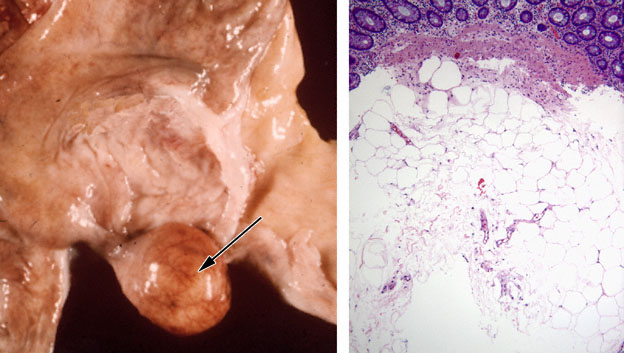
A 68-year-old man dies of a massive cerebral infarction. The gross and microscopic appearances of a colonic lesion (indicated by the arrow in the photograph) found at autopsy are shown. Which of the following best describes this lesion?
CorrectIncorrect