
NBME 32 – Block 2 (Duplicate 1)
Time limit: 0
Quiz Summary
0 of 20 Questions completed
Questions:
Information
You have already completed the quiz before. Hence you can not start it again.
Quiz is loading…
You must sign in or sign up to start the quiz.
You must first complete the following:
Results
Quiz complete. Results are being recorded.
Results
0 of 20 Questions answered correctly
Your time:
Time has elapsed
You have reached 0 of 0 point(s), (0)
Earned Point(s): 0 of 0, (0)
0 Essay(s) Pending (Possible Point(s): 0)
Categories
- Not categorized 0%
- 1
- 2
- 3
- 4
- 5
- 6
- 7
- 8
- 9
- 10
- 11
- 12
- 13
- 14
- 15
- 16
- 17
- 18
- 19
- 20
- Current
- Review
- Answered
- Correct
- Incorrect
-
Question 1 of 20
1. Question
A 65-year-old man comes to the physician because of a 1-month history of difficulty urinating. He says that he has difficulty initiating urination, and once initiated, the urine tends to “dribble.” Rectal examination shows a diffusely enlarged, firm, nontender prostate. Which of the following findings is most likely to be found on histologic examination of the prostate?
CorrectIncorrect -
Question 2 of 20
2. Question
A 7-year-old boy with an 8-month history of splenomegaly is brought to the physician 1 day after the sudden onset of bruising on his arms and legs. There has been no trauma. Physical examination shows numerous ecchymoses over the upper and lower extremities, mild lymphadenopathy, and splenomegaly. Laboratory studies show:
Leukocyte count
15,000/mm3 (N=4500–13,500)
Segmented neutrophils
35%
Bands
6%
Eosinophils
1%
Lymphocytes
55%
Monocytes
3%
Platelet count
20,000/mm3 (N=50,000–400,000)
Serum IgG
1700 mg/dL (N=608–1572)
Flow cytometry shows an increased concentration of T lymphocytes expressing α- and β-antigen receptors but lacking either CD4 or CD8. Genetic testing shows a defect in the FAS gene. Which of the following cellular processes is most likely impaired in this patient’s lymphocytes?
CorrectIncorrect -
Question 3 of 20
3. Question
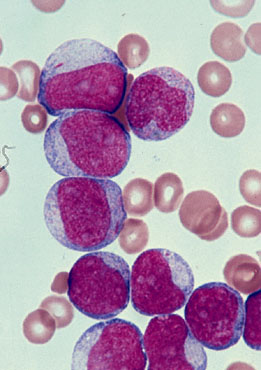
A 55-year-old woman comes to the physician because of a 1-month history of fever, fatigue, shortness of breath, decreased appetite, and easy bruisability. Her temperature is 37°C (98.6°F), pulse is 105/min, respirations are 28/min, and blood pressure is 115/70 mm Hg. Physical examination shows pallor. A complete blood count shows a hemoglobin concentration of 10 g/dL, hematocrit of 30%, and platelet count of 75,000/mm3. A photomicrograph of a peripheral blood smear is shown. A bone marrow biopsy is planned. Which of the following is the most likely diagnosis?
CorrectIncorrect -
Question 4 of 20
4. Question
A 28-year-old man is admitted to the hospital because of a 6-month history of progressive fatigue and lethargy. He also has had episodes of diplopia, hallucinations, changes in personality with apathy, speech loss, myoclonus, tremor, gait ataxia, and a 20-kg (44-lb) weight loss during this period. There is a family history of six similar cases dating back four generations. Serum studies and analysis of cerebrospinal fluid obtained via lumbar puncture show no abnormalities. An MRI of the brain shows hyperintense signals in the cortical ribbon, basal ganglia, and thalamus. An EEG shows signs of diffuse, nonspecific parenchymal dysfunction. Which of the following mechanisms is the most likely cause of this patient’s symptoms?
CorrectIncorrect -
Question 5 of 20
5. Question
A 67-year-old woman comes to the physician because of a 2-week history of bright red bleeding with defecation. Anoscopy shows a 2-cm rectal polyp 2 cm above the pectinate line. Blood flow to this polyp is most likely supplied by which of the following arteries?
CorrectIncorrect -
Question 6 of 20
6. Question
A 52-year-old man recently diagnosed with type 2 diabetes mellitus comes to the physician for a follow-up examination. Physical examination shows no abnormalities. Laboratory studies show an increased hemoglobin A1c despite patient compliance with diet and exercise recommendations. Treatment with a thiazolidinedione is initiated. The beneficial effect of this medicine is most likely due to which of the following?
CorrectIncorrect -
Question 7 of 20
7. Question
A 46-year-old man comes to the emergency department because of a 2-hour history of chest pain. He says that the pain began when he was shoveling snow. He appears anxious and is leaning forward in the hospital bed. He is 185 cm (6 ft 1 in) tall and weighs 84 kg (185 lb); BMI is 24 kg/m2. His pulse is 85/min, respirations are 20/min, and blood pressure is 170/85 mm Hg. Which of the following statements or questions by the physician would be most helpful in eliciting a history from this patient?
CorrectIncorrect -
Question 8 of 20
8. Question
A 30-year-old woman is brought to the physician because of progressive vision loss in her left eye during the past 2 days. She has hyperextensible joints, and her skin is very stretchable and extremely fragile. Ophthalmologic examination shows retinal detachment, and she undergoes an operation. The most likely cause of this patient’s disease is a defect in the structure of which of the following proteins?
CorrectIncorrect -
Question 9 of 20
9. Question
A 75-year-old man comes to the emergency department 30 minutes after the sudden onset of profuse rectal bleeding. His last examination by a physician occurred 10 years ago. Rapid determination of this patient’s blood loss is most likely to be obtained via which of the following measurements?
CorrectIncorrect -
Question 10 of 20
10. Question
An investigator is studying an outbreak of severe diarrhea caused by norovirus in a skilled nursing care facility. During the past year, the facility participated in an experimental trial of an oral vaccine containing live, attenuated norovirus. The vaccine was administered to all patients and staff members. Four months after receiving the vaccine, 25% of the immunized patients developed norovirus-related diarrhea. All of the patients who became ill were 75 years of age or older; the illness affected both men and women. The staff members and the younger patients (50 to 55 years of age) of the facility have developed no symptoms. Further study of the affected residents will most likely show which of the following findings?
CorrectIncorrect -
Question 11 of 20
11. Question
A 20-year-old man is brought to the emergency department by his girlfriend 30 minutes after he took crystal methamphetamine and became aggressive at a music concert. On arrival, the patient has agitation and euphoria. His pulse is 115/min, and blood pressure is 155/95 mm Hg. Physical examination shows tremulousness. The behavioral effects of the drug used by this patient are achieved through which of the following mechanisms?
CorrectIncorrect -
Question 12 of 20
12. Question
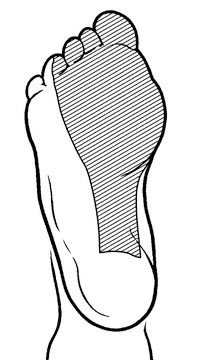
A 58-year-old woman comes to the physician because of a 3-month history of numbness and tingling over the bottom of her right foot. Sensation to pinprick is decreased over the shaded area in the diagram of the right foot shown. A branch of which of the following nerves is most likely injured in this patient?
CorrectIncorrect -
Question 13 of 20
13. Question
A 13-year-old girl is brought to the physician by her mother because of a 3-month history of heavy menses and nosebleeds. Menarche occurred at the age of 11 years, and menses now occur at regular 26- to 28-day intervals with heavy flow. Physical examination shows a petechial rash over the upper and lower extremities and trunk. Laboratory studies show a decreased platelet count. Immunologic studies show antibodies to platelets but no other abnormalities. Which of the following is the most likely underlying cause of the immunologic study results in this patient?
CorrectIncorrect -
Question 14 of 20
14. Question
A 40-year-old woman comes to the physician because of progressive hearing loss of the left ear during the past 4 years. Examination of the external ears and auditory canals shows no abnormalities. Neurologic examination shows moderate loss of hearing on the left. When a vibrating tuning fork is held to the patient’s forehead, she says that it sounds louder in the left ear. Which of the following is the most likely cause of this patient’s hearing loss?
CorrectIncorrect -
Question 15 of 20
15. Question
A 42-year-old woman comes to the emergency department because of a 2-day history of intermittent lower abdominal pain and nausea and vomiting. She has not passed flatus or stool during this time. She describes the pain as waxing and waning. Initially, the vomitus was food that she had recently eaten, but it is now bilious; there has been no blood in the vomit. She underwent a hysterectomy 2 years ago for leiomyomata uteri. Vital signs are within normal limits. Examination shows a distended tympanitic abdomen with diffuse tenderness and no rebound. Bowel sounds are high-pitched. Abdominal x-rays show distended loops of bowel with air-fluid levels. Which of the following is the most likely cause of this patient’s symptoms?
CorrectIncorrect -
Question 16 of 20
16. Question
A 54-year-old man comes to the physician for a follow-up examination. He has a long-standing history of coronary artery disease, atrial fibrillation, and hypertension. Current medications are lisinopril, metoprolol, and apixaban. He says that about 1 year ago, he began to take an over-the-counter medication to treat what he calls “ulcer pains.” His pulse is 80/min, and blood pressure is 136/82 mm Hg. Physical examination shows gynecomastia. This patient is most likely taking a drug with which of the following mechanisms of action?
CorrectIncorrect -
Question 17 of 20
17. Question
A 14-year-old boy is brought to the physician by his mother because of breast development during the past year. He is at the 50th percentile for height and 60th percentile for weight. Physical examination shows bilateral enlarged breast tissue. The patient is concerned that his classmates will tease him, and his mother asks what can be done to resolve his breast enlargement. Which of the following responses by the physician is most appropriate?
CorrectIncorrect -
Question 18 of 20
18. Question
A 27-year-old man comes to the physician because of a 2-day history of persistent bleeding after a tooth extraction. He has a history of recurrent severe nosebleeds; his mother has a history of similar bleeding problems. Laboratory studies show:
Platelet count
250,000/mm3
Factor VIII (antihemophilic factor)
25% (N=55%–145%)
Platelet aggregation studies
normal
Prothrombin time
13 sec (INR=1)
Partial thromboplastin time (activated)
40 sec
Which of the following is the most likely diagnosis?
CorrectIncorrect -
Question 19 of 20
19. Question
A 52-year-old woman comes to the physician for a health maintenance examination. Physical examination shows no abnormalities. Serum studies show a total cholesterol concentration of 261 mg/dL, HDL-cholesterol concentration of 22 mg/dL, and triglyceride concentration of 189 mg/dL. Treatment with atorvastatin is begun. One month later, her serum total cholesterol concentration is 219 mg/dL, and serum triglyceride concentration is 161 mg/dL. A drug to inhibit cholesterol absorption via enterocytes is added to her medication regimen. One month later, her serum total cholesterol concentration is 199 mg/dL. Which of the following drugs was most likely added to this patient’s medication regimen?
CorrectIncorrect -
Question 20 of 20
20. Question
In a study to determine whether preterm delivery (<32 weeks) is associated with attention-deficit/hyperactivity disorder (ADHD), a group of 1000 children delivered prior to 32 weeks’ gestation is compared to a group of 2000 children delivered at term (>36 weeks). The children are followed for 5 years with an assessment made by the child’s physician. Which of the following best describes this study design?
CorrectIncorrect