
NBME 32 – Block 1 (Duplicate 2)
Time limit: 0
Quiz Summary
0 of 20 Questions completed
Questions:
Information
You have already completed the quiz before. Hence you can not start it again.
Quiz is loading…
You must sign in or sign up to start the quiz.
You must first complete the following:
Results
Quiz complete. Results are being recorded.
Results
0 of 20 Questions answered correctly
Your time:
Time has elapsed
You have reached 0 of 0 point(s), (0)
Earned Point(s): 0 of 0, (0)
0 Essay(s) Pending (Possible Point(s): 0)
Categories
- Not categorized 0%
- 1
- 2
- 3
- 4
- 5
- 6
- 7
- 8
- 9
- 10
- 11
- 12
- 13
- 14
- 15
- 16
- 17
- 18
- 19
- 20
- Current
- Review
- Answered
- Correct
- Incorrect
-
Question 1 of 20
1. Question
During a 10-km (6-mile) race in hot (90°F) weather, a 35-year-old man is brought to the emergency department 30 minutes after he became disoriented and collapsed. His rectal temperature is 41°C (105.8°F), pulse is 130/min and weak, and blood pressure is 90/50 mm Hg. Physical examination shows hot dry skin. His condition gradually improves over the next 48 hours, but he remains oliguric during this period. This patient most likely has which of the following lesions in the kidneys at this time?
CorrectIncorrect -
Question 2 of 20
2. Question
A 16-year-old boy comes to the physician because of a 2-month history of falling asleep during classes at school. He has no other concerns or stressors. He says that he recently began going to bed about midnight and getting up at 6 am in order to be at school in time for his first class that begins at 7:30 am. He maintains a B grade average and is a member of the chess club at his high school. He is 183 cm (6 ft) tall and weighs 79 kg (175 lb); BMI is 24 kg/m2. His vital signs are within normal limits. Physical examination shows no abnormalities. Which of the following is the most appropriate initial response by the physician?
CorrectIncorrect -
Question 3 of 20
3. Question
A 56-year-old woman comes to the office because of a 2-week history of shortness of breath and nonproductive cough; the shortness of breath is more severe when she is lying down. She also has had a 5.5-kg (12-lb) weight loss during the past 3 months. She had breast cancer 12 years ago that was treated with chemotherapy and surgery. Her respirations are 20/min, and blood pressure is 90/60 mm Hg. Physical examination shows a jugular venous pressure of 15 cm H2O (N=5–8). The lungs are clear. Cardiac examination shows decreased heart sounds and a grade 1/6 systolic murmur that is heard throughout the precordium. Which of the following is the most likely cause of this patient’s condition?
CorrectIncorrect -
Question 4 of 20
4. Question
A previously healthy 18-year-old woman is brought to the emergency department because of drowsiness for 6 hours. Two days ago, she took an overdose of acetaminophen following an argument with her boyfriend. Her pulse is 100/min, and blood pressure is 90/60 mm Hg. Physical examination shows jaundice and a soft abdomen with tenderness of the right upper quadrant. During the examination, she has a generalized tonic-clonic seizure. Her blood glucose concentration is 40 mg/dL. Which of the following is the most likely underlying cause of the laboratory findings in this patient?
CorrectIncorrect -
Question 5 of 20
5. Question
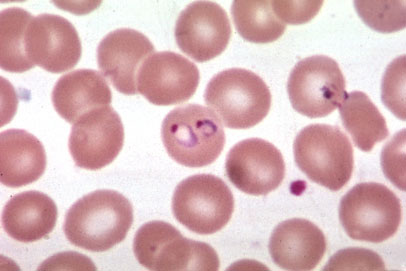
A 24-year-old woman comes to the emergency department because of a 1-day history of fever, chills, headache, and severe malaise. Two days ago, she returned from a 3-week mission trip to Kenya. While she was in Kenya, she took chloroquine, which was given to her by a friend, for antimalarial prophylaxis and drank only bottled water. Current medications also include an oral contraceptive. Her temperature is 38.2°C (100.8°F), pulse is 84/min, respirations are 14/min, and blood pressure is 110/70 mm Hg. Physical examination shows pallor. A photomicrograph of a peripheral blood smear is shown. Which of the following best explains this patient’s apparent acquisition of this infection?
CorrectIncorrect -
Question 6 of 20
6. Question
A 20-year-old woman is brought to the emergency department because of a 1-week history of temperatures greater than 39°C (102.2°F), shortness of breath, severe chest pain, and a persistent cough. Her temperature now is 38.9°C (102°F), and respirations are 22/min. Pulse oximetry on room air shows an oxygen saturation of 84%. Physical examination shows mild cyanosis of the lips and nail beds. Chest x-rays show consolidation of the right lower lobe of the lung. A sputum culture grows Streptococcus pneumoniae. Which of the following is the most likely cause of the cyanosis in this patient?
CorrectIncorrect -
Question 7 of 20
7. Question
A 56-year-old man comes to the physician for a follow-up examination after he had blood pressure readings of 162/98 mm Hg and 174/100 mm Hg during a 2-week period. His pulse is 84/min, and blood pressure now is 172/96 mm Hg. Physical examination shows no other abnormalities. His serum creatinine concentration is 0.9 mg/dL. An ECG shows no abnormalities. A diagnosis of hypertension is made, and enalapril and a low-sodium diet are prescribed. Two weeks later, his blood pressure is 128/82 mm Hg, and serum creatinine concentration is 3.2 mg/dL. Which of the following is the most likely cause of this patient’s hypertension?
CorrectIncorrect -
Question 8 of 20
8. Question
A previously healthy 49-year-old man comes to the emergency department because of a 4-hour history of severe, cramping, flank pain. The pain is intense, and he describes it as “coming in waves.” He is 168 cm (5 ft 6 in) tall and weighs 64 kg (142 lb); BMI is 23 kg/m2. Physical examination shows marked right flank tenderness. Two hours later, the pain migrates down the pelvis, and he passes a renal calculus. His serum calcium concentration is 11.5 mg/dL, and his serum phosphorus concentration is 1.8 mg/dL. Urinalysis shows blood. After discussing the diagnosis with the patient, it is most appropriate for the physician to state which of the following?
CorrectIncorrect -
Question 9 of 20
9. Question
A 37-year-old woman returns to the physician’s office after having been evaluated for a breast lump that is malignant and has metastasized widely. Which of the following is the most appropriate action immediately after informing the patient of the diagnosis?
CorrectIncorrect -
Question 10 of 20
10. Question
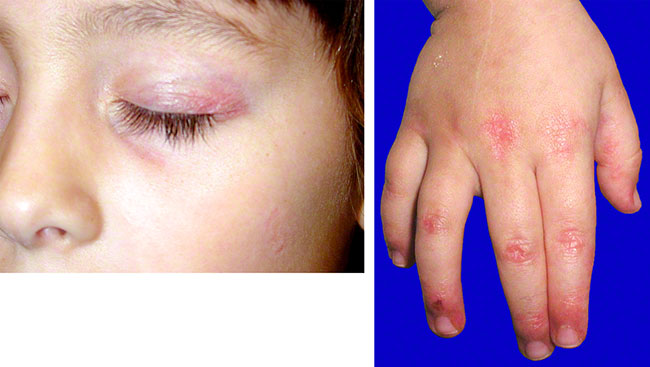
A 10-year-old girl is brought to the office by her father because of a 2-week history of a rash on her face, eyelids, and the knuckles of both hands. She also has had generalized muscle pain and weakness during this period that has made it difficult for her to keep her arms elevated while brushing her hair and getting in and out of the car. She has fallen twice but has not sustained any injuries. She has no history of serious illness and receives no medications. Her 15-year-old sister has no history of serious illness. The patient’s temperature is 37.2°C (99.0°F), pulse is 68/min, respirations are 14/min, and blood pressure is 105/65 mm Hg. Photographs of the patient’s left eyelid and right hand are shown. Periorbital edema is noted bilaterally. Erythrocyte sedimentation rate is 20 mm/h. If a muscle biopsy specimen were obtained in this patient, it would most likely show which of the following findings?
CorrectIncorrect -
Question 11 of 20
11. Question
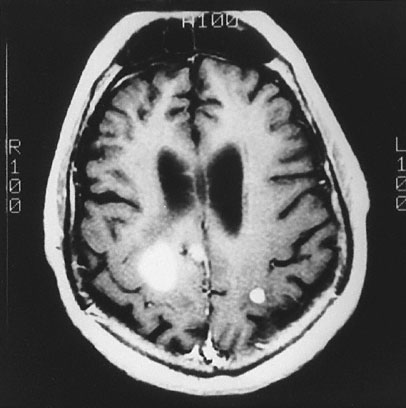
A 64-year-old man is brought to the emergency department 30 minutes after he had a convulsion at home. His wife says he stopped talking, his eyes rolled back, and he had jerking of his arms and legs for 5 seconds. He has no history of seizures. He has hypertension and hepatitis C. His only current medication is lisinopril. He has smoked one-half pack of cigarettes daily for 40 years and drinks six 12-oz beers daily. On arrival, he is alert and fully oriented. His vital signs are within normal limits. Physical and neurologic examinations show no abnormalities. An MRI of the brain is shown. Which of the following is the most likely cause of this patient’s convulsion?
CorrectIncorrect -
Question 12 of 20
12. Question
A 20-year-old woman comes to the office because of a 2-month history of persistent fatigue. Her temperature is 37.2°C (99°F), pulse is 80/min, respirations are 25/min, and blood pressure is 140/86 mm Hg. Physical examination shows jaundice and splenomegaly. Results of laboratory studies are shown:
Hemoglobin
7.2 g/dL
Hematocrit
21%
Mean corpuscular volume
74 μm3
Red cell distribution width
13% (N=13–15)
If performed, DNA analysis would show that the sequence located between 32 and 26 base pairs 5′ to the mRNA cap site of the β-globin gene is CGTAAAA. This sequence in a healthy individual is CATAAAA. Which of the following properties of β-globin gene expression is most likely abnormal in this patient?
CorrectIncorrect -
Question 13 of 20
13. Question
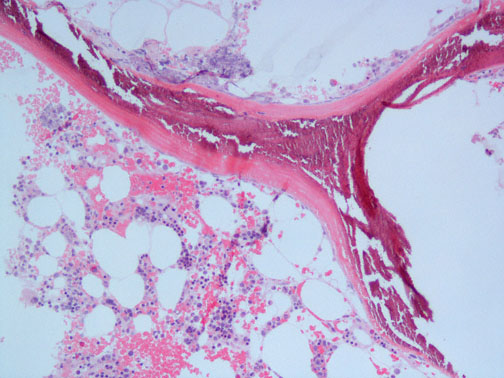
A 54-year-old woman is brought to the emergency department 30 minutes after injuring her left arm in a fall in her kitchen. She is in severe pain. She has a 4-year history of celiac disease. She is noncompliant with her dietary restrictions, and as a result she has had frequent diarrhea. Menopause occurred 2 years ago. Physical examination shows marked swelling, redness, and tenderness of the left forearm. Serum studies show a calcium concentration of 8 mg/dL, phosphorus concentration of 2.5 mg/dL, and 25-hydroxycholecalciferol concentration of 10 ng/mL (N=14–60). An x-ray of the left upper extremity shows a fracture of the radius accompanied by diffuse osteopenia. An open reduction of the fracture is scheduled. During the procedure, a biopsy specimen of the fracture site is obtained; a photomicrograph of the specimen is shown. This patient most likely has which of the following conditions?
CorrectIncorrect -
Question 14 of 20
14. Question
A 59-year-old woman comes to the physician because of a 3-week history of intermittent facial pain, double vision, and transient vision loss. She also has a 6-month history of joint pain and stiffness and pain in her neck, shoulders, and back. She has had a 6.8-kg (15-lb) weight loss during the past 4 months due to decreased appetite. She is 152 cm (5 ft) tall and now weighs 51 kg (112 lb); BMI is 22 kg/m2. Her temperature is 37.9°C (100.3°F), and blood pressure is 142/84 mm Hg. Laboratory studies show:
Hemoglobin
11 g/dL
Hematocrit
33%
Mean corpuscular volume
93 μm3
Erythrocyte sedimentation rate
62 mm/h
Serum
Antinuclear antibodies
weakly positive
Rheumatoid factor
weakly positive
Histologic examination of a biopsy specimen of the temporal artery in this patient will most likely show which of the following types of vasculitis?
CorrectIncorrect -
Question 15 of 20
15. Question
An investigator conducts a clinical trial of gene transfer therapy. Twenty boys between the ages of 2 and 5 years with X-linked severe combined immunodeficiency are treated. Autologous hematopoietic stem cells taken from each patient are transduced with a gamma retroviral vector containing a functional copy of the interleukin-2 receptor gamma (IL2RG) gene. Three months later, it is found that the immune systems in the majority of the patients were successfully reconstituted. Three years later, one of the patients develops clonal T-lymphocyte proliferation and four others develop overt T-lymphocytic leukemia. Which of the following characteristics of the vector used in this trial most likely contributed to the development of the T-lymphocyte proliferation in these patients?
CorrectIncorrect -
Question 16 of 20
16. Question
A 15-year-old boy is brought to the physician by his mother because of a 6-week history of disinterest in activities that he had previously enjoyed, including sports, music, and the math team at school. He no longer spends time with his friends, choosing to stay in his bedroom with the door shut. His grades at school have dropped, and he is easily frustrated. During the interview, he denies that anything is wrong, answers questions in monosyllables, and does not make eye contact. Which of the following is the most likely diagnosis?
CorrectIncorrect -
Question 17 of 20
17. Question
A 4-day-old male newborn is brought to the office by his parents for a follow-up examination because of yellow-tinged skin since birth. He was delivered via spontaneous vaginal delivery at 36 weeks’ gestation after an uncomplicated pregnancy. He was discharged from the hospital after successfully breast-feeding for 24 hours. At the time of discharge, physical examination showed mild jaundice and ecchymoses on the head. Since then, his urine output has been normal in color and volume. Stools appear yellow. He has lost 7% of his birth weight and now weighs 3288 g (7 lb 4 oz). Physical examination shows conjunctival icterus. Neurologic examination shows no abnormalities. A complete blood count is within the reference ranges. Serum studies show a total bilirubin concentration of 13.2 mg/dL (N=0.1–1.0) and direct bilirubin concentration of 0.1 mg/dL (N=0.0–0.3). Which of the following is the most likely underlying cause of the findings in this patient?
CorrectIncorrect -
Question 18 of 20
18. Question
A 73-year-old man has had intermittent painless hematuria and a 13.6-kg (30-lb) weight loss during the past 6 months. Physical examination shows a palpable right flank mass. A CT scan shows a solid mass 10 cm in diameter that replaces the upper pole of the right kidney. Which of the following is the most likely cell of origin for this neoplasm?
CorrectIncorrect -
Question 19 of 20
19. Question
A 50-year-old woman comes to the office because she would like to quit smoking. She has chronic obstructive pulmonary disease and a long history of bipolar disorder. She has read that quitting smoking is associated with depression relapse in patients with mood disorders. She is concerned about getting depressed again. Which of the following is the most appropriate initial response by the physician?
CorrectIncorrect -
Question 20 of 20
20. Question
A 15-year-old boy with Crohn disease that is extensive in the distal small bowel is brought to the office because of a 10-day history of intermittent diarrhea. He appears to be in no distress. Vital signs are within normal limits. Physical examination shows a scaphoid, nondistended abdomen with diffuse, mild tenderness, and hyperactive bowel sounds. The most likely cause of this patient’s current symptom is a decrease in which of the following substances?
CorrectIncorrect