
NBME 32 – Block 1 (Duplicate 1)
Time limit: 0
Quiz Summary
0 of 20 Questions completed
Questions:
Information
You have already completed the quiz before. Hence you can not start it again.
Quiz is loading…
You must sign in or sign up to start the quiz.
You must first complete the following:
Results
Quiz complete. Results are being recorded.
Results
0 of 20 Questions answered correctly
Your time:
Time has elapsed
You have reached 0 of 0 point(s), (0)
Earned Point(s): 0 of 0, (0)
0 Essay(s) Pending (Possible Point(s): 0)
Categories
- Not categorized 0%
- 1
- 2
- 3
- 4
- 5
- 6
- 7
- 8
- 9
- 10
- 11
- 12
- 13
- 14
- 15
- 16
- 17
- 18
- 19
- 20
- Current
- Review
- Answered
- Correct
- Incorrect
-
Question 1 of 20
1. Question
A 25-year-old man of Asian descent comes to the physician 1 week after an episode of facial flushing, severe headache, and profuse sweating after consuming 2 ounces of alcohol over a 60-minute period. Physical examination shows no abnormalities. An inherited decrease in the activity of which of the following hepatic enzymes is the most likely cause of this patient’s symptoms?
CorrectIncorrect -
Question 2 of 20
2. Question
An 85-year-old woman dies of complications of dementia, Alzheimer type, and an autopsy is planned. During autopsy, the examiner wants to determine whether reactive astrogliosis occurred in the areas in or surrounding amyloid plaques in the brain. Immunohistochemistry will be used to quantify the presence of reactive astrocytes. The antibodies for this analysis will be chosen because of their ability to bind to which of the following proteins?
CorrectIncorrect -
Question 3 of 20
3. Question
A 67-year-old man comes to the physician because of a 6-month history of progressive urinary frequency and urgency that often awaken him at night. Examination of the prostate shows a 3-cm, palpable hard mass. His serum prostate-specific antigen concentration is markedly increased. A prostate biopsy specimen shows adenocarcinoma. Which of the following structures is most susceptible to direct extension of this tumor?
CorrectIncorrect -
Question 4 of 20
4. Question
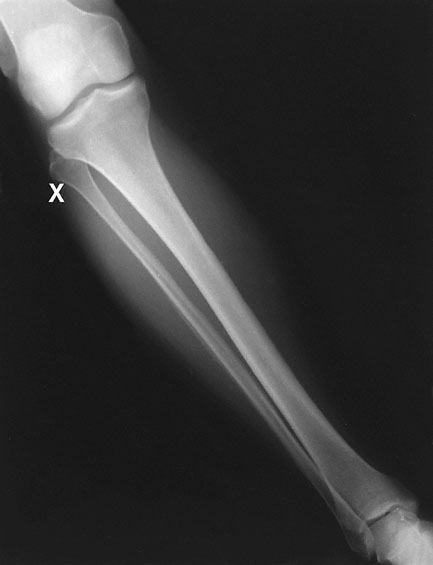
A 23-year-old man comes to the physician to have an orthopaedic cast removed 6 weeks after he sustained a fracture to his right lower leg in a skateboarding accident. After removal of the cast, examination of the right lower extremity shows markedly decreased sensation to pinprick over the dorsum of the foot. An x-ray of the right lower extremity is shown; the X indicates the subcutaneous position of the injured nerve. This nerve most likely supplies which of the following muscles in this patient?
CorrectIncorrect -
Question 5 of 20
5. Question
An 83-year-old woman is brought to the emergency department because of an 8-hour history of severe abdominal pain. She has a history of atrial fibrillation, cerebral infarction, coronary artery disease, and type 2 diabetes mellitus. She is not currently receiving anticoagulant therapy because of several recent falls. Her temperature is 38.4°C (101.1°F), pulse is 130/min, respirations are 18/min, and blood pressure is 90/50 mm Hg. Palpation of the abdomen elicits severe pain with rebound tenderness. Results of laboratory studies are shown:
Hemoglobin
8 g/dL
Hematocrit
24%
Leukocyte count
23,000/mm3
Platelet count
75,000/mm3
Serum
Na+
138 mEq/L
K+
5 mEq/L
Cl−
100 mEq/L
HCO3−
7 mEq/L
Urea nitrogen
38 mg/dL
Creatinine
1.5 mg/dL
Glucose
233 mg/dL
Methanol
0 μg/mL (N<200)
Salicylates
0 μg/mL (N=150–300)
An abdominal CT scan shows free air in the abdomen and a diffusely edematous colon. Which of the following is the most likely cause of the serum findings in this patient?
CorrectIncorrect -
Question 6 of 20
6. Question
A 39-year-old woman who received her first chemotherapy session for breast cancer has nausea and vomiting in the elevator as she leaves the clinic. Two weeks later, she vomits as she steps off the elevator for her second chemotherapy appointment. Which of the following mechanisms is most likely to be involved?
CorrectIncorrect -
Question 7 of 20
7. Question
A 63-year-old woman with a history of congestive heart failure comes to the physician because of a 1-day history of fever, headache, and nonproductive cough. Her temperature is 38.6°C (101.5°F), pulse is 94/min, respirations are 16/min, and blood pressure is 144/84 mm Hg. Physical examination shows no other abnormalities. Rapid antigen testing of a nasopharyngeal swab specimen is positive for influenza A virus. Treatment with oseltamivir is initiated. Which of the following viral processes is likely to be affected the most by this medication?
CorrectIncorrect -
Question 8 of 20
8. Question
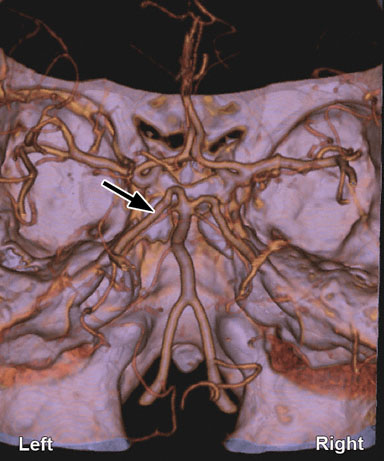
A 64-year-old man is brought to the emergency department by ambulance 30 minutes after he collapsed at home following the onset of a severe headache. A normal CT angiogram of the arteries at the base of the brain is shown; the arrow indicates the occluded vessel in this patient. Which of the following neurologic findings is most likely present in this patient?
CorrectIncorrect -
Question 9 of 20
9. Question
A pilot study is conducted to determine if a low-fat diet is effective in promoting weight loss in six overweight patients who are seen at a clinic. The patients’ weights are measured at the time the diet is begun and 6 months later. Results are shown:
Weight (kg)
Patient Number
Before the Diet
After 6 Months
1
75
70
2
80
75
3
90
85
4
100
95
5
110
105
6
95
90
Which of the following statistical tests is the best method to determine if the diet is effective in promoting weight loss in these patients?
CorrectIncorrect -
Question 10 of 20
10. Question
A 5-year-old boy is brought to the physician for evaluation of a possible immunodeficiency. He has a history of numerous episodes of otitis media and sinusitis, and two episodes of pneumonia. Today, his T-lymphocyte counts are within the reference ranges. Serologic studies show:
IgA
4 mg/dL
IgE
not detected
IgG
20 mg/dL
IgM
2600 mg/dL
Type IV (delayed) hypersensitivity responses to mumps and diphtheria toxoid antigens are normal. In vitro lymphocyte proliferation studies with phytohemagglutinin show normal findings. A deficiency of which of the following best explains the immunologic abnormality in this patient?
CorrectIncorrect -
Question 11 of 20
11. Question
A 23-year-old man is admitted to the hospital with community-acquired pneumonia. He is treated with azithromycin and ceftriaxone. Two days later, he becomes agitated and disoriented, and he also develops diarrhea. His friends say that the patient frequently abuses prescription medications, but they are not sure what he has been taking. Physical examination shows dilated pupils that are reactive to light and diaphoresis with piloerection. The most likely cause of these findings is withdrawal from which of the following drugs?
CorrectIncorrect -
Question 12 of 20
12. Question
A 45-year-old man undergoes cardiac catheterization because of a 1-year history of chest pain with exertion. During the procedure, acetylcholine is infused into a coronary artery, and it causes vasoconstriction. The dysfunctional endothelial cells from this artery are more likely than normal endothelial cells to do which of the following?
CorrectIncorrect -
Question 13 of 20
13. Question
A 45-year-old man with alcohol use disorder is admitted to the hospital for acute pancreatitis. He initially responds well to bed rest and intravenous fluid, but 1 week later he has persistent fever and epigastric pain. His temperature is 38.6°C (101.5°F). Abdominal examination shows a tender epigastric mass. Laboratory studies show a leukocyte count of 13,500/mm3 and serum amylase activity of 300 U/L. Which of the following is the most likely cause of these findings?
CorrectIncorrect -
Question 14 of 20
14. Question
A 55-year-old postmenopausal woman comes to the physician because of two episodes of uterine bleeding, abdominal discomfort, and bilateral breast tenderness during the past 3 months. Physical examination shows a normal-sized uterus and a 10-cm mass in the left ovary. Which of the following neoplasms is most likely in this patient’s left ovary?
CorrectIncorrect -
Question 15 of 20
15. Question
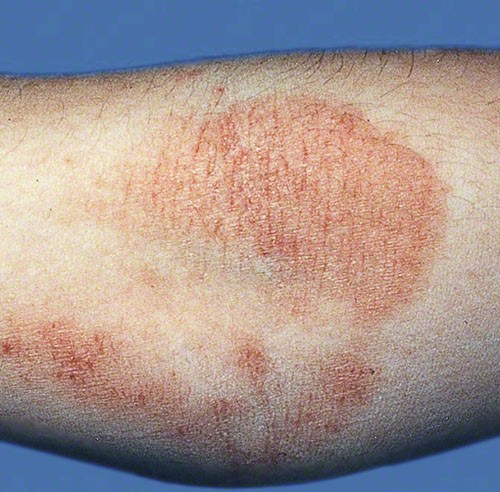
A previously healthy 11-year-old boy is brought to the physician by his mother because of a 3-month history of an itchy rash on the inside of his elbows and behind his knees. There is a family history of asthma and hay fever. His temperature is 37°C (98.6°F). Physical examination shows the rash depicted in the photograph shown. Which of the following is the most likely diagnosis?
 CorrectIncorrect
 -
Question 16 of 20
16. Question
A 3-year-old girl is brought to the emergency department by her parents 45 minutes after the patient inserted a peanut into her left nostril. The parents were unable to retrieve it. She has no history of serious illness and receives no medications. The patient appears healthy and is alert and crying. She is at the 50th percentile for height and weight. BMI is at the 50th percentile. Vital signs are within normal limits. Physical examination shows no abnormalities. Nasoscopic examination is most likely to show the object lodged in which of the following spaces in this patient?
CorrectIncorrect -
Question 17 of 20
17. Question
A 35-year-old woman comes to the physician because of a 3-month history of heat intolerance, palpitations, anxiety, and shakiness of her hands. Her pulse is 100/min, respirations are 20/min, and blood pressure is 140/60 mm Hg. Physical examination shows hand tremor. Serum studies show a thyroid-stimulating hormone (TSH) concentration less than 0.1 μU/mL and thyroxine (T4) concentration of 20 μg/dL. Treatment with methimazole is begun. Her symptoms resolve within 3 weeks. Which of the following initial mechanisms of action best explains the timing of the resolution of this patient’s symptoms?
CorrectIncorrect -
Question 18 of 20
18. Question
An investigator is studying the role of Bruton tyrosine kinase (BTK) in an immunodeficiency disorder. It is found that the function of BTK, which plays a primary role in the maturation of B lymphocytes from pro-B lymphocytes to pre-B lymphocytes, is abnormal in patients with this condition. Which of the following structures is most likely to have a normal number of lymphocytes in these patients?
CorrectIncorrect -
Question 19 of 20
19. Question
A 24-year-old white woman is brought to the emergency department 90 minutes after the sudden onset of moderate chest pain and shortness of breath. She has no history of recent trauma, hospitalizations, or operative procedures. She was treated for deep venous thrombosis at the age of 20 years. She is in obvious discomfort. Her temperature is 37.6°C (99.7°F), pulse is 100/min, respirations are 30/min, and blood pressure is 140/100 mm Hg. Pulse oximetry on room air shows an oxygen saturation of 88%. A diagnosis of pulmonary embolism is made. Which of the following hypercoagulable disorders is the most common predisposing risk factor for this condition in this patient?
CorrectIncorrect -
Question 20 of 20
20. Question
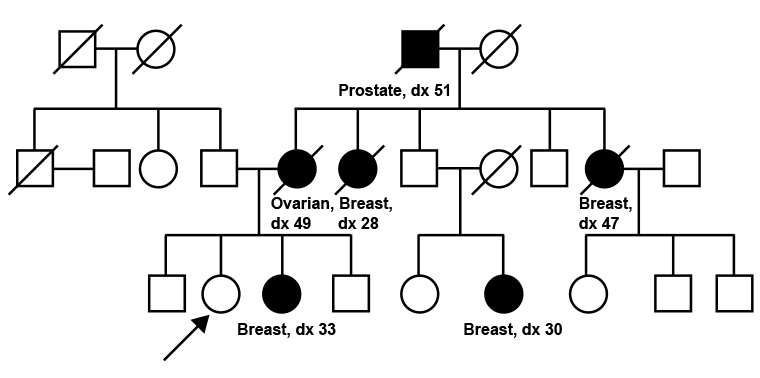
A 25-year-old woman comes to the office to undergo genetic testing because of multiple instances of cancer in her family, illustrated in the pedigree shown. The patient is indicated by the arrow. The type of cancer and the age (in years) when the family member was diagnosed (dx) are also indicated. She has no history of serious illness and takes no medications. Vital signs are within normal limits. Physical examination shows no abnormalities. Which of the following genetic mechanisms best explains this patient’s risk for developing a type of cancer experienced by one of her family members?
CorrectIncorrect