
NBME 14 – Block 4
Time limit: 0
Quiz Summary
0 of 20 Questions completed
Questions:
Information
You have already completed the quiz before. Hence you can not start it again.
Quiz is loading…
You must sign in or sign up to start the quiz.
You must first complete the following:
Results
Quiz complete. Results are being recorded.
Results
0 of 20 Questions answered correctly
Your time:
Time has elapsed
You have reached 0 of 0 point(s), (0)
Earned Point(s): 0 of 0, (0)
0 Essay(s) Pending (Possible Point(s): 0)
Categories
- Not categorized 0%
- 1
- 2
- 3
- 4
- 5
- 6
- 7
- 8
- 9
- 10
- 11
- 12
- 13
- 14
- 15
- 16
- 17
- 18
- 19
- 20
- Current
- Review
- Answered
- Correct
- Incorrect
-
Question 1 of 20
1. Question
A 37-year-old woman comes to the emergency department 12 hours after the onset of severe epigastric pain that radiates to her back. Two weeks ago, abdominal ultrasonography showed gallstones, and she began a low-fat diet. She has no other history of serious illness. On arrival, her temperature is 37.9°C (100.2°F), pulse is 130/min, respirations are 28/min and shallow, and blood pressure is 95/60 mm Hg. Abdominal examination shows distention and ecchymoses over the periumbilical area. There is diffuse severe tenderness of all quadrants. Bowel sounds are absent. Serum studies show a total bilirubin concentration of 1 mg/dL, amylase activity of 1400 U/L, and lipase activity of 950 U/L (N=14–280). Which of the following is the most appropriate next step in diagnosis?
CorrectIncorrect -
Question 2 of 20
2. Question
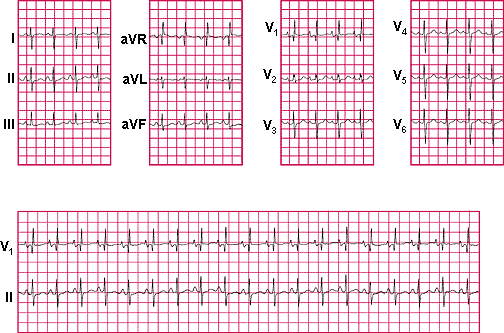
A 72-year-old woman comes to the physician because of a 3-month history of progressive shortness of breath with exertion and nonproductive cough. She has systemic sclerosis (scleroderma) treated with lisinopril and prednisone. Her temperature is 37°C (98.6°F), pulse is 90/min, respirations are 18/min, and blood pressure is 130/80 mm Hg. Examination shows tight facial skin and telangiectasias over the cheeks. There is thick, taut skin over the fingers. Bilateral basilar crackles are heard. On cardiac examination, a right ventricular heave is palpated at the left sternal border where a grade 2/6, systolic ejection murmur is also heard best. A fixed, split S2 and an S3 gallop are heard. An ECG is shown. Which of the following is the most likely diagnosis?
CorrectIncorrect -
Question 3 of 20
3. Question
A 16-year-old girl is brought to the physician by her mother because she has not yet had a menstrual period. She has no history of serious illness and takes no medications. Her immunizations are up-to-date. She does not appear to be in acute distress. She is at the 75th percentile for height, 80th percentile for weight, and 55th percentile for BMI. Breast and pubic hair development are sexual maturity rating stage 1. Pelvic examination shows no abnormalities. Serum studies show a thyroid-stimulating hormone concentration of 2.4 μU/mL, follicle-stimulating hormone concentration of 76 mIU/mL, and prolactin concentration of 13 ng/mL. Which of the following is the most appropriate next step in diagnosis?
CorrectIncorrect -
Question 4 of 20
4. Question
In a recent study of Americans, the following data were presented:
Mortality Rate From Firearms
Group
(per 100,000)
Native
2.2
African
1.2
Caucasian
0.8
Asian
0.1
The authors concluded that, in the USA, a greater number of Native Americans died of injuries sustained from firearms than did Caucasian Americans. Which of the following is the most accurate interpretation of the authors’ conclusion?
CorrectIncorrect -
Question 5 of 20
5. Question
An 8-year-old girl with attention-deficit/hyperactivity disorder is brought to the office by her mother for a well-child examination. The mother says that her daughter has been generally healthy and has been doing well in school since beginning long-acting methylphenidate therapy 2 years ago. The mother is concerned about her daughter having to take the medication for an extended period of time. Medical history is otherwise unremarkable and she takes no other medications. The patient is at the 25th percentile for height and weight. Vital signs are normal. Physical examination discloses no abnormalities. Which of the following is the most appropriate response to the mother regarding this patient’s need for medication?
CorrectIncorrect -
Question 6 of 20
6. Question
A 68-year-old man comes to the emergency department because of a 1-week history of severe low back pain that worsens with movement. He also has a 2-month history of fatigue and decreased appetite resulting in a 7-kg (15-lb) weight loss. He has not had fever, night sweats, bowel incontinence, urinary retention, or weakness. He has hypertension treated with hydrochlorothiazide. He smoked one pack of cigarettes daily for 30 years but quit 20 years ago. He does not drink alcohol or use illicit drugs. He is 178 cm (5 ft 10 in) tall and weighs 77 kg (170 lb); BMI is 24 kg/m2. Vital signs are within normal limits. Pulse oximetry on room air shows an oxygen saturation of 99%. There is tenderness to palpation at L2–4. Muscle strength is 5/5 in the lower extremities. Deep tendon reflexes are normal at the knees and ankles; there is no clonus. Rectal tone is normal. The remainder of the examination shows no abnormalities. Results of laboratory studies are shown:
Hemoglobin
11.2 g/dL
Serum
Urea nitrogen
54 mg/dL
Creatinine
2.1 mg/dL
Protein, total
7.8 g/dL
Albumin
3.2 g/dL
Alkaline phosphatase
67 U/L
Which of the following is the most appropriate next step in evaluation?
CorrectIncorrect -
Question 7 of 20
7. Question
Four days after undergoing uncomplicated left total hip replacement, a hospitalized 75-year-old man has a 1-day history of progressive confusion. He began ambulating on postoperative day 1 and previously had been alert, fully oriented, and cognitively intact. He has been receiving hydrocodone for pain as needed; he has requested one dose during the past 24 hours. He has hypertension well controlled with atenolol. He has no other history of serious illness and takes no other medications. On admission, the patient said he did not drink alcohol; today, his brother says that the patient drinks six to eight 12-oz beers daily. The patient’s temperature is 37°C (98.6°F), pulse is 90/min, respirations are 14/min, and blood pressure is 130/80 mm Hg. Physical examination shows lateral gaze palsy. The surgical incision is clean, dry, and nonerythematous. Neurologic examination shows ataxia. On mental status examination, he is alert but not oriented to person, place, or time. He identifies only one of three objects after six attempts. He recalls zero of three objects after 5 minutes. Results of a complete blood count, measurement of serum electrolyte and glucose concentrations, and liver and renal function tests are within the reference ranges. Urine toxicology screening is negative. An ECG shows no abnormalities. Which of the following is the most appropriate next step in management?
CorrectIncorrect -
Question 8 of 20
8. Question
A 42-year-old man comes to the physician because of a 1-day history of increasingly severe pain of his right knee associated with redness and swelling for the past 6 hours. He has had two episodes of pain in his right great toe over the past 8 months and missed 2 weeks of work in construction during each episode. He has been otherwise healthy. Examination of the right knee shows marked tenderness, swelling, and erythema. Laboratory findings are within the reference range except for a serum uric acid concentration of 7.6 mg/dL. Examination of synovial fluid aspirate shows uric acid crystals. Which of the following is the most appropriate initial pharmacotherapy?
CorrectIncorrect -
Question 9 of 20
9. Question
A 14-month-old girl is brought to the physician by her father because of a 3-week history of cough. One month ago, she had the onset of nasal congestion and runny nose. Two days later, she was noted to have a cough. The nasal congestion and runny nose resolved spontaneously after 7 days; the cough has not improved. Her father describes the cough as a “dry, smoker’s cough.” The patient has had similar symptoms twice during the past 6 months. Each episode resolved spontaneously after 2 weeks. At the age of 3 months, she had bronchiolitis. She has eczema treated with topical hydrocortisone. She was born at term following an uncomplicated pregnancy and spontaneous vaginal delivery. She receives no other medications. Her mother has a childhood history of asthma, and her father has seasonal allergies. The patient attends day care 5 days weekly. She coughs intermittently in the examination room. She is at the 20th percentile for length and 10th percentile for weight. Her temperature is 37°C (98.6°F), pulse is 72/min, respirations are 22/min, and blood pressure is 103/72 mm Hg. The lungs are clear to auscultation. The remainder of the examination shows no abnormalities. Which of the following is the most likely diagnosis?
CorrectIncorrect -
Question 10 of 20
10. Question
A previously healthy 24-year-old nurse is brought to the emergency department because of weakness of the lower extremities for 24 hours. She takes no medications. Her temperature is 37°C (98.6°F), pulse is 100/min, and blood pressure is 112/78 mm Hg. Muscle strength is 4/5 in the upper and lower extremities. Laboratory studies show:
Serum
Na+
134 mEq/L
Cl−
94 mEq/L
K+
2.4 mEq/L
HCO3−
34 mEq/L
Mg2+
2.4 mEq/L
Urea nitrogen
14 mg/dL
Glucose
118 mg/dL
Urine
Na+
46 mEq/L
K+
64 mEq/L
Surreptitious laxative useWhich of the following is the most likely cause of this patient’s hypokalemia?
CorrectIncorrect -
Question 11 of 20
11. Question
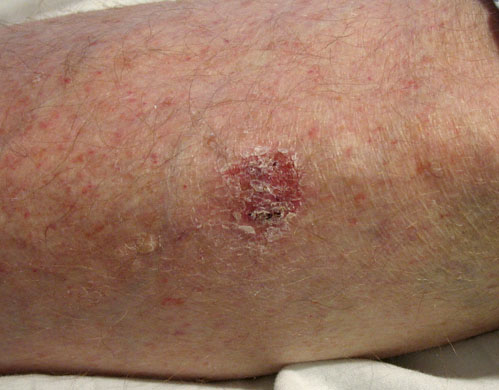
A 47-year-old man comes to the office because of a 6-month history of a nonpainful, nonitchy lesion over his left forearm. Three years ago, he underwent a renal transplant for chronic renal failure secondary to IgA nephropathy. His only medication is tacrolimus. Vital signs are within normal limits. A photograph of the lesion is shown. The remainder of the examination shows no abnormalities. Which of the following is the most likely diagnosis?
CorrectIncorrect -
Question 12 of 20
12. Question
A 62-year-old man with chronic obstructive pulmonary disease comes to the physician because of a 1-month history of leg swelling and progressive shortness of breath. He has not had fever or cough. He smoked one and one-half packs of cigarettes daily for 45 years but quit 1 year ago. His medications are theophylline and albuterol and ipratropium inhalers. His temperature is 36.7°C (98°F), pulse is 96/min, respirations are 22/min, and blood pressure is 150/76 mm Hg. Examination shows jugular venous distention 10 cm above the sternal angle. Breath sounds are markedly decreased throughout all lung fields. Cardiac examination shows decreased heart sounds with no murmurs, gallops, or rubs. The liver edge is palpated 3 cm below the right costal margin. There is 2+ pitting edema to the knees. His FEV1 is 1.05 L (40% of predicted). Arterial blood gas analysis on room air shows:
pH
7.42
Pco2
48 mm Hg
Po2
45 mm Hg
HCO3−
30 mEq/L
An x-ray of the chest shows hyperinflated lungs with apical bullae. Which of the following is the most appropriate next step in management?
CorrectIncorrect -
Question 13 of 20
13. Question
A 21-year-old man is brought to the emergency department because of a 2-hour history of muscle spasms of the face and neck; his eyes appear to be rolling up inside his head. He began treatment with haloperidol 24 hours ago for paranoid ideation. His temperature is 37°C (98.6°F), pulse is 96/min, respirations are 18/min, and blood pressure is 130/82 mm Hg. He is fully oriented and cognitively intact, but he is adamant that he has been poisoned. Which of the following is most appropriate to add to his medication regimen?
CorrectIncorrect -
Question 14 of 20
14. Question
A 60-year-old man with stage 4 chronic kidney disease comes to the office for a follow-up examination. He also has type 2 diabetes mellitus and hypertension. Medications are insulin, lisinopril, furosemide, amlodipine, and aspirin. Vital signs are temperature 37.0°C (98.6°F), pulse 80/min, respirations 15/min, and blood pressure 145/85 mm Hg. Cardiopulmonary examination discloses no abnormalities. There is 1+ lower extremity edema. Laboratory studies show a serum intact parathyroid hormone concentration of 258 pg/mL (N=10–60). Measurement of additional serum laboratory studies is most likely to show which of the following?
Option
Phosphorus
Calcium
Calcitriol
A
Decreased
Decreased
Decreased
B
Decreased
Increased
Decreased
C
Decreased
Increased
Increased
D
Increased
Decreased
Decreased
E
Increased
Decreased
Increased
F
Increased
Increased
Increased
CorrectIncorrect -
Question 15 of 20
15. Question
A 7-year-old boy is brought to the office by his mother for an initial well-child visit to establish care. The patient’s family recently emigrated from Eastern Europe. The mother is concerned about her son’s behavior at home and at school. He has been easily distracted, has difficulty completing his chores at home, has been fidgety during classes, and often disrupts others by talking out of turn. His mother says that as an infant he underwent surgical correction of a cleft palate and a heart defect, but she does not have his medical records with her today. The patient is at the 5th percentile for height and weight and the 10th percentile for BMI. Examination shows an elongated face with narrow palpebral fissures, low-set ears, a broad nasal bridge, micrognathia, downward turned mouth, and small teeth. Results of which of the following laboratory studies are most likely to be abnormal in this patient?
CorrectIncorrect -
Question 16 of 20
16. Question
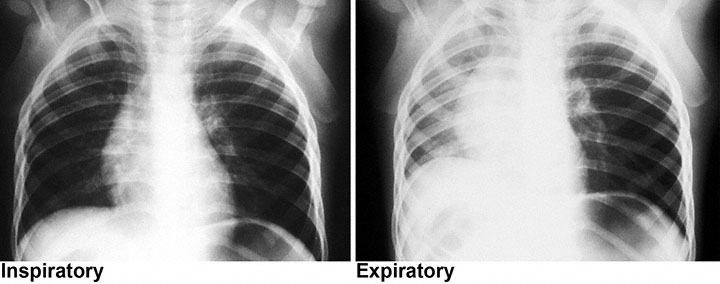
A 4-year-old boy is brought to the emergency department 30 minutes after the sudden onset of shortness of breath and wheezing at a birthday party. Witnesses report that he was acting normally until he was noted to be in distress; they did not see him choke on anything. He has no history of serious illness and receives no medications. His temperature is 37°C (98.6°F), pulse is 100/min, respirations are 24/min, and blood pressure is 90/60 mm Hg. Pulse oximetry on room air shows an oxygen saturation of 95%. Examination shows decreased breath sounds over the left hemithorax. Inspiratory and expiratory chest x-rays are shown. Which of the following is the most likely diagnosis?
CorrectIncorrect -
Question 17 of 20
17. Question
A hospitalized 59-year-old man has undergone three unsuccessful attempts at endoscopic sclerotherapy of esophageal varices during the past 4 days. On admission, he had a 1-week history of recurrent upper gastrointestinal bleeding. He has necrotizing pancreatitis, splenic vein thrombosis, type 2 diabetes mellitus, and hypertension. His medications are insulin, hydrochlorothiazide, lisinopril, and pancrelipase. He has a history of alcohol use disorder but has not consumed alcohol during the past 8 years. He has no other history of psychiatric illness. He is an inmate in a federal prison and has 18 years remaining on his sentence. He asks that no further efforts to control the bleeding be undertaken. His brother, who has not visited the patient in 6 years, says this is the patient’s way of committing suicide; the brother insists that efforts to extend the patient’s life be continued. The patient appears cachectic but alert. His pulse is 104/min, respirations are 18/min, and blood pressure is 88/68 mm Hg. Pulse oximetry on 4 L/min of oxygen by nasal cannula shows an oxygen saturation of 94%. Physical examination shows scattered ecchymoses and petechiae over the upper extremities. On mental status examination, he provides an accurate account of his current condition and the probable outcome, including death, if he continues to bleed. He says he is “down” but then says he means “tired.” He reports no suicidal ideation. Which of the following is the most appropriate next step in management?
CorrectIncorrect -
Question 18 of 20
18. Question
A 12-year-old girl is brought to the emergency department by her parents because of a 2-hour history of severe weakness involving the right side of her face. The weakness has been present since the patient awoke from sleep. She is now drooling from the right side of her mouth. She has had an upper respiratory illness for the past 3 days, with symptoms of nasal congestion, cough, and muffling of sounds and pain in her right ear. Medical history is otherwise unremarkable. She has been taking acetaminophen as needed for the ear pain. Vital signs are normal. The patient is awake and alert. Her speech is dysarthric. The right side of her face is severely weakened, with inability to sustain eye closure against resistance. The remainder of the physical examination discloses no abnormalities. Which of the following is the most likely natural evolution of her condition if left untreated?
CorrectIncorrect -
Question 19 of 20
19. Question
A 56-year-old woman comes to the clinic for examination prior to undergoing a dental procedure. She will be visiting her dentist frequently for multiple procedures to have braces placed on her teeth because of severe temporomandibular joint pain; she is concerned about her risk for infection. She has mitral valve prolapse and intermittent palpitations. She also has hypertension and osteopenia. Her only medication is atenolol. Her blood pressure is 110/60 mm Hg. Examination shows no abnormalities. Antibiotic prophylaxis is indicated for this patient for which of the following procedures?
CorrectIncorrect -
Question 20 of 20
20. Question
A 62-year-old man comes to the physician for a preoperative evaluation before undergoing elective cataract removal. He has a 3-month history of progressive mild shortness of breath with exertion. He takes no medications. He drinks three beers daily. His blood pressure is 150/92 mm Hg. Examination shows no other abnormalities. Laboratory studies show:
Hematocrit
26%
Mean corpuscular volume
75 μm3
Leukocyte count
6000/mm3
Platelet count
700,000/mm3
Prothrombin time
11 sec (INR=1)
Serum
Glucose
89 mg/dL
Creatinine
1.6 mg/dL
Alkaline phosphatase
142 U/L
AST
55 U/L
Urine
Glucose
2+
Protein
1+
Which of the following is most likely to have prevented this patient’s hematologic condition?
CorrectIncorrect